
Why Airports Choose MBR for Wastewater Treatment
Airport sewage is a blend of terminal blackwater, catering FOG, ground-support wash water and seasonal de-icing runoff, layered on top of diurnal passenger surges from early-morning troughs to peak boarding waves. The US EPA MBR Fact Sheet and the MAK Water MBR datasheet identify MBR as a technology that tolerates these swings through high mixed-liquor suspended solids (MLSS) operation and automatic control, rather than relying on a downstream clarifier that would be knocked off-spec by a catering-spill or glycol event. Land near terminals is scarce and priced accordingly, and both the EPA fact sheet and the Liu et al. (2007) Qingdao case study flag low footprint as a primary design driver — at Qingdao the entire 1,000 m³/d plant sits on a 10,000 m² site that also has to house screening, blowers and a sludge handling area.
Because the membrane is an absolute solids barrier, MBR effluent is consistently low in suspended solids and turbidity without depending on settling, which is the prerequisite for routing treated water to non-potable end-uses such as irrigation, fire-system makeup, toilet flushing and car-wash reuse. The Karratha Airport packaged MBR in Western Australia was specifically designed against the WA Department of Health's "risk category high" reuse values for toilet flushing, landscape irrigation and the automatic car-wash facility — a documented 2026-relevant precedent for high-exposure reuse at a regional terminal. The full MBR train, from the anoxic/aerobic biological zone through the submerged flat-sheet module, can be packaged into a single skid, making an integrated MBR system or a modular DF series flat-sheet MBR module a defensible selection for terminal or apron upgrades where civils work and commissioning windows are constrained.
Qingdao International Airport MBR — The Reference Case
The most-cited airport MBR dataset in the peer-reviewed literature is the Qingdao International Airport Wastewater Treatment Station in China. The plant uses an MBR as the backbone for biological COD, nitrogen and phosphorus removal, was commissioned in 2002, and was described in detail by Liu, Qun, An and Sun (2007, Desalination vol. 202, issues 1–3, pages 144–149). The design priorities the authors recorded — efficiency, simplicity, reliability, low construction and O&M cost, and low land requirement — are exactly the criteria an airport engineer should lift into a 2026 basis-of-design. The abstract provides the two-year average influent and effluent that follow.
| Parameter | Two-year average influent (mg/L) | Two-year average effluent (mg/L) | National effluent standard cited in the paper (mg/L) |
|---|---|---|---|
| BOD5 | 102 | 5.2 | < 0.8 |
| COD | 208 | 17.3 | — |
| SS | 160 | 4 | < 6 |
| T-N | 36.2 | 11.6 | < 3.4 |
| T-P | 1.7 | 0.4 | < 0.12 |
The paper concludes that the operating effluent demonstrates that the MBR process is both effective and efficient in meeting the water discharge and reuse quality requirements at the airport. The economics and passenger context of that same plant are reported by Carvalho et al. (2013, Resources, Conservation and Recycling vol. 74): the system cost US$800,000, has a design capacity of 1,000 m³/d, occupies an area of 10,000 m², and serves an airport that handled 8.2 million passengers in 2008. These two references are the only published dataset that pairs full influent/effluent characterisation with documented CAPEX, footprint and passenger throughput for an airport MBR, serving as the reference citation in 2026 specifications even though the operating year is 2005–2006.
Typical MBR Process Train for an Airport WWTP
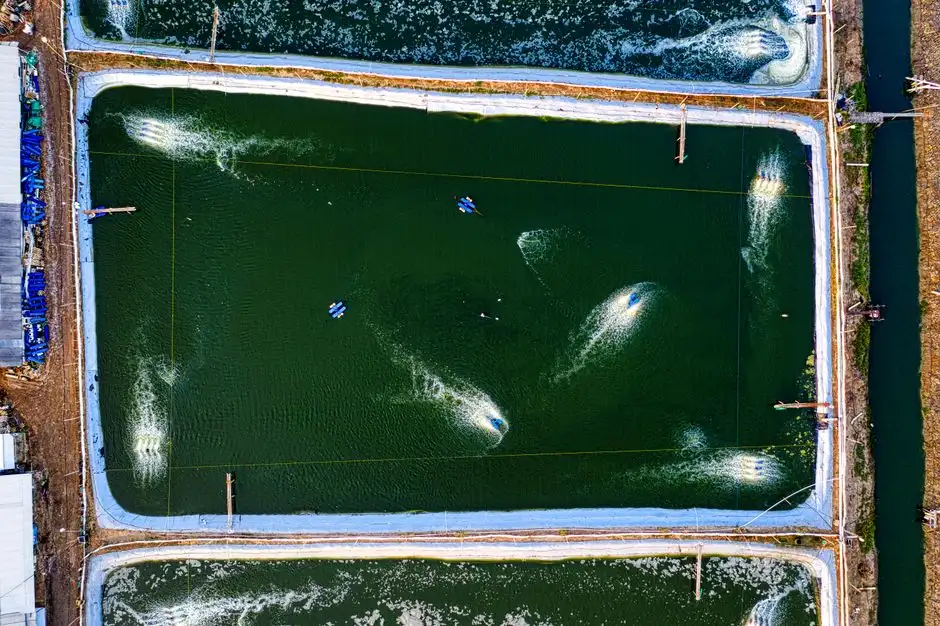
The process flow used in packaged airport MBR installations, as documented in the MAK Water MBR datasheet, runs: influent screening → balance/equalisation tank → anoxic zone → aerobic zone → submerged flat-sheet membrane module with continuous air scour and clean-in-place (CIP) → disinfection (hypochlorite dosing, with UV as a chemical-free upgrade). A rotary mechanical bar screen ahead of the balance tank protects the downstream membranes from rags, ground-support debris and catering solids that arrive unpredictably. The balance tank is sized to absorb the diurnal peak from boarding surges and from batch de-icing events, both of which are documented sources of shock load at terminals.
High MLSS operation inside the MBR tank — enabled by the membrane's absolute solids retention rather than by gravity settling — is the technical reason an MBR absorbs catering-FOG and de-icing-season spikes better than conventional activated sludge. Continuous coarse-bubble air scour on the underside of the flat-sheet cassette keeps solids in suspension and limits cake formation; scheduled CIP (typically a sodium hypochlorite soak, sometimes with a citric-acid step) restores permeability on a calendar basis. For non-potable reuse, a downstream UV steriliser is the default polishing step at risk-category-high sites such as Karratha, with residual chlorine as a secondary barrier in the reuse distribution loop. Effluent equalisation and irrigation pumping are normally packaged with the bioreactor skid so the reuse train is a single procurement line.
2026 Design Criteria for Airport MBR Plants
An airport MBR basis-of-design should be parameterised against published operating data, not against generic municipal defaults, because catering FOG, glycol and apron wash water push the design envelope above typical domestic sewage. The most defensible starting point is the Liu et al. (2007) two-year average influent, then layered with a documented safety factor for the wet seasons and de-icing campaigns that are specific to each terminal. Effluent targets should be set by the airport's reuse end-uses, not just by the national discharge standard, because the disinfection and monitoring scope — and the validation cost — change sharply between risk-category-low and risk-category-high reuse.
| Design parameter | 2026 value / range | Source / basis |
|---|---|---|
| Influent BOD5 (mg/L) | 102 (two-year average) | Liu et al., 2007, Desalination 202 |
| Influent COD (mg/L) | 208 (two-year average) | Liu et al., 2007 |
| Influent SS (mg/L) | 160 (two-year average) | Liu et al., 2007 |
| Influent T-N (mg/L) | 36.2 (two-year average) | Liu et al., 2007 |
| Influent T-P (mg/L) | 1.7 (two-year average) | Liu et al., 2007 |
| Effluent BOD5 (mg/L) | 5.2 (two-year average) | Liu et al., 2007 |
| Effluent COD (mg/L) | 17.3 (two-year average) | Liu et al., 2007 |
| Effluent SS (mg/L) | 4 (two-year average) | Liu et al., 2007 |
| Effluent T-N (mg/L) | 11.6 (two-year average) | Liu et al., 2007 |
| Effluent T-P (mg/L) | 0.4 (two-year average) | Liu et al., 2007 |
| Design capacity (m³/d) | 1,000 | Carvalho et al., 2013, RCR 74 |
| Footprint (m²) | 10,000 | Carvalho et al., 2013 |
| CAPEX reference (US$) | 800,000 (2008-era, China) | Carvalho et al., 2013 |
| Reuse compliance | WA DoH "risk category high" values for toilet flushing, landscape irrigation, car wash | MAK Water MBR datasheet (Karratha Airport case) |
| Reuse split (Qingdao) | 30% afforestation / 40% irrigation / 20% fire control / 10% discharge | Carvalho et al., 2013 |
For a packaged modular envelope, the integrated MBR system covers 10–2,000 m³/d, which is the band most terminal and apron WWTPs sit inside. CIP frequency, MLSS set-point and aeration intensity should be written into the O&M contract as airport-specific KPIs rather than copied from a municipal tender, because fouling risk scales with the variability of the feed — a point reinforced in the 2021 Membranes review of MBR fouling prediction.
Reuse Allocation and Compliance Considerations
The cleanest published template for an airport MBR reuse allocation is the Qingdao split reported by Carvalho et al. (2013): 30% of treated effluent to afforestation, 40% to landscape irrigation, 20% to the fire-control system, and 10% to controlled discharge. That allocation works because landscape and fire-system end-uses absorb the bulk of the flow during normal operations, and the 10% discharge buffer absorbs wet-weather and maintenance periods without forcing a permit excursion. For terminals that also want toilet flushing and car-wash reuse, the Karratha Airport precedent — a packaged MBR validated by the WA Department of Health against "risk category high" values, with continuous monitoring — is the relevant 2026 reference.
Membrane fouling is the single largest operational risk for an airport MBR because the plant is run at high MLSS to absorb passenger-driven peaks; the 2021 Membranes review (MDPI) confirms that fouling prediction and control remains the main barrier to wider MBR adoption. Specify continuous air-scour blower redundancy, a documented CIP interval, and MLSS set-point control in the basis-of-design so that vendors are evaluated against a fouling-management plan rather than just turnkey cost. Excess sludge is low for MBR versus CAS, but the sludge stream still has to be dewatered on site to protect the footprint saving — a small plate-and-frame filter press is the usual packaged match, with a chlorine dioxide generator retained as the polishing disinfectant for reuse loops that cannot tolerate persistent chlorinated by-products.
Frequently Asked Questions
Why is MBR preferred over conventional activated sludge for airport sewage treatment plants?
Three engineering reasons keep coming up in airport tenders. First, footprint: an MBR removes the clarifier and runs at higher MLSS, which is decisive when the terminal WWTP is wedged between apron, taxiway and landside buildings. Second, effluent quality: the membrane is an absolute barrier to suspended solids, so the reuse train (irrigation, fire, toilet, car wash) does not need a separate polishing stage. Third, load tolerance: the US EPA MBR Fact Sheet and the Liu et al. (2007) Qingdao paper both document that MBRs absorb the diurnal passenger swings and seasonal de-icing/catering spikes that knock conventional activated sludge off-spec. The Qingdao two-year operating data — influent BOD5 102 mg/L, COD 208 mg/L, SS 160 mg/L, T-N 36.2 mg/L, T-P 1.7 mg/L down to 5.2, 17.3, 4, 11.6 and 0.4 mg/L respectively — is the published evidence to cite in the basis-of-design.
What capital cost should be budgeted for a 1,000 m³/d airport MBR in 2026?
The only published CAP
Frequently Asked Questions
Why do airports use MBR for wastewater treatment?
Membrane Bioreactor (MBR) technology is preferred at airports due to its compact footprint and ability to handle the highly variable organic loads typical of terminal operations. By combining biological degradation with membrane filtration (typically 0.04 to 0.4 micron pore size), MBR systems eliminate the need for secondary clarifiers, reducing the physical site area required by up to 50% compared to conventional activated sludge processes.
Furthermore, MBRs provide superior resistance to shock loads caused by fluctuating passenger traffic and seasonal surges. The technology consistently manages high-strength industrial wastewater components, such as glycol residues from de-icing operations, which would otherwise destabilize traditional biological treatment systems.
What effluent quality can an airport MBR realistically deliver?
A properly operated MBR system typically achieves BOD5 concentrations of less than 5 mg/L, Total Suspended Solids (TSS) of less than 1 mg/L, and turbidity levels below 0.2 NTU. This high-clarity effluent is essentially free of bacteria and protozoa, meeting stringent discharge standards even in sensitive ecological zones adjacent to airport facilities.
Beyond basic parameters, MBRs are highly effective at nutrient removal. With optimized aerobic and anoxic zones, these systems can achieve Total Nitrogen (TN) levels below 10 mg/L and Total Phosphorus (TP) levels below 1 mg/L, ensuring compliance with evolving 2026 regional environmental regulations for groundwater recharge or surface water discharge.
How much does a 1,000 m³/day airport MBR plant cost in 2026?
In 2026, the capital expenditure (CAPEX) for a modular 1,000 m³/day airport MBR plant typically ranges between $1.8 million and $2.5 million USD, depending on the level of automation, specific membrane material (PVDF vs. ceramic), and the complexity of the pre-treatment stage. This figure encompasses mechanical equipment, membrane cassettes, control systems, and assembly.
Operational expenditure (OPEX) is estimated at $0.35 to $0.60 per cubic meter of treated water. This includes electricity for aeration and permeate suction, chemical cleaning agents for membrane maintenance (CIP), and periodic membrane replacement cycles, which typically occur every 7 to 10 years.
Can MBR effluent be reused for toilet flushing and fire systems at an airport?
Yes, MBR effluent is ideal for non-potable reuse applications, including toilet flushing, cooling tower make-up water, and landscape irrigation. Because the membrane barrier provides a physical log-reduction of pathogens, the permeate meets most international standards for urban water reuse, provided it is paired with a secondary disinfection step such as UV irradiation or residual chlorination.
For fire suppression systems, the water must be treated to prevent corrosion and biological growth within the pipe network. While MBR effluent is chemically suitable, airports must implement dedicated purple-pipe distribution systems to ensure complete physical separation from the potable water supply, adhering to local building codes and cross-connection control requirements.
What is the biggest operational risk for an airport MBR and how is it controlled?
The primary operational risk is membrane fouling, caused by the accumulation of organic matter, inorganic scales, or debris on the membrane surface, which leads to increased transmembrane pressure (TMP) and decreased flux. If left unmanaged, fouling can cause irreversible damage to the membranes and force a premature system shutdown.
Control is achieved through a combination of automated physical and chemical maintenance. This includes regular air scouring (back-pulsing with air bubbles) to dislodge solids, automated back-flushing with permeate, and scheduled Clean-in-Place (CIP) cycles using dilute sodium hypochlorite or citric acid. Real-time monitoring of TMP and permeate flux allows operators to adjust cleaning frequencies proactively before fouling reaches critical levels.