
Why Tbilisi Is Not Baku — But Is on the Same Trajectory
The Mtkvari (Kura) river is a transboundary allocation problem masquerading as a local water issue. The basin is shared between Georgia, Azerbaijan, and downstream irrigation demand in the Ararat plain, and although Tbilisi's own intake is not formally closed, the downstream allocation headroom is already consumed by the Samur-Absheron canal and Kura-Araks agricultural withdrawals (per Azerbaijan Law on Environmental Protection, 1992 as amended, applied upstream of the Mtkvari confluence). A Tbilisi hyperscale hall drawing 1,000 m³/day from the Mtkvari therefore competes with users whose permits pre-date the data center boom. The practical counterparty is MEPA (Ministry of Environmental Protection and Agriculture) under Georgia's Environmental Assessment Code, with the Gardabani and Ortachala corridors as the realistic receiving-water references for any 2026 EIA submission.
The Baku trajectory is the signal to read, not the binding rule. When the Ararat basin reached allocation closure, the Armenian MoE made >80% internal reuse a permit pre-condition rather than an ESG preference, and MEPA's 2026 review practice for hyperscale ICT projects now mirrors that pattern (RA MoE 2026 practice; MEPA 2026 review trend). The full-EIA review clock for a hyperscale project runs 90–180 days from submission, and below the 80% reuse line the permit turns conditional and the clock effectively resets. This article assumes 80% reuse as the design floor, 95% as the practical ceiling, and full-stream ZLD reserved for any co-located fab or fab-hall hybrid where HF, TMAH, and Cu-CMP loads cannot be negotiated down to the Mtkvari receiving-water band.
Stand-Alone Data Hall vs. Co-Located Fab: Two Different Wastewater Problems
The treatment train you design depends entirely on whether a fab is co-located, and the receiving-water question is binary. A stand-alone Tbilisi data hall sees cooling-tower blowdown at 4–6 cycles of concentration with TDS up to 2,000 ppm at 30–40 °C, plus AHU condensate typically <50 mg/L TDS, and an optional sanitary load if co-mingled (HydropureWater field data, 2026). A co-located fab adds HF-etch fluoride at 50–500 mg/L, TMAH in the developer stream, CMP nanoparticles (silica, ceria, alumina) from slurry, and Cu up to 100 mg/L in untreated Cu-CMP effluent (per Lai & Lin 2004). The Mtkvari corridor will not accept that combined load, so co-located fabs default to ZLD; stand-alone halls can negotiate an 80–95% reuse path with MEPA.
Blowdown sizing drives the RO train. The blowdown formula B = E/(COC−1) converts evaporation rate E into blowdown volume, which works out to 25% blowdown at 4 COC and 20% at 6 COC. A 5–20 MW Tbilisi hall typically falls in the 200–1,000 m³/day band, and a 1,000 m³/day hall at 6 COC needs a train sized for ~200 m³/day of RO feed after reuse, not for the full evaporation rate. That ratio is the single number a procurement lead should pin down before the RO vendor shortlist is issued.
| Parameter | Stand-alone data hall | Co-located fab / fab-hall |
|---|---|---|
| Dominant waste stream | Cooling-tower blowdown, AHU condensate, sanitary | HF-etch, TMAH, Cu-CMP, nanoparticles, CTBD |
| TDS at the RO feed | 1,500–2,000 mg/L (blowdown) | Highly variable; up to 5,000 mg/L on combined fab+CTBD |
| Fluoride (F⁻) | Negligible | 50–500 mg/L (HF-etch) |
| Cu, untreated | <1 mg/L | Up to 100 mg/L (Cu-CMP) |
| Receiving-water option | Gardabani/Ortachala corridor after 80–95% reuse | None — full-stream ZLD is the 2026 default |
| Design floor | 80% reuse | Full-stream ZLD (≥99% recovery) |
Stage 1 — Segregation and Equalization for Tbilisi Sites
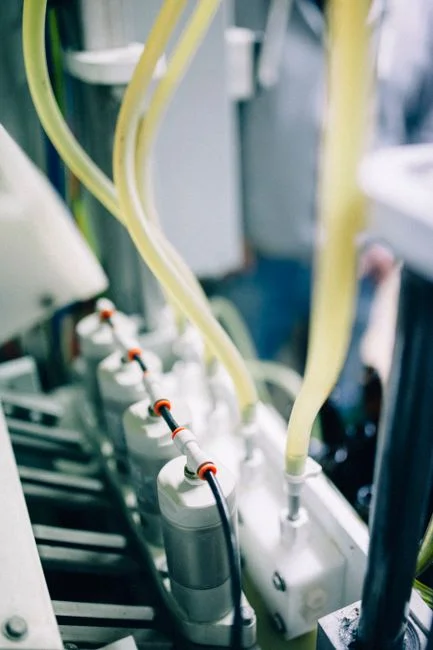
A dedicated EQ tank at 4–8 h HRT with online pH and conductivity is the buffer that every downstream chemistry step depends on, because routine chiller trips on a Tbilisi hyperscale site drive 1–5 pH excursions through the equalization basin faster than any unit operation can absorb them. Without an EQ sized to 4–8 h of peak flow, those excursions walk straight into the RO feed and trigger accelerated CIP.
AHU condensate must be segregated on its own line, typically <50 mg/L TDS, because glycol from coil leaks requires stripping rather than blending into the main RO loop. The segregation philosophy set at Stage 1 is the one the rest of the train depends on: fab streams must be split from sanitary and from cooling blowdown at this point, not downstream. Retrofitting segregation after the EQ is a rebuild, not a modification.
Stage 2 — DAF and Multi-Media Filtration
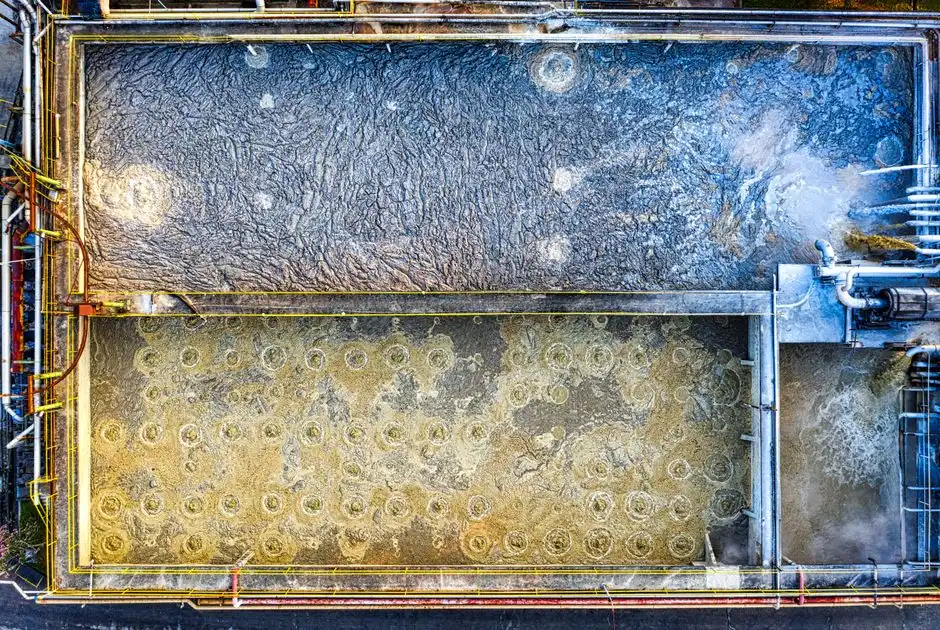
A DAF system in the 4–300 m³/h class floats oils, biofilm, and metal-hydroxide floc before any membrane sees the feed. For fab trains with Cu-CMP load, a hollow-fiber UF step upstream of DAF stabilizes colloid removal and prevents copper hydroxide floc from breaking through into the multi-media filter. The DAF air-to-solids ratio should be sized for 0.005–0.015 lb air/lb solids, not for a generic municipal spec.
Multi-media filtration (anthracite over sand over garnet) drops the Silt Density Index to below 3, which is the threshold an RO train can accept on Tbilisi intake without accelerated fouling. On Tbilisi's variable Mtkvari intake, the multi-media filter must be sized to track seasonal turbidity swings rather than a single setpoint: spring snowmelt drives turbidity up to several hundred NTU for weeks, and a filter sized only for summer baseline will blind during the freshet. For reuse projects in the broader region, the Kinshasa semiconductor wastewater guide walks through a similar pretreatment envelope under different receiving-water constraints.
Stage 3 — Softening and Antiscalant Dosing
A twin-tank industrial water softener targets hardness <50 mg/L as CaCO₃ and silica <10 mg/L as SiO₂ before the RO feed, with PLC-controlled antiscalant dosing tied to RO feed flow to handle the residual scaling potential that ion exchange cannot reach. On Tbilisi's Mtkvari intake, residual silica is the swing variable rather than hardness, and the softener should be sized on silica breakthrough rather than on calcium capacity alone.
The softener is a runtime cost, not a capital line — regeneration salt is the recurring OPEX item a procurement manager will ask about. At 200–1,000 m³/day feed flow, NaCl consumption runs 3–6 kg per m³ of softened water depending on incoming hardness, and that line item belongs in the 2026 OPEX sheet, not buried in the CAPEX quotation. For a broader capex reference, the industrial RO cost guide documents the softener line as a fixed percentage of total installed cost across the 200–1,000 m³/day band.
Stage 4 — MBR Polishing (Stand-Alone Halls Only)
A submerged PVDF MBR membrane bioreactor with 0.1 µm membranes delivers <1 NTU and <10 mg/L COD, allowing direct RO feed without media filtration and skipping the multi-media stage entirely when sanitary load is co-mingled. This is the path for stand-alone Tbilisi halls that are co-mingling domestic waste with cooling blowdown, and the MBR acts as both the BOD reduction step and the SDI <3 guarantor.
For fab streams, MBR is replaced by a dedicated HF-removal and metals-precipitation step upstream of UF. The chemistry is different: HF must be precipitated as CaF₂, copper must be precipitated as Cu(OH)₂ at pH 8.5–9.5, and a generic MBR will not remove HF to the Mtkvari receiving-water band. The Baku envelope for the logic transplant is useful, and the Mtkvari receiving-water band is looser than the Caspian/Maraza corridor, so a Tbilisi MBR can run with a smaller safety margin than a Caspian-band MBR (HydropureWater field data, 2026).
Stage 5 — Two-Pass RO at 80–95% Recovery
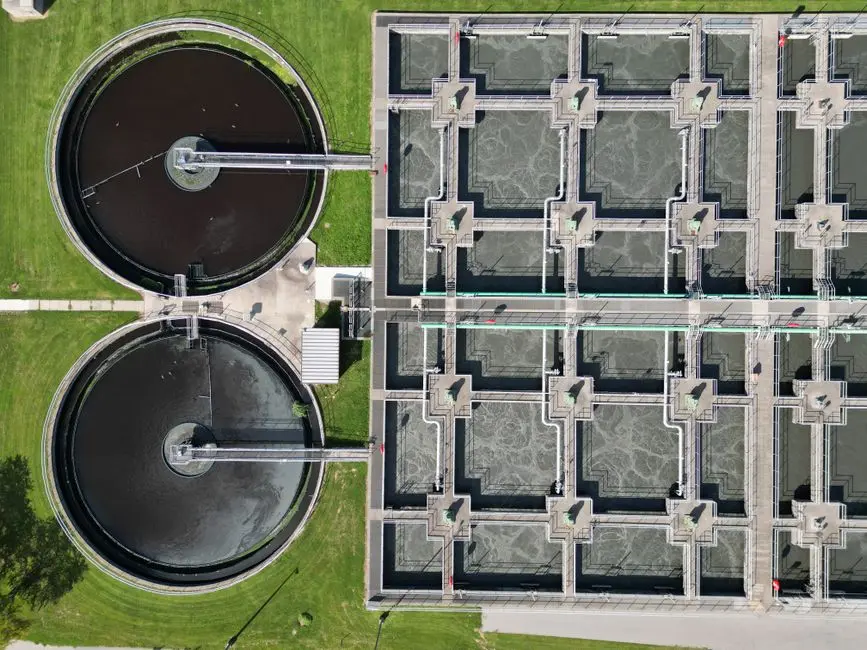
Two-pass industrial RO is the reuse step that closes the Mtkvari mass balance. The first pass runs at 150–250 psi (10–17 bar) for bulk salts, and the second pass polishes to TDS <200 mg/L and Cl⁻ <100 mg/L — the spec a Tbilisi cooling tower can accept as make-up. 80–95% is the practical operating window; above 95% recovery, silica scaling on the second-pass membranes drives CIP frequency up sharply and erodes the OPEX gain (per RO design criteria 2026 reference).
Use RO/UF membrane elements rated for high-silica feed to control replacement frequency — this is the single biggest OPEX lever on a Tbilisi site with variable Mtkvari silica. A side-stream filtration step at 1–5% of total circulation using 10–25 µm self-cleaning spiral units drops suspended solids to levels the RO can handle without pre-coat, which is the cheapest way to push COC higher and shrink the RO train.
| Parameter | First pass | Second pass |
|---|---|---|
| Operating pressure | 150–250 psi (10–17 bar) | 100–200 psi (7–14 bar) |
| Recovery target | 70–85% | 85–95% |
| Permeate spec | TDS <500 mg/L | TDS <200 mg/L, Cl⁻ <100 mg/L |
| Feed hardness target | <50 mg/L as CaCO₃ | — |
| Feed silica target | <10 mg/L as SiO₂ | — |
| Antiscalant | PLC-tied to feed flow | — |
Stage 6 — MVC Brine Concentration and ZLD Decision
Mechanical vapor recompression concentrates RO brine at 25–40 kWh/m³ of brine concentrated (HydropureWater field data, 2026), and that line is what pushes total cost of ownership up fastest on a Tbilisi site. A chlorine dioxide generator side-loop upstream of the RO controls biofouling without the isothiazolinone residual load that shortens RO membrane life — an explicit OPEX gain a vendor that proposes isothiazolinone dosing is implicitly not offering.
Stand-alone Tbilisi halls use MVC on the RO brine stream only, not full stream. Full-stream ZLD is over-specified unless the Gardabani or Mtkvari discharge path is restricted, and MEPA does not require it for a stand-alone hall at 80–95% recovery. Co-located fabs default to full-stream ZLD in 2026 because the combined HF + nanoparticle + TMAH load cannot be negotiated down to the Mtkvari receiving-water band, and MEPA treats it as a permit pre-condition rather than a design preference.
CAPEX, OPEX, and Payback for Tbilisi Sites
2026 CAPEX bands (engineering estimates, not firm quotes) for a Tbilisi site: a small hall under 200 m³/day with package plant plus haul-off runs $150–300/m³/day installed; a mid-size 200–1,000 m³/day MBR + RO train runs $400–700/m³/day installed, which is where the typical 5–20 MW Tbilisi hall sits; a hyperscale or co-located fab with brine ZLD runs $800–1,200/m³/day installed. The industrial RO cost guide walks through a parallel cost stack for comparison.
Avoided-discharge math at $5–15/kgal: 100 m³/day of untreated blowdown at the upper end is ~USD 400/day, so an 80% recovery RO pays back inside ~24 months at hyperscale flow (HydropureWater field data, 2026). For a parallel tropical-climate comparison, the data center cooling water treatment 2026 guide walks through a similar payback envelope under different ambient conditions.
| Flow band | Configuration | CAPEX (USD/m³/day installed) | Dominant OPEX line |
|---|---|---|---|
| <200 m³/day | Package plant + brine haul-off | $150–300 | Haul-off trucking, softener regeneration salt |
| 200–1,000 m³/day | MBR + two-pass RO + MVC on brine | $400–700 | RO CIP, antiscalant, ClO₂ residual, MVC electricity 25–40 kWh/m³ |
| Hyperscale / co-located fab | MBR + two-pass RO + full-stream MVC ZLD | $800–1,200 | MVC electricity 25–40 kWh/m³, high-silica RO element replacement |
OPEX lines that push cost up: membrane CIP frequency above 95% recovery on the second pass due to silica scaling; isothiazolinone biocide residuals shortening RO life; MVC electricity at 25–40 kWh/m³ of brine concentrated. The 80% reuse floor is what closes Tbilisi permit economics; 95% is the practical ceiling before silica CIP erodes the OPEX gain.
Frequently Asked Questions
What is the minimum reuse rate MEPA will accept for a 2026 Tbilisi hyperscale permit?
MEPA's 2026 review practice for hyperscale ICT projects anchors an 80% internal reuse floor, mirroring the RA MoE pattern seen when the Ararat basin reached allocation closure. Below that line, the EIA clock (90–180 days) effectively resets and the permit turns conditional (per RA MoE 2026 practice).
Can a Tbilisi data hall discharge to the Gardabani or Ortachala municipal sewer at hyperscale flow?
Not at hyperscale flow. The Gardabani/Ortachala receiving works are not sized for cooling-tower blowdown volumes in the 200–1,000 m³/day band, and MEPA treats municipal-sewer discharge as a non-starter for ICT projects above the small-hall threshold in 2026.
When does a Tbilisi fab or fab-hall hybrid require full-stream ZLD instead of 80–95% reuse?
Whenever HF-etch fluoride (50–500 mg/L), CMP nanoparticles, and TMAH co-occur in the wastewater envelope. The combined load cannot be negotiated down to the Mtkvari receiving-water band, and MEPA's 2026 practice treats full-stream ZLD as the default for any co-located fab or fab-hall hybrid (per Lai & Lin 2004).
What is the 2026 CAPEX band for a mid-size 5–20 MW Tbilisi data hall wastewater train?
A mid-size 200–1,000 m³/day MBR + RO train runs $400–700/m³/day installed, which is where the typical 5–20 MW Tbilisi hyperscale hall sits. A small hall under 200 m³/day with package plant plus haul-off runs $150–300/m³/day; hyperscale or co-located fab with brine ZLD runs $800–1,200/m³/day (HydropureWater field data, 2026).