The Three Compliance Layers Cleveland Pharma Plants Must Stack in 2026
A Cleveland-area pharmaceutical manufacturer discharging to the Northeast Ohio Regional Sewer District (NEORSD) collection system does not face a single "pretreatment limit" — it faces a stack of three, and engineering to the wrong layer is the most common source of Notice of Violation letters in 2026. The binding number on any pollutant is whichever standard is most stringent of the three layers, and both federal and local must be checked against the same influent data set before equipment selection begins.
Layer 1 is the general and specific prohibitions at 40 CFR 403.5(a) and 403.5(b), which ban any discharge that causes pass-through — defined at 40 CFR 403.3(p) as a discharge that exits the POTW in quantities or concentrations that cause an NPDES permit violation — or interference, defined at 40 CFR 403.3(k) as a discharge that inhibits or disrupts the POTW and is a cause of an NPDES or sludge-use violation (per EPA, 2026). Layer 2 is the categorical pretreatment standard, and for pharmaceutical manufacturing the binding subpart is 40 CFR Part 439. Layer 3 is NEORSD's Sewer Use Ordinance local limits, published under 40 CFR 403.5(c), which can be more stringent than the federal floor because NEORSD's own NPDES permit from Ohio EPA constrains its headroom on the Cuyahoga River. Statutory authority sits in Clean Water Act §307(b) and §402(n).
The practical rule for an EHS lead: confirm the controlling number parameter by parameter before any process flow diagram is drawn. A plant that engineers to 40 CFR Part 439 alone and ignores the NEORSD local limit will miss the binding number on metals, ammonia, and TTO; a plant that engineers to the local limit alone and ignores the federal categorical standard can lose SIU status and the protection that goes with it.
Which 40 CFR Part 439 Subpart Applies to Your Cleveland Plant
40 CFR Part 439 is the binding categorical standard for pharmaceutical manufacturing, and selecting the correct subpart is the first step in confirming which daily-maximum and monthly-average limits actually apply (per EPA, 2026). EPA revises these subparts on a multi-year cycle, so the exact numeric values must be confirmed against the current Code of Federal Regulations, not against a memory or a sales sheet. Most Cleveland-area pharma plants run more than one operation type and therefore owe compliance with more than one subpart at once; the equipment train is sized to the most demanding stream, which is usually the Subpart B synthesis stream when solvent load is present.
| Subpart | Operation covered | Dominant pollutant envelope | Typical upstream unit operation |
|---|---|---|---|
| A — Fermentation Products | Antibiotic, vitamin, amino acid, enzyme production | COD 1,000–10,000 mg/L; BOD 500–5,000 mg/L; TSS from mycelia and spent media | Equalization → MBR or activated sludge → multimedia polish |
| B — Synthesis Products | Chemical synthesis of APIs and intermediates, extraction | Solvent residuals (acetonitrile, methanol, DCM); mother liquor COD; trace metal catalysts | Solvent recovery / stripping → equalization → DAF (if FOG) → biological polishing |
| C — Formulation / Finished Dosage | Tablet compression, coating, granulation, packaging wash | TSS, color, trace API, coating polymer residuals | Equalization → DAF → multimedia/carbon |
Subpart A carries the heaviest BOD/COD load because the broth, mycelia, and spent media arrive as a near-raw waste stream. Subpart B carries the tightest toxic-organic ceilings because the synthesis mother liquor and wash solvents concentrate acetonitrile, methanol, dichloromethane, and trace metal catalysts in a stream that, if released untreated, will exceed both the categorical TTO limits and NEORSD's 2.13 mg/L TTO ceiling. Subpart C is the lightest of the three on organics but is not trivial — coating polymer residuals and trace API bleed-off will fail NEORSD's color and trace-organic schedules without carbon polishing. A plant that runs synthesis and formulation under one roof must treat both subparts and document the segregation in the slug load control plan under 40 CFR 403.8(f).
What NEORSD's Local Limits Add on Top of the Federal Floor
NEORSD's Sewer Use Ordinance local limits are frequently the controlling number on a parameter-by-parameter basis for Cleveland-area pharma, and the 2024–2026 enforcement cycle has tightened the program materially (per HydropureWater field data, 2026). The parameters that typically drive design are metals (Pb, Cd, Cr, Ni, Zn, Cu), oil and grease, sulfides, phenols, ammonia, cyanide, and total toxic organics (TTO) at roughly 2.13 mg/L, with pH held inside the 6–9 discharge window. The exact schedule in the current Sewer Use Ordinance publication is the legal reference; the numbers here are the design envelope used in 2026 proposal work.
The Cuyahoga River phosphorus TMDL and the Lake Erie algae targets push NEORSD to set tight ammonia and total nitrogen caps, and receiving-water metals criteria tighten the local metal ceilings below the categorical standards for most subparts. Per the Ohio EPA PFAS Action Plan carried into NEORSD's 2024–2026 enforcement cycle, any SIU using fluorinated feedstocks, fluoropolymer processing aids, or PFAS-containing surfactants must submit quarterly PFAS analytical results against the 29-compound EPA Method 533/537.1 list, with non-detect triggers at the practical quantitation limit; NPDES-driven numeric PFAS limits are expected in NEORSD permits by 2027.
Surcharges for oil and grease, COD, and ammonia exceedances are calculated on a per-pound basis and can exceed six figures annually for a mid-sized pharma plant (per HydropureWater field data, 2026). A 90-day compliance report showing two or three exceedances on ammonia or TTO is enough to trigger the surcharge schedule and a compliance order, so the equipment train must hold the local envelope continuously, not on a monthly-average basis only. For deeper coverage of the local-limit framework, the Cleveland chemical plant pretreatment guide walks the same three-layer stack with chemical-plant examples.
The 2026 Treatment Train Sized for API and Solvent Load
Six unit operations, in roughly this order, handle the vast majority of Cleveland pharma wastewater streams that go to NEORSD. Not every plant needs all six; the right subset is a function of the controlling pollutant and the binding subpart.
Stage 1 — Equalization. Sized for hours to days of retention, the basin damps batch swings in pH, flow, temperature, and concentration and is the baseline defense against pass-through and slug load excursions under 40 CFR 403.5(a) and 40 CFR 403.8(f). For a 50 m³/h design flow, an 8-hour HRT translates to roughly a 400 m³ basin with mechanical mixers at 4–6 W/m³ to prevent settling (per HydropureWater design data, 2026).
Stage 2 — pH neutralization. PLC-controlled acid/caustic dosing maintains the inlet pH inside the 6–9 NEORSD window; an automatic chemical dosing system closes the loop between the inline pH probe and the metering pump and feeds coagulant and flocculant on a streaming-current signal.
Stage 3 — DAF or lamella. A DAF system handles oils, FOG, and TSS from formulation and coating at 4–300 m³/h, with oil and grease below 10 mg/L and TSS below 30 mg/L at 5–25 m/h hydraulic loading. A lamella clarifier is the alternative for moderate TSS and chemical-precipitation duty at 20–40 m/h surface loading with no oil removal — pair it with DAF if FOG is present.
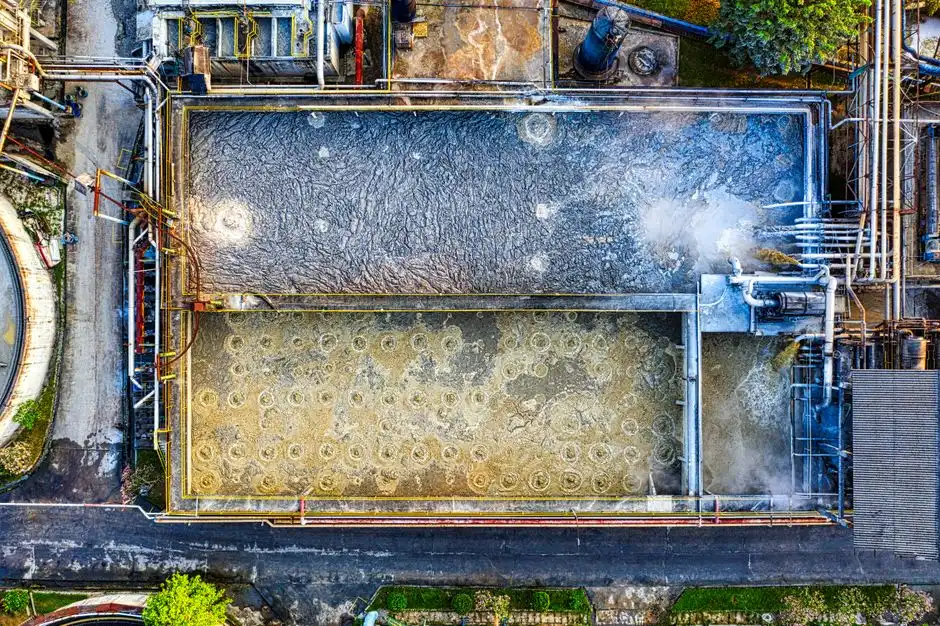
Stage 4 — Biological polishing. Activated sludge, SBR, or an MBR drives COD/BOD removal and complete ammonia removal via nitrification-denitrification; effluent ammonia below 1 mg/L as N is achievable under stable operation. MLSS typically runs 6,000–10,000 mg/L in an MBR versus 2,000–4,000 mg/L in conventional activated sludge (per HydropureWater design data, 2026).
Stage 5 — Multimedia or carbon polishing. Polishing drops residual COD, color, and trace organics; activated carbon is the standard answer for TTO components approaching the 2.13 mg/L local ceiling. Source segregation of high-strength streams (phenol condensates, ammoniacal process water, solvent washwater) upstream of the main equalization basin is the cheapest insurance a plant can buy and is the difference between a biological stage that is sized for 5,000 mg/L COD and one sized for 1,500 mg/L. Steam stripping is the workhorse for ammonia- and phenol-bearing streams; solvent extraction handles phenolics in petrochemical-adjacent streams that would otherwise poison an MBR; activated carbon adsorption polishes TTO and color bodies down to the local schedule. For a fermentation-dominated plant, SBR design for amino acid fermentation wastewater walks the biological sizing.
DAF vs Lamella vs MBR vs Activated Sludge: A Cleveland Decision Matrix
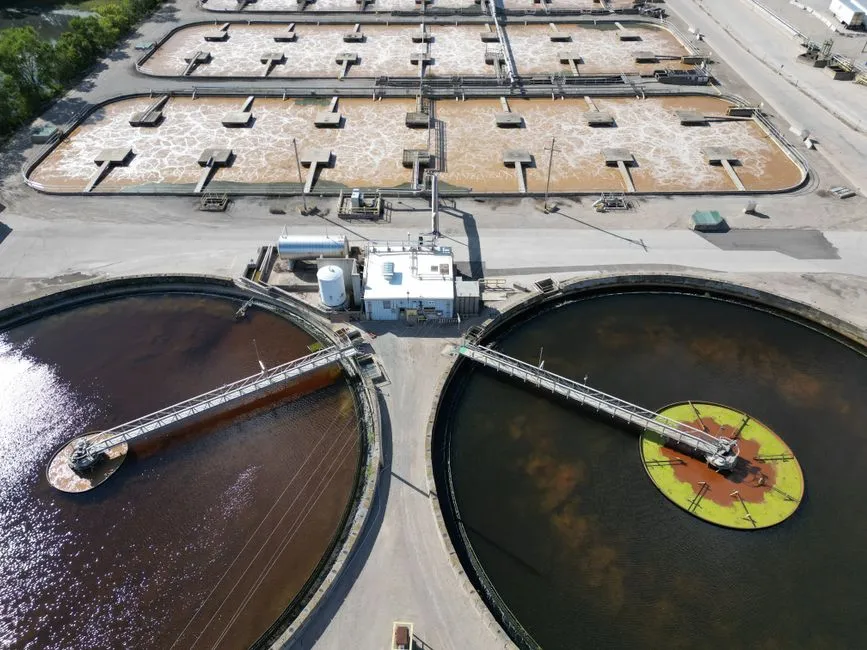
Four decision axes determine which combination of unit operations to build: controlling pollutant, SIU status, batch versus continuous flow pattern, and whether the plant is moving toward reuse. The table below frames the technology choice for a Cleveland site with a tight envelope and a constrained footprint.
| Technology | Best-fit duty | Effluent envelope | Footprint / CAPEX note |
|---|---|---|---|
| DAF | High-FOG and free-oil streams — synthesis washwater, lube contamination, surfactant-laden process water | Oil & grease <10 mg/L; TSS <30 mg/L; 4–300 m³/h; bubble 30–80 μm | Higher CAPEX than gravity clarification; smaller footprint; faster startup |
| Lamella clarifier | Moderate TSS and metal-hydroxide sludge; no oil removal | TSS 20–40 m/h surface loading; ~30% lower polymer consumption than circular clarifiers | Smallest footprint in the clarifier class; pair with DAF if FOG is present |
| MBR | Sub-1 μm polishing; tight local limits; small footprint sites; reuse pathway | TSS below detection; turbidity <1 NTU; COD/BOD <10 mg/L; 0.1–0.4 μm PVDF | ~60% smaller footprint than CAS; higher CAPEX; 5–8 year membrane life; lower sludge OPEX |
| Conventional activated sludge | High-flow BOD/COD where footprint is not constrained and discharge-only | COD/BOD 20–30 mg/L; needs separate clarifier | Lowest CAPEX; highest sludge OPEX |
An MBR polishing system wins for tight Cleveland sites and tight local limits on a 10-year total cost of ownership basis, with the trade-off that membrane replacement every 5–8 years is a real line item. Conventional activated sludge is still the right answer for high-flow BOD/COD where the plant has the land and the local envelope allows 20–30 mg/L TSS in the effluent. For solids handling on the back end, a high-efficiency sedimentation tank thickens before dewatering and reduces hauling volume. To complete the monitoring loop required by NEORSD's self-monitoring schedule, the automatic samplers for wastewater buyer's guide covers refrigerated samplers and magnetic flow meters at the discharge manhole.
SIU Permit Timeline, Slug Load Plan, and Sludge Disposal
New SIU permits typically take 90–180 days from application through NEORSD's industrial waste review, with a 30-day public comment period applying to new categorical industrial users; start the application at least six months before the planned discharge date (per HydropureWater field data, 2026). A Baseline Monitoring Report (BMR) is required at categorical standard promulgation or at new-discharge startup, followed by 90-day compliance reports on the schedule the Control Authority sets. A slug load control plan under 40 CFR 403.8(f) is typically required for batch SIUs and combines three elements: equalization capacity sized to absorb batch surges, flow and pH monitoring with defined alarm setpoints, and written batch-release procedures that sequence CIP rinses, API reactor discharges, and formulation wash waters to keep the combined discharge within the pass-through and interference prohibitions of 40 CFR 403.5(a). Most BMR and 90-day-report gaps trace back to a missing or vague slug load plan, not to bad unit-operation selection.
Dewatered sludge from a Cleveland pharma plant is typically a non-hazardous industrial waste classified under Ohio Administrative Code 3745-30, but it must be analyzed for metals and TTO before landfill disposal. A plate and frame filter press for dewatering residuals to 25–35% dry solids minimizes hauling volume and disposal cost, and manifests are required for all off-site shipments. Procurement tip: ask bidders for guaranteed effluent values against the controlling parameter (not generic "treated water" claims), for PLC-controlled chemical dosing integration, and for dewatering equipment sized against the sludge load their equipment produces.
Frequently Asked Questions
Which 40 CFR Part 439 subpart controls a Cleveland-area pharma plant that runs both synthesis and formulation?
Subpart B (Synthesis Products) and Subpart C (Formulation / Finished Dosage) both apply. The plant owes compliance with each, and the equipment train is sized to the most demanding stream — usually the synthesis stream under Subpart B when solvent residuals (acetonitrile, methanol, DCM) are present (per EPA, 2026).
How often must a Cleveland pharma SIU sample for PFAS under NEORSD in 2026?
Quarterly PFAS sampling against the 29-compound EPA Method 533/537.1 list is required for any SIU using fluorinated feedstocks, fluoropolymer processing aids, or PFAS-containing surfactants, with non-detect triggers at the practical quantitation limit. NPDES-driven numeric PFAS limits are expected in NEORSD permits by 2027 (per HydropureWater field data, 2026).
What is the typical NEORSD pH and TTO envelope for 2026?
pH is typically held inside 6–9 at the point of discharge to the sanitary sewer, and total toxic organics (TTO) is typically capped at roughly 2.13 mg/L. Confirm the exact schedule in the current NEORSD Sewer Use Ordinance publication before final design (per HydropureWater field data, 2026).
How long does a new SIU permit take in Cleveland, and when should the application start?
New SIU permits typically take 90–180 days through NEORSD's industrial waste review, with a 30-day public comment for new categorical industrial users. Start the application at least six months before the planned discharge date to avoid delaying startup (per HydropureWater field data, 2026).