
Why Marseille is a 2026 focal point for semiconductor and data hall wastewater
Marseille is France's second-largest data center market and a trans-Atlantic subsea cable gateway — AAE-1 and SEA-ME-WE-5 land within three kilometers of the major colocation campuses, which is why Nautilus has signed a 7.5 MW liquid-cooled lease in the port zone and Digital Realty operates 62.8k m² of carrier-neutral colocation space serving more than 200 customers (Nautilus, 2024; Digital Realty, 2025). France data center revenue grew from €7.6B in 2020 to €11.6B in 2025, projected to reach €14.3B by 2029, with Marseille positioned as a Mediterranean complement to the Lyon/Paris axis (Exyte, 2025). Adjacent Aix-Marseille and the wider Provence microelectronics cluster host fabs drawing up to approximately 37,850 m³/day of process water, of which CMP (chemical-mechanical planarization) slurry waste alone represents 30–40% of total fab discharge (Gradiant, 2025).
The 2026 equipment-market signal is concrete: France's data center water and wastewater treatment equipment market sits at $80.7M in 2026 and is projected to reach $175.6M by 2031 at a 16.8% CAGR, substantially above the global 12.3% rate (MarketsandMarkets, 2026). For a facilities director preparing a 2026 ICPE filing, this is no longer an EHS line item — it is a board-level permitting and capital decision. The reason Marseille is materially different from Lyon is the intake water envelope: Mediterranean supply carries higher chloride and bromide than the Rhône, with a narrower seasonal turbidity range, which shifts the Langelier Saturation Index (LSI) operating window, lowers the safe silica cycles-of-concentration, and forces a different AOP (advanced oxidation process) design baseline than the Lyon guide describes (see the 2026 Lyon semiconductor and data hall compliance guide for the Rhône comparison).
The 2026 regulatory stack: ICPE, CWW BREF, WFD, and PFAS
Four overlapping instruments govern a 2026 Marseille discharge. The ICPE (Installations Classées pour la Protection de l'Environnement) regime is France's transposition of EU Industrial Emissions Directive 2010/75/EU, and for fabs above IED capacity thresholds, the CWW BREF (Common Waste Water and Waste Gas Treatment in the Chemical Sector) BAT-AELs (Best Available Technique-Associated Emission Levels) apply directly to process drains. The Marseille-administering authority is DREAL Provence-Alpes-Côte d'Azur (DREAL PACA), which is analogous to but jurisdictionally distinct from DREAL Auvergne-Rhône-Alpes in Lyon; the permit officer, the redevance math, and the local inspection cadence are not the same. EU Water Framework Directive 2000/60/EC layers on top, requiring "good ecological status" for the receiving Mediterranean coastal water body, and DREAL PACA increasingly writes mandated reuse quotas directly into individual permit conditions rather than relying solely on discharge concentration limits.
PFAS is the 2026 wildcard. EPA's PFAS roadmap with legally binding MCLs and CERCLA hazardous-substance designation is already reshaping global fab design (IDE Technologies, 2025), and France is following with its own PFAS restrictions under REACH on a 2026–2028 horizon. The defensible 2026 move is to integrate a PFAS destruction train — HPRO (high-pressure reverse osmosis) plus AOP plus GAC (granular activated carbon), or destruction technologies such as supercritical water oxidation — into the base specification, because retrofitting a high-recovery RO with PFAS polishing after commissioning typically runs 20–30% above in-base-spec cost.
Local by-laws and the Agence de l'Eau Rhône-Méditerranée-Corse define self-monitoring frequency, effluent self-surveillance obligations, and the pollution redevance — a fee structure that scales with pollutant loading and can run into six figures annually for a 5,000 m³/day site. That redevance is the single largest variable OPEX line item a CFO will see on the Marseille wastewater budget, and modeling it correctly is what separates a defensible board paper from an optimistic one.
Classifying the wastewater: dominant streams at a Marseille site
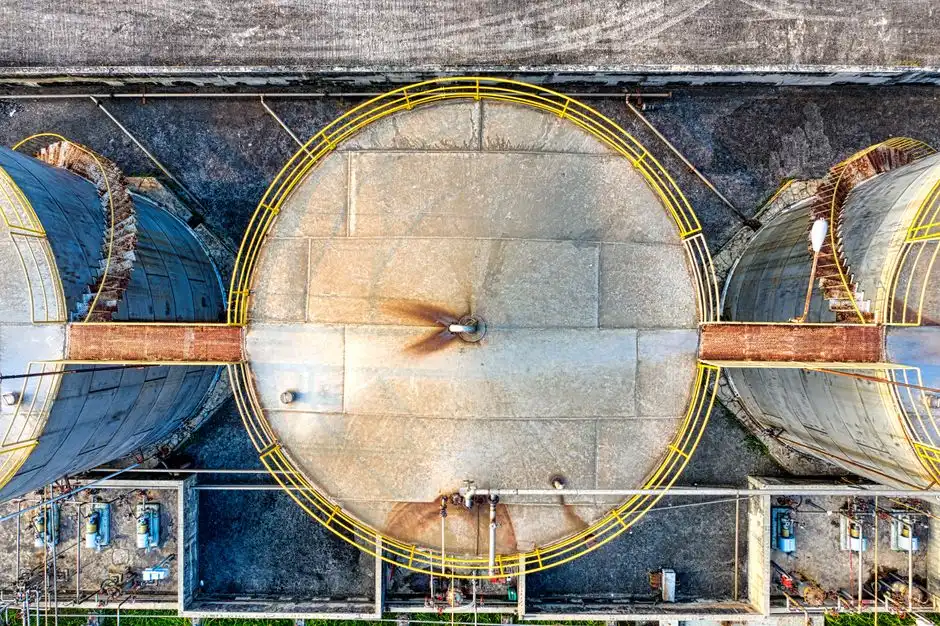
Classifying your facility correctly is the first engineering decision, because the treatment train differs by an order of magnitude depending on what reaches equalization. Semiconductor fabs typically split their drain network into 15–18 segregated grades of differing quality, from UPW reject to acid etch waste (Govindan, Gradiant, 2025); data halls usually need 3–5 segregated streams. CMP wastewater is the single largest by volume in a fab and cannot be co-mingled with fluoride waste — the two streams cross-precipitate and crash pH in any shared equalization tank. Cooling-tower blowdown is the dominant stream by volume at a data hall, typically 60–80% of total site wastewater, and is what the reuse envelope must be sized around.
| Stream | Key constituents | Loading / target | Primary treatment |
|---|---|---|---|
| CMP slurry | Suspended solids (silica, ceria), Cu, Ni, W | 30–40% of fab total volume; TSS 500–5,000 mg/L | Lamella clarifier or DAF; never co-mingled with fluoride |
| Fluoride waste | HF, NH₄F, acidic rinse | F⁻ typically 50–500 mg/L; target < 15 mg/L | CaCl₂ precipitation; dedicated acid-resistant header |
| Photoresist / solvent | Organic polymers, TMAH, NMP | COD 500–3,000 mg/L | MBR or AOP; segregated from acid lines |
| NH₃ stripper | NH₃-N, isopropyl alcohol | NH₃-N 50–500 mg/L; target < 5 mg/L | Nitrification/denitrification; pH control |
| Cooling-tower blowdown | Hardness, silica, scale inhibitor, biocide | LSI −0.3 to +0.5 target; SiO₂ < 150 mg/L | Side-stream filtration + RO for reuse |
| Scrubber condensate | Acidic aerosols, dissolved metals | pH 1–4; TSS variable | Neutralization + precipitation |
| Chiller / humidification bleed | Low TSS, moderate hardness | 60–80% of data hall wastewater volume | Often RO-polished for tower makeup |
The 2026 treatment train: segregated lines, MBR polish, RO reuse
The five-stage architecture below is the 2026 baseline for a Marseille-area fab or combined site. Stage 1 is segregated equalization: dedicated headers for fluoride, CMP, NH₃, and sanitary/cooling streams with hold times of 4–8 hours and pH swings held below ±1.5. Materials of construction matter here — HF, HCl, and H₂SO₄ attack standard 304/316 stainless, so fluoride headers, equalization, and precipitation reactors must be PVDF-lined or solid FRP.
Stage 2 is primary solids and metal removal. A lamella clarifier at 3–5 m³/m²·h overflow rate or a DAF for CMP slurry and fluoride pre-clarification handles the bulk TSS load — typically > 90% TSS removal and F⁻ reduction to < 15 mg/L. CMP slurry lines need abrasion-resistant urethane or rubber-lined piping because silica and ceria slurries will cut standard stainless within months.
Stage 3 is biological polishing using a submerged MBR for photoresist and NH₃ stripper streams, operated at MLSS 8,000–12,000 mg/L with NH₃-N held below 5 mg/L in the effluent. The 2026 MBR engineering spec for wafer cleaning wastewater is laid out separately in the 2026 MBR engineering specs for wafer cleaning wastewater guide.
Stage 4 is reuse polishing: UF → RO → EDI, with an AOP (UV/H₂O₂ or O₃) stage for trace organics and a GAC or ion-exchange step sized for PFAS polishing. A high-recovery industrial RO system with up to 95% recovery closes the loop on the cleanest segregated streams, and a UV-C polishing stage drops TOC below 50 ppb before the final EDI polish. UPW loops require sanitary 316L with orbital welding and electropolishing, per the 2026 UPW contamination budget and ASTM/SEMI specs guide.
Stage 5 is brine and ZLD: high-recovery RO → brine concentrator → crystallizer, with an overall reuse baseline of 85–90% and 99% demonstrated at a $300M semiconductor water plant (Gradiant, 2025). ZLD should be specified only where Mediterranean permit conditions explicitly demand it; for most Marseille sites, the cycle-count math on the cooling-tower blowdown side does the heavy lifting without paying the full ZLD energy penalty.
Cooling-tower blowdown reuse: the Mediterranean parameter envelope
Cooling-tower blowdown is the largest reuse opportunity by volume — 60–80% of total site wastewater at a data hall, and a major stream at a fab where up to 40% of process water ends up in towers and scrubbers (Gradiant, 2025). Two operating numbers govern the 2026 design: LSI held in the −0.3 to +0.5 range to prevent both scale and corrosion, and silica (SiO₂) kept below ~150 mg/L to keep the RO from fouling prematurely.
The Mediterranean intake envelope differs from the Rhône baseline in three ways that matter for engineering. Chloride and bromide are higher and more variable seasonally, which compresses the safe cycles-of-concentration window to 4–6 cycles before LSI or silica limits are hit (versus the Rhône's slightly higher cycle count at moderate hardness). Turbidity swings are narrower, which simplifies upstream media-filter loading, but the higher bromide shifts UV/H₂O₂ AOP stoichiometry because bromate formation becomes a permit-relevant byproduct above ~50 µg/L.
| Parameter | Marseille (Mediterranean) | Lyon (Rhône) | 2026 design implication |
|---|---|---|---|
| Total hardness (°f) | 25–40 (higher seasonal) | 15–25 (moderate) | Antiscalant dose higher at Marseille |
| Cl⁻ (mg/L) | 80–180 | 10–30 | 316L borderline; consider duplex for hot legs |
| Br⁻ (mg/L) | 0.4–1.2 | < 0.1 | UV/H₂O₂ AOP must control bromate < 50 µg/L |
| SiO₂ (mg/L) | 8–18 | 6–12 | 150 mg/L ceiling realistic before RO fouling |
| LSI at cycles | 4–6 cycles before breach | 5–7 cycles | Marseille needs tighter blowdown control |
| Seasonal Δ turbidity (NTU) | 2–15 (narrow) | 5–80 (wide) | Multi-media filter loading more stable at Marseille |
The standard 2026 block is a high-recovery industrial RO system paired with a multi-media filter upstream and a PLC-controlled antiscalant and biocide dosing skid. For sites with hard makeup, a pre-softening stage is often the most cost-effective way to push cycles higher before the RO. For hyperscale sites choosing zero-water liquid cooling (Nautilus-style, where the cooling system itself consumes no water), the cooling-tower blowdown stream is largely eliminated — but the fab's hot-side streams (CMP, fluoride, NH₃) still require the MBR + RO polish above, so the segregation discipline does not go away.
CAPEX, OPEX, and reuse payback for a 5,000 m³/day Marseille site
CAPEX for a 5,000 m³/day combined fab and data hall treatment train — MBR plus RO plus reuse polishing, with segregated fluoride and CMP lines — typically falls in the €8–18M range depending on ZLD scope and PFAS destruction inclusion. Budget ±20% contingency for a PFAS retrofit if it is not in the base design; the 2026 defensible move is to build the HPRO + AOP + GAC block in from day one rather than accept the 20–30% retrofit premium later.
OPEX is dominated by three lines: energy for RO high-pressure pumps and MBR blowers (35–45% of OPEX), chemicals for antiscalants and pH adjustment (15–25%), and membrane replacement on a 3–5 year UF/RO cycle (10–20%). Realistic 2026 reuse-ratio targets are stream-specific: 85–90% for fabs and 50–70% for data halls. TSMC achieved 12% reclaimed-water replacement of total fresh-water demand in 2023 versus a 5% target, and Gradiant has demonstrated 99% recycling at a $300M semiconductor water plant (Manufacturing Dive, 2025) — both useful benchmarks for the upper end of what is technically achievable at a Marseille site.
Mediterranean intake stress, the EU PFAS compliance trajectory on a 2026–2028 horizon, and the Rhône-Méditerranée-Corse redevance combine to push Marseille facilities toward a 5–7 year payback on reuse versus continued fresh-water plus discharge fees. France's 16.8% CAGR for water treatment equipment (MarketsandMarkets, 2026) signals strong local vendor and service capacity — a real procurement advantage for 2026 Marseille projects, because lead times on HPRO skids, MBR modules, and RO trains are materially shorter when sourced through PACA-region integrators than through shipped-from-elsewhere channels.
Specification discipline: what makes a 2026 Marseille permit hold
Specification discipline is the difference between a permit that holds and one that gets revised under DREAL PACA pressure. The five moves below are what the 2026 audit cycle is checking for. Lock the segregated header map into the base design — retrofitting segregation after equalization is the single most common 2026 audit finding because operators discover too late that the floor drains were never physically separated. Spec PVDF-lined or solid FRP for all fluoride service, urethane or rubber-lined piping for CMP slurry, and sanitary 316L with orbital welding and electropolishing for UPW loops; the materials of construction are not optional in Marseille's Mediterranean chemistry.
Build the PFAS destruction train into the base design — HPRO + AOP + GAC, or destruction technologies such as supercritical water oxidation — rather than as a 2030 retrofit. Anchor the redevance calculation up front, because a 5,000 m³/day site can run into six figures annually and modeling it correctly is what separates a defensible board paper from an optimistic one. Apply the same specification-by-specification evaluation discipline that the DAPHNE4NFDI consortium used for ELN selection (Science Diffusion, 2025-09) — separately rating each spec (pH swing, TSS removal, NH₃-N effluent, RO recovery, TOC < 50 ppb) rather than scoring the train holistically — to keep the bid evaluation unbiased when three or four vendors submit proposals.
Frequently Asked Questions
Who actually issues a 2026 Marseille fab or data hall wastewater permit?
DREAL Provence-Alpes-Côte d'Azur (DREAL PACA) issues the ICPE permit under France's transposition of EU Industrial Emissions Directive 2010/75/EU, which is a different administering authority from DREAL Auvergne-Rhône-Alpes in Lyon. For facilities above IED capacity thresholds, the CWW BREF BAT-AELs apply directly to process drains, and the Agence de l'Eau Rhône-Méditerranée-Corse administers the self-monitoring obligations and the pollution redevance.
What reuse ratio is realistic for a 2026 Marseille data hall or fab?
A defensible 2026 target is 85–90% reuse for a semiconductor fab and 50–70% for a data hall, driven primarily by cooling-tower blowdown, which represents 60–80% of total site wastewater at a data hall. ZLD at 99% has been demonstrated at a $300M semiconductor water plant (Gradiant, 2025) but is generally specified only where Mediterranean permit conditions explicitly demand it because the energy penalty is steep.
How should PFAS be handled in a 2026 Marseille ICPE filing?
Integrate the PFAS destruction train into the base specification now — HPRO plus AOP plus GAC, or destruction technologies such as supercritical water oxidation — because French PFAS restrictions under REACH are tightening on a 2026–2028 horizon and retrofitting a high-recovery RO with PFAS polishing after commissioning typically runs 20–30% above in-base-spec cost.
What CAPEX envelope should be budgeted for a 5,000 m³/day Marseille site?
A 5,000 m³/day combined fab and data hall treatment train with MBR, RO, reuse polishing, and segregated fluoride and CMP lines typically runs €8–18M depending on ZLD scope. Budget ±20% contingency for PFAS destruction if it is not in the base design, and model the Agence de l'Eau Rhône-Méditerranée-Corse redevance up front, because it can run into six figures annually for a site of that size.
Why is the Mediterranean intake envelope different from the Rhône baseline for cooling-tower blowdown reuse?
Mediterranean intake water at Marseille carries higher chloride (80–180 mg/L) and bromide (0.4–1.2 mg/L) than the Rhône, which compresses the safe cycles-of-concentration window to 4–6 cycles before LSI or silica limits are hit, and forces UV/H₂O₂ AOP designs to control bromate formation below 50 µg/L — both of which are materially different from the Lyon engineering baseline.