Why Biosolids Costs Are Reshaping Utility Budgets in 2026
Biosolids disposal is no longer a routine line item for U.S. utilities in 2026. According to Water & Wastes Digest (wwdmag.com, 2025-09), four forces are impacting budgets: a patchwork of state-level PFAS rules, tightening landfill capacity, aging incinerators, and diesel fuel volatility. These forces have moved biosolids from a predictable cost center to a strategic risk; wwdmag notes that the 5-25 year fixed planning windows utilities once used for solids programs are being replaced by annual strategy re-evaluation, with operators stress-testing capital decisions against regulatory and market shifts.
For a plant manager, the practical consequence is that two budget items — hauling and tipping fees — scale linearly with wet tonnes leaving the site. Volume reduction at the dewatering stage is the highest-leverage control point in the biosolids value chain. The benchmark to measure against is well established: a thermal hydrolysis plant running Cambi-style pretreatment typically produces cake around 25% dry solids (DS), the figure Cambi itself uses as its worked example (cambi.com, 2025). If your cake is sitting at 18-22% DS on a legacy belt press, you are paying to haul roughly 1.1-1.4 tonnes of water for every tonne of dry solids shipped out.
The Cost-Reduction Logic: Volume × Pathway
Every biosolids cost-reduction program relies on two levers operating simultaneously: wet-tonne reduction at the front of the solids train and the selection of the disposal pathway. The first lever includes better digestion, optimized polymer conditioning, higher cake dryness, and selective thermal drying. The second lever involves shifting volumes from expensive, contractually fragile outlets to more reliable ones, or building redundancy so no single regulatory or market shock disrupts the entire program.
Wwdmag makes the volume case bluntly: even incremental reductions in volume yield meaningful savings in regions with high hauling distances or tipping fees, and higher-quality biosolids expand reuse options, which increases contract leverage when negotiating disposal terms. A 3-percentage-point jump in cake DS may sound modest, but on a 10,000 wet-tonne-per-year program, it can move six-figure OPEX without touching a single disposal contract.
The second lever is pathway. Cambi notes that controlled landfill or monofill disposal remains the standard contingency route when biosolids do not meet land application standards or when other outlets are unavailable (cambi.com, 2025). A single-outlet strategy is now an audit risk. Upstream of both levers sits a third opportunity the industry is only starting to operationalize — biology that reduces organics before they accumulate as sludge. Spadefoot/EnBiorganic's bioaugmentation approach sits here as a complementary technology to mechanical dewatering, claiming documented 62% hauling-cost reductions in operational deployments (spadefoot.eco, 2025).
Mechanical Dewatering Technologies Compared
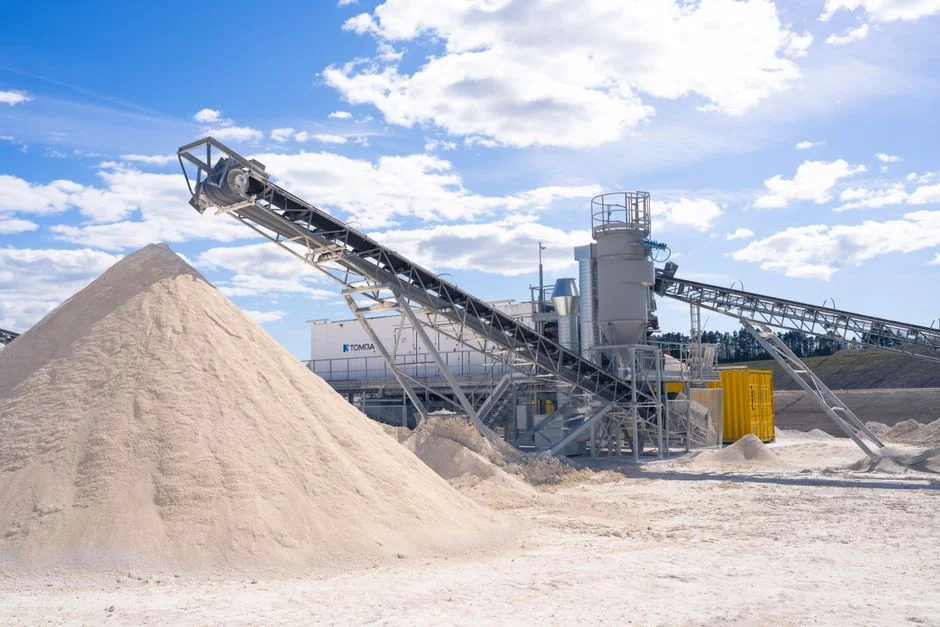
Three mechanical options dominate municipal and industrial solids handling: the decanting centrifuge, the belt press, and the plate-and-frame filter press. The most important metric is achievable cake DS, because wet-tonne hauling and tipping fees both scale with water shipped. Polymer dose, energy use, footprint, and operator skill all factor into total cost of ownership.
| Parameter | Decanting Centrifuge | Belt Press | Plate-and-Frame Filter Press |
|---|---|---|---|
| Typical achievable cake DS | 20-25% (anaerobic digesters) / 14-18% (waste activated) | 18-22% | 25-35% (often 28-32% on digested cake) |
| Polymer dose range | 8-20 lb active polymer / dry ton | 8-15 lb / dry ton | 4-10 lb / dry ton |
| Energy use | High (back-drive, polymer pump) | Moderate | Low-moderate (batch hydraulic) |
| Footprint | Compact, vertical | Long horizontal, gravity drainage | Larger floor area, batch skid |
| Operator skill | Moderate (vibration, pond depth) | Low-moderate (tracking, wash water) | Moderate (cycle, pressure ramp) |
| Best fit | High-flow continuous duty, WAS thickening | Mid-size continuous duty, lower capital | Smaller plants, digester cake, targets >28% DS |
Plate-and-frame presses reach higher cake dryness than decanting centrifuges on most municipal and industrial sludges because they apply batch hydraulic compression across a fixed chamber, squeezing more water out than the centrifugal G-force and gravity drainage of a continuous machine. The anchor spec for this category is broad: a plate-and-frame filter press for sludge dewatering is typically offered from 1-500 m² filtration area with manual, hydraulic, or PLC-controlled cycle modes, which lets a plant match the press to its flow and target cake DS.
The lever inside any of these technologies is dryness. Moving cake from 20% DS to 30% DS on a given dry-solids load cuts wet tonnes from 5.0 to 3.3 per unit of dry mass — a 34% reduction in material leaving the site. Cambi notes that pretreatment such as thermal hydrolysis or advanced digestion improves dewaterability, lowers polymer demand, and reduces odour potential (cambi.com, 2025), which is why most plants chasing 28%+ DS pair the press with an upgraded digester. Selection logic is straightforward: high-flow continuous duty favors centrifuge or belt press; smaller plants, digester cake, or any site targeting >28% DS should evaluate plate-and-frame.
Upstream Levers: Digestion, Conditioning, and Bioaugmentation
The cheapest kilogram of biosolids is the one never produced. Cambi summarizes the pretreatment benefit stack clearly: higher biogas production, greater solids reduction, improved dewaterability, and reduced odour potential (cambi.com, 2025). Those gains flow downstream into every hauling, polymer, and disposal dollar on the site. A well-run mesophilic or thermophilic anaerobic digester typically destroys 40-50% of volatile solids, and digester cake dewatered to 25-30% DS behaves very differently at the press than waste activated sludge at 16-18% DS.
Real digester performance often runs below design, and the failure mode is usually silent. Foaming, ammonia toxicity, and trace-metal inhibition routinely destroy dewatering performance without producing a process alarm. The anaerobic digester common problems and solutions 2026 field guide walks through the diagnostic checklist — foaming control, ammonia-nitrogen thresholds above ~1,500-1,800 mg/L, and the role of micronutrient dosing — that any plant chasing a higher DS baseline needs to control first.
Polymer and conditioning choices matter just as much. Cationic polymer demand typically falls as cake solids rise, but over-polymerizing raises OPEX and can impair cake release. A PLC-controlled polymer and chemical dosing system tied to incoming feed solids and flow gives a more stable dose than manual jar-test adjustments, which translates directly into lower polymer $/dry ton. Upstream of the digester, a high-efficiency lamella clarifier (HydropureWater spec: 20-40 m/h overflow rate, ~30% chemical reduction versus conventional clarification) reduces the mass of solids entering the biological stage. The Spadefoot/EnBiorganic upstream bioaugmentation claim of 62% hauling-cost reduction is a pilot-validated, site-specific option; the operator data is real, but the percentage will move with influent characteristics, and most prudent buyers will run a six-to-twelve-month pilot before scaling.
Disposal Pathways Under 2026 PFAS and Market Pressure
Every disposal contract in 2026 carries a risk profile that did not exist five years ago. The wwdmag framing is direct: land application is the lowest-cost option historically, but it is the most exposed to state PFAS monitoring rules and outright bans, and the regional patchwork of state programs makes long-term planning hard. A pathway that is acceptable today may face new limitations in the future (wwdmag.com, 2025-09).
| Pathway | 2026 Cost Position | 2026 Risk Profile | Resilience Lever |
|---|---|---|---|
| Land application | Lowest direct cost | High — state PFAS monitoring rules, outright bans in some states | PFOA/PFOS monitoring, source control, backup contract |
| Landfill / monofill | Moderate, rising | Moderate-high — tightening regional capacity, rising tipping fees | Volume reduction (cake DS) to extend capacity |
| Incineration | Moderate-high | High — aging assets, emissions rules forcing closures in some regions | Secondary thermal contract, drying to lower transport mass |
| Cement kilns / industrial reuse | Variable, often competitive | Moderate — depends on product quality (cake DS) and proximity | Higher DS and consistent product spec |
| Thermal drying / pyrolysis / gasification / hydrothermal | Highest direct OPEX, but volume destruction can flip the math | High capex, high operational complexity | Phase as part of 12-24 month roadmap; pair with capex plan |
Landfill and monofill remain the standard contingency route per Cambi, but wwdmag warns that landfill capacity is tightening in certain regions and monofill tipping fees are rising. Incineration is the most exposed traditional outlet: aging assets and emissions rules are forcing closures in some regions, and capacity that exists today may not exist when a 10-year contract renews. Cement kilns and other industrial reuse are a real outlet where they exist, but Cambi notes the gatekeeper is consistent product quality, which is again a dewatering story. Thermal alternatives under active evaluation — thermal drying, pyrolysis, gasification, hydrothermal treatment — all reduce volume and may destroy certain contaminants, but they carry higher capex and operational complexity. A diversified, contractually flexible disposal mix is now a hard requirement, not a best practice.
A 12-24 Month Phased Cost-Reduction Plan
Wwdmag's phased approach is the right template: process optimization and capacity improvements first, advanced technologies as part of a longer-range roadmap. The three phases below are sized for a single plant manager to present to leadership and regulators.
Phase 1 (0-6 months): Baseline current cake DS, polymer dose in lb/dry ton, hauled wet tonnes per year, and contract exposure for each disposal outlet. Audit single-outlet risk. If more than 70% of volume leaves through one pathway, contract a secondary outlet even at higher unit cost. Run a quick polymer audit on a PLC-controlled polymer and chemical dosing system if you are still on manual dose adjustment.
Phase 2 (6-12 months): Optimize polymer conditioning, digestion performance, and dewatering operation. Resolve the digester upsets documented in the 2026 field guide (foaming, ammonia toxicity, micronutrient dosing) before chasing new hardware. Retrofit a plate-and-frame filter press for sludge dewatering or re-rate an existing press where 28-30% DS is achievable on the current digester cake.
Phase 3 (12-24 months): Evaluate thermal drying, pyrolysis, or hydrothermal treatment against the long-range capital plan, and secure secondary disposal contracts. Wwdmag notes that capital investment for advanced thermal can be substantial and operational complexity is higher than conventional processes, so this step belongs in a multi-year capital improvement program, not an emergency procurement.
A worked ROI sketch: assume a baseline of 20% DS at 10,000 wet tonnes/year, and a plate-and-frame upgrade moving cake to 28% DS. Hauled wet tonnes fall from 10,000 to ~7,140, a ~29% reduction in hauling and tipping OPEX before any polymer and energy deltas. At a $60/tonne hauling + tipping blended rate, that is ~$170,000/year in direct OPEX reduction on a mid-size plant. The same logic scales linearly with size.
Frequently Asked Questions
What cake dryness should a utility target for biosolids in 2026?
Municipal plants should benchmark against the 25% DS figure used by
Frequently Asked Questions
What is the cheapest way to reduce biosolids disposal costs for a wastewater utility in 2026?
The most cost-effective strategy remains the optimization of mechanical dewatering performance to maximize cake solids concentration. By reducing the total volume of water transported, utilities can achieve immediate savings in hauling and tipping fees, which typically account for 50% to 70% of total biosolids management budgets.
Beyond dewatering, regional collaborative disposal agreements and the transition to Class B land application—where regulatory compliance allows—remain the lowest-cost endpoints compared to landfilling or incineration. Implementing advanced polymer conditioning and routine centrifuge or press maintenance typically yields an internal rate of return within 12 to 18 months.
How much does increasing cake dryness from 20% to 30% DS actually save on biosolids hauling?
Increasing cake solids from 20% to 30% reduces the total mass of biosolids by 33%, directly resulting in a proportional reduction in hauling trips and fuel consumption. For a facility producing 10 dry tons per day, this improvement eliminates approximately 1,600 tons of water per year from the transport stream.
In 2026 market conditions, with average hauling costs ranging from $60 to $120 per wet ton depending on distance, this shift can save a medium-sized utility between $150,000 and $300,000 annually in transportation and disposal fees alone, excluding the potential for reduced polymer dosing efficiencies.
Is land application of biosolids still a safe disposal option under 2026 PFAS rules?
Land application remains a viable option, but it is increasingly subject to stringent state-specific screening levels and monitoring requirements for per- and polyfluoroalkyl substances (PFAS). Utilities must now conduct regular source control audits and effluent testing to ensure compliance with the EPA’s 2026 updated biosolids risk assessment frameworks.
While federal standards encourage beneficial reuse, many states have implemented strict soil concentration limits for PFOA and PFOS. Utilities are advised to utilize soil testing protocols that align with the latest 2026 analytical methods to mitigate long-term liability and maintain public trust in agricultural application programs.
Plate-and-frame filter press vs centrifuge: which gives higher cake solids for biosolids?
Plate-and-frame filter presses consistently achieve higher cake solids concentrations, typically ranging from 30% to 45% dry solids (DS), compared to centrifuges which generally reach 20% to 30% DS. The higher pressure exerted during the filtration cycle allows for greater water extraction from the biosolids matrix.
However, centrifuges offer superior throughput capacity and lower labor requirements through continuous operation. The selection depends on the utility's specific disposal pathway: high-solids presses are preferred for thermal drying or long-distance hauling, whereas centrifuges are often sufficient for local land application or landfilling where moisture content is less critical to the bottom line.
When does thermal drying or pyrolysis of biosolids make financial sense for a utility?
Thermal drying or pyrolysis becomes financially viable when hauling and tipping fees exceed $150 per wet ton, or when local regulations effectively ban land application and landfilling. These technologies significantly reduce the final volume of biosolids, often by 70% to 90%, and can convert the material into a Class A marketable fertilizer or biochar product.
Utilities typically see a positive return on investment for these systems when processing volumes exceed 20 dry tons per day, provided the facility can leverage renewable energy credits or offset natural gas costs through the use of waste-heat recovery or syngas generated during the pyrolysis process.