The Three Numeric Caps Every Fairfield Chemical Plant Discharge Must Hit
Chemical plants discharging to the public sewer in the Town of Fairfield, Maine must hold four headline parameters below the Sewer Use Ordinance limits before their stream reaches a compliance sampling point: biochemical oxygen demand (BOD) ≤ 300 parts per million, total suspended solids (TSS) ≤ 350 ppm, chlorine requirement 5 to 15 ppm, and a discharge temperature not exceeding 104°F (per Sewer Use Ordinance Article VIII Section 3). The same section prohibits any storm water, surface water, groundwater, roof runoff, subsurface drainage, uncontaminated cooling water, or unpolluted industrial process water from entering a sanitary sewer — a rule that defines the hydraulic boundary of any pretreatment train. The KSTD (Kennebec Sanitary Treatment District) may layer additional limits on top, and those limits bind whenever they are stricter than the ordinance.
Federal categorical pretreatment standards issued under 40 CFR Part 403 coexist with, and override, local limits when the federal number is lower (Sewer Use Ordinance Section 29). For a chemical plant, the controlling envelope is therefore a stack: local ordinance caps on top, applicable 40 CFR Part 414, 415, or 417 subpart limits in the middle, and the downstream Fairfield-Suisun POTW's NPDES effluent envelope — pH 6.5–8.5, total ammonia 2.0–4.0 mg/L as N, total recoverable copper 11–15 μg/L, total cyanide 7.4–12 μg/L, turbidity not to exceed 10 NTU (per NPDES Order R2-2025-0028, Table 2) — as the binding downstream constraint. The 10 NTU turbidity cap and the 1.4 × 10⁻⁸ to 2.8 × 10⁻⁸ μg/L dioxin-TEQ ceiling flow backward as design targets on the plant's clarifier overflow.
Slug loading is the ordinance's own term for any discharge "at a flow rate or pollutant concentration that may interfere with the public sewer or wastewater treatment facilities" (Section 31). That single definition drives most of the engineered safeguards in the unit-operation train that follows.
| Parameter | Local / Federal Limit | Source | Engineering Implication |
|---|---|---|---|
| BOD (5-day) | ≤ 300 ppm | Sewer Use Ordinance Article VIII Section 3 | Drives biological stage sizing |
| Total Suspended Solids | ≤ 350 ppm | Sewer Use Ordinance Article VIII Section 3 | Drives DAF or lamella sizing |
| Chlorine Requirement | 5 to 15 ppm | Sewer Use Ordinance Article VIII Section 3 | Sets disinfection ceiling |
| pH | 6.5 to 8.5 | NPDES Order R2-2025-0028, Table 2 | Drives equalization chemistry |
| Temperature | ≤ 104°F | Sewer Use Ordinance Article VIII Section 3 | Quenches biological kinetics above 40°C |
| Storm / cooling / roof water | Prohibited to sanitary sewer | Sewer Use Ordinance Article VIII Section 1 | Defines hydraulic isolation |
Which Federal Categorical Standards Apply to Chemical Plants
Categorical pretreatment standards under 40 CFR Part 403 dictate the actual numeric discharge limits for specific SIC codes, and they supersede the local ordinance whenever they are stricter. Three subparts dominate the chemical sector: 40 CFR Part 414 for organic chemicals manufacturing, 40 CFR Part 415 for inorganic chemicals manufacturing, and 40 CFR Part 417 for soap and detergent manufacturing. Each subpart carries subpart-specific limits on BOD, TSS, and listed organic or metal parameters, and each has its own effective date that starts the 180-day application clock described in the next paragraph. Before sizing any unit operation, the engineer must identify the controlling subpart from the facility's primary SIC code and pull the subpart's daily-maximum and monthly-average limits from the e-CFR.
The Sewer Use Ordinance's reporting deadlines track the federal program verbatim. Within 180 days after the effective date of a categorical pretreatment standard, an existing industrial user subject to that standard must submit a categorical permit application to the KSTD (Article XII Section 5). Within 90 days after the date for final compliance — or, for a new source, after the introduction of wastewater into the public sewer — the user must submit a report stating the nature and concentration of pollutants from each regulated process, plus the average and maximum daily flow for those process units (Article XII Section 6). Those two clocks are non-negotiable: missing the 180-day application slot restarts the 90-day compliance clock on a worse footing.
One lesser-known lever sits in Section 12: the Superintendent may temporarily exclude industrial wastes from one or more users, pretreated or not, "if necessary or helpful in determining the effects of such wastes upon the public sewer or KSTD facilities." For a chemical plant commissioning a new line, that exclusion is the controlled path to characterize a new stream against the existing collection system before it goes live. The full text of these provisions is in the Fairfield Sewer Use Ordinance.
Building the Pretreatment Train: Unit Operations in Sequence
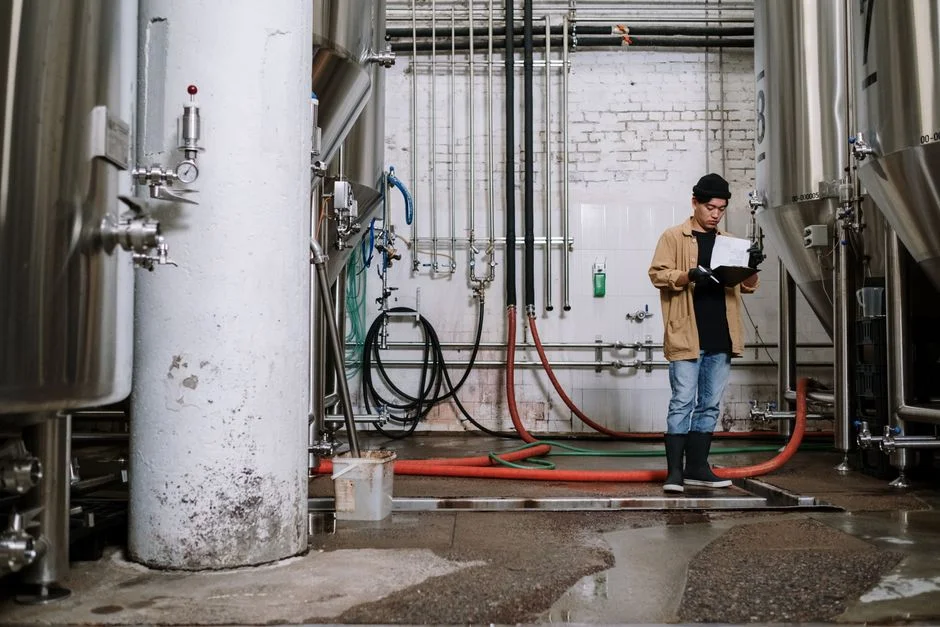
A defensible chemical-plant pretreatment train is a four-stage sequence, and each stage carries a numeric target that ties back to the limits in the first section.
Stage 1 — Flow and pH equalization. An equalization basin sized for 6 to 24 hours of hydraulic retention, with diffused mixing, online pH probes, conductivity probes, and an automatic chemical dosing system for pH adjustment into the 6.5 to 8.5 band, is the first engineered defense against slug loading. The dosing loop is PLC-controlled with feedback from the probes; high-low pH or high-conductivity excursions trip a diversion valve back to a holding basin. Equalization alone routinely smooths a 500–1,500 ppm TSS influent variability down to a steady ±10% feed, which lets downstream units run at their design points.
Stage 2 — Coagulation, flocculation, and dissolved air flotation or lamella clarification. A coagulant dose — typically ferric chloride at 50 to 150 mg/L or alum at 100 to 250 mg/L — is followed by a polymer flocculant at 1 to 5 mg/L, then either a dissolved air flotation system for oil- and FOG-bearing streams or a lamella clarifier for predominantly particulate streams. Micro-bubble flotation or inclined-plate sedimentation achieves 50 to 90% TSS removal and most of the FOG reduction, which brings the 500–1,500 ppm TSS influent down to under 100 ppm at the outlet — well under the 350 ppm cap.
Stage 3 — Biological treatment. When influent BOD runs high (500 to 5,000 mg/L is typical for many chemical process streams) or swings widely, a biological stage is non-negotiable. Three configurations dominate: conventional activated sludge (lower capex, larger footprint, F/M 0.2–0.5 kg BOD/kg MLSS·d), an MBR membrane bioreactor (smaller footprint, better effluent, mixed-liquor suspended solids 8,000–12,000 mg/L, higher opex), or a sequencing batch reactor (SBR) for variable flows. A properly sized biological stage takes BOD from 1,000 to 5,000 ppm down to under 50 ppm, leaving the 300 ppm cap with a 6× safety margin even under shock loading.
Stage 4 — Polishing and disinfection. Multimedia filtration or activated carbon removes residual organics and any chlorine-demand precursors, after which chlorination (with dechlorination if residual TRC must stay low) or UV satisfies the 5 to 15 ppm chlorine requirement ceiling and any downstream bacterial limits. End-of-pipe, the process flow reads: raw wastewater → bar screen → equalization → DAF or lamella → biological → clarifier or MBR → filtration → disinfection → compliance sample point. A plate-and-frame filter press handles the sludge sidestream at 60 to 80% moisture reduction before disposal.
Parameter Table: Matching Each Pollutant Cap to a Unit Operation
The table below is the single reference an engineer can lift into a P&ID or process design basis. The "typical chemical-plant influent" column is drawn from municipal-industrial survey data; the "design target at outlet" column is the number the unit must hit before the next stage to keep the cumulative effluent under the ordinance cap.
| Pollutant | Limit (ppm or unit) | Typical Influent | Recommended Unit Operation | Design Target at Outlet |
|---|---|---|---|---|
| BOD (5-day) | ≤ 300 | 1,000 to 5,000 ppm | Activated sludge, MBR, or SBR | < 50 ppm (6× safety margin) |
| TSS | ≤ 350 | 500 to 1,500 ppm | DAF or lamella clarifier | < 100 ppm (3.5× margin) |
| Chlorine requirement | 5 to 15 ppm | 20 to 60 ppm | Chlorination / dechlorination or UV | ≤ 15 ppm ceiling |
| pH | 6.5 to 8.5 | 2 to 12 (process swings) | Equalization with auto-dosing | 7.0 ± 0.3 |
| Oil & grease | ≤ 100 (typical local cap) | 200 to 1,000 ppm | DAF with polymer | < 25 ppm |
| Temperature | ≤ 104°F (40°C) | Up to 140°F process | Equalization + cooling | < 95°F (35°C) |
For plants pursuing water reuse, an ultrafiltration water treatment system with a 0.03 μm PVDF membrane can polish the secondary effluent further; the membranes tolerate up to 300 ppm turbidity at the inlet and operate chemical-free with automatic backwash cycles, which suits the variable feed that comes off a chemical plant's biological stage.
Slug-Load Control: The Most Common Compliance Failure

Slug loading — defined in the ordinance as any discharge "at a flow rate or pollutant concentration that may interfere with the public sewer or wastewater treatment facilities" (Section 31) — is the single most common cause of categorical permit violations at chemical plants. The triggers are familiar to anyone who has run a batch process: CIP washouts, tank draindowns, batch reactor dumps, and solvent-bearing cleanup water all arrive at the pretreatment headworks in pulses that an unguarded collection system cannot absorb.
The engineered safeguards are a layered set. The equalization basin provides 6 to 24 hours of hydraulic buffering — long enough to absorb an entire shift's worth of batch dumps. Online pH and conductivity meters feed a PLC, which commands a chemical dosing loop and triggers an automatic diversion valve on out-of-band readings. An automatic chemical dosing system with closed-loop feedback keeps the pH in the 6.5 to 8.5 window even when feed chemistry swings. High-high pH, low-low pH, or high-conductivity trips automatically route the offending slug back to a holding basin for re-blending.
These safeguards are also the plant's insurance against forced shutdown. The Superintendent may, after formal notice, "immediately halt or prevent any discharge of pollutants reasonably appearing to present an imminent endangerment" or that "threatens to interfere with operation of the public sewer or wastewater treatment facilities" (Sewer Use Ordinance Article XII Section 3). A working equalization and diversion system is the engineering evidence that no such endangerment is occurring — the difference between a routine inspection and an ex-parte injunctive halt.
Documentation, Sampling, and the 180/90-Day Clock
The ordinance's paperwork is not optional, and the deadlines are short. Within 180 days after the effective date of a categorical pretreatment standard, an existing industrial user must submit a categorical permit application to the KSTD (Article XII Section 5). Within 90 days after the date for final compliance — or, for a new source, after the introduction of wastewater into the public sewer — the user must submit a compliance report stating the nature and concentration of pollutants from each regulated process and the average and maximum daily flow for those process units (Article XII Section 6). A working sampling program is what makes both reports defensible.
Engineer the sampling program as follows: install 24-hour composite samplers on each regulated process wastewater stream, with flow-paced pacing; install a final compliance sampler at the discharge monitoring point; and align all methods to 40 CFR Part 136. Maintain chain of custody from sampler to laboratory, and keep results on a rolling 3-year retention. Quarterly sewer service charges collected by the Town Treasurer (Article XIII Section 4) underwrite the POTW capital and O&M budget; the user's compliance documentation underpins any rate challenge, so the cost of a clean record-keeping system is recovered many times over.
For the text of every deadline and every section referenced above, the controlling document is the Fairfield Sewer Use Ordinance as administered by the KSTD.
Frequently Asked Questions
What are the numeric discharge limits a chemical plant must hit before sewer discharge in Fairfield, Maine?
Under the Sewer Use Ordinance Article VIII Section 3, the local caps are BOD ≤ 300 ppm, TSS ≤ 350 ppm, chlorine requirement 5 to 15 ppm, and temperature ≤ 104°F. Federal categorical pretreatment standards under 40 CFR Part 414, 415, or 417 may impose stricter subpart-specific limits that override the local caps (Sewer Use Ordinance Section 29). The downstream Fairfield-Suisun POTW's NPDES permit adds pH 6.5 to 8.5, total ammonia 2.0 to 4.0 mg/L as N, total recoverable copper 11 to 15 μg/L, and total cyanide 7.4 to 12 μg/L as a binding downstream envelope (NPDES Order R2-2025-0028, Table 2).
How is "slug loading" defined and what unit operations prevent it?
The ordinance defines slug loading in Section 31 as "discharge at a flow rate or pollutant concentration that may interfere with the public sewer or wastewater treatment facilities." The standard engineered safeguards are a 6 to 24-hour equalization basin, online pH and conductivity meters tied to a PLC-controlled diversion valve, and an automatic chemical dosing loop for pH adjustment. The equalization system is both the compliance mechanism and the engineering evidence that protects the plant against the Section 3 halt-and-prevent enforcement clause.
When are the 180-day and 90-day categorical pretreatment deadlines?
Within 180 days after the effective date of an applicable categorical pretreatment standard, an existing industrial user must submit a categorical permit application to the KSTD (Sewer Use Ordinance Article XII Section 5). Within 90 days after the date for final compliance — or after a new source begins discharging — the user must submit a compliance report with pollutant nature, concentration, and average and maximum daily flow for each regulated process (Article XII Section 6). A 24-hour composite sampling program aligned to 40 CFR Part 136 is what makes both reports defensible.