Where the Kilowatts Actually Go in a DAF
The recycle pump dominates the energy balance of any dissolved air flotation (DAF) system, typically drawing 80–90% of total DAF electricity because it must pressurize 10–50% of the treated flow to 3–6 bar. The WesTech reference case for a 40-foot DAF on 1,000 gpm of waste activated sludge (WAS) confirms this distribution: a 55 kW recycle pump, a 5 kW air compressor, and a 1 kW skimmer drive — the pump alone accounts for roughly 90% of connected load (WesTech, Reduce Energy Costs Using DAF for WAS Thickening). Sigma DAF states the same point more bluntly: "The recirculation pump has a higher energy consumption in a DAF system" (Sigma DAF FAQ, S3). If you are chasing dissolved air flotation energy consumption reduction, the pump loop is the only load that matters at scale — skimmers, compressors, and controls together rarely exceed 10–15% of the bill.
The pump kW is set by two physical variables — recycle flow as a fraction of influent flow, and discharge pressure set by the saturator. Sigma DAF specifies the design window as 10–50% recycle at 3–6 bar, with 10–40% the typical operating band (S3). Doubling recycle % at constant pressure roughly doubles pump kW; raising saturator pressure from 4 bar to 6 bar at constant flow increases pump work by about 50%. The remaining DAF auxiliaries are essentially fixed overhead and offer little optimization headroom. For comparison, induced-air flotation (IAF/CAF) avoids the recycle loop entirely, but DAF delivers higher separation efficiency (≈90% TSS, ≥95% FOG) in a smaller footprint — the design trade-off most plants inherited when they specified DAF (Sigma DAF, S3).
| DAF Load Component | Reference Size (WesTech 40-ft unit, 1,000 gpm WAS) | Share of DAF kWh |
|---|---|---|
| Recycle pump | 55 kW | ~90% |
| Air compressor | 5 kW | ~8% |
| Skimmer drive motor | 1 kW | ~2% |
| Total connected | 61 kW | 100% |
The Pressure–Recycle Trade-Off: Finding the Lowest-Energy Operating Point
Air solubility in water follows Henry's law: the higher the saturator pressure, the more air dissolves per unit recycle flow, and the smaller and more numerous the microbubbles released on depressurization. Sigma DAF quantifies the trade-off directly: "The higher the pressure, the greater the solubility of the air and the creation of more abundant and homogeneous microbubbles, which improves the buoyancy of the particles to be separated, but also increases energy consumption proportionally" (Sigma DAF FAQ, S3). The design window is 3–6 bar saturator pressure with 10–40% recycle (S3), producing 50–100 µm microbubbles (S3). The 50–100 µm band is the engineering target — bubbles larger than 100 µm rise too fast and provide little flotation surface, while sub-50 µm bubbles often re-dissolve before contacting solids.
Operators chasing lower DAF kWh per m³ should treat the (pressure, recycle %) pair as a decision matrix, not a single setpoint. A practical worked example: a site running 6 bar at 30% recycle with a 55 kW pump can step down to 4 bar at 20% recycle when influent SS is consistently below ~1,500 mg/L. The hydraulic-power saving follows ΔkW ≈ ρ·g·Q·ΔH/η, where ρ = 1,000 kg/m³, g = 9.81 m/s², η ≈ 0.70 pump+motor efficiency, and Q is the recycle flow. Dropping from 6 bar (≈60 m head) at 30% recycle on a 1,000 gpm (227 m³/h) unit to 4 bar (≈40 m head) at 20% recycle (151 m³/h) cuts hydraulic power from roughly 53 kW to about 24 kW — a 55% reduction in recycle-pump draw, worth approximately $22,000/year at $0.11/kWh and 8,760 operating hours.
| Operating Point | Saturator Pressure | Recycle % | Microbubble Size (S3) | Recycle Pump kW (1,000 gpm unit, η=0.70) | Indicative Use Case |
|---|---|---|---|---|---|
| Low-energy | 3.5 bar | 15% | 70–100 µm | ~14 kW | Low SS (<1,000 mg/L), low FOG |
| Standard | 4.0 bar | 20% | 60–90 µm | ~21 kW | Typical mixed industrial wastewater |
| High-load | 5.0 bar | 30% | 50–80 µm | ~40 kW | High SS or FOG (food, dairy, refinery) |
| Maximum | 6.0 bar | 40% | 50–70 µm | ~64 kW | Peak-load or emulsified oil streams |
Motor and Drive Upgrades: VFDs, IE4/IE5 Motors, and Soft Starters
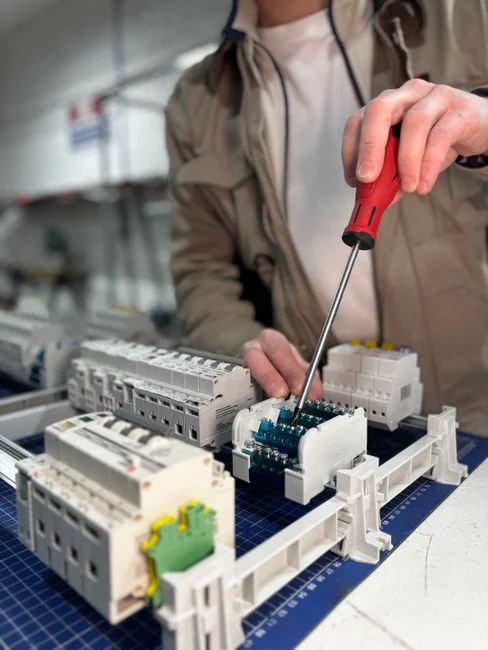
The fastest path to DAF recycle pump kW reduction is a variable-frequency drive (VFD) on the existing motor, ideally paired with an IE4 or IE5 premium-efficiency motor replacement at end-of-life. A VFD lets the pump track influent flow via a 4–20 mA signal from the plant flowmeter, which matters because most DAFs run well below nameplate flow for substantial portions of the day — pump affinity laws say that a 20% flow reduction at constant pressure cuts kW by roughly 50%. The pump itself, the saturator, and the existing fixed-speed motor in the WesTech 55 kW reference case do not change.
Three scenarios for the same 55 kW recycle pump at 0.8 load factor, $0.11/kWh, and 8,760 h/yr:
- Fixed-speed DOL (baseline): 55 × 0.8 × 8,760 × $0.11 ≈ $42,400/year. Annual electricity: ~385,000 kWh.
- VFD retrofit on existing motor: 20–30% kWh reduction → ~$8,500–$12,700/year saved. VFD hardware and install: $15,000–$25,000 for a 55 kW unit. Simple payback: 1.2–3.0 years.
- VFD + IE4/IE5 motor replacement: 25–40% combined kWh reduction → ~$10,600–$17,000/year saved. Combined hardware: $30,000–$50,000. Payback: 1.8–4.7 years — but you also drop motor losses from ~6% (IE2) to ~3% (IE5) and gain a 20-year asset with better thermal margin.
Commissioning sequence: (1) baseline the recycle line with a temporary kWh meter for 7 days at typical duty, (2) specify the VFD for the existing motor's full-load amps with 110% overload, (3) wire a 4–20 mA input from the influent flowmeter and tune the speed setpoint, (4) re-measure kWh for another 7 days. VFDs add 3–5% losses at full speed but recover multiples of that on partial-load recycle operation, which is the normal DAF duty cycle. Soft starters are a cheaper alternative if the flow is essentially constant, but they offer no ongoing energy savings.
Process-Level Savings: DAF as an Energy-Efficient Pre-Thickener
Sometimes the dissolved air flotation OPEX case is won not on the DAF's own pump, but on what the DAF prevents downstream. WesTech modeled a 40-foot DAF thickening WAS from 0.5% (5,000 mg/L) to 4% (40,000 mg/L), cutting digester feed from 1,000 gpm to 125 gpm — an 8× reduction in the flow the digester must heat (WesTech, S5). Mesophilic digesters target 68–108°F with 98°F typical (S5); most US plants see 50–60°F influent, so the digester must supply a 38–48°F temperature rise (S5). The 875 gpm of water no longer heated saves substantial energy: at a 40°F delta-T and the specific heat range of 4.178–4.205 kJ/kg/°C (S5), the avoided heating load is on the order of 8–10 MMBTU/h — translating to roughly $200,000–$300,000/year in avoided natural gas at $3/MMBTU before subtracting digester biological heat recovery.
This is the bigger number for sites already running anaerobic digestion. Sigma DAF puts a 3–4% DM ceiling on DAF-thickened sludge (S3), which is high enough to feed a mesophilic digester directly without intermediate dewatering. The combined OPEX — DAF pump kWh saved by VFD/IE4 plus digester heating saved by pre-thickening — typically beats the pump-only case by 3–5×, which is why the anaerobic digester common problems 2026 field guide treats thickening as the first lever, not the last. A pre-thickening DAF also shrinks the digester footprint or frees volume for higher throughput.
| Pathway | WAS Feed to Digester | Digester DM Feed | Heating Load (ΔT=40°F, S5) | Avoided Gas Cost (@$3/MMBTU) |
|---|---|---|---|---|
| No DAF pre-thickening | 1,000 gpm at 0.5% | ~4,200 lb DM/hr | Baseline | — |
| DAF to 4% DM | 125 gpm at 4% | ~4,200 lb DM/hr | ~88% lower | $200k–$300k/yr |
| DAF + downstream plate and frame filter press to 20–25% DM | 25 gpm at 20% | ~4,200 lb DM/hr | ~97% lower | $220k–$330k/yr |
A 2026 OPEX Worksheet: Estimating Your DAF Energy Bill
Use this five-step worksheet to translate pump nameplate data into 2026 OPEX and to size a VFD/IE4 retrofit. The math is the same regardless of flow class — the DAF line covers 4–300 m³/h, so the same worksheet applies to a 50 m³/h food-processing unit and a 300 m³/h petrochemical unit.
- Get the recycle-pump nameplate kW. From the pump data plate or P&ID. If unknown, estimate as ρ·g·Q_rec·H / (1,000·η), where Q_rec is recycle flow in m³/s, H is pressure head in meters, η ≈ 0.65–0.75.
- Apply a load factor of 0.7–0.9 to reflect real-world duty. Continuous DAF operation rarely runs at nameplate for 8,760 h/yr.
- Multiply by operating hours and tariff: Annual kWh = kW × LF × 8,760 h; Annual $ = kWh × $/kWh. Use 2026 US industrial tariff range $0.10–$0.12/kWh (extended from WesTech's $0.075–$0.29/kWh range, S5).
- Subtract VFD savings: 20–30% reduction is typical on partial-load recycle duty; 25% is a defensible mid-case.
- Compute payback: Payback (years) = VFD retrofit cost ÷ annual $ saved.
Worked example — the WesTech 55 kW reference pump at LF=0.8, $0.11/kWh, 8,760 h/yr: 55 × 0.8 × 8,760 × $0.11 ≈ $42,400/year (≈385,000 kWh). A 25% VFD cut saves ~$10,600/year. Against a $20,000 VFD retrofit (mid-point of $15,000–$25,000 for 55 kW), payback is roughly 1.9 years. The single highest-ROI instrumentation move is a sub-meter on the recycle line — typically $800–$2,000 installed, with a 2-week measurement window that lets you baseline before any capital spend. Pairing the meter with a properly tuned automatic chemical dosing system also prevents over-dosing coagulant, which otherwise inflates sludge mass and indirectly raises pump work.
Frequently Asked Questions
How much electricity does a DAF use per m³?
For a typical 4–300 m³/h HydropureWater DAF system, budget 0.05–0.20 kWh/m³. The recycle pump typically accounts for 80–90% of that figure; a well-tuned 4-bar, 20%-recycle DAF with a VFD on a 100 m³/h unit sits near 0.08 kWh/m³, while a 6-bar, 40%-recycle unit on the same flow runs closer to 0.18 kWh/m³.
What saturator pressure gives the lowest energy use?
4 bar with 15–25% recycle is the common 2026 sweet spot, producing 60–90 µm bubbles adequate for most industrial wastewater (Sigma DAF FAQ, S3). Going to 6 bar roughly doubles pump kW for marginal bubble-quality gains; dropping below 3.5 bar risks incomplete dissolution and unstable TSS removal.
Does a VFD pay back on a DAF recycle pump?
Yes — typically 1.5–2.5 years on a 55 kW pump at 2026 US industrial tariffs of $0.10–$0.12/kWh. The math scales linearly: a 30 kW pump pays back in 2.5–4 years on the same tariff, while a 110 kW pump pays back in under 1.5 years because the VFD hardware cost is sub-linear in motor size.
Can a DAF reduce energy use elsewhere in the plant?
Yes — pre-thickening WAS from 0.5% to 4% cuts mesophilic digester feed by 8×, dropping digester heating load by roughly 4–8× (WesTech, S5). For a 1,000 gpm WAS stream, that is on the order of $200,000–$300,000/year in avoided natural gas at $3/MMBTU, often larger than the DAF's own pump savings.
Is DAF more energy-intensive than IAF or CAF?
Yes, on pumping — DAF pressurizes 10–50% of the flow to 3–6 bar, while induced-air flotation uses no recycle loop. DAF delivers higher separation efficiency (≈90% TSS, ≥95% FOG) in a smaller footprint (Sigma DAF FAQ, S3), so the energy premium is the cost of that higher performance. The trade-off is well documented in the what is a DAF unit for wastewater explainer and the best DAF unit for industrial wastewater 2026 buyer guide.