The Three-Layer Compliance Stack for Agrochemical Discharges
Three regulatory layers sit on top of a fertilizer or pesticide formulating plant near Kenansville, NC before any process wastewater can reach a sewer. The first is the federal definition of pretreatment standards in 40 CFR 403.3(j) — pollutant discharge limits applied to industrial users (IUs) that route wastewater indirectly through a publicly owned treatment works (POTW) — together with the categorical prohibitions in 40 CFR 403.5 against pass-through under 403.3(p) and interference under 403.3(k). A pass-through is any discharge that causes a POTW to violate its own NPDES permit; interference is any discharge that disrupts POTW treatment or sludge processes to the same end.
The second layer is the categorical pretreatment standard. EPA codifies these across 40 CFR Parts 405 through 471, with 40 CFR Part 455 covering fertilizer manufacturing and the agricultural chemicals subcategory. EPA's pretreatment page confirms that categorical standards apply whether or not the receiving POTW has an approved pretreatment program and whether or not the discharger already holds a control mechanism (per HydropureWater's 2026 EPA industrial effluent guide). The standard exists as a national technology-based floor at the IU–POTW connection, expressed as both daily maximum and 30-day average concentration limits and as mass limits per 40 CFR 403.12.
The third layer is site-specific. Under 40 CFR 403.5(c), a POTW must evaluate its own treatment capability and the sensitivity of its receiving water and sludge, then issue numeric or narrative local limits enforceable at the end-of-pipe. In Duplin County, the Town of Kenansville WWTP is the control authority; the North Carolina Department of Environmental Quality (NCDEQ) holds delegation for the broader NPDES program. Local limits are typically stricter than the federal categorical floor, and they are the numbers an engineer has to actually hit. (Source: EPA, Pretreatment Standards and Requirements — Local Limits, npdes/pretreatment-standards-and-requirements-local-limits.)
Which EPA Category Applies to a Kenansville Agrochemical Plant
40 CFR Part 455 is split into four production-based subcategories, and picking the wrong one is the single most common mistake engineers make when they copy a generic pretreatment table from a metal-finishing or food-sector source. Each subcategory has its own pretreatment standards for existing sources (PSES) and for new sources (PSNS), with Best Available Technology Economically Achievable (BAT) governing PSES for toxic and non-conventional pollutants. A fertilizer blender that also formulates pesticides can trigger two subcategories on one site.
Confirming the subcategory requires three working documents: the SIC/NAICS code on file with the control authority, the raw-material list (phosphate rock, ammonia, urea, sulfuric acid, solvents, and the specific active ingredients being formulated), and the production basis in units the permit uses (kg of product, kg of active ingredient, or kg of feedstock). EPA's category index, updated March 11, 2026, records different substantive-revision years for each industrial category — 2025 for Meat and Poultry Products, 2026 for Steam Electric Power Generating — so a calendar year is a signal to read the rule, not a guarantee of changed values for Part 455 (per HydropureWater's 2026 EPA industrial effluent guide). The category index is a screening tool, not a permit.
| Part 455 Subcategory | Typical Operation Near Kenansville | Standard Type | Key Production Basis |
|---|---|---|---|
| Phosphate Fertilizers | Granulation, ammoniation, acidulation with phosphate rock | PSES / PSNS | kg P₂O₅ product |
| Nitrogen Fertilizers | Ammonia, urea, ammonium nitrate production and blending | PSES / PSNS | kg N product |
| Mixed Fertilizers | Bulk blending of N, P, K and micronutrients | PSES / PSNS | kg blended product |
| Agricultural Chemicals (Pesticide Formulating) | Wettable powders, emulsifiable concentrates, suspension concentrates | PSES / PSNS | kg active ingredient formulated |
Pollutants of Concern in Agricultural Chemical Process Wastewater
Generic screening tables published elsewhere are built for metal finishing and food processing, so they under-represent the parameters that drive compliance at an agrochemical site. EPA's local-limit development framework identifies the pollutant families that any POTW must consider when designing its local limits: conventional (BOD₅, TSS, oil & grease, pH), non-conventional (COD, ammonia, total phosphorus, fluoride, residual chlorine, total residual oxidants), and toxic (priority pollutant metals, cyanide, sulfides, and active ingredients from pesticide formulating). For a fertilizer or pesticide formulating plant, fluoride, ammonia, and pesticide active ingredients are the parameters most likely to exceed local limits and trigger pass-through or interference findings (per EPA, Local Limits Development Guidance).
The influent chemistry is the second driver. Phosphate fertilizer production generates a stream high in fluoride from acidulation of phosphate rock, with a concurrent fluoride-bearing scrubber blowdown stream that is hard to blend into a single equalization basin. Nitrogen fertilizer streams carry high ammonia nitrogen from neutralized ammonium nitrate and urea solutions. Pesticide formulating lines add organic solvent load, suspended wettable powders, and low-concentration active ingredients that have to be tracked on a mass basis because they are regulated at microgram-per-liter levels in the receiving stream. Metals — particularly As, Cd, Cr, Pb, Hg, Se, and Zn — are typically introduced through trace contaminants in phosphate rock and through raw-material catalysts rather than through process chemistry, but they remain on the categorical list and on local-limit tables.
Concentration and mass are tracked separately. A plant can meet a 30-day average concentration while exceeding the mass cap by underreporting flow at a batch discharge. Categorical standards under 40 CFR Part 455 use both forms; the permit specifies which is binding on a given day.
| Parameter | Source in Agrochemical Wastewater | Why It Drives Local-Limit Risk | Typical Treatment Target |
|---|---|---|---|
| Fluoride | Phosphate rock acidulation, scrubber blowdown | Pass-through to receiving stream; toxicity to aquatic life | Precipitation to < local limit (often 10–30 mg/L) |
| Ammonia (as N) | Ammonium nitrate, urea, neutralization skids | Interference with biological treatment; oxygen demand | Nitrification/denitrification or breakpoint chlorination |
| COD / BOD₅ | Organic solvents, pesticide carriers, CIP | POTW oxygen demand and biomass loading | MBR effluent typically 30–60 mg/L COD (HydropureWater field data, 2026) |
| Total Phosphorus | Phosphate fertilizers, process water | Receiving-water eutrophication | Chemical precipitation to < 1 mg/L |
| Pesticide AIs | Formulating equipment wash, batch losses | Toxicity to aquatic life; bioaccumulation | Adsorption, advanced oxidation, source control |
| Metals (As, Cd, Cr, Pb, Hg, Se, Zn) | Phosphate rock trace content, catalysts | Toxic pollutants under 40 CFR 403 Appendix A | Hydroxide or sulfide precipitation |
| pH, Oil & Grease, TSS | Process water, CIP, fugitive dust | Standard POTW protection parameters | pH 6–9, FOG < 100 mg/L, TSS < permit value |
Designing the Treatment Train to Hit the Local-Limit Numbers
The treatment train has to be designed around the hardest parameter, not the average parameter. For most Kenansville-area agrochemical sites that means fluoride, ammonia, and total phosphorus are the binding constraints, and the train is sequenced to remove them in the right order.
- Flow and load equalization. Batch discharges from formulating equipment, CIP skids, and tank-flush events routinely swing pH and COD by an order of magnitude. A two-basin equalization system with at least 24 hours of hydraulic residence time damps the peaks so downstream chemistry and biology can run steady. Without equalization, pH excursion from a neutralization skid failure will blow through the whole train and trip an exceedance at the discharge manhole.
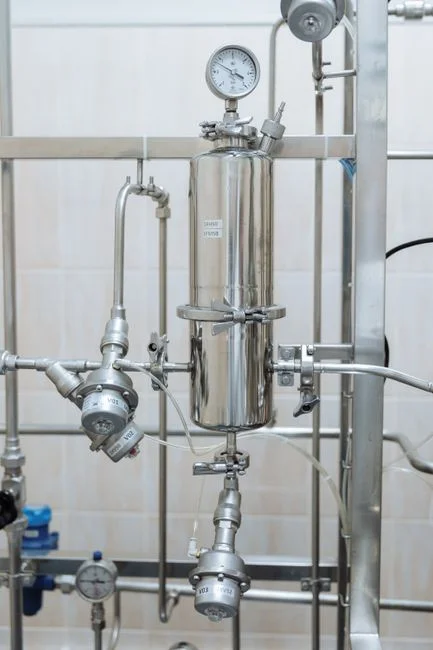
- pH adjustment and fluoride precipitation. Lime or calcium chloride is dosed to raise pH into the 8–9 range and precipitate calcium fluoride. Residence time of 30–60 minutes in a stirred reactor is typical; a lamella or plate separator follows to pull the precipitate before it carries into the biological stage. Fluoride is removed at this point so the downstream biomass is not exposed to inhibitory concentrations.
- Dissolved air flotation primary stage. A high-rate DAF system takes out suspended solids, oils, and floated carryover from the fluoride precipitation stage. HydropureWater field data for this configuration reports 4–6 $·m⁻³ OPEX and a capacity envelope of 4–300 m³/h, which is a useful preliminary sizing band for an agrochemical site at this scale (per HydropureWater's 2026 EPA industrial effluent guide).
- Biological reduction. An integrated MBR system handles the residual COD and ammonia. Field data on the MBR configuration report effluent COD in the 30–60 mg/L range with a footprint roughly 60% smaller than conventional activated sludge (CAS), which matters where the plant is land-constrained inside an existing agrochemical complex (per HydropureWater's 2026 EPA industrial effluent guide). Where ammonia targets are below 5 mg/L, biological nitrification–denitrification is built into the MBR aeration cycle rather than added as a tertiary step.
- Nutrient polishing and UF barrier. Total phosphorus is reduced by chemical precipitation with alum or ferric chloride; breakpoint chlorination or biological denitrification handles residual ammonia. A 0.03 μm hollow-fiber ultrafiltration stage acts as the final barrier for residual TSS and bound active ingredients, and it positions the plant for potential reuse if the permit allows.
- PLC-controlled chemical dosing. An PLC-controlled chemical dosing skid ties coagulant, flocculant, and pH trim dosing to inline pH and flow meters, with interlocks to the equalization basin and the slug-control diversion. The dosing logic is the part of the system that prevents the train from running open-loop during a batch event. Where coagulant carryover is an issue, the PAM dosing system troubleshooting guide covers the failure modes that drive most field exceedances.
Sampling, Self-Monitoring, and POTW Reporting Duties

Self-monitoring under 40 CFR 403.12 is the part of the program most plants under-resource, and the part the control authority uses to revoke an industrial user permit. A new or substantially changed industrial user files a baseline monitoring report (BMR) before discharge begins, and a 90-day compliance report after the categorical limit's effective date, with subsequent reports on a schedule set by the control authority. Monitoring must report both daily maximum and 30-day average values, and for categorical standards with a mass basis the report must also show the mass loading in kg per 1,000 kg of product (per HydropureWater's 2026 EPA industrial effluent guide).
A 24-hour flow-paced composite sampler at the discharge manhole is the minimum defensible installation; for batch operations, the sampler should be triggered to start on the first flow signal and continue for the full batch event so the composite is not biased toward the dilution water. Monitoring waivers — which remove parameters from the routine report — are not granted on request. The control authority expects at least 6 months of 95th-percentile data, a documented surrogate relationship, and a record of routine calibration before a waiver is approved (per HydropureWater's 2026 EPA industrial effluent guide).
Slug-Control BMPs and What Happens When a Batch Goes Wrong
40 CFR 403.5(b) defines a slug load as any discharge of a non-routine, episodic nature, including an accidental spill or a noncustomary batch discharge, that has a reasonable potential to cause interference or pass-through. The regulation places an immediate notification duty on the industrial user; the call to the POTW has to go out within the time frame set by the control authority's slug-control BMP, which is normally 24 hours or less.
The three most common slug scenarios at agrochemical sites are a spill of concentrated active ingredient during a formulating batch, a hot clean-in-place (CIP) discharge that overwhelms the equalization basin, and a pH excursion from a neutralization skid failure. The defense is equalization tank sizing that holds at least one full batch volume, an automatic diversion valve to a holding basin triggered by inline pH and conductivity limits, and a hardwired interlock between the PLC-controlled chemical dosing skid and the diversion valve so a chemistry failure cannot ship downstream unnoticed. The slug-control BMP is filed with the control authority, and a working BMP is the single biggest variable in whether an excursion becomes a permit violation or a closed-out incident report.
Cost, Footprint, and 10-Year NPV Considerations
CAPEX decisions in pretreatment are usually framed around a single compliance sample, and that approach systematically undersizes the equalization basin and the biological stage. A 10-year net present value (NPV) comparison captures the difference between an activated-sludge basin and an MBR when the MBR's 60% smaller footprint frees real estate for production, and when the MBR's tighter effluent opens up a reuse credit on the water side (per HydropureWater's 2026 EPA industrial effluent guide). The two configurations should be compared on the same flow profile and the same discharge route, not on a single effluent grab.
| Decision Variable | Conventional Activated Sludge (CAS) | Integrated MBR | Implication for 10-Year NPV |
|---|---|---|---|
| Footprint | Larger aeration basin + clarifier | ~60% smaller (HydropureWater field data, 2026) | MBR frees land for production |
| Effluent COD | Often > 80 mg/L without polishing | 30–60 mg/L (HydropureWater field data, 2026) | MBR removes one tertiary stage |
| Sludge handling | Waste activated sludge, lower solids | Higher MLSS, smaller wasted volume | Plate and frame filter press dewater to ~35% solids (HydropureWater field data, 2026) |
| Reuse potential | Limited | Suitable for reuse (HydropureWater field data, 2026) | Reuse credit offsets higher CAPEX |
Solids handling closes the loop. The hydroxide sludge from fluoride precipitation and the waste activated sludge from the biological stage are dewatered on a plate and frame filter press, which field data reports dewatering to roughly 35% solids and cutting haul-away volume by about 28% (per HydropureWater's 2026 EPA industrial effluent guide). Disposal routing for the cake goes to the NCDEQ-permitted subtitle D facility rather than the POTW's sludge line.
Frequently Asked Questions
Do I still need categorical pretreatment if my local POTW has no approved program?
Yes. EPA's pretreatment program applies categorical standards whether or not the receiving POTW has an approved pretreatment program and whether or not the discharger holds an existing control mechanism (per HydropureWater's 2026 EPA industrial effluent guide). Where the POTW has no approved program, NCDEQ acts as the control authority and the categorical standard is enforced directly. A sewer connection does not remove federal obligations.
How are local limits developed and reviewed?
Under 40 CFR 403.5(c), the POTW evaluates its own treatment capability, sludge quality, and the sensitivity of the receiving water, then issues numeric or narrative local limits that apply at the end-of-pipe. EPA's local-limit development guidance covers the technical basis — maximum allowable headworks loadings, pollutants of concern, and annual review with periodic reevaluation — and the POTW is required to redo the analysis when a new industrial user or a new pollutant changes the headworks picture.
What is the difference between a daily maximum and a 30-day average?
A daily maximum is the highest single value permitted on any one day, while a 30-day average is the arithmetic mean across a continuous 30-day period. A plant can pass a 30-day average and still violate a daily maximum on a single batch, or hit a daily maximum while staying below the monthly cap through dilution (per HydropureWater's 2026 EPA industrial effluent guide). Both numbers are binding, and the permit specifies which is the enforcement point on a given day.
Can a process change trigger a new categorical standard?
Yes. The categorical standard is anchored to the subcategory and the production basis, and a change in raw material, product mix, or production rate can move the facility into a different subcategory or change which BAT/PSES/PSNS set applies. The control authority should be notified before the change is implemented, and the permit reissued with the new standards and a new BMR cycle.
How does a variance work for categorical pretreatment?
A variance is a regulatory action, not a design assumption. The control authority may grant one when the facility demonstrates that it differs materially from the assumptions behind the standard, with technical justification, supporting monitoring, and a defined compliance path (per HydropureWater's 2026 EPA industrial effluent guide). The treatment system should be designed to meet the applicable limit while the variance is under review; designing to a variance that has not been granted is a permit-violation risk.