
Why Taipei Hotels Default to Packaged MBR in 2026
Taipei hotel sites in 2026 default to packaged MBR because three site-specific constraints converge on a single technology choice: basement or podium plant rooms of 80-120 m², weekend occupancy swings of 50-95% that punish fixed-volume basins, and the Taipei City Department of Environmental Protection's local threshold of COD <80 mg/L for new hospitality or mixed-use developments, which sits 20% below the national <100 mg/L ceiling. A packaged submerged membrane bioreactor eliminates the secondary clarifier, produces <1 mg/L TSS and <5 mg/L BOD routinely, and fits roughly 60% less plant-room area than a conventional activated sludge layout (per HydropureWater Taiwan field data, 2025). The reference benchmark is a 200-bed 5-star hotel running 250 m³/day on hollow-fiber MBR since startup, with treated water cleared for non-potable reuse (per Imemflo). For a 200-key Taipei property on a tight footprint with strict local discharge limits, MBR is no longer an option to evaluate — it is the engineering default.
Step 1: Size the Plant from Room Count, Not Gut Feel
Size the STP from the room count using a per-guest water budget, then apply a peaking factor that reflects Taiwan's hospitality demand curve. A full-service Taipei hotel runs 200-300 L per guest per day (covering guest rooms, F&B, laundry, and back-of-house); economy and business hotels trend 150-200 L; luxury 5-star sites with spa, banquet, and conferencing can exceed 350 L. Taiwanese hotels run near-full on weekends and event nights and drop sharply midweek, so apply a peaking factor of 1.3-1.5 over average flow. MBR hydraulic retention time of 4-8 h needs that buffer to avoid membrane trans-membrane pressure spikes during peak loading.
Worked example: 200 keys × 0.9 occupancy × 250 L = 45 m³/d average; × 1.4 peaking = ~63 m³/d design flow; round up to a standard 75 m³/d packaged skid, the smallest commercially available containerized MBR unit. Confirm influent loading against design inputs: hotel wastewater typically runs BOD 200-400 mg/L, COD 400-700 mg/L, TSS 150-300 mg/L, and FOG 50-100 mg/L. If FOG exceeds 100 mg/L, a DAF or grease trap upstream is mandatory. Taiwan's subtropical wastewater temperature of 25-35°C increases membrane flux but demands precise DO control to prevent sludge bulking — bake 32°C into the aeration design.
| Hotel Tier | Water Use (L/guest/day) | 200-Key Avg Flow @ 90% Occ. | Peaked Flow (×1.4) | Recommended Packaged MBR Skid |
|---|---|---|---|---|
| Economy / Business | 150-200 | 27-36 m³/d | 38-50 m³/d | 50-75 m³/d containerized |
| Full-service (3-4 star) | 200-300 | 36-54 m³/d | 50-75 m³/d | 75-100 m³/d containerized |
| Luxury 5-star with spa/banquet | 300-350+ | 54-63 m³/d | 75-88 m³/d | 100 m³/d dual skid or 125 m³/d |
Step 2: Pick the Membrane Geometry — Hollow Fiber vs Flat Sheet
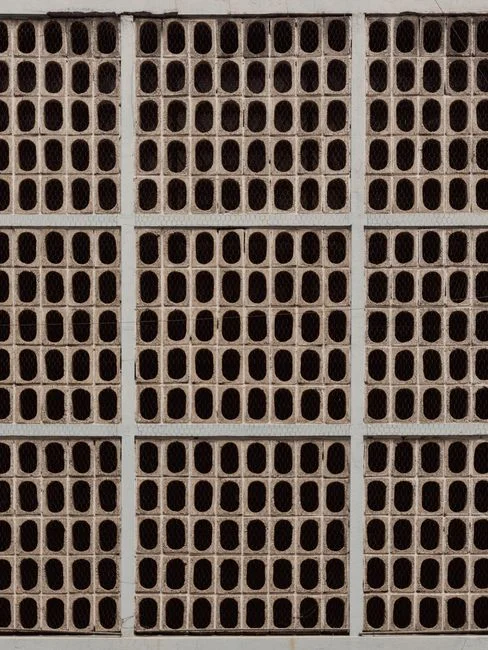
Choose between hollow-fiber and flat-sheet PVDF MBR based on operator skill level, midweek loading patterns, and warranty structure. Hollow-fiber MBR offers higher packing density and lower CAPEX at small flows (50-250 m³/d); the Imemflo reference installation is a 250 m³/d hollow-fiber unit running in a 5-star hotel. Hollow-fiber bundles can break if scouring aeration is uneven, and fiber sloughing forces a full module replacement at end of life. Flat-sheet MBR (DF series) uses 0.1 μm PVDF plates in stainless frames, tolerates thicker sludge at MLSS up to 12,000 mg/L, and cleans in place roughly once every six months on average (per Smith & Loveless TITAN MBR data). Flat-sheet elements are individually replaceable, which protects the operator from a 5-8 year full-module swap-out.
For Taipei hotels, prefer flat-sheet PVDF when the site has long periods of low loading (midweek) where bundled fibers risk fouling, when the operator is non-specialist, or when the hotel wants 5+ year warranty with element-level replacement. Both types use 0.1-0.4 μm PVDF ultrafiltration, so the decision is operational, not effluent-quality.
| Parameter | Hollow-Fiber MBR | Flat-Sheet MBR (DF Series) |
|---|---|---|
| Pore size | 0.1-0.4 μm PVDF | 0.1-0.4 μm PVDF |
| MLSS tolerance | 8,000-10,000 mg/L | Up to 12,000 mg/L |
| Cleaning interval | CIP every 2-3 months | CIP every ~6 months on average |
| Element-level replacement | No (full module swap) | Yes (plate-by-plate) |
| Best fit for Taipei hotel | 50-250 m³/d, specialist operator | Midweek low-load, non-specialist operator, 5+ year warranty |
Review a DF-series flat-sheet PVDF membrane module for the configuration referenced above.
Step 3: Match the Process to Taipei Discharge and Reuse Goals
Map each biological process to Taipei's discharge thresholds and the hotel's reuse economics before committing CAPEX. MBR delivers 90-95% contaminant removal and produces a clear, low-TSS effluent (per Imemflo) suitable for direct toilet-flushing or landscape irrigation without tertiary polishing. SBR is cheaper on CAPEX but needs a downstream sand filter and cannot reach reuse-grade TSS without it, eroding the footprint advantage. MBBR is robust against toxic shock, but its effluent typically requires sand filtration + UF before reuse, adding two stages inside a Taipei plant room that has no spare metres. Conventional activated sludge (CAS) at 200-500 m³/d hotel scale needs roughly 3× the footprint of MBR, a separate clarifier, and a sand filter for reuse — rarely cost-effective in Taipei.
If the hotel has a large laundry (linen service for more than 300 keys), many operators install a separate greywater treatment plant plus an oil/grease interceptor on kitchen lines (per Imemflo) to protect the main MBR from FOG and lint shocks. Where water tariff is a concern — Taipei commercial water is in the NT$ 15-30/m³ range — MBR is the right default because its effluent already meets CNS 12548 reuse criteria (SDI <3, turbidity <1 NTU), feeding non-potable reuse with no extra polishing stage. For the typical 250 m³/d hotel, prioritizing MBR over SBR/MBBR/CAS recovers the CAPEX premium in 3-5 years through avoided water purchase.
| Criterion | MBR | SBR | MBBR | CAS (Conventional ASP) |
|---|---|---|---|---|
| Footprint vs MBR | 1× (baseline) | ~1.2× | ~1.1× | ~3× |
| Effluent TSS | <1 mg/L | 10-20 mg/L (needs sand filter) | 15-30 mg/L (needs sand + UF) | 15-30 mg/L (needs clarifier + filter) |
| Reuse-ready (CNS 12548) | Yes, direct | No without tertiary | No without tertiary | No without tertiary |
| Operator skill required | Low-medium | Medium-high | Low-medium | High |
| Best Taipei hotel fit | Constrained basement + reuse | Low budget, no reuse target | Toxic-shock tolerance, no reuse | Land-rich, no reuse target |
A packaged PVDF MBR system for hotel-scale flows typically satisfies all four criteria above in a single containerized skid.
Step 4: Verify Taiwan EPA and Taipei Permitting in the Spec Sheet
Confirm in the bid spec — not in a sales call — that the packaged MBR clears both national and local discharge limits. Taiwan EPA's 2025 industrial discharge standard sets COD <100 mg/L, NH3-N <10 mg/L, and TSS <30 mg/L; MBR routinely beats all three. Taipei City local ordinances often tighten COD to <80 mg/L for new hospitality or mixed-use developments. Verify the stricter number with the Taipei City Department of Environmental Protection before locking the spec, and bake that limit into the bid documents.
Plants treating more than 1,000 CMD trigger Environmental Impact Assessment; most Taipei hotels fall under this, so confirm the MBR vendor supplies membrane integrity test protocols and biological stability data to shorten the EIA from the typical 3-6 month window. Document the anoxic + aerobic + MBR tank configuration with HRT 4-8 h and SRT 15-30 days (per HydropureWater Taiwan engineering data) so the regulator can sign off on nitrification performance, not just TSS removal. Confirm the spec quotes sludge yield of 0.2-0.4 kg TSS per kg BOD removed so the downstream dewatering sizing and disposal cost are realistic. For sludge handling, a sludge dewatering filter press sized to the predicted wet-tonnage keeps disposal within budget.
Step 5: Read the Cost and ROI Like a Procurement Manager
Translate the technical spec into a defensible NT$ budget. CAPEX benchmark 2025-2026 (per HydropureWater Taiwan data): NT$ 1.2M for 10 m³/day, NT$ 2.5-4M for 100 m³/day, NT$ 8.5M for 500 m³/day. Packaged or containerized units run 40-60% higher than CAS but recover the gap on footprint and reuse. Membrane modules are roughly 40% of CAPEX; replacement every 5-8 years runs NT$ 200-400/m², so ask the vendor to disclose total membrane area on the data sheet so the 5-year reserve is auditable.
OPEX is NT$ 0.8-1.5 per m³ treated; energy is ~50% of the monthly bill (blowers for aeration and membrane scouring). A 250 m³/d Taipei hotel therefore spends NT$ 60,000-110,000/month on power alone. Reuse ROI: at NT$ 15-30/m³ avoided water purchase, a 250 m³/d hotel reusing 50-70% of effluent saves NT$ 0.7-1.6M/year and pays back the MBR premium in 3-5 years. Explore Taiwan EPA subsidies covering up to 30% of water-reuse CAPEX and green loans at 2-3% to shorten the payback. Grease, FOG, and lint removal upstream via a packaged DAF for kitchen FOG and hotel greywater protects the membrane and keeps the OPEX forecast honest — a fouled membrane cuts flux and roughly doubles energy draw.
| Capacity | CAPEX (NT$) | 5-yr Membrane Reserve (NT$) | OPEX (NT$/m³) | Payback vs CAS (with 60% reuse) |
|---|---|---|---|---|
| 10 m³/d | ~1.2M | 0.1-0.2M | 1.2-1.5 | 4-6 years |
| 75-100 m³/d | 2.5-4M | 0.6-1.0M | 0.9-1.3 | 3-5 years |
| 250 m³/d | 5-6.5M | 1.2-1.8M | 0.8-1.1 | 3-4 years |
| 500 m³/d | ~8.5M | 2.0-3.0M | 0.8-1.0 | 3-4 years |
For broader context on the Taiwanese cost structure, the HydropureWater Taiwan MBR engineering guide covers the same CAPEX/OPEX model in industrial detail.
Step 6: Run a Taipei-Specific Supplier Vetting Checklist
Convert the earlier recommendations into a scorecard the procurement team can put in front of vendors. Score each "yes" as 1 point; reject any vendor scoring below 4. Does the vendor have a Taiwan-based technical team that can reach Taipei within 24 hours? Membrane fouling events are time-critical and a remote-only support model fails the first fouling incident. Is the warranty 5+ years on the membrane modules, and is the warranty differentiated by material (PVDF vs PTFE)? Can the vendor show a Taiwanese reference list hitting Taiwan EPA 2025 and Taipei's local COD <80 mg/L — not just generic global hotel installations?
What is the full-system kWh/m³ rating at design flow? Anything above ~1.2 kWh/m³ for a hotel MBR suggests oversized blowers or a membrane geometry mismatch. Is the unit delivered as a 20- or 40-foot ISO container pre-plumbed and pre-wired (S&L TITAN MBR QUBE-style) to minimize on-site civil work and basement crane time in Taipei? Is element-level membrane replacement supported, or does the operator have to swap the whole module at 5-8 year end-of-life? A vendor answering "no" to the last two questions should not be on a Taipei shortlist.
| Vetting Criterion | Pass Threshold | Reject If |
|---|---|---|
| Taipei-area service response | ≤24 h on-site | Remote-only or overseas dispatch |
| Membrane warranty | 5+ years (PVDF) | <3 years or undifferentiated |
| Local reference at COD <80 mg/L | ≥1 Taiwanese site | Generic global only |
| Specific energy at design flow | ≤1.2 kWh/m³ | >1.5 kWh/m³ |
| Containerized delivery | 20- or 40-ft ISO pre-plumbed | Field-assembled only |
| Element-level membrane replacement | Yes (plate-by-plate) | Full module swap mandatory |
For comparison with similar hospitality projects in other dense-Asian urban markets, see the parallel hotel MBR buying guide for Colombo.
Frequently Asked Questions
How do I size a packaged MBR STP for a 200-room Taipei hotel?
Use 200-300 L per guest per day for a full-service hotel, apply 0.9 average occupancy, and multiply by a peaking factor of 1.3-1.5. For 200 keys, that yields ~63 m³/d design flow, which rounds up to a standard 75 m³/d packaged skid — the smallest commercially available containerized MBR unit.
Is MBR or SBR better for a hotel with a reuse target?
MBR is the correct choice when reuse is a goal. MBR produces <1 mg/L TSS and <5 mg/L BOD, meeting CNS 12548 reuse criteria (SDI <3, turbidity <1 NTU) directly. SBR needs a downstream sand filter to reach the same TSS band, adding footprint and CAPEX that defeat the SBR cost advantage in a Taipei basement plant room.
What are the Taiwan EPA and Taipei discharge limits for a hotel STP in 2026?
Taiwan EPA 2025 industrial discharge limits are COD <100 mg/L, NH3-N <10 mg/L, and TSS <30 mg/L. Taipei City local ordinances often tighten COD to <80 mg/L for new hospitality or mixed-use developments — confirm the local threshold with the Taipei City Department of Environmental Protection before locking the bid spec.
What is the typical CAPEX for a packaged MBR STP in Taipei?
2025-2026 benchmarks (per HydropureWater Taiwan data): NT$ 1.2M for 10 m³/day, NT$ 2.5-4M for 100 m³/day, and NT$ 8.5M for 500 m³/day. Packaged MBR runs 40-60% above CAS but recovers the premium in 3-5 years through footprint savings and reuse offset at NT$ 15-30/m³ avoided water purchase.
How long do MBR membranes last, and what is the replacement cost?
PVDF MBR membranes in a hotel duty cycle last 5-8 years before replacement. Replacement cost runs NT$ 200-400/m², and membrane modules are roughly 40% of total CAPEX. Ask the vendor to disclose total membrane area on the data sheet so the 5-year reserve is auditable.
What ROI can a Taipei hotel expect from MBR water reuse?
A 250 m³/d hotel reusing 50-70% of MBR effluent at NT$ 15-30/m³ avoids NT$ 0.7-1.6M/year in water purchase, paying back the MBR CAPEX premium over CAS in 3-5 years. Taiwan EPA subsidies covering up to 30% of water-reuse CAPEX and green loans at 2-3% can shorten that further. For an EU comparison benchmark, the Madrid hotel MBR selection guide uses the same reuse-offset methodology.