
Why a Packaged MBR Fits a Kaohsiung Hotel
A packaged MBR combines anoxic and aerobic activated sludge with submerged ultrafiltration membranes (0.03–0.1 µm pore size) in a factory-built skid or container, eliminating the secondary clarifier and cutting the reactor footprint by roughly 60% versus a conventional activated-sludge plant of equal capacity (per HydropureWater MBR spec, 2026). For a 200-key full-service hotel the Imemflo reference plant delivers 90–95% removal of BOD, COD, TSS, and pathogens, producing reuse-grade water that offsets NTD 12–18 of municipal tariff per cubic metre at current Kaohsiung rates (Imemflo hotel reference). Four MBR attributes align with Kaohsiung hotel site constraints: small footprint suited to basement or service-yard retrofits, high effluent quality that supports on-site reuse, >99.9% pathogen and coliform removal that satisfies KHB discharge limits, and tolerance of the variable occupancy loads typical of a 100–400-key property.
Two Kaohsiung-specific risks must be designed into the package. Chloride-rich coastal subsoil along the Lingang, Qianzhen, and Cijin corridors corrodes buried carbon steel within 5–7 years; specify FRP or 316L stainless tanks and avoid carbon-steel pipework in the biological and sludge zones. Typhoon-season peak flows (May–October) can hit 2× the daily average within hours, so the equalisation basin and MBR hydraulic train must be rated for the peak factor, not the daily mean. A properly specced packaged MBR system for hotels addresses both risks at the design stage, before they become operating penalties.
Sizing the Plant: From Room Count to m³/day
The anchor benchmark for hotel MBR sizing in 2026 is the Imemflo 200-bed five-star hotel reference plant at 250 m³/d, which works out to 1.25 m³ per available key per day (Imemflo hotel reference, 2026). That single number scales to most Kaohsiung projects once property type is layered on top: budget and limited-service hotels run 0.6–0.8 m³/key, business and mid-scale hotels run 0.9–1.1 m³/key, and five-star or resort properties with full F&B, spa, and laundry run 1.3–1.6 m³/key. The deltas capture kitchen FOG, laundry greywater, and pool backwash that a budget hotel simply does not generate.
Daily average is not the hydraulic design number. Hotel wastewater is sharply diurnal — morning checkout showers overlap with breakfast-service pot-wash and laundry start-up, producing peak flows 1.5–2.0× the daily mean within 90-minute windows. Apply a peak factor of 1.8 for business hotels and 1.5 for resort properties with distributed pool and spa use. The worked example: 150-key business hotel × 1.0 m³/key = 150 m³/d average; ×1.8 peak factor = 270 m³/d hydraulic design flow. Size the equalisation tank for at least 4 hours of peak flow (≥45 m³ in this case) so the MBR sees a dampened, near-constant feed.
| Property type | m³ per key per day | Peak factor | 100-key example (m³/d design) |
|---|---|---|---|
| Budget / limited-service | 0.6–0.8 | 1.5–1.7 | 90–136 |
| Business / midscale | 0.9–1.1 | 1.7–1.9 | 153–209 |
| Resort / 5-star with spa & laundry | 1.3–1.6 | 1.4–1.6 | 182–256 |
For overseas vendor communication, convert to imperial units using IDA factors: 1 MGD = 3,785 m³/d and 1 MIGD = 4,546 m³/d (IDA Water Security Handbook 2020–2021). The 150-key example above is 0.04 MGD or 0.033 MIGD, the unit range most European and Japanese MBR suppliers quote on data sheets.
Taiwan EPA Effluent Standards and Kaohsiung Permit Reality
Hotel-scale packaged MBRs discharging to the KHB sewer must meet Taiwan EPA effluent targets of BOD ≤30 mg/L, COD ≤100 mg/L, TSS ≤30 mg/L, NH₃-N ≤10 mg/L, and fecal coliform ≤200 CFU/100 mL (per Taiwan EPA effluent schedule, 2026). Submerged MBR with PVDF membranes meets all five parameters directly from the membrane tank without tertiary polishing, which is one of the technology's strongest commercial arguments over SBR or MBBR.
If the hotel plans on-site reuse for landscape irrigation, toilet flushing, or cooling-tower make-up, the targets tighten: TSS typically ≤5 mg/L and turbidity ≤2 NTU. Submerged MBR achieves both directly; a basic SBR would need a downstream sand filter and UV unit to reach the same bar, adding footprint, capex, and another failure point. Confirm the discharge mode with the Kaohsiung Environmental Protection Bureau (KHB) at pre-consultation — connection to the municipal sewer is faster to permit but eliminates the reuse-ROI case; direct discharge to a receiving water body requires a separate KHB permit and a more rigorous effluent schedule. The documentation bidders must supply: design flow, peak factor, influent characterisation, MBR membrane specifications (PVDF, pore size, surface area per cassette), and projected effluent quality at year 1 and year 5.
Hollow-Fiber vs Flat-Sheet MBR: Which Suits a Hotel?
The hollow-fiber (HF) and flat-sheet (FS) formats both meet the same effluent spec; the choice is driven by FOG tolerance, footprint, and operator skill. HF MBR delivers higher packing density and lower membrane cost per m², making it the default for urban business hotels under footprint pressure. Specified brands include Mitsubishi, Suez/Zenon, and DuPont. FS MBR tolerates higher FOG, lint, and hair — the typical influent signature of resort laundry and spa backwash — and cleans more easily via integrated aeration scouring; Toray is the dominant flat-sheet brand (Imemflo, 2026). The HydropureWater DF series flat-sheet module uses 0.1 µm PVDF in 80–225 m² configurations, delivering 32–135 m³/d per cassette.
| Parameter | Hollow-fiber (HF) MBR | Flat-sheet (FS) MBR |
|---|---|---|
| Membrane material | PVDF, 0.03–0.04 µm | PVDF, 0.1 µm |
| Footprint per m³/d | 0.04–0.06 m² | 0.06–0.09 m² |
| FOG tolerance (no DAF) | <30 mg/L | <50 mg/L |
| Cleaning method | Backflush + CIP | Aeration scour + CIP |
| Membrane replacement cycle | 5–7 years | 6–8 years |
| CAPEX per m² membrane | Lower (~NTD 6,000–9,000) | Higher (~NTD 9,000–14,000) |
| Specs drawn from HydropureWater DF series FS module and HF benchmarks (2026) | ||
Decision rule: choose HF when footprint and CAPEX dominate and kitchen FOG is managed upstream by a grease interceptor; choose FS when the influent carries >50 mg/L FOG, the property has on-site laundry, or the hotel engineering team has limited membrane-washing experience. PVDF flat-sheet MBR cassettes in the DF series are the safer spec for resort properties in the Kaohsiung coastal corridor.
Pretreatment and Sludge Handling: Don't Forget the Auxiliaries
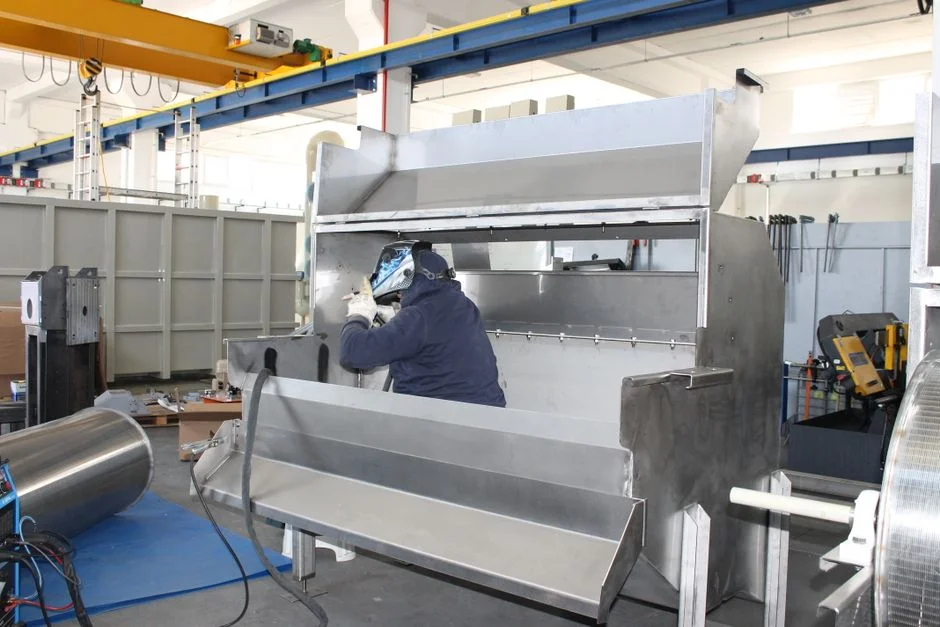
The MBR skid is only the biological core; the auxiliaries decide whether the plant runs at design performance for five years or chokes on FOG in month six. Specify a rotary fine bar screen with ≤3 mm aperture upstream of the MBR to remove hair, lint, and plastic from guest rooms and laundry — the single highest-impact upstream device in any hotel STP. Add a DAF unit or grease interceptor ahead of the biological stage for hotel kitchens; keeping FOG below 50 mg/L entering the MBR extends membrane life from ~5 years to ~8 years and prevents the irreversible fouling that drives mid-cycle membrane replacement.
Size sludge handling for the duty. A 250 m³/d hotel MBR produces 60–80 kg dry solids per day at typical SRT; specify a small plate-and-frame filter press for weekly dewatering rather than hauling liquid sludge, which doubles the disposal cost. Disinfection is the last quality gate: UV is the lowest-maintenance option for reuse-grade water and is well matched to Kaohsiung's high ambient UV-irradiance rooftop installations. Chlorine dioxide is required only when the hotel plans direct discharge to a sensitive water body under the KHB permit. An optional multi-media filter polishing step brings MBR effluent to <1 NTU for cooling-tower make-up — the highest-value reuse end use in a tropical Kaohsiung hotel where chilled-water reject heat drives evaporative losses year-round. Refer to the HydropureWater DAF grease and FOG pre-treatment, rotary bar screen, plate-and-frame filter press, UV steriliser, and chlorine dioxide generator lines for skid-matched auxiliary equipment.
2026 Cost Benchmarks and Vendor Selection Checklist
CAPEX for a packaged hotel MBR in 2026 runs NTD 180,000–380,000 per m³/d of design capacity on a turnkey basis, including civil works, MBR equipment, controls, and commissioning (HydropureWater field data, 2026). Containerised skid units sit at the low end (NTD 180K–250K per m³/d) and suit retrofits with tight site access; buried concrete-tank installations sit at the high end (NTD 300K–380K per m³/d) and suit new-builds where architectural integration matters. OPEX lands at NTD 8–14 per m³ treated, with aeration energy at ~60% of the total and membrane replacement reserves at ~15%. A 250 m³/d plant should be budgeted at NTD 1.2–1.8 million per year all-in.
The reuse-ROI pivot changes the conversation. At Kaohsiung municipal water tariffs of NTD 12–18/m³ and a 60% reuse rate for toilet flushing, landscape irrigation, and cooling-tower make-up, a 250 m³/d hotel can offset NTD 600,000–800,000 per year in water purchase — a 5–7 year simple payback on the MBR premium versus a basic SBR with no reuse case. For a deeper look at the SBR alternative, see the SBR for Hotel Wastewater Cost: 2026 Pricing, Design & Buyer's Guide; for tropical-coastal MBR sizing parallels, see the How to Choose a Packaged MBR STP for a Hotel in Colombo, Sri Lanka (2026 Guide). Peak-factor handling for non-hotel flows is detailed in Packaged Plant for a 25,000 GPD Rural Subdivision: Peak Factors, I&I and TCEQ Compliance (2026).
| Cost line | 2026 range (NTD) | Driver |
|---|---|---|
| CAPEX — containerised skid | 180,000–250,000 per m³/d | Factory build, fast install |
| CAPEX — buried concrete tank | 300,000–380,000 per m³/d | Civil works, architectural integration |
| OPEX | 8–14 per m³ treated | Aeration 60%, membranes 15% |
| Annual OPEX, 250 m³/d plant | 1.2–1.8 million / year | Energy + membrane reserve + labour |
| Water-purchase offset at 60% reuse | 600,000–800,000 / year | Tariff NTD 12–18/m³ |
| Simple payback vs SBR baseline | 5–7 years | MBR premium recovered via reuse |
Vendor shortlist checklist (10 items, all required): (1) influent and effluent guarantees in writing with liquidated damages, (2) membrane brand and replacement cost stated per cassette, (3) local service partner physically based in Kaohsiung, (4) KHB permit support documented, (5) PLC with remote monitoring and trend logging, (6) factory acceptance test video before shipment, (7) minimum 2-year performance warranty covering membrane flux and effluent, (8) spare-membrane inventory commitment with delivery time, (9) on-site training for hotel engineering staff in Mandarin, (10) ISO 9001 and ISO 14001 certification. For the biological skid plus chemical dosing controls, refer to the packaged MBR system for hotels and the automatic chemical dosing system.
Frequently Asked Questions
How do I size a packaged MBR for a Kaohsiung hotel?
Use 1.0–1.3 m³ per available key per day as the base flow for full-service hotels (1.25 m³/key is the Imemflo 200-bed benchmark at 250 m³/d), then apply a peak factor of 1.5–2.0 to get the hydraulic design flow that sizes the equalisation tank and membrane train. Budget hotels drop to 0.6–0.8 m³/key, five-star resorts rise to 1.3–1.6 m³/key.
What does a packaged hotel MBR cost in Kaohsiung in 2026?
CAPEX runs NTD 180,000–380,000 per m³/d turnkey, OPEX runs NTD 8–14 per m³ treated, and a 250 m³/d plant should be budgeted at NTD 1.2–1.8 million per year. At 60% reuse and Kaohsiung municipal tariffs of NTD 12–18/m³, water-purchase offset is NTD 600,000–800,000 per year, giving 5–7 year simple payback versus a basic SBR.
Should I choose SBR or MBR for a Kaohsiung hotel?
SBR is acceptable for budget hotels with adequate land, no reuse plan, and discharge to a municipal sewer. MBR is required for any hotel pursuing on-site reuse, facing basement or service-yard footprint pressure, or discharging to a sensitive receiving water body under a KHB permit.
When should I approach KHB about permitting?
Before equipment purchase. KHB pre-consultation confirms whether the project will connect to the municipal sewer (faster permitting, no reuse ROI) or discharge to a water body (separate permit, tighter effluent schedule), and flags site-specific setbacks for buried plants in saline coastal subsoil.
How long do MBR membranes last in a hotel application?
5–8 years. Flat-sheet PVDF in FOG-controlled applications (with upstream DAF or grease interceptor) reaches the upper end at 6–8 years. Hollow-fiber in unmanaged kitchen-waste streams can drop to 5 years; budget accordingly in OPEX.