Why the Federal Ceiling Is the Wrong Number to Design Against
Mining and metals plants near Maybee, Michigan meet pretreatment limits before sewer discharge by treating acid mine drainage and process water through a staged train — equalization, pH adjustment to 9.5–10.5, hydroxide or sulfide precipitation for copper, lead, zinc, and cadmium, DAF or lamella clarification, multimedia filtration, and RO polishing to 50–70% recovery — sized to the local POTW's sewer-use ordinance under 40 CFR Part 403, not to the 40 CFR Part 437 federal categorical ceiling, which is almost always looser than what the receiving Monroe County or Lake Erie basin POTW actually enforces.
The regulatory chain is short and unforgiving. Clean Water Act §307(b) and 40 CFR Part 403 delegate pretreatment enforcement to the local POTW through its sewer-use ordinance (per EPA, "Pretreatment Standards and Requirements-Local Limits"). 40 CFR Part 437 (Ore Mining and Dressing) and 40 CFR Part 433 (Metal Finishing) set the federal floor for Categorical Industrial Users. 40 CFR 403.5(c) authorizes POTWs to develop numeric local limits specifically to protect three things: the activated-sludge biomass, the sludge management program, and the receiving water (per EPA, 40 CFR 403.5(c)). For a Maybee-area site discharging to a Monroe County or western Lake Erie basin POTW, those receiving-water concerns include Lake Erie itself, the Raisin River watershed, and the western basin algal-nutrient dynamics that have driven Michigan and Ohio to tighten zinc, copper, lead, and ammonia caps well below the Part 437 numbers.
The numerical gap is large. 2026 local caps on the receiving POTWs typically run zinc 0.3–1.0 mg/L monthly average and copper 0.3–0.5 mg/L monthly average. The 40 CFR Part 437 categorical daily maximum for the same parameters sits at 1.0 mg/L (per EPA 40 CFR 437.40–437.47). A plant specified to the federal ceiling is therefore under-designed by default — it can pass the categorical standard and still trigger a local-limit excursion on a single monthly-average sample. The penalty structure magnifies the cost of that mistake: civil penalties under CWA §309 reach $25,000 per violation per day, so one bad month on a tighter local cap can dwarf the cost of the equalization basin that would have prevented it. The first action item in any 2026 spec is to request the current sewer-use ordinance and the POTW's most recent local-limits evaluation from the control authority before selecting equipment.
Pollutant Profile Driving the Train for a Maybee-Area Site
Raw acid mine drainage in this basin typically arrives at pH 2–4 with total suspended solids in the hundreds to several thousand mg/L, carrying dissolved Cu, Pb, Zn, Cd, Ni, and As in solution (per Fluence, 2024-11). Treating that stream to a Lake Erie basin POTW cap means reducing each dissolved metal by one to two orders of magnitude before the sewer manhole, and the receiving POTW's local limits are the numbers that actually drive equipment selection. For aggregate and nonferrous operations around Maybee, dewatering discharge often exceeds 1,000 gpm and dominates flow rather than chemistry, so equalization volume and reuse economics usually drive the design as much as the metals removal (per NREL/OSTI mine water study, 2021).
Sulfate scaling is the binding constraint on any downstream RO. High-sulfate AMD requires recovery capped at 50–70% on standard BWRO membranes to avoid premature membrane replacement; pushing recovery above 70% on AMD is the most common cause of short membrane life (per AMPAC USA, 2026). Cyanide, ammonia, and residual flotation reagents (xanthates, dithiophosphates) appear in gold-circuit and copper-mill streams and force an oxidation or MBR step ahead of the RO; a pure AMD stream does not need that stage. The single most common cause of failed compliance at operating AMD sites is competing chelants — EDTA, citric acid, ammonia — that bind metal ions and defeat hydroxide precipitation (per watertechusa metal precipitants guide, 2026). Jar testing on the actual plant water is the only reliable way to detect them before full-scale design is committed.
From Regulation to Design Target: The Parameter Table
The table below maps each regulated pollutant to the federal categorical ceiling, the typical 2026 POTW local cap, and a defensible stage-by-stage design target. It is the artifact an engineer should print and tape to the wall during equipment selection.
| Pollutant | 40 CFR Part 437 Daily Max (mg/L) | Typical 2026 Local POTW Cap (mg/L) | Post-Hydroxide Target (pH 9–10.5) | Post-Sulfide Target (pH 7–8) | Notes |
|---|---|---|---|---|---|
| Copper (Cu) | 1.0 | 0.3–0.5 monthly avg | <1.0 | <0.1 | Optimum pH 9–10 |
| Lead (Pb) | 0.6 | 0.1–0.2 monthly avg; LCRR pushing toward 10 µg/L | <0.5 | <0.1 | Optimum pH 9.5–10.5 |
| Zinc (Zn) | 1.0 | 0.3–1.0 monthly avg | <1.0 at pH 9; sensitive to pH swing | <0.1 | 1 pH unit swing = 10× residual change |
| Cadmium (Cd) | 0.4 | 0.1–0.3 monthly avg | 0.1–0.5 at pH 10–11 | <0.1 | Sulfide required for tightest caps |
| Nickel (Ni) | 1.0 | 0.5–1.0 monthly avg | <1.0 at pH 9.5–10.5 | <0.1 | — |
| Sulfate (SO₄) | — | ~250 (sewer corrosion / digester upset) | 1,000–3,000 after lime softening | — | Sets RO recovery ceiling |
| TSS | 30 (DAF or lamella at 20–40 m/h) | 30–50 monthly avg | <30 | — | Multimedia filter strips to <10 mg/L |
| pH | 6.0–9.0 instantaneous | 6.0–9.0 instantaneous (most POTWs) | 9.5–10.5 | 7–8 | Two-stage set points common on AMD |
Two practical notes make or break compliance. First, hydroxide precipitation is most effective between pH 9 and 11, but each metal has its own optimum — copper pH 9–10, lead 9.5–10.5, cadmium 10–11 (per watertechusa metal precipitants guide, 2026). A single pH set point cannot hit all of them; two-stage precipitation (pH 7–8 for Fe/Mn, then 9.5–10.5 for Cu/Zn/Pb) is common on AMD streams. Second, the zinc row of the table is the one that causes the most excursions: a 1 pH unit swing can move zinc from under 1 mg/L to over 10 mg/L with no other chemistry change. Hold pH inside ±0.2 with a PLC-controlled dosing skid, or expect monthly-average failures.
The Pretreatment Train, Stage by Stage
The equalization basin is the most undersized piece of equipment in most mining pretreatment plants. Spec the basin at 8–24 hours of average daily flow, not the typical 4 hours, because a 4-hour basin passes every shift-change and dump-leach spike straight into the clarifier and overwhelms it. pH correction comes next: lime (Ca(OH)₂) is cheaper per ton but generates 3–5× more sludge, while NaOH is cleaner and simpler to dose on PLC. Target pH 9.5–10.5 for the metals-precipitation stage, and stage the dosing in two reactors if the influent swings more than 2 pH units. A PLC-controlled dosing skid that handles both pH adjustment and coagulant feed on a single controller keeps pH inside a ±0.2 band.
Hydroxide precipitation is the default because reagent is cheap and chemistry is well understood. Sulfide precipitation (NaHS, FeS, Na₂S) is reserved for streams where residual metal must drop below 0.1 mg/L — sulfide residuals run 0.01–0.05 mg/L versus 0.5–2.0 mg/L for hydroxide, but reagent cost runs 2–4× higher and sealed reactors with H₂S scrubbing are mandatory. Clarification follows: a DAF system for oil-, grease-, or colloid-bearing streams, or a lamella clarifier for metal-hydroxide sludge at higher flow. A multimedia filter (anthracite over sand over garnet) at 1–2 m/h then strips residual TSS to below 10 mg/L and provides a buffer for days when the clarifier underperforms. Where the local sewer-use ordinance requires a residual, chlorine dioxide at 1–5 mg/L avoids the regulated trihalomethanes that chlorine produces.
Sludge from the clarifier and DAF is itself a regulated waste. A sludge filter press dewatering to 25–35% dry solids (60–70% for hazardous metal sludge) produces a stackable cake for Subtitle-D landfill or smelter recovery; filtrate returns to the head of the plant. For a parallel review of biological-stage selection on similar streams, see our analysis of MBR vs conventional activated sludge for mining wastewater.
DAF vs Lamella vs Multimedia Filter: The Selection Decision
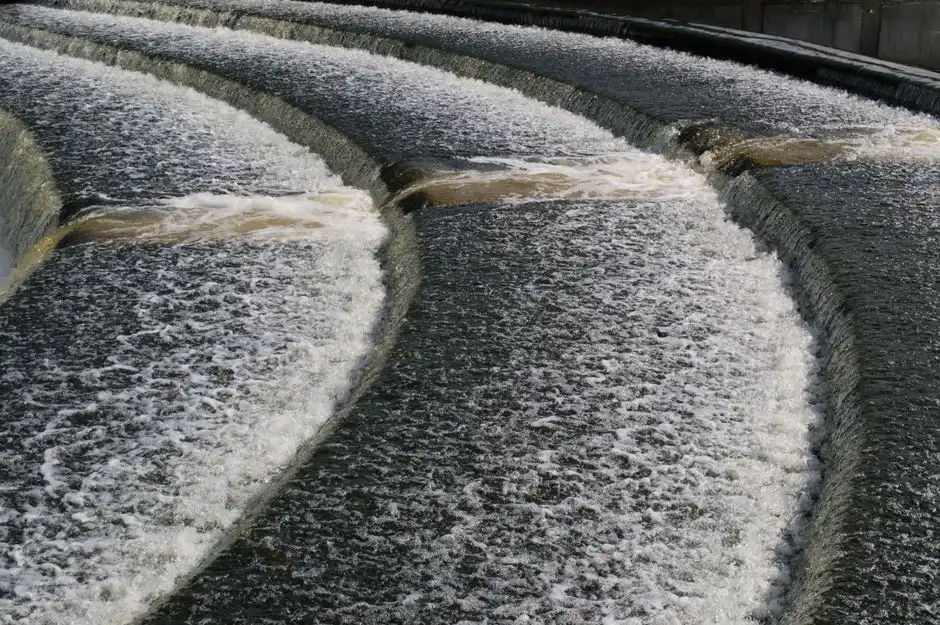
This is the question most engineers actually face when they walk into a vendor meeting. Both DAF and lamella work; neither is universally better; the multimedia filter slots in after either as a safety net. The selection hinges on stream character and flow.
| Criterion | DAF | Lamella Clarifier | Multimedia Filter |
|---|---|---|---|
| Hydraulic / surface loading | 5–25 m/h | 20–40 m/h | 1–2 m/h |
| TSS removal | 90–98% | 85–95% | Strips to <10 mg/L |
| Oil/grease removal | 85–95% | Poor on free oil | Negligible |
| Footprint | Moderate | ~1/3 of conventional clarifier | Compact |
| Best-fit stream | Oil, grease, colloidal fines; flow <200 m³/h | Metal-hydroxide sludge; flow >100 m³/h; footprint-constrained | Always, as a polishing / safety-net stage |
| Backwash | Built-in | Sludge blow-down | dP-triggered, sized for backwash cycle |
| Capacity range | 4–300 m³/h across 13 DAF models | Scalable, custom | Scalable, custom |
Use the heuristic: DAF for oil/grease/colloidal metal streams under 200 m³/h; lamella for metal-bearing sludge streams over 100 m³/h with a footprint constraint. The multimedia filter slots in downstream of either, sized for the backwash cycle rather than average flow. For sizing depth on the membrane side, the RO design criteria for 2026 reference walks through recovery and SDI targets in detail.
When RO, MBR, or ZLD Enters the Picture
RO polishing after multimedia filtration handles reuse and tighter discharge caps. 50–70% recovery is the standard 2026 design target for AMD and high-sulfate streams; pushing above 70% on AMD is the most common cause of premature membrane replacement (per AMPAC USA, 2026). Internal reuse enabled by RO can cut freshwater intake 40–60% versus once-through operation, and that is often the largest single economic lever in a 2026 capex decision at water-stressed sites. A submerged PVDF MBR stage at 0.1–0.4 µm is the right add when the stream carries ammonia, cyanide-breakdown products, or variable organics — it protects the RO by removing COD and ammonia to consistently low-SDI feed water in a single stage.
ZLD (RO + brine concentrator + crystallizer) is increasingly a 2026 design requirement for new mines facing tailings facility closure liability, but ZLD OPEX runs 2–4× a discharge-permitted train, driven almost entirely by thermal energy. It is justified only where reuse value, avoided discharge fees, or TSF closure liability offset the cost (per AMPAC USA, 2026). For most Maybee-area sites with a willing POTW, the discharge-permitted train with optional RO reuse is the economic answer. RO train sizing follows the RO design criteria for 2026 reference parameters.
2026 Compliance Risks and Operational Levers
Three EPA actions are reshaping what counts as compliant in 2026. The Lead and Copper Rule Revisions are pushing lead action levels toward 10 µg/L and forcing POTWs to re-derive local limits at much lower numbers (per EPA, 2024). The 2024 Multi-Sector General Permit added PFAS monitoring (PFOS, PFOA, PFHxS, PFNA) to metal-mining discharges, and local control authorities are adopting the same analytical suite for industrial users discharging to sewer. The 2025 ore-mining BAT revisions are tightening the cost-benefit envelope on total recoverable metals. Treat all three as the next permit-cycle risk and build pilot testing, two-stage precipitation, and RO recovery ceiling of 50–70% into the 2026 spec.
Two operational levers decide whether the design holds up. First, pilot the precipitation stage before committing to full-scale design and budget the pilot at 3–6% of full-scale capex — jar testing is the only reliable way to lock in the pH set points and to detect competing chelants (EDTA, citric acid, ammonia) that defeat hydroxide precipitation. Second, two-stage precipitation (pH 7–8 for Fe/Mn, then 9.5–10.5 for Cu/Zn/Pb) is common on AMD streams because a single pH set point cannot hit all metal optima simultaneously. The selection of the biological stage, when one is needed, is covered in the parallel MBR vs conventional activated sludge for mining wastewater review. Design the train to generate the flow, recovery, and reuse data needed to populate GRI 303 disclosures — a 2026 spec that does not is out of date before it ships.
Frequently Asked Questions
Should a mining or metals plant near Maybee, Michigan design to the federal categorical ceiling or the local POTW limit?
Design to the local POTW sewer-use ordinance, not the 40 CFR Part 437 categorical standard. Local limits are written under 40 CFR 403.5(c) to protect the POTW's biomass, sludge, and receiving water (Lake Erie basin). Typical 2026 local caps run zinc 0.3–1.0 mg/L monthly average and copper 0.3–0.5 mg/L monthly average, which is tighter than the Part 437 daily maximum of 1.0 mg/L.
What pH window achieves the lowest residual metals in hydroxide precipitation?
The optimum window is pH 9–11 overall, but each metal has its own optimum: copper pH 9–10, lead 9.5–10.5, cadmium 10–11, and Fe/Mn 7–8 (per watertechusa metal precipitants guide, 2026). Two-stage precipitation (pH 7–8 for Fe/Mn, then 9.5–10.5 for Cu/Zn/Pb) is the standard answer for AMD streams because one set point cannot hit all metal optima.
What RO recovery should be specified for AMD and high-sulfate mining streams in 2026?
Specify 50–70% recovery on standard BWRO membranes. Pushing above 70% on AMD is the most common cause of premature membrane replacement because sulfate scaling accelerates sharply (per AMPAC USA, 2026). In ZLD trains, the RO stage recovery rises to 70–85% because the concentrate is sent to a thermal stage.
When is DAF the right clarifier versus a lamella clarifier?
DAF at 5–25 m/h hydraulic loading is the right call when the stream carries oil, grease, or fine colloidal metals, typically under 200 m³/h. Lamella at 20–40 m/h surface loading handles heavy metal-hydroxide flocs very well and is the better choice for metal-bearing sludge streams above 100 m³/h with a footprint constraint. A multimedia filter (anthracite over sand over garnet) at 1–2 m/h then strips residual TSS to below 10 mg/L regardless of which clarifier is upstream.
What is the civil penalty exposure for a single local-limit excursion?
Civil penalties under CWA §309 reach $25,000 per violation per day. A single monthly-average excursion on zinc or copper against a tightened local limit can therefore cost the operator six figures in a week, which is why a properly sized equalization basin (8–24 hours of ADF) and PLC-controlled pH control (±0.2 band) are the most cost-effective insurance in the entire train.