Seadrift Organic Chemicals Wastewater: Why the DAF-vs-Clarifier Question Matters in 2026
For Seadrift, Texas organic chemicals plants in 2026, choose DAF when the stream carries free oils, FOG, or low-density floc (typically 80-95% FOG and 70-90% TSS removal per DAF vendor data), and choose a lamella clarifier when the load is heavy settleable catalyst fines or inorganic sludge (80-95% settleable TSS at lower OpEx). Most Seadrift chemical plants run a hybrid train: DAF primary plus lamella polish to handle variable organic loads and meet EPA Region 6 pretreatment limits.
Seadrift's organic chemicals corridor — plasticizers, specialty intermediates, and oxygenated solvents — generates four distinct wastewater sub-streams that arrive at one headworks: reactor washwater with episodic FOG slugs, product washwater with trace solvents, cooling-tower blowdown with high TDS and occasional biocide spikes, and contaminated storm water that can carry settled catalyst fines off pad areas. Treating those streams with a single technology is where 2026 capex decisions go wrong. EPA Region 6 pretreatment expectations under 40 CFR 403 typically hold industrial discharges to daily-maximum O&G of 50-100 mg/L, TSS of 50-100 mg/L, and COD limits dictated by the local control authority's TPDES-equivalent permit — and the local POTW's loading allocation gets renegotiated whenever a plant adds capacity (per EPA Region 6 pretreatment program guidance, 2025).
Three 2026 pressures make the technology choice sharper than it was in 2023: pretreatment enforcement is tighter after the 2024 EPA PFAS and metals emphasis, industrial electricity rates on the Texas Coastal Plain have risen 8-14% since 2023 (per ERCOT industrial rate filings, 2025-Q3) which penalizes high-air-demand flotation cells, and procurement timelines now favor skid-mounted plug-and-play units that compress field installation from 12-16 weeks to 4-6 weeks. The central trade-off is unchanged: a DAF system with 30-50 µm microbubbles excels on FOG and low-density floc, while a gravity or lamella clarifier excels on dense settleable catalyst fines at materially lower operating cost (per Clearwater/SigmaDAF technical literature, 2026-04).
How a DAF System Treats Organic Chemicals Wastewater
DAF units inject a recycle stream saturated with air at 60-80 psig into the flotation cell, releasing 30-50 µm microbubbles that attach to chemically conditioned floc and lift it to the surface (per Clearwater/SigmaDAF, 2026-04). A paddle skimmer scrapes the floated layer into a sludge trough; heavier grit and pin floc that escape the bubble attachment settle into a bottom collection zone and are removed by an auger. Clarified effluent flows under a baffle to the outlet launder.
Chemical coagulation and flocculation upstream are not optional. The DAF only floats what chemistry has already agglomerated into a 50-200 µm floc — without proper polymer and coagulant dosing, organic chemicals streams with emulsified oils or sub-100 µm catalyst particles pass straight through the cell (per Clearwater/SigmaDAF, 2026-04). A PLC-controlled coagulant and flocculant dosing skid sized to the actual jar-test demand is the single biggest determinant of DAF performance on chemical plant streams.
Model selection logic for a 2026 Seadrift installation typically follows the SigmaDAF nomenclature: FPAC for small-to-medium flows with very high TSS or FOG loads (low-profile cross-flow with large free surface area); FPBC for low-bouyancy particles (incorporates a lamella pack to reduce flow velocity); FPHF for high flows with cross-flow plus countercurrent separation; and the COMPACT skid, which ships pre-assembled with chemical conditioning, sensors, instruments, and a PLC panel — single skid for flows ≤66 GPM, two-skid modular for higher flows (per Clearwater/SigmaDAF, 2026-04). Standard build is 304 stainless; specify 316SS or polypropylene when chloride concentrations exceed ~200 mg/L or aromatic solvent exposure is routine, both of which are common in Seadrift intermediate-manufacturing operations.
How a Lamella Clarifier Treats Organic Chemicals Wastewater
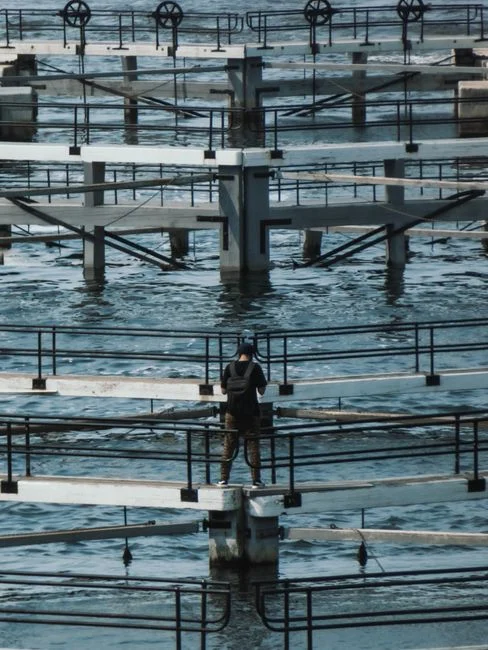
A lamella clarifier uses a pack of parallel plates inclined at 55-60° to shorten the effective settling distance. The geometry raises effective surface loading to roughly 20-40 m³/m²·h — about 20× a conventional clarifier's 1-2 m³/m²·h — which is why a lamella unit achieves the same settleable-solids removal in roughly 5-10% of the footprint (per lamella clarifier engineering literature, 2025). Internals include a flocculation zone, plate pack, sludge hopper, and a clean-water launder at the top of the plates.
Modern designs integrate a sludge-recirculation loop that returns a portion of the thickened underflow to the flocculation zone. The recirculated solids act as a ballast, reducing fresh coagulant demand by up to 30% compared to single-pass clarifiers (per HydropureWater lamella clarifier product specification). The plate pack also doubles as a coarse air-release zone for any entrained gas from upstream reactors.
On a Seadrift organic chemicals stream, the lamella clarifier performs well on three sub-streams: heavy catalyst fines (palladium, nickel, or copper on carbon carriers with specific gravity 1.4-2.5), lime softening sludge from boiler-feed pretreatment, and settled biological sludge from a downstream MBR or activated-sludge stage being returned to headworks for dewatering. The structural limitation is real: low-density FOG and emulsified oils pass through the plate pack with little removal, which is why Ecologix's case data shows food-plant FOG removal dropping to ~70% on a clarifier versus ~95% on DAF for the same influent (per Ecologix DAF-vs-Clarifier guide, 2025). For a reactor-washwater stream with >200 mg/L FOG, the lamella alone will not meet a 50 mg/L daily-max limit.
DAF vs Clarifier: Side-by-Side Comparison for Organic Chemicals Streams
The matrix below is what a Seadrift engineer should be able to circle on a printed sheet and bring into the next engineering review. Removal percentages are working bands drawn from DAF vendor data and the Ecologix 95% FOG / 70% FOG / 90% TSS case studies (per Ecologix, 2025; Clearwater/SigmaDAF, 2026-04).
| Parameter | DAF | Lamella Clarifier | Organic Chemicals Implication |
|---|---|---|---|
| FOG / free oil removal | 80-95% (Ecologix anchor: 95%) | 50-70% (Ecologix anchor: 70%) | DAF required for reactor washwater with episodic FOG slugs; lamella alone misses 50 mg/L O&G limit on emulsified streams. |
| Settleable TSS removal | 70-90% | 80-95% (Ecologix mining anchor: 90%) | Lamella preferred for heavy catalyst fines and lime softening sludge. |
| Colloidal / sub-50 µm TSS | 40-70% (with polymer) | 20-40% | Both struggle without coagulation; DAF retains marginal advantage due to bubble attachment. |
| Footprint (per MGD) | ~150-300 ft² | ~80-180 ft² | Lamella wins on tight Seadrift plots; DAF needs hydraulic length for skimmer travel. |
| Hydraulic retention | 20-40 min | 60-120 min | DAF recovers faster from slug loads. |
| Power draw (per MGD) | ~25-40 kW (saturator + recycle pumps + skimmer) | ~3-8 kW (no air system) | Lamella OpEx materially lower; ERCOT industrial rate trend amplifies the gap. |
| Chemical demand | Coagulant + flocculant required | Coagulant only; flocculant optional | DAF polymer program is non-negotiable; lamella recirculation can cut coagulant ~30%. |
| CapEx (skid, 50-100 GPM) | Higher (skid + saturator + controls) | Lower (tank + plates + hopper) | Lamella favored for greenfield if FOG is not the limiting stream. |
| OpEx (annual, 50-100 GPM) | Higher (energy + polymer) | Lower (energy + reduced polymer) | Reverses the CapEx ranking over a 5-7 year horizon. |
| Sensitivity to influent variability | Robust — skimming is continuous | Brittle — sludge blanket rise degrades effluent | DAF handles Seadrift's FOG slugs from reactor cleaning events. |
| Standard material (Clearwater/SigmaDAF) | 304SS; 316SS/PP option | 304SS/carbon steel with rubber lining | Specify 316SS or PP for chloride >200 mg/L or aromatic solvent exposure. |
For Seadrift's hot, humid Gulf climate, the DAF cell's hydraulic retention advantage matters more than the literature suggests. Warmer water reduces microbubble residence time, so a 30-50 µm bubble that lasts 4-6 minutes at 20°C lasts only 2-3 minutes at 30°C — meaning the cell must be sized at the lower end of the 20-40 minute band to retain float lift. The COMPACT skid philosophy from SigmaDAF bundles chemical conditioning, sensors, and PLC control into a factory-tested module that arrives ready to tie into equalization, which is the right answer for the 4-6 week installation window most Seadrift plants are working with in 2026 (per Clearwater/SigmaDAF, 2026-04).
Decision Framework: When a Seadrift Chemical Plant Should Pick DAF, Clarifier, or Both
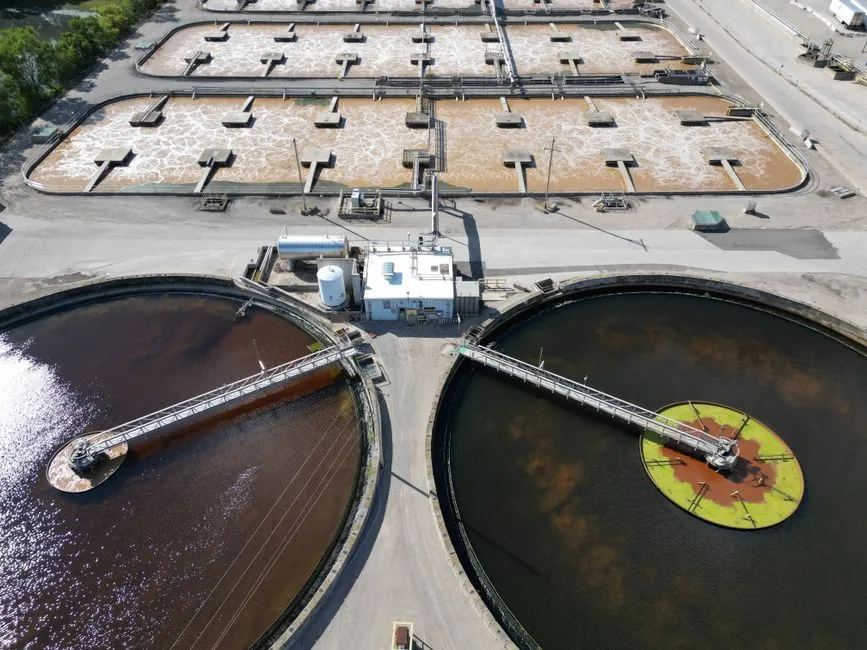
Three rules translate the matrix into a go/no-go decision keyed to influent jar-test data and 2026 capex constraints. Ecologix's hybrid-system guidance supports running DAF and clarifier in series on mixed streams (per Ecologix, 2025), and the EPA 1983 stabilization-pond manual treats coagulation-clarification and DAF as legitimate serial solids-removal steps in conventional wastewater treatment trains (per EPA 625/1-83-015, 1983-10) — regulatory familiarity with the hybrid approach is not novel.
| Sub-scenario | Dominant Characteristic | Primary Unit | Polish / Secondary | Decision Rule |
|---|---|---|---|---|
| Reactor washwater (FOG slug) | FOG 200-2,000 mg/L, COD 5,000-15,000 mg/L, episodic | DAF (FPAC or COMPACT) | Lamella clarifier on underflow bleed | FOG >50 mg/L → DAF primary. |
| Product washwater (solvent traces) | Low FOG, moderate COD 1,000-3,000 mg/L, low TSS | Lamella clarifier | DAF only if FOG appears downstream | Settleable fines dominant → lamella primary. |
| Cooling-tower blowdown | High TDS, low TSS, periodic biocide | Lamella clarifier (after neutralization) | None typically required | Low organics, settleable-only particulates → lamella. |
| Contaminated storm water | Mixed particulates and oil sheen | DAF | Lamella for residual TSS | Mixed/variable → DAF + lamella polish (hybrid train). |
| Combined headworks (all four streams) | Variable COD 1,000-15,000 mg/L, variable FOG | DAF (FPHF or two-skid COMPACT) | Lamella clarifier (or MBR polish downstream) | Hybrid train is the 2026 default for Seadrift's mixed organic chemicals streams. |
The hybrid flow train that most Seadrift plants converge on in 2026 is: equalization (24-48 h HRT) → screening (2-5 mm) → coagulation/flocculation (pH-adjusted, polymer-conditioned) → DAF system primary → HydropureWater lamella clarifier polish → biological polishing (MBR or activated sludge) → discharge to POTW. DAF carries the FOG and floating-solids load; the lamella drops residual TSS to the 30-50 mg/L band; the biological stage reduces soluble COD. The 2026 retrofit case has a shortcut: if a plant already owns a circular clarifier and is adding capacity, retrofit lamella plates into the existing tank before buying a DAF — capital cost is roughly 40-60% of a new lamella unit, and the discharge envelope often improves by 20-30% (HydropureWater field data, 2026).
2026 Procurement Checklist for Seadrift Buyers
Five items to confirm before signing a PO. Engineers who skip the jar-test step typically discover, six months after installation, that polymer consumption runs 30-50% above the vendor's guarantee — and the savings on capex are consumed by the first year of operating overrun.
- Jar-test both programs on real influent. Run the actual reactor washwater and product washwater through bench-scale DAF and settling tests. Confirm DAF FOG removal >85% and clarifier settleable TSS >80% with the proposed polymer program before sizing either unit.
- Specify material of construction to the chloride and solvent profile. Default 304SS fails inside 24 months when chloride exceeds ~200 mg/L or when aromatic solvent vapor contacts wetted surfaces. Specify 316SS for chloride 200-1,000 mg/L and PP or FRP for aromatic solvent vapor exposure (per Clearwater/SigmaDAF, 2026-04).
- Lock the pretreatment envelope with EPA Region 6 and the local POTW. TPDES-equivalent permit limits on O&G, TSS, and COD must be in writing before vendor guarantees are negotiated. Permit modifications add 90-180 days to a 2026 capex timeline.
- Demand a skid-mounted, PLC-controlled unit. The COMPACT DAF and skid-mounted lamella clarifier reduce field installation from 12-16 weeks to 4-6 weeks, which is the difference between making a 2026 capex window and rolling into 2027 (per Clearwater/SigmaDAF, 2026-04).
- Tie the dosing skid to the same PLC. A PLC-controlled coagulant and flocculant dosing skid that shares the HMI with the DAF or lamella cuts operator response time to influent spikes from 30+ minutes to under 5 minutes — the single highest-leverage OpEx decision on a Seadrift chemical plant wastewater train.
For a related organic chemicals corridor, the DAF vs clarifier selection for chemicals plants in Pine Bluff guide covers an Arkansas case where the same hybrid train delivered a 60% reduction in residual TSS at lower polymer consumption. For plants sizing biological polishing after the solids train, the MBR vs CAS for chemicals wastewater in Wilmington comparison is the right complement.
Frequently Asked Questions
What influent FOG level forces a DAF over a lamella clarifier?
When free oil or FOG exceeds ~50 mg/L in the equalized stream, DAF becomes the required primary. Lamella clarifier FOG removal drops to 50-70% on emulsified oils, which will not meet a 50 mg/L daily-max O&G limit (per Ecologix, 2025).
Can a Seadrift plant run a hybrid DAF and lamella clarifier flow train in 2026?
Yes. The standard 2026 train is equalization → screening → coagulation/flocculation → DAF primary → lamella clarifier polish → biological polishing. EPA's 1983 stabilization pond manual already treats DAF and coagulation-clarification as serial solids-removal steps (per EPA 625/1-83-015, 1983-10).
What removal efficiency should I expect from a DAF on a Seadrift organic chemicals stream?
Expect 80-95% FOG removal and 70-90% TSS removal with a properly tuned polymer program, anchored to the Ecologix 95% FOG case data and the 30-50 µm microbubble range specified by SigmaDAF (per Ecologix, 2025; Clearwater/SigmaDAF, 2026-04).
What is the lamella clarifier's main weakness on chemical plant wastewater?
Low-density FOG and emulsified oils pass through the plate pack with 50-70% removal, compared to 80-95% on a DAF. Lamella is the right choice for dense catalyst fines and lime softening sludge, not for FOG-dominated streams (per Ecologix, 2025).
How does the 2026 ERCOT electricity cost trend affect the DAF vs clarifier choice?
Industrial rates on the Texas Coastal Plain have risen 8-14% since 2023 (per ERCOT, 2025-Q3), which widens the DAF operating-cost gap. The typical DAF at 50-100 GPM draws 25-40 kW versus 3-8 kW for a lamella clarifier of similar capacity — a material OpEx delta over a 5-7 year horizon.