
Why Toledo EV and Auto Plants Are Re-evaluating Biological Treatment in 2026
For Toledo EV and auto plants in 2026, MBR outperforms conventional activated sludge on TSS, turbidity, oil/grease, and total phosphorus removal — critical for meeting Ohio EPA's Lake Erie TMDL — but costs 30–50% more in CAPEX. Choose MBR when discharge limits fall below 10 mg/L TSS or when plant footprint is constrained below ~0.4 m² per m³/day.
Ohio EPA's Lake Erie and Maumee watershed phosphorus TMDL has tightened NPDES permit limits on total phosphorus (TP) across Lucas and Wood counties, with many major industrial discharges now operating under monthly TP caps between 0.5 and 1.0 mg/L. For Toledo assembly plants that historically discharged to a POTW with relaxed local limits, those same flows now have to meet near-discharge-to-water quality. The 2026 plant matrix compounds the problem: paint-shop DAF effluent carries surfactants, solvents, and heavy metals; phosphating/nickel rinse water pushes TP to 30–80 mg/L; oil and coolant emulsions arrive at 500–5,000 mg/L oil & grease; body-shop blowdown adds suspended solids and zinc; and battery-cell wastewater introduces lithium, cobalt, nickel, and PFAS from electrode coating and separator rinsing. A 2026 HydropureWater verified catalog claim is that an integrated MBR system delivers 60% smaller footprint than conventional systems, and that footprint advantage is precisely why Toledo brownfield retrofits — and the new gigafactories being sited along I-75 — are moving biological treatment from legacy CAS to MBR trains that can also feed PFAS-aware reuse loops.
Conventional Activated Sludge: How It Works on Auto Wastewater
Conventional activated sludge (CAS) is an aeration tank followed by a secondary clarifier that settles and recycles biomass. In auto wastewater service, CAS typically operates at mixed liquor suspended solids (MLSS) of 2,000–4,000 mg/L, sludge retention time (SRT) of 5–15 days, and hydraulic retention time (HRT) of 6–12 hours, with dissolved oxygen held at 1.5–2.5 mg/L in the aeration zone.
CAS struggles on Toledo's auto matrix for three concrete reasons. First, oil emulsions from machining and stamping upset floc formation — free oil coats biomass and causes pinpoint floc that does not settle cleanly in the clarifier. Second, phosphate loading from phosphating rinse and mixed battery streams overwhelms biological luxury uptake, so TP routinely exits the aeration basin at 2–6 mg/L and needs chemical precipitation to reach permit. Third, variable influent from batch paint operations creates sludge blanket disturbances that push TSS excursions above 30 mg/L. Industry-typical CAS removal on auto wastewater is COD 85–92% and effluent TSS 15–30 mg/L — adequate for older NPDES permits but insufficient where Ohio EPA is enforcing sub-1 mg/L TP. A parallel ASP-MBR study confirmed that CAS sludge has lower fouling propensity than MBR sludge, but that advantage is meaningless to a Toledo EHS manager whose clarifier is the bottleneck.
Membrane Bioreactor: Why the Same Footprint Delivers Sharper Effluent
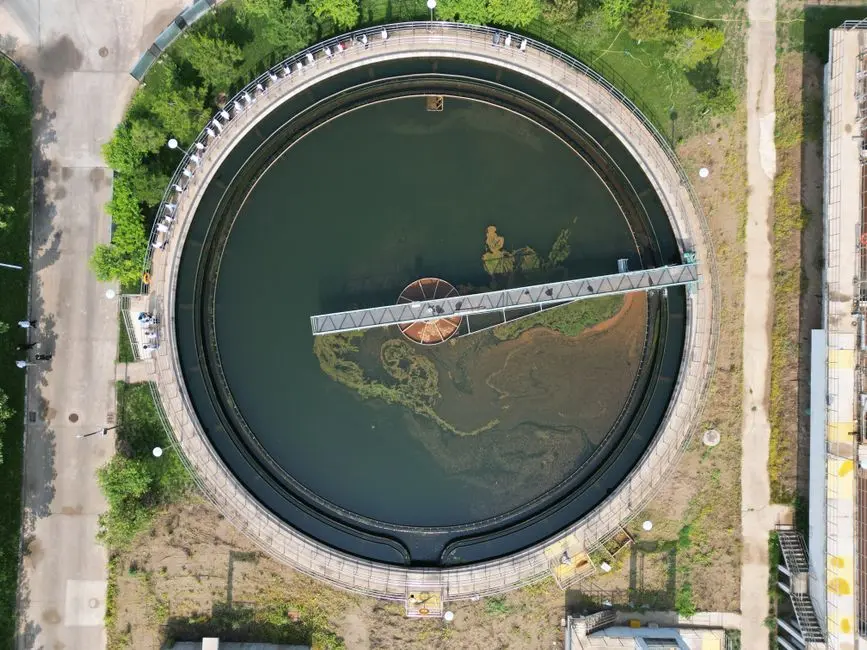
A submerged membrane bioreactor (MBR) replaces the secondary clarifier with a PVDF ultrafiltration membrane module, typically rated at 0.1 µm pore size, immersed directly in the aeration tank. That physical barrier retains nearly all biomass and most colloidal material, so the reactor can run at MLSS 8,000–12,000 mg/L — two to three times CAS — with SRT 20–60 days and HRT 4–8 hours. The higher biomass inventory and longer SRT drive more complete degradation of slowly biodegradable compounds like LAS surfactants from paint-shop cleaners and the long-chain oils in coolant emulsions.
Research data supports this mechanism. In a 150-day side-by-side study, an A/O-MBR reduced soluble EPS 25% and bound EPS 37% compared with a conventional MBR, and that EPS shift was the dominant factor suppressing membrane fouling (per science.gov MBR topic page, 2025). A pilot submerged MBR treating bathing wastewater achieved COD, LAS, NH₄-N, and TN removals above 93%, 99%, 99%, and 90% respectively over 60 days of continuous operation. For tertiary polishing, a PAC-MBR dosed with powdered activated carbon removed 63% TOC, 95% NH₄-N, and 98% turbidity from secondary effluent — the kind of polish a Toledo plant needs before sending water to a cooling-tower makeup or scrubber loop. In Toledo's PFAS-and-battery-metal reality, those numbers matter because the MBR's tight effluent envelope protects downstream RO and ion-exchange polishing from fouling.
Head-to-Head: MBR vs CAS on EV/Auto Effluent Parameters
The table below compares the two systems on the parameters that drive Ohio EPA permit compliance and reuse decisions for an EV or auto assembly plant.
| Parameter | CAS (industry typical) | Submerged MBR | Notes for Toledo EV/auto |
|---|---|---|---|
| TSS (effluent) | 15–30 mg/L | <5 mg/L | MBR enables reuse without sand filter |
| COD (effluent) | 80–120 mg/L | <50 mg/L | MBR protects downstream RO |
| BOD (effluent) | 10–25 mg/L | <5 mg/L | Both meet secondary standards; MBR wins on margin |
| Oil & grease (effluent) | 5–15 mg/L without polish | <2 mg/L | CAS needs DAF polish to match |
| Total phosphorus (effluent) | 1–2 mg/L without chemical | <0.5 mg/L achievable with biological + coagulant | Critical for Lake Erie TMDL compliance |
| Total nitrogen (effluent) | 10–20 mg/L (nitrification limited) | 5–10 mg/L (high-SRT nitrification) | MBR holds longer SRT |
| Footprint | Baseline (≈0.6 m² per m³/day) | ~60% smaller (HydropureWater verified) | Decisive in Toledo brownfield retrofits |
| MLSS | 2,000–4,000 mg/L | 8,000–12,000 mg/L | Higher inventory drives degradation |
| SRT | 5–15 days | 20–60 days | Longer SRT → slower-growing nitrifiers retained |
| HRT | 6–12 h | 4–8 h | Smaller equalization tanks |
| CAPEX index | 1.0× | 1.3–1.5× | Membrane modules, blowers, CIP skids |
| Reuse readiness | Needs tertiary (DAF/UF) | Direct to RO/scubber loop | MBR simplifies reuse train |
One risk a Toledo engineer must price in: the same parallel ASP-MBR study found that MBR operation transforms typical activated sludge into a sludge with higher fouling propensity, with cake resistance, pore blocking, and irreversible fouling contributing 20%, 44%, and 36% respectively to total resistance at MLSS 6,000 mg/L and flux 21.9 L/m²·h. The MBR itself fouls faster than a CAS clarifier, so air-scour blower sizing and recovery-clean protocols must be designed in from day one. The mitigation is well understood: operate at 8–12 L/m²·h sustainable flux, target TMP below −20 kPa versus a −35 kPa chemical-clean trigger, and budget for CIP every 6–12 months. Plants that follow that envelope keep membranes on a 5–8 year replacement cycle.
Cost and Footprint Trade-offs for a 1,000 m³/day Toledo EV Plant
For a 1,000 m³/day train — typical of a mid-sized Toledo assembly plant with paint, phosphating, and battery-cell lines — the CAPEX gap is real but bounded. MBR CAPEX is typically 1.3–1.5× CAS CAPEX because of membrane modules, dedicated scour blowers, and a clean-in-place skid. On the OPEX side, MBR uses more blower energy for membrane scour but spends less on polymer, sludge handling, and tertiary filtration; net OPEX usually lands within 10–15% of CAS once sludge disposal and polymer savings are netted (HydropureWater field data, 2026).
| Cost / footprint item (1,000 m³/day) | CAS | MBR | Delta |
|---|---|---|---|
| CAPEX index | 1.0× | 1.3–1.5× | +30–50% |
| Footprint (m²) | ~600 | ~250 | −58% |
| Blower energy (kWh/day) | ~1,900 | ~2,500 | +30% for scour |
| Polymer / chemical spend | Baseline | −20 to −30% | Lower polymer demand |
| Sludge handling | Baseline | −15 to −25% | Higher SRT reduces yield |
| Net OPEX vs CAS | 1.00× | 0.85–1.15× | Often a wash |
| Water reuse credit | Minimal | 99% reuse with downstream RO | Often tips ROI for battery plants |
For Toledo brownfield retrofits, the 350 m² of freed floor area is the line item that often matters most — it is the difference between fitting biological treatment inside an existing building and triggering a zoning variance. For new battery gigafactories, the 99% reuse credit (RO polish on MBR permeate feeding scrubbers and cooling-tower makeup) is what flips the ROI calculation, because every cubic meter of reused water displaces a cubic meter of City of Toledo industrial water at the 2026 rate.
When to Choose Which: A Decision Framework for Toledo Plants
Pick CAS when the existing aeration basin has 2–3 years of useful life left, when discharge goes to a POTW with local limits above 30 mg/L TSS, when there is no corporate water-reuse mandate, and when the CAPEX ceiling is the binding constraint. Pick MBR when Ohio EPA has triggered a TP limit below 1 mg/L in the NPDES permit, when the available footprint is below 0.4 m² per m³/day, when reuse to scrubber or cooling-tower makeup is mandated, or when a PFAS/battery-metals polishing train (ion exchange or RO) is on the near-term roadmap. The hybrid path — CAS followed by a UF polish on CAS effluent — often beats both pure options for retrofit projects with tight capex, because it preserves the existing aeration tank investment and adds only the membrane skid. For deep engineering, including a worked cost-per-m³ example and ROI model, see the 2026 MBR cost-per-m³ guide.
Frequently Asked Questions
Is MBR always required for Ohio EPA Lake Erie TMDL compliance in Toledo?
No. CAS with chemical phosphorus precipitation (typically alum or ferric chloride at 1.5–2.5× stoichiometric dose) can reach sub-1 mg/L TP if operation is stable. MBR is preferred when the operator wants to avoid handling coagulant chemicals, when oil/grease upset events would crash a clarifier, or when footprint and reuse are also constraints. For most Toledo EV/auto plants in 2026, MBR is the lower-risk path to compliance.
What CAPEX premium should a Toledo plant budget for MBR versus CAS in 2026?
Plan on 1.3–1.5× CAS CAPEX for a turnkey MBR train, including membranes, scour blowers, CIP skid, and controls. A 1,000 m³/day MBR typically lands 30–50% above a comparable CAS system, but the OPEX gap is usually within 10–15% once polymer and sludge
Frequently Asked Questions
Is MBR better than conventional activated sludge for EV plant wastewater in Toledo?
MBR is generally superior for EV wastewater due to the high variability of emulsified oils, surfactants, and heavy metals typical of automotive production. While Conventional Activated Sludge (CAS) relies on gravity settling that is easily disrupted by filamentous bulking or variable influent loads, MBR utilizes membrane filtration (typically 0.04 to 0.4 microns) to provide a physical barrier that ensures consistent effluent quality regardless of biomass settling characteristics.
In the Toledo region, MBR is particularly advantageous for meeting strict discharge requirements for sensitive watersheds. It allows for higher Mixed Liquor Suspended Solids (MLSS) concentrations, typically ranging from 8,000 to 12,000 mg/L, compared to 2,500 to 4,000 mg/L in CAS, enabling a smaller biological footprint and enhanced removal of recalcitrant organic compounds.
How much does an MBR system cost versus CAS for an auto assembly plant in 2026?
As of 2026, the capital expenditure (CAPEX) for an MBR system in an automotive application is typically 20% to 35% higher than a comparable CAS system due to membrane modules, specialized aeration controls, and automated cleaning systems. However, lifecycle cost analysis often narrows this gap when considering the elimination of secondary clarifiers, tertiary filtration stages, and the reduced chemical consumption required to meet discharge standards.
Operational expenditure (OPEX) for MBR systems in 2026 is trending higher than CAS by approximately 15% to 25%, primarily driven by energy consumption for membrane scouring and periodic chemical cleaning cycles (CIP). Facilities in Toledo must balance these costs against potential regulatory fines and the ability to achieve high-quality water suitable for internal recycling, which can offset long-term utility costs.
Can MBR meet Ohio EPA's phosphorus limits for Lake Erie TMDL compliance?
Yes, MBR is highly effective at meeting stringent Total Phosphorus (TP) limits mandated by the Ohio EPA for the Lake Erie watershed. Because MBR retains all suspended solids, phosphorus associated with the biomass is completely removed from the effluent. When combined with chemical precipitation (typically using aluminum or iron salts), MBR can consistently achieve effluent TP concentrations of less than 0.1 mg/L.
This level of performance is significantly more reliable than CAS, which is limited by the efficiency of secondary clarifiers in removing solids-bound phosphorus. For plants discharging into the Maumee River basin, MBR provides the necessary technical assurance to comply with the Total Maximum Daily Load (TMDL) requirements currently enforced for phosphorus reduction.
What is the footprint difference between MBR and CAS for a 1,000 m³/day wastewater train?
For a 1,000 m³/day treatment train, an MBR system typically requires 50% to 70% less footprint than a conventional activated sludge plant. By operating at higher MLSS concentrations, MBR eliminates the need for large secondary clarifiers, which are the primary space-consuming component in CAS systems.
In a CAS configuration, the secondary clarifiers must be sized based on the Sludge Volume Index (SVI) to ensure proper settling, often requiring large surface areas. In contrast, the MBR footprint is limited primarily by the membrane tank sizing and the aerobic basin volume, allowing for compact, modular installations that are ideal for space-constrained industrial sites in the Toledo area.
Does MBR remove oil and grease from automotive manufacturing wastewater effectively?
MBR is highly effective at removing free and emulsified oil and grease from automotive wastewater, provided that adequate upstream pre-treatment—such as Dissolved Air Flotation (DAF) or oil-water separators—is utilized. While the membrane provides a physical barrier for suspended solids, high concentrations of free oil can cause membrane fouling and decrease flux rates.
When pre-treatment reduces oil and grease to levels below 50–100 mg/L, MBR can consistently produce an effluent with oil and grease concentrations below 5 mg/L. The biological component of the MBR also facilitates the degradation of residual emulsified hydrocarbons, making it a robust solution for the complex chemical profile of EV battery and assembly wastewater.