Why Freeport Fabricated Metals Wastewater Breaks Conventional Activated Sludge
A Freeport, Texas fabricated-metals plant running cutting, stamping, plating, machining with soluble coolant, and light forming generates an influent envelope that conventional activated sludge (CAS) cannot reliably treat at design load. Routine feed values include 2,000–6,000 mg/L TDS, 400–1,500 mg/L chloride from pickle-bath rinses and cooling-tower bleed, 1,000–4,000 mg/L COD, FOG 100–300 mg/L from stamping lubricants and soluble coolants, nickel 5–50 mg/L (spikes to 80+ during plating-line dumps), zinc 10–80 mg/L, total chromium 2–20 mg/L, and pH swings between 5 and 10 during a single shift (HydropureWater field data, 2025-Q4). Freeport's Brazos-fronting sites also see 2–3× design hydraulic loading inside a few hours during June–November tropical systems, on top of the daily process slugs.
Each parameter maps to a specific failure mode in a CAS train. Filamentous organisms — Microthrix parvicella, Nocardia spp., and halotolerant Haliscomenobacter — proliferate on oil-coated mixed liquor; the resulting high SVI destroys clarifier settling, and solids carry over the weirs for hours (HydropureWater 2026). Ammonia above 200–300 mg/L NH₃-N, common after a plating-line dump or a coolant-tank turnover, strips the slow-growing nitrifier population, and at Freeport's 35 °C mixed-liquor temperature combined with 1,000 mg/L chloride, both free-ammonia toxicity and halide inhibition are active. Hydraulic shock from a Brazos surge or hurricane storm pushes the clarifier overflow rate past the design limit, the sludge blanket rises, and TSS excursions trigger TCEQ TPDES permit violations on the same afternoon.
For a Freeport metals plant, those events are weekly — coolant-tank turnovers, spent pickle-bath dumps, cooling-tower blowdown cross-connections, and storm surges — not edge cases (HydropureWater 2026). The secondary clarifier is the single point of failure in any CAS train, and the metals-finishing influent envelope stresses that single point of failure every operating day. That framing is what makes the MBR vs CAS question for fabricated metals a different problem than the same question for municipal or petrochemical service.
MBR and CAS at a Glance: What Actually Differs Inside the Tank
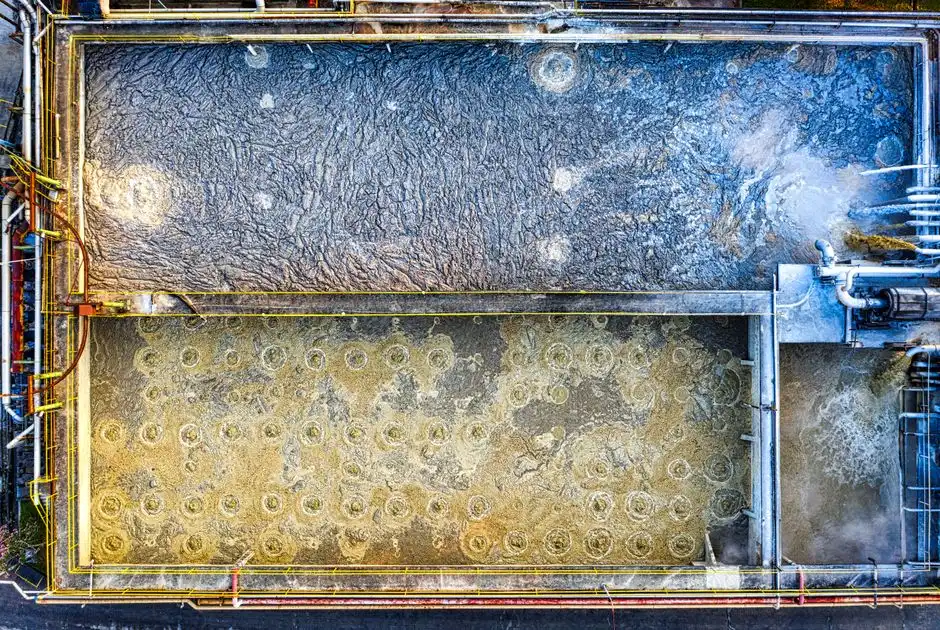
A membrane bioreactor (MBR) is an activated-sludge reactor in which submerged microfiltration or ultrafiltration membranes — typically 0.1–0.4 μm PVDF flat-sheet or hollow-fiber — replace the secondary clarifier as the solid–liquid separation step. Mixed liquor is drawn through the membrane under a small vacuum (0.1–0.3 bar transmembrane pressure); permeate exits as effluent, and the rejected biomass stays in the aeration basin. There is no settling step, no sludge blanket, and no clarifier overflow rate to manage. If you need a refresher on how an MBR works end to end, that process description is the engineering-level walkthrough.
Conventional activated sludge pairs an aeration basin with a secondary clarifier and RAS/WAS pumping. Biomass retention depends entirely on settling, which means HRT and SRT are coupled — both typically 4–12 h on industrial streams — and the clarifier is a hard constraint on mixed-liquor concentration and on the population of slow-growing organisms like nitrifiers.
Banu et al. (2009), as cited in HydropureWater's 2026 engineering brief, demonstrated that a long-SRT MBR can run stably at high MLSS for 270 days at a designed flux of 77 LMH (HydropureWater 2026). That is the single most cited proof point for MBR on industrial streams: the membrane decouples HRT from SRT in a way CAS cannot, and the result is a reactor that tolerates the chloride, FOG, and ammonia envelopes that a Freeport metals site generates on a Monday morning. The 2012 MBR thesis work at the Institut Européen des Membranes (Montpellier) added that membranes with a 0.04–0.2 μm cutoff retain bacteria and viruses "almost completely," which is useful for any cooling-tower or rinse-water reuse loop downstream of the biological stage (S4).
MBR vs CAS Parameter Table for Freeport Metals Streams
The table below consolidates the design envelope a Freeport process engineer can defend to a TCEQ reviewer or a capital committee. Values are typical ranges for high-strength industrial streams, drawn from the 2026 HydropureWater design guide and the Banu et al. (2009) long-SRT finding.
| Parameter | MBR (submerged PVDF, 0.1–0.4 μm) | CAS (aeration basin + clarifier) | Source |
|---|---|---|---|
| MLSS (mg/L) | 8,000–12,000 | 2,000–5,000 | HydropureWater 2026 design guide |
| SRT (days) | 20–60 (long-SRT operation) | 5–15 | HydropureWater 2026 design guide; Banu et al. 2009 |
| HRT (hours) | 4–12 | 6–12 | HydropureWater 2026 design guide |
| F/M (d⁻¹) | 0.05–0.15 | 0.2–0.5 | HydropureWater 2026 design guide |
| Effluent TSS (mg/L) | <5 | 10–30 (no tertiary filtration) | Typical chemical-stream effluent |
| Effluent COD (mg/L, typical) | <50 | 80–150 | HydropureWater 2026 design guide |
| Effluent turbidity (NTU) | <1 | 5–20 | HydropureWater 2026 design guide |
| SVI risk | Low (no clarifier) | High on FOG and halide streams | Field experience, metals service |
| Footprint | DF-series rated ~60% smaller (2026) | Reference baseline | HydropureWater 2026 design guide |
| Ammonia tolerance (mg/L NH₃-N) | 500–1,500 (long-SRT) | Collapse above ~300 at 35 °C and 1,000 mg/L Cl⁻ | Field experience, metals service |
| Chloride tolerance (mg/L) | Up to 1,500 sustained; higher in spikes | Nitrification inhibited above ~1,000 | HydropureWater 2026 design guide |
| FOG tolerance with DAF upstream | DAF to <30 mg/L FOG → monthly CIP | Recurrent bulking above ~100 mg/L | HydropureWater 2026 design guide |
| Sludge yield (kg WAS/kg COD removed) | 20–40% lower at matched SRT | Reference | Banu et al. 2009; long-SRT decay |
| Permeate SDI | <3 (direct RO feed) | SDI >5 (needs multimedia/DAF) | HydropureWater field data, 2025-Q4 |
The two lines to circle for a Freeport capital committee are sludge yield and permeate SDI. At matched SRT, MBR produces 20–40% less waste activated sludge than CAS per Banu et al.'s 2009 finding of "relatively high decay rate and less sludge production due to much longer sludge age" (HydropureWater 2026). On a Freeport metals site already paying Texas-licensed disposal rates of $300–$800 per wet ton, that delta is a six-figure annual number, not a rounding error. SDI <3 on the MBR permeate is the threshold below which thin-film composite RO membranes can be fed directly — CAS effluent almost never meets that without tertiary filtration or DAF, and that gap is where the headline CAPEX differential starts to close (HydropureWater field data, 2025-Q4).
Pretreatment Chain Freeport Metals Plants Cannot Skip
An MBR is almost never the first unit operation on a Freeport metals train. The realistic chain is rotary bar screen → flow equalization (12–24 h, mechanical mixing) → pH and alkalinity adjustment → hydroxide precipitation for nickel and zinc, with Cr(VI) reduced to Cr(III) first → DAF for FOG and free-oil removal → nutrient balance to BOD:N:P ≈ 100:5:1 → MBR. A GX-series rotary bar screen at the headworks protects the rest of the train from rags and machining swarf that would otherwise accumulate in the EQ basin and foul the DAF.
FOG is the dominant fouling vector. Hydrocarbon-coated PVDF membranes foul irreversibly — the fouling is mechanical (pore occlusion) and chemical (oils adsorbing into the polymer) — and no CIP cycle fully recovers flux. A well-sized DAF cutting FOG from 200 mg/L to <30 mg/L is the difference between monthly and weekly CIP, and that ratio alone often determines whether a CAS-to-MBR retrofit holds its OPEX budget (HydropureWater 2026).
Metal precipitation must precede the biological stage. Free nickel and zinc at >1 mg/L are biocidal to nitrifiers, so on a nickel-plating line the clarifier and the bioreactor both fail if the hydroxide precipitation stage is mis-sized. Chromium(VI) must be reduced to Cr(III) before pH adjustment, because Cr(VI) does not precipitate cleanly under the 8.5–9.5 pH band used for nickel and zinc; an incomplete Cr(VI) reduction shows up downstream as a TCEQ total-Cr excursion. Equalization is not optional either: a 12–24 h EQ basin with mechanical mixing absorbs both the hydraulic surge from a Brazos-fronting tropical event and the concentration slug from a plating-line dump, and it is the cheapest insurance on the entire train.
When MBR Wins, When CAS Still Makes Sense
The right choice depends on the TCEQ permit limit, available land, influent character, and whether reuse water has a paying role. The decision rule below is built for a real Freeport metals project, not a textbook case.
MBR wins when any of the following is true: the TCEQ permit requires <10 mg/L TSS or strict total metals and the CAS baseline would need cloth-media discs to meet it; the site is land-constrained — 40–60% footprint savings change the project economics inside an existing shed; influent FOG or chloride regularly exceeds CAS tolerance and the operator is paying for monthly bulking events; or downstream RO is planned for cooling-tower or rinse-water reuse, where MBR permeate at SDI <3 feeds RO directly and extends RO CIP intervals by 30–50% (HydropureWater field data, 2025-Q4). HydropureWater's integrated MBR membrane bioreactor system and DF-series PVDF flat-sheet MBR cassettes are the standard reference units for this duty, and a comparative MBR vs CAS analysis for adjacent mining and metals service in Ganado confirms the same envelope in a different influent context.
CAS still wins when: the site is greenfield with ample land, the influent is biodegradable with low FOG and TDS, the operator base is municipal-trained with no membrane discipline (membrane discipline is a real operating risk), and the discharge consent is met without tertiary filtration. The operator-skill line is worth a TCEQ reviewer's attention: a CAS plant that runs badly can be fixed by adjusting RAS rates and wasting sludge; an MBR plant that runs badly loses cassettes on a 5–8 year amortization.
For Freeport retrofits specifically — the most common 2026 project type — the realistic path is to repurpose the existing aeration basin as the MBR aeration zone, drop in submerged DF-series cassettes, and demolish the secondary clarifier. That retrofit is often cheaper than a greenfield MBR and avoids writing off the aeration-basin civil cost. It also captures the 40–60% footprint saving without taking new land, which matters inside an existing Freeport metals shed where every square meter is allocated to a stamping press or a plating line.
2026 CAPEX, OPEX, and Payback for a Freeport Metals Project
Indicative 2026 turnkey CAPEX for skid-integrated, EPC-scope plants lands at $80–$220 per m³/d for CAS and $180–$420 per m³/d for MBR (HydropureWater 2026). Freeport metals projects cluster in the upper half of those ranges because of stainless construction in chloride service, higher influent strength requiring thicker tanks and larger blowers, and TPDES permit-driven monitoring scope. OPEX lands at $0.10–$0.22/m³ for CAS and $0.18–$0.42/m³ for MBR, with three line items driving the MBR premium (HydropureWater 2026 ranges, detailed in the 2026 MBR cost-per-m³ guide):
| Cost line | MBR (per m³/d or per m³ treated) | CAS (per m³/d or per m³ treated) | Driver |
|---|---|---|---|
| Turnkey CAPEX | $180–$420 | $80–$220 | Stainless in chloride service, Freeport upper half |
| OPEX (electrical + chemical + membrane amortization) | $0.18–$0.42/m³ | $0.10–$0.22/m³ | MBR premium is real, decomposable |
| Membrane-scour air | 30–50% of MBR electrical load | N/A | Separate from biological oxygen demand |
| CIP chemicals | NaOCl 300–500 mg/L + citric or oxalic | N/A | 1–4 week cycle, shortened by FOG breakthrough |
| Membrane replacement | Amortized 5–8 years | N/A | PVDF cassette life |
| Tertiary filtration to <10 mg/L TSS | Not required | Often required (sand, cloth-media disc) | Closes the CAS→MBR CAPEX gap |
| RO pretreatment (multimedia / DAF) | Not required | Often required | SDI <3 permeate feeds RO directly |
The hidden CAS costs matter as much as the headline. To meet a TCEQ limit of <10 mg/L TSS or to feed RO for cooling-tower reuse, a CAS train typically needs tertiary filtration (sand filters or cloth-media discs) and, often, a separate DAF or multimedia filter ahead of the RO. Those line items routinely close half the headline CAPEX gap between CAS and MBR (HydropureWater 2026). Payback for a CAS-to-MBR upgrade lands at 3–6 years when any of three conditions hold: reuse water is monetized, land cost is high enough that the 40–60% footprint saving shifts the project economics, or the discharge consent forces <10 mg/L TSS and the CAS baseline would need cloth-media discs to meet it. For a 1,000–5,000 m³/d Freeport metals plant, the reuse credit on a 30–50% extension of RO CIP intervals alone can fund the MBR CAPEX differential inside the payback window.
Frequently Asked Questions
What chloride level can MBR handle versus CAS for a Freeport metals plant?
MBR at long SRT (20–60 days) sustains 1,500 mg/L chloride and tolerates spikes to roughly 2,000 mg/L before nitrification efficiency drops materially. CAS nitrification collapses above ~1,000 mg/L chloride at Freeport's 35 °C mixed-liquor temperature, and above 200–300 mg/L NH₃-N the slow-growing nitrifier population strips out within days (HydropureWater 2026).
How much does a Freeport metals MBR cost in 2026?
Turnkey CAPEX for a skid-integrated, EPC-scope MBR lands at $180–$420 per m³/d, with Freeport metals projects in the upper half because of stainless construction in chloride service. OPEX is $0.18–$0.42/m³, dominated by membrane-scour air (30–50% of electrical load), CIP chemicals, and 5–8 year membrane replacement (HydropureWater 2026).
Can MBR replace an existing CAS train without building a new basin?
Yes, and it is often cheaper than a greenfield MBR. The existing aeration basin is repurposed as the MBR aeration zone, DF-series flat-sheet cassettes are added, and the secondary clarifier is taken offline. RAS pumping, scum removal, and mixed-liquor distribution need redesign, but the aeration-tank civil cost is preserved and the 40–60% footprint saving is captured without new land (HydropureWater 2026).
Does MBR permeate feed RO directly on a metals service train?
Yes, with SDI typically <3, MBR permeate can feed thin-film composite RO without multimedia filtration or DAF pretreatment. HydropureWater field data from 2025-Q4 shows RO CIP intervals extend 30–50% relative to CAS-fed RO on the same chemical stream, which is the line item that closes the MBR CAPEX differential inside the 3–6 year payback window (HydropureWater field data, 2025-Q4).