
Why Belt Press Sizing Starts With Solids, Not Flow
Belt filter press capacity is sized on dry solids loading, not wastewater flow: convert feed solids concentration (mg/L or %) and sludge flow (m³/h) into kg dry solids per hour, then divide by a design loading rate of 40–230 kg/h/m (low-strength sludge) or 300–910 kg/h/m (well-conditioned sludge) per meter of belt width. The resulting belt width sets machine count, typically with a 1.25–1.5× design safety factor for digester upsets and feed variability.
Designers often mistake flow for mass loading, leading to incorrect sizing. Two plants with identical 50 m³/h flows can sit an order of magnitude apart in required belt width if one feeds 0.8% waste activated sludge and the other feeds 4% digested primary sludge. Belt presses are designed for solids capacity by weight or volume, not hydraulic flow (per Wikipedia, S5), so the sizing currency throughout this article is kg dry solids per hour per meter of belt width (kg DS/h/m), with hydraulic loading checked as a separate constraint.
The Four-Step Belt Press Sizing Workflow
Reproducible sizing follows a four-step process to ensure the math remains defensible in design reports or vendor technical meetings.
- Characterize the sludge. Capture feed solids concentration (as % or mg/L), flow rate (m³/h), sludge type (WAS, primary, aerobic/anaerobic digested, industrial chemical, or mixed), temperature, and pH. These five numbers fix which loading-rate band applies and whether you need a three-belt design for dilute feeds.
- Convert to kg DS/h. Use the working formula kg DS/h = flow (m³/h) × solids concentration (kg/m³). Note that 1% solids = 10 kg/m³. Worked example for a municipal WAS at 2% solids and 50 m³/h: 50 × 20 = 1,000 kg DS/h.
- Select a loading-rate band. Apply 40–230 kg/h/m for raw, poorly conditioned, or industrial sludge, and 300–910 kg/h/m for well-conditioned, thickened, or digested sludge (per Wikipedia, S5). For a thickened WAS at ~3% with good polymer conditioning, plan around the middle of the high band, roughly 400–500 kg/h/m.
- Solve for belt width and apply a design safety factor. Required belt width = total kg DS/h ÷ design loading rate. Worked example: 1,000 kg DS/h ÷ 400 kg/h/m = 2.5 m, round up to a standard 3.0 m belt. Apply a 1.25–1.5× safety factor to cover digester upsets, seasonal solids swings, and polymer variability, which pushes the design width to 3.75 m. In practice that means either two parallel 2.0 m machines (N+1 redundancy) or a single 3.0 m unit operated with nameplate headroom.
Use N+1 dual-train configuration whenever the plant exceeds 20,000 m³/d, when biosolids handling is on the critical path of the permit, or when maintenance windows force a unit offline for days at a time. For smaller plants, a single oversized machine with a rental or sister-plant contingency is usually cheaper than two smaller units (per HydropureWater field data, 2026).
| Step | Input | Worked Example (municipal WAS) | Result |
|---|---|---|---|
| 1. Characterize | Solids, flow, type, T, pH | 2% WAS, 50 m³/h, 20 °C, pH 7 | — |
| 2. Convert to kg DS/h | m³/h × kg/m³ | 50 × 20 | 1,000 kg DS/h |
| 3. Pick loading band | 40–230 (low) / 300–910 (high) kg/h/m | Well-conditioned WAS | 400 kg DS/h/m |
| 4. Solve width | kg DS/h ÷ kg/h/m | 1,000 ÷ 400 = 2.5 m | 3.0 m standard belt |
| Apply safety factor | × 1.25–1.5 | 2.5 × 1.5 = 3.75 m | Two × 2.0 m machines (N+1) |
For plants comparing this output against a higher-cake-solids alternative, the HydropureWater plate and frame filter press product line covers 1–500 m² filtration areas and is the natural contrast technology at higher dryness targets.
Hydraulic Loading: The Constraint Most Sizing Guides Ignore
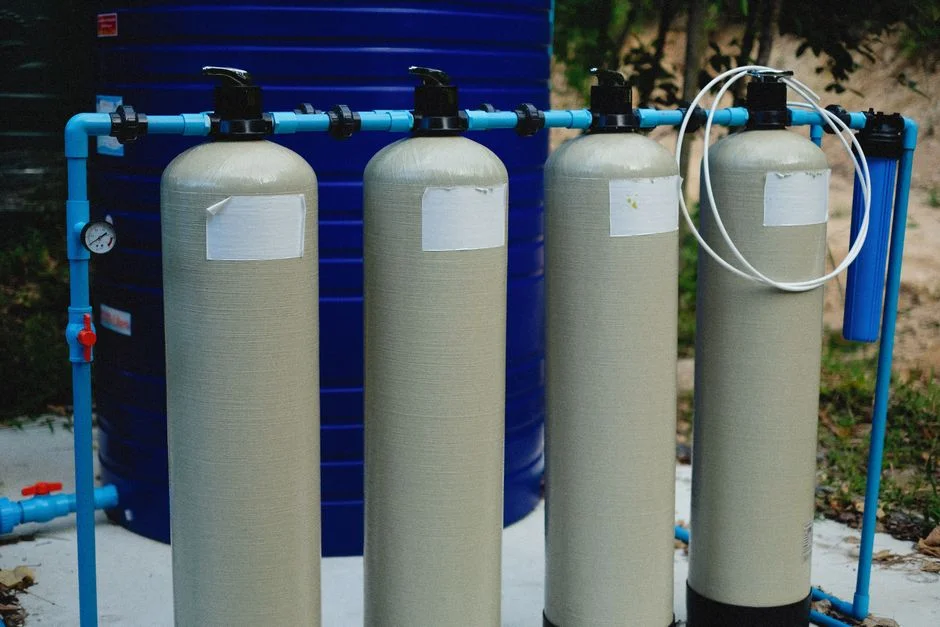
Hydraulic loading, defined as m³/h per m of belt width, serves as the second primary sizing currency and acts as the binding constraint for dilute feeds. A belt press that handles the dry-solids load on paper can still flood at commissioning if the gravity drainage zone cannot pass the feed water before the cake reaches the compression rollers.
For feeds below 1.5% solids, the rule of thumb in municipal dewatering is that hydraulic loading governs, not dry-solids loading. Wikipedia notes that three-belt designs are specifically engineered to extend hydraulic capacity for these dilute feeds by allowing independent belt speeds and a dedicated, longer gravity zone (per Wikipedia, S5). Two-belt presses typically run out of drainage capacity well before they run out of solids capacity on a 1% feed.
Check it explicitly: divide feed flow (m³/h) by selected belt width (m) and compare to the press rating at your cake thickness target. If you are above rating, you have three options — widen the belt, add a second machine, or specify a three-belt design. Polymer conditioning has an outsized effect: overdosing or poor mixing collapses floc structure and reduces drainage rate, which effectively lowers hydraulic capacity even when the machine is mechanically rated for the flow (per Wikipedia, S5). This is why a bench-scale CST and Buchner funnel program is non-optional.
Design Parameters That Move the Loading Rate Up or Down
The 40–230 vs. 300–910 kg/h/m bands are determined by conditioning chemistry and the upstream process. Four parameters dictate these shifts.
Sludge type. Aerobically digested WAS typically lands in the mid band, roughly 200–400 kg/h/m with good polymer conditioning. Primary sludge can reach the high band (>500 kg/h/m) because the solids are larger and easier to drain. Industrial chemical sludge varies widely; treat vendor data as optimistic until you have piloted it.
Feed solids concentration. Above 3–4% the high band is realistic. Below 1.5%, even a three-belt design struggles to push past the low band (per Wikipedia, S5). Thickening upstream is often the cheapest capacity upgrade available.
Polymer selection and dose. Correct flocculation is the single biggest lever. The Wikipedia caveat on pH matters: low pH decreases flocculation, so a digested sludge drifting to pH 6.0 will see throughput collapse before any mechanical limit is reached. Run jar tests and CST across the expected pH and solids range, not just at one point.
Belt media and cake dryness target. More open weaves raise hydraulic capacity but reduce filtrate clarity — a real constraint if the filtrate is recycled to the head of the plant. Pushing for higher cake solids (say, 25% vs. 20%) typically costs 20–40% of throughput because the compression rollers become the bottleneck.
| Parameter | Pushing Loading Rate Down | Pushing Loading Rate Up |
|---|---|---|
| Feed solids % | < 1.5% (gravity zone floods) | 3–4%+ (high band realistic) |
| Sludge type | Industrial chemical, high oil/grease | Primary, well-digested, well-thickened |
| Polymer conditioning | Overdosed, poorly mixed, wrong MW | Optimized via CST + jar test |
| pH | < 6.0 destroys floc structure | 6.8–7.5 for most cationic polymers |
| Belt media | Tight weave, blinded cloth | Open weave, effective wash section |
| Cake dryness target | 25%+ target costs 20–40% throughput | 18–22% target leaves headroom |
Pilot Testing Before You Commit to a Design
A six-figure capital purchase requires a rigorous de-risking sequence: bench-scale testing, vendor pilot, and finally full-scale deployment.
Start at the bench with capillary suction time (CST) and Buchner funnel tests. CST gives you a fast read on polymer type and dose across a matrix of conditions; Buchner funnel gives you achievable cake solids and drainage rate. Both are cheap, both run on a few liters of sludge, and both should bracket the seasonal and operational variation you expect (digester upsets, wet-weather flows, industrial batch discharges).
A vendor or rental pilot unit then measures what bench tests cannot: sustained kg DS/h, cake solids, solids recovery, polymer consumption, and belt blinding behavior at your actual sludge over 1–4 weeks. The pilot duration matters — a single good day is not a design basis. Insist on at least one full diurnal cycle and, where possible, both a "best" and a "worst" sludge week. Wikipedia specifically notes that the gravity drainage section can be replicated at lab scale to optimize conditioning before any full-scale trial (per Wikipedia, S5), preventing the need to tune polymer dose on a $400,000 machine.
Belt Press vs Plate-and-Frame vs Decanter Centrifuge at Matched Capacity
Once you have a sized belt press, the procurement question is whether it is the right technology at all. The comparison at matched throughput (~1,000 kg DS/h) is summarized below. Belt presses win on throughput per meter, flocculant consumption, energy, and capital cost for mid-size plants, while plate-and-frame systems offer higher cake dryness and centrifuges provide smaller footprints.
| Criterion | Belt Filter Press | Plate-and-Frame Filter Press | Decanter Centrifuge |
|---|---|---|---|
| Achievable cake dryness | 18–24% | 28–35% | 20–28% |
| Polymer consumption | Lowest (excl. membrane) | Low–moderate | Moderate–high |
| Footprint (per 1,000 kg DS/h) | Large, open layout | Moderate | Compact, enclosed |
| Energy (kWh/m³ filtrate) | Low (~0.5–1.0) | Low–moderate | Higher (~2–4) |
| Capital cost band | Lowest of the three | Moderate | Moderate–high |
| Sensitivity to feed variability | High — needs operator attention | Moderate | Low — easier to automate |
| Cost-efficient above | 4 MGD (~15,000 m³/d) (per Wikipedia, S5) | Smaller plants, high dryness targets | Tight footprints, enclosed installations |
| Operator skill required | Higher (visual tuning, polymer prep) | Moderate (cycle management) | Moderate (back-drive, pond depth) |
For a procurement manager, the belt press is the right answer when throughput is high and cake dryness around 20% is acceptable. The HydropureWater plate and frame filter press wins when cake solids above 28% are needed to cut hauling costs, and the decanter centrifuge process flow guide is the reference for enclosed or space-constrained sites. Engineers dealing with feed-side clarification issues upstream of any of these should also see the high-efficiency sedimentation tank troubleshooting guide.
Frequently Asked Questions
What loading rate should I use to size a belt filter press for waste activated sludge?
For well-conditioned WAS at 2–4% solids, plan on 300–
Frequently Asked Questions
How do you calculate belt filter press capacity?
Belt filter press capacity is calculated by determining the mass loading rate of dry solids per unit of belt width per hour, typically expressed in kg/m/h or lb/ft/h. The formula requires the influent flow rate (m³/h), the feed solids concentration (%), and the belt width (m). The target throughput must account for the sludge's specific drainage characteristics, often determined through laboratory bench-scale testing or pilot studies to establish the critical flux rate.
What is the typical dry solids loading rate for a belt filter press?
Typical dry solids loading rates range from 200 to 600 kg/m/h for municipal wastewater sludges. Industrial applications vary significantly based on sludge composition; for example, primary sludge may allow loading rates at the higher end of the spectrum (up to 800 kg/m/h), while secondary biological sludges often require lower loading rates between 150 and 300 kg/m/h to maintain effective drainage and prevent belt blinding.
How much belt width do I need for a given sludge flow rate?
Belt width requirements are sized based on the hydraulic loading limit and the solids loading limit. As a general industry standard, a 2-meter belt press can process between 15 to 40 m³/h of sludge depending on the feed solids concentration, which typically ranges from 1% to 4%. Engineers must size the unit based on the peak flow rate plus a safety factor of 1.2 to 1.5 to accommodate fluctuations in sludge characteristics and polymer conditioning efficiency.
When is a belt filter press not cost-effective compared to a centrifuge?
A belt filter press is generally less cost-effective than a centrifuge when processing low-concentration, high-volume secondary sludges that require high polymer dosages or when the facility has limited footprint, as centrifuges offer a significantly higher throughput per square foot. Additionally, if the required final cake dryness exceeds 25-30% total solids, a centrifuge or a high-pressure membrane filter press is usually superior, as belt presses struggle to achieve these levels with difficult-to-dewater sludge types.
What is the difference between a two-belt and three-belt filter press?
A two-belt filter press utilizes a single gravity drainage zone followed by a pressure zone where the sludge is sandwiched between two belts. A three-belt press incorporates an additional independent gravity drainage belt located above the main assembly, which increases the initial drainage area and allows for higher hydraulic throughput. Three-belt configurations are specifically engineered for dilute sludges where the initial gravity drainage phase is the primary bottleneck in the dewatering process.