Why Biopharmaceutical Wastewater Needs Fenton Oxidation
Biopharmaceutical effluent routinely arrives at the treatment plant with COD between 2,000 and 15,000 mg/L, a BOD5/COD ratio frequently below 0.2, and a load of recalcitrant beta-lactam antibiotics, residual active pharmaceutical ingredients (APIs), and fermentation broth by-products that conventional activated sludge struggles to break down (per S3 composite industrial wastewater characterization, Nature 2024). The chemical structure of these compounds — saturated heterocycles, sulfonamide groups, and high-molecular-weight excipients — is precisely what makes biological treatment stall, because the bacteria cannot cleave the bonds and the toxicity suppresses endogenous respiration. Even moderately biodegradable streams exhibit a 23-day BOD plateau in the Lovibond BD600 assay (S3), confirming that adding biology alone does not push COD low enough for discharge or reuse.
Photo-Fenton pretreatment is established in pharmaceutical manufacturing: 35% of the photo-Fenton studies in the S4 MDPI review (Catalysts, 2020) cover industrial wastewater from pharmaceutical, refinery, textile, and pesticide sectors. Fenton chemistry generates hydroxyl radicals (·OH) at pH 3 from Fe2+ and H2O2, with a standard reduction potential of 2.80 V that non-selectively oxidizes the recalcitrant APIs and lifts the BOD5/COD ratio above 0.3 so a downstream MBR or activated sludge stage can finish the job.
Fenton Reaction Chemistry and Why pH 3 Is Non-Negotiable
The classical Fenton reaction (S3 Eq. 2) is Fe2+ + H2O2 → Fe3+ + OH− + ·OH. The hydroxyl radical is the working species; everything else — pH, iron dose, H2O2 stoichiometry — is about sustaining its production rate. A secondary pathway (S3) regenerates the catalyst: Fe3+ + H2O2 → Fe2+ + ·OOH + H+, which keeps the radical flux going without continuous iron make-up.
pH 3 is the operating floor because the Fenton sweep across pH 3–11 (S3) shows COD removal collapsing once the solution moves past pH 5. Above that threshold, ferric iron precipitates as Fe(OH)3, scavenging the catalyst and producing dense iron sludge that wastes reagent and fouls downstream equipment. Operating at pH 2 or below is also counterproductive because H2O2 is protonated to H3O2+ and the radical yield drops. Sulfuric acid (H2SO4) is the preferred acidulant for cost and chloride avoidance, and sodium hydroxide (NaOH) is the standard neutralizer before the biological polishing stage.
Design Parameters and COD Removal Performance
Engineers size a Fenton skid for biopharma strength by adhering to specific operating ranges. The bench-scale anchor is the S3 composite industrial wastewater dataset: at pH 3, 1 mg/L Fe2+, and 0.3 g/L H2O2, conventional Fenton delivers 78.43% COD removal and electro-Fenton reaches 84.3% COD. The S3 electrode study used two 5 × 8 cm plates with an effective surface area of 9 cm² immersed in a 1 L beaker at pH 5, 0.3 g/L H2O2, 1 mg/L Fe2+.
| Parameter | Typical range | COD removal reference | Source |
|---|---|---|---|
| pH | 2.5–3.5 (operating), 6.5–7.5 (post-neutralization) | Optimum pH 3; collapse above pH 5 | S3 |
| Fe2+ dose | 0.5–150 mg/L (catalyst) | 78.4% at 1 mg/L; >80% at 150 mg/L (textile SBB) | S3 |
| H2O2 dose | 0.05–0.5 g/L | 78.4% at 0.3 g/L; 84.3% (electro-Fenton) at 0.3 g/L | S3 |
| HRT (reaction tank) | 30–120 min | 30 min at 150 mg/L Fe2+ + 100 mg/L H2O2 → >80% | S3 (SBB textile, 2021) |
| Fe2+ : H2O2 stoichiometry | 2 mM Fe2+ : 1000 ppm H2O2 (≈111 : 1000) | 76.8% COD on synthetic textile (EF) | S3 (Suhan et al., 2020) |
| Acid / base | H2SO4 (acidulation), NaOH (neutralization) | NaOH at €0.55/kg | S4 |
For an antibiotic or API stream, expect to operate in the upper half of the Fe2+ range (50–150 mg/L) and the middle of the H2O2 range (0.2–0.4 g/L) because fermentation residues carry more electron-dense organics than a generic composite sample. The 150 mg/L Fe2+ + 100 mg/L H2O2 + 30 min SBB textile result is a defensible upper-dose benchmark for a high-strength API batch; the 1 mg/L Fe2+ + 0.3 g/L H2O2 composite result is the lower-dose anchor for streams closer to 5,000 mg/L COD.
Fenton Variants: Conventional, Electro, Photo, and Solar
The variant choice depends on energy, reagent, and footprint requirements rather than chemistry fundamentals, as every variant relies on ·OH generated through the Fe2+/H2O2 cycle.
| Variant | COD removal (S3 composite) | CAPEX vs. conventional | OPEX drivers | Best fit |
|---|---|---|---|---|
| Conventional Fenton | 78.43% | Lowest (no power supply, no UV) | H2O2, FeSO4, acid/base | Default pretreatment skid |
| Electro-Fenton | 84.3% | Higher (rectifier, electrodes, in-situ H2O2 via O2 + 2H+ + 2e− → H2O2, S3 Eq. 1) | Electricity, electrode wear | Tight COD targets, H2O2 logistics constrained |
| Photo-Fenton (UV/H2O2/Fe) | Listed as BAT for textile (S4) | Higher (UV lamps, reactors) | UV electricity; S4 reports 350 kWh/m³ dropping to 60–100 kWh/m³ with coagulation pretreatment | Plants with low-carbon grid, post-biology polishing |
| Solar photo-Fenton | Feasible at 200 W/m² irradiance (S4) | Lowest energy CAPEX (compound parabolic collectors) | Very low Fe (0.5 mg/L) and H2O2 (5 mg/L) | High-irradiance sites, ≤20 m³/d |
The 6 percentage-point gain from conventional to electro-Fenton (78.43% → 84.3%) is real but rarely justifies the rectifier and electrode replacement cost for a biopharma plant below ~50 m³/h. Photo-Fenton's energy cost advantage materializes when coagulation upstream cuts UV load by 80–85% (S4).
Hybrid Train Design: Fenton Pretreatment Followed by MBR
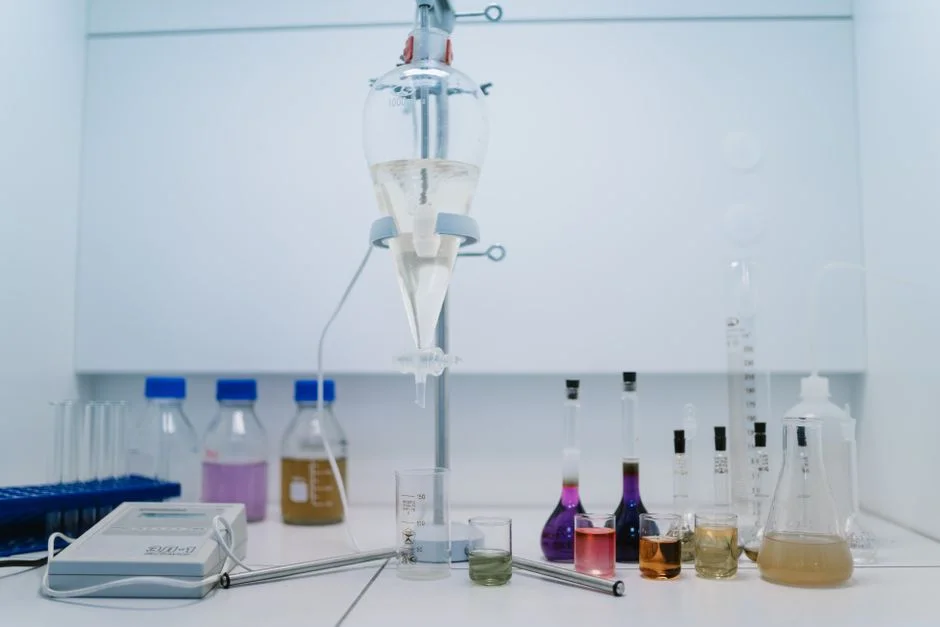
Fenton acts as a pretreatment to enhance biodegradability rather than a terminal step. The recommended process flow is: equalization → pH adjustment to 3 with H2SO4 → Fe2+ + H2O2 reaction tank (30–60 min HRT) → neutralization to pH 6.5–7.5 with NaOH → DAF unit or lamella clarifier for iron sludge removal → MBR membrane bioreactor biological polishing → disinfection (UV or chlorine). The PLC-controlled chemical dosing skid handles both the acid/Fe2+/H2O2 feed and the NaOH neutralization in one package.
The Fenton step lifts the BOD5/COD ratio from ~0.1 to ≥0.3, enabling heterotrophs to metabolize the broken-down fragments. The S3 28-day BOD assay confirms that Fenton-pretreated composite wastewater is "moderately biodegradable" by the time it leaves the reaction tank. Combined train performance typically reaches ≥95% COD removal and BOD5 ≤30 mg/L, satisfying most POTW discharge and many on-site reuse targets.
Iron sludge is the most visible waste stream — typically 0.3–0.6 kg dry solids per m³ treated, depending on Fe2+ dose. Dewater it on a plate-and-frame filter press to ≥35% dry solids before landfill or hazardous-waste routing, depending on API carry-through.
2026 Cost and Operating Economics
Chemical OPEX in 2026 is dominated by H2O2 (€0.7/kg, S4) and NaOH (€0.55/kg, S4). A 0.3 g/L H2O2 dose translates to roughly €0.21 of peroxide per m³ treated, before NaOH neutralization and FeSO4 catalyst cost. Energy OPEX for a UV/H2O2 full-scale installation in Sweden was 0.064 €/m³ at 5000 J/m² UV dose, 20 mg/L H2O2, and 0.12 mg/L dissolved iron, with lamp replacement every 1.5 years (S4) — about 35% of that figure is electricity, the rest is lamp and consumable cost. Conventional Fenton sits below that energy line because no UV system is in scope.
| Cost line | 2026 reference value | Assumption | Source |
|---|---|---|---|
| H2O2 reagent | €0.7/kg | Bulk 50% w/w | S4 (2020 review, still quoted in 2026 EU tenders) |
| NaOH reagent | €0.55/kg | Bulk 50% liquid | S4 |
| UV/H2O2 OPEX (full-scale) | 0.064 €/m³ | Sweden reference, 5000 J/m² UV, 20 mg/L H2O2 | S4 |
| Sludge disposal | 20–35% of OPEX | Iron hydroxide + API carry-through | Engineering judgment, 2026 EU hazardous-waste rates |
| Fenton skid CAPEX (5–50 m³/h) | Driven by reactor volume (HRT × flow), materials (CSTR with rubber-lined carbon steel or PP/FRP for chloride exposure), H2O2 storage and dosing panels, and neutralization tankage | Not quoted as a single number — sizing is project-specific | — |
The Fenton oxidation system for pharmaceutical wastewater guide walks through a similar cost stack. If the project sits in the UK, the effluent treatment plant buyer's guide covers 2026 procurement specifics, and iron-sludge handling is detailed in the sludge treatment process guide.
Frequently Asked Questions
What pH does a Fenton oxidation system need for biopharmaceutical wastewater?
pH 3 is the operating optimum, typically controlled between 2.5 and 3.5 with sulfuric acid. Above pH 5, iron precipitates as Fe(OH)3, catalyst is lost, and COD removal collapses (S3 composite industrial wastewater parameter sweep, pH 3–11).
How much COD can Fenton remove on a biopharma-strength stream?
Bench-scale data on composite industrial wastewater shows 78.43%
Frequently Asked Questions
What is the optimum pH for a Fenton oxidation system treating biopharmaceutical wastewater?
The optimum pH range for traditional Fenton oxidation is strictly between 2.8 and 3.5. Operating within this acidic window is critical to prevent the precipitation of iron as ferric hydroxide, which would terminate the catalytic cycle and inhibit the formation of highly reactive hydroxyl radicals.
How much COD removal can a Fenton system achieve on pharmaceutical effluent?
Fenton oxidation typically achieves Chemical Oxygen Demand (COD) removal efficiencies ranging from 60% to 90%, depending on the complexity of the organic matrix. For recalcitrant biopharmaceutical compounds, mineralization rates are highly dependent on the initial COD:H2O2 mass ratio and the specific molecular structure of the pharmaceutical ingredients present.
Should Fenton be used as pretreatment or as a final polishing step for biopharma wastewater?
Fenton oxidation is most effectively utilized as a pretreatment step to increase the biodegradability (BOD5/COD ratio) of wastewater containing toxic or refractory pharmaceutical intermediates. By breaking down complex aromatic rings and inhibitory compounds, the effluent becomes suitable for conventional aerobic biological treatment processes, though it can also serve as a final polishing step if targeting trace concentrations of persistent micro-pollutants.
What is the typical Fe2+ and H2O2 dose for a Fenton reactor in a pharmaceutical plant?
Typical molar ratios for Fenton reactions in pharmaceutical applications generally follow a ratio of Fe2+:H2O2:COD ranging from 1:5:10 to 1:10:50. While specific dosages are determined by bench-scale jar testing, operators typically maintain H2O2 concentrations between 500 mg/L and 2,000 mg/L, with iron catalysts dosed at 50 mg/L to 200 mg/L to ensure sufficient radical generation.
How much does a Fenton oxidation system cost per cubic meter in 2026?
In 2026, the operational expenditure (OPEX) for Fenton oxidation, including hydrogen peroxide, ferrous sulfate, and pH adjustment chemicals, typically ranges from $1.50 to $4.50 per cubic meter of treated effluent. Total costs vary based on the initial COD load, local utility pricing, and the specific chemical consumption rates required to meet local discharge standards.