Why Merritt Island Transportation Shops Need a Different Pretreatment Strategy
Merritt Island's transportation equipment sector is a Space Coast cluster where NASA-adjacent aerospace suppliers, satellite hardware manufacturers, Port Canaveral marine repair yards, ground-vehicle assembly lines, and Defense Department subcontractors generate a single shared wastewater signature. That signature is dominated by emulsified cutting fluids, synthetic and semi-synthetic machining coolants, hydraulic oil carry-over, tramp grease, and rinse water spiked with total dissolved solids (TDS) from brackish supply. Heavy metal fines from titanium and aluminum machining, plus zinc and copper from plating rinse lines, sit alongside FOG in the same floor drain.
The single most important performance gap for these streams is that a DAF system achieves up to 95% FOG removal versus 70% for a conventional clarifier (Ecologix Systems, 2026-05). On the solids side, that same clarifier reaches 90% TSS reduction at roughly 30% lower chemical cost. A typical Merritt Island aerospace wash bay produces both, which is why single-technology answers fail here. The same hybrid logic applies in Bradenton's EV/auto shops, but with a different metal mix.
Brevard County industrial pretreatment requirements, administered through the county's Industrial Pretreatment Program, are the compliance driver that forces the technology choice. Discharge to the county sewer system is governed by local limits on FOG, TSS, and metals that align with — but are often tighter than — EPA 40 CFR 133 categorical standards. The wrong pretreatment unit triggers surcharges on deep-well injection and reclaimed-water quality violations that compound month over month.
DAF vs Clarifier: How Each Technology Actually Works on Transportation Effluent
A DAF system saturates a pressurized side stream with air at 60-80 psig, then releases the stream through a needle valve into the main flotation tank. The pressure drop nucleates a cloud of 30-50 micron microbubbles (Clearwater Industries, 2026-04) that attach to oil droplets, flocculated solids, and FOG, lifting them to the surface where a paddle skimmer scrapes the float layer into a hopper. The clarified underflow exits the bottom of the tank. Heavier settleable solids collect in a bottom cone and are augered out separately.
These two systems operate on distinct physical principles, requiring site-specific analysis of the influent stream to determine the appropriate equipment.
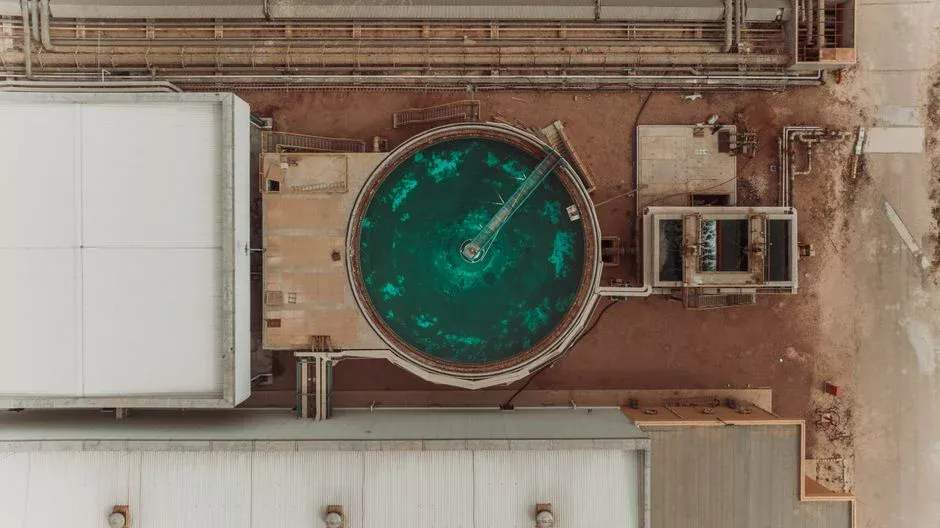
A clarifier is a gravity device. Influent enters a center well or inlet baffle, the cross-sectional velocity drops, and Stokes-law settling takes over for particles denser than water. A slowly rotating scraper arm pushes bottom sludge to a central hopper for removal. A lamella clarifier — the workhorse of high-load industrial sites — inserts a stack of inclined plates at 55-60°. Those plates shorten the effective settling distance, allowing surface loading rates of 20-40 m/h on a footprint one-third to one-fifth the size of an equivalent circular clarifier (HydropureWater lamella clarifier guidance, 2026-05).
Emulsified oils resist gravity separation for a specific physical reason. Cutting fluids and coolants contain surfactants that stabilize oil-in-water emulsions at droplet sizes below 20 microns. At that diameter, Stokes-law settling velocity becomes negligible — a 10-micron oil droplet settles roughly 1,000 times slower than a 100-micron grit particle. The droplet effectively behaves like a dissolved species, which is why a clarifier returns only 70% FOG removal on these streams while a DAF system, attaching microbubbles directly to those droplets, hits 95%.
Neither technology works without upstream chemistry. Coagulant (typically a cationic polymer or ferric chloride) neutralizes the surface charge on colloidal particles, and flocculant (anionic or nonionic polyacrylamide) bridges them into pin-flocs large enough for microbubbles to lift — or dense enough to settle. A DAF without dosing is a bubble bath; a clarifier without dosing is a cloud.
Side-by-Side Performance Comparison for Merritt Island Conditions
The table below consolidates the operating envelope of both technologies on transportation effluent. Material recommendations assume salt-air exposure on the Barrier Island and Port Canaveral-adjacent sites.
| Parameter | DAF System | Lamella Clarifier |
|---|---|---|
| FOG removal efficiency | Up to 95% (Ecologix, 2026-05) | ~70% (Ecologix, 2026-05) |
| TSS removal efficiency | 60-75% | Up to 90% (Ecologix, 2026-05) |
| Oil droplet size handled | Down to ~5 microns after flocculation | Ineffective below ~50 microns |
| Hydraulic loading / surface loading rate | 5-25 m/h (Clearwater, 2026-04) | 20-40 m/h (HydropureWater, 2026-05) |
| Footprint (per m³/h treated) | 0.04-0.20 m² | 0.025-0.05 m² |
| Chemical demand | High — coagulant + flocculant required | Moderate — flocculant typically sufficient |
| Sludge solids concentration | 3-7% (floated, high quality) | 1-3% (settled, requires thickening) |
| CAPEX (skid, 25-100 GPM) | Higher (air system, pumps, controls) | Lower (passive tank, scraper) |
| OPEX (energy + chemicals) | Higher energy, lower chemical unit cost | Lower energy, ~30% lower chemical cost |
| Maintenance hours / week | 4-8 (skimmer, air system, dosing pumps) | 1-3 (scraper bearings, sludge pump) |
| Material recommendation (salt air) | 316 SS or FRP | 316 SS, FRP, or coated carbon steel |
| Flow range covered | 4-300 m³/h (DAF mid-range catalog) | 5-500 m³/h (lamella stacks) |
For Barrier Island sites within sight of the lagoon, default to 316 stainless steel or fiberglass-reinforced plastic (FRP). 304 SS is acceptable only for indoor equipment, and coated carbon steel has a service life penalty of roughly 5-7 years in salt-air service versus 15+ years for 316 SS.
Sizing Math: Translating Your Shop's GPM into a Real Equipment Footprint
The first conversion every plant engineer needs is that 1 GPM equals 0.227 m³/h. The relevant breakpoints for a Merritt Island transportation shop are 25 GPM (a single wash bay), 100 GPM (a small machine shop with two or three CNC cells), and 150 GPM (a Port Canaveral marine repair bay with deck wash-down).
For a lamella clarifier at 30 m/h surface loading — the middle of the 20-40 m/h range — the math runs as follows. A 25 GPM stream (5.7 m³/h) needs roughly 5.7 / 30 = 0.19 m² of effective plate area, easily packaged into a 1.5 m × 0.8 m skid. A 100 GPM stream (22.7 m³/h) needs about 0.76 m², typically a 2.0 m × 1.2 m footprint. A 150 GPM stream (34 m³/h) needs about 1.13 m², packaged in a 2.5 m × 1.5 m skid.
For a DAF system at 15 m/h — a conservative mid-range value that accounts for the hydraulic residence time needed for bubble attachment — a 100 GPM stream (22.7 m³/h) needs 22.7 / 15 = 1.51 m² of effective flotation surface, which maps directly to the mid-range DAF system catalog covering 4-300 m³/h. A 25 GPM stream fits a compact skid, while a 150 GPM stream steps into a two-skid or larger rectangular tank configuration.
Transportation maintenance flow is rarely steady. Wash bays discharge in surges tied to shift changes, parts washer cycles, and shipyard dry-dock events. Apply a 1.5-2x peaking factor when sizing the equalization basin upstream of either technology. Skipping this step is the single most common cause of float carry-over in DAF systems and resuspension of settled sludge in clarifiers.
Decision Framework: Which Unit Goes First, Which Goes Second, and When You Only Need One
Three rules cover roughly 90% of Merritt Island transportation effluent profiles.
Rule 1 — FOG-dominated stream: If FOG exceeds 200 mg/L and TSS runs below 500 mg/L (typical of a CNC machine shop with light parts-washer discharge), a DAF unit alone is the right answer. Skip the clarifier entirely. Target the DAF system sized for your peak GPM, and budget for an automatic chemical dosing skid sized to the polymer feed rate.
Rule 2 — Solids-dominated stream: If TSS exceeds 1,000 mg/L and FOG runs below 100 mg/L (typical of a ship repair yard with grit blast residue and metal fines), a lamella clarifier alone is correct. The HydropureWater lamella clarifier handles the load at 30-40 m/h surface loading and tolerates the abrasive fines that would chew up DAF skimmer blades.
Rule 3 — Hybrid train (most common at aerospace wash bays): If both are high — FOG above 200 mg/L and TSS above 1,000 mg/L — install the clarifier first as a grit cap, then the DAF as an oil polish. The clarifier strips the abrasive load that destroys DAF skimmers; the DAF strips the emulsified oil the clarifier cannot touch. The hybrid train is the default recommendation for any Brevard County facility that runs both metal machining and wash-bay operations in the same building.
For space-constrained Barrier Island sites, two compact options exist. Skid-mounted DAF units at 66 GPM or less (Clearwater Industries, 2026-04) fit inside a standard equipment room with overhead clearance under 3 m. For surge loads, planned maintenance shutdowns, or emergency response, mobile trailer DAF units deploy within a single day and integrate with existing piping via cam-lock connections (WesTech mobile DAF, 2026).
The economic case is straightforward. Brevard County deep-well injection surcharges scale with both volume and contaminant load, and reclaimed-water quality violations carry per-incident penalties plus monthly non-compliance fees. A DAF-and-clarifier hybrid train sized to your actual GPM pays back the incremental CAPEX over the avoided surcharges within 12-24 months on a typical 100 GPM transportation shop. The wrong single-technology choice extends that payback indefinitely, because the unit cannot hit the discharge limit in the first place.
Frequently Asked Questions
What FOG removal efficiency can a DAF system achieve on Merritt Island aerospace wash-water?
A DAF system with proper coagulant and flocculant dosing achieves up to 95% FOG removal on emulsified aerospace coolant streams, compared to roughly 70% for a conventional clarifier (Ecologix Systems, 2026-05). The gap comes from the microbubble attachment mechanism, which targets oil droplets below 20 microns that gravity separation cannot reach.
Can a clarifier and a DAF system be used together in a hybrid treatment train?
Yes, and for most Merritt Island aerospace wash bays, they should be. Place a HydropureWater lamella clarifier upstream to strip grit and metal fines, then a DAF system downstream to polish residual FOG and colloidal solids. This is the configuration most Brevard County pretreatment audits will accept as best available technology for the transportation sector.
How important is automatic chemical dosing for DAF or clarifier performance?
Automatic chemical dosing is critical, as manual dosing drifts within hours and