Why Tallahassee-area petroleum sites face a different pretreatment path than a refinery
The Tallahassee region has no true petroleum refinery, but Leon, Gadsden, Wakulla, Jefferson, and Liberty counties host a meaningful cluster of bulk storage terminals, trans-load facilities, and lubricant-handling operations that fall under the non-categorical Significant Industrial User (SIU) rules at 40 CFR Part 403, not the categorical petroleum refining standards at 40 CFR Part 419. Under 40 CFR Part 403.3(j), an "Industrial User" is any non-domestic source that discharges process wastewater to a POTW or contributes ≥25,000 gpd of non-domestic waste; once a bulk plant or terminal crosses that threshold, it inherits the same federal pass-through and interference floor that a refinery does, minus the technology-based categorical numbers. The local control authority for sites discharging to the City of Tallahassee system is the Underground Utility & Public Infrastructure / Water Quality Division, which administers Technically Based Local Limits (TBLLs) derived using the EPA Maximum Allowable Headworks Loading (MAHL) method (per the 2020 St. Joseph, MO TBLL evaluation by Black & Veatch). Because MAHL-driven TBLLs protect the receiving POTW's NPDES permit, biosolids program, and downstream water quality, they are routinely more stringent than the federal categorical numbers — a reality the top national guides tend to gloss over when they lump "petroleum plants" together.
For day-to-day operations, the Sanford, FL Pretreatment Program provides a useful administrative template: a Wastewater Discharge Application is due at least 90 days pre-discharge for new construction and within 30 days for existing users, with a $250 initial permit fee and a $150 renewal (City of Sanford, 2025). The Tallahassee program follows a comparable intake and inspection cadence. FDEP holds state-level oversight through the NPDES program and through the Basin Management Action Plans (BMAPs) for the Ochlockonee and Apalachicola basins, which add reuse and nutrient pressure to the engineering rationale for tightening the front of the train.
The 40 CFR Part 403 compliance framework as Florida applies it
The 40 CFR Part 403.5(a) general prohibition forbids any discharge that causes "pass-through" or "interference" at the receiving POTW, and it applies whether or not the local control mechanism has been issued — there is no "silent" exemption just because the City of Tallahassee has not yet issued a permit (EPA pretreatment standards page, 2025-09). Pass-through, defined at 40 CFR Part 403.3(p), is a discharge that exits the POTW into waters of the U.S. and, alone or with other sources, is a cause of a violation of the POTW's NPDES permit, including any increase in the magnitude or duration of an existing violation. Interference, defined at 40 CFR Part 403.3(k), is a two-prong test: the discharge must (1) inhibit or disrupt the POTW, its treatment processes, or its sludge use/disposal, AND (2) therefore cause an NPDES or RCRA / CWA §405 violation.
The specific prohibitions at 40 CFR Part 403.5(b) forbid eight pollutant categories. The four most relevant to a Tallahassee-area petroleum site are: (1) flashpoint <140°F (60°C) closed cup; (2) pH lower than 5.0 unless the works is specifically designed for it; (5) heat in amounts that push POTW influent above 40°C (104°F); and (6) petroleum oil, nonbiodegradable cutting oil, or products of mineral oil origin in amounts that cause pass-through or interference (40 CFR Part 403.5(b), 55 FR 30082, 1990). Florida implements the program under FDEP rules with the local POTW as the Control Authority; Tallahassee-area sites additionally fall under the Ochlockonee and Apalachicola BMAPs, which add water-reuse and nutrient-reduction pressure. The most common enforcement hook in 2024–2026 EPA consent decrees is the slug-control plan language at 40 CFR Part 403.8(b)(4) and the SIU permit's slug provisions, where a missing or untrained plan is treated as a self-inflicted SNC.
What the local Tallahassee POTW is actually measuring in 2026

Typical Florida POTW local limit bands sit at 50–100 mg/L oil & grease, 1–10 mg/L sulfides, and 0.5–5 mg/L phenols, with metals and BTEX often pulled in as quarterly monitoring parameters under the SIU permit (per S1, 2026). For petroleum bulk plants, the HEM ceiling is typically 100–200 mg/L daily maximum with ~250 mg/L TSS; stricter reuse-basin permits push HEM toward 50 mg/L (per the 2020 St. Joseph, MO TBLL by Black & Veatch). HEM is measured by EPA Method 1664A (n-hexane extraction) and is the federally used surrogate for fats, oils, and grease under 40 CFR § 401.16. The self-monitoring cadence most Florida POTWs expect in 2026: daily visual free-oil inspection at the outlet weir, weekly TSS grab, monthly HEM composite (24-hour flow-proportional where the permit specifies), and quarterly BTEX/TPH where the local limit is non-zero.
Surcharge triggers mirror the City of Sanford program: pH <5 or >9, plus high CBOD, TSS, and O&G each trigger a surcharge (City of Sanford Surcharge Program FAQ, 2025-08). A sampling manhole or representative sample point is mandatory for the Surcharge Program and is the most common audit finding when missing (S3, 2025-08). The table below translates the federal rule into the parameter list and the limit ranges a Tallahassee-area inspector will grade against.
| Parameter | Typical FL POTW Local Limit (Daily Max) | Measurement Method | Minimum Monitoring Cadence |
|---|---|---|---|
| Oil & Grease (HEM) | 50–200 mg/L | EPA Method 1664A (n-hexane) | Monthly composite |
| TSS | ~250 mg/L | SM 2540D | Weekly grab |
| Sulfides (total) | 1–10 mg/L | SM 4500-S²⁻ | Monthly |
| Phenols | 0.5–5 mg/L | EPA 420.1 / 625 | Monthly |
| BTEX | 0.1–1 mg/L (often GC/MS quarterly) | EPA 624 / 8260 | Quarterly |
| pH | 5.0–9.0 (surcharge outside) | Online probe | Continuous |
| Flow | Site-specific (gpd cap) | Calibrated magmeter | Continuous |
The five-stage pretreatment train sized for a Leon County flow band
A Leon or Gadsden county terminal in the 5–50 m³/h band is sized for an API or CPI primary, a DAF emulsified-oil polisher, equalization with pH trim, biological polishing, and a fluorescence-monitored final effluent — the same unit operations a refinery runs, but at a smaller footprint and without the spent-caustic and desalter streams. Stage 1 is free-oil removal by gravity. An API separator leaves 100–200 mg/L oil & grease in the water phase; a corrugated-plate interceptor (CPI) hits a similar band in a much smaller footprint and is the typical choice for space-constrained Leon County retrofits (per S1, 2026). Stage 2 is dissolved air flotation. The dissolved air flotation (DAF) system is specified in the 4–300 m³/h capacity range; micro-bubble flotation strips emulsified oil, FOG, and colloidal TSS down to 15–30 mg/L, with air-to-solids ratio (A/S) at 0.02–0.06, HRT 15–30 min, and saturator recycle 20–50% of forward flow. Stage 3 is equalization and neutralization. An EQ basin sized for 8–24 hours of hydraulic retention with pH adjusted to 6–9 is the single most important control point for preventing interference from spent-caustic pushes and desalter upsets.
Stage 4 is biological polishing with an MBBR or MBR. MBBR tolerates 200–800 mg/L COD that survives the front of the train; the integrated MBR system adds a <1 μm flat-sheet PVDF membrane barrier that holds biomass at 8,000–12,000 mg/L and produces <5 mg/L TSS and <1 NTU turbidity in roughly 60% of the footprint an equivalent CAS basin would need. Stage 5 is polishing and monitoring. A multimedia filter catches any TSS breakthrough, a fluorescence-based online oil-in-water analyzer alarms on a 10–20 mg/L setpoint, and pH/conductivity probes feed the control room. Every stage in the train maps to either a pass-through risk (oil, TSS, BTEX, ammonia) or an interference risk (sulfides, phenols, pH swings, slug flows) defined in 40 CFR Part 403.
| Stage | Unit Operation | Typical Outlet | Risk Addressed |
|---|---|---|---|
| 1 | API or CPI | 100–200 mg/L O&G | Free oil (pass-through) |
| 2 | DAF | 15–30 mg/L O&G | Emulsified oil / colloidal TSS |
| 3 | EQ + pH trim to 6–9 | Stable pH, dampened slug | Interference from pH/flow swings |
| 4 | MBBR or MBR | <5 mg/L TSS; reduced COD/sulfides/phenols | Pass-through organics; interference to biomass |
| 5 | Multimedia filter + online OIW | <10 mg/L HEM (alarm) | Permit protection; final barrier |
Choosing the right primary and polishing equipment for a non-refinery site
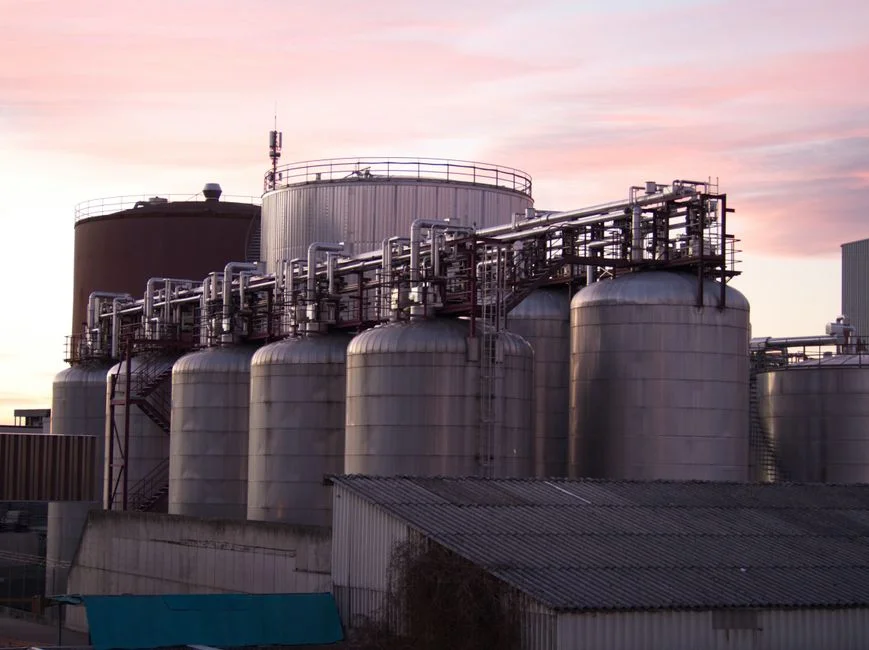
The droplet-size distribution a Tallahassee-area terminal or trans-load site actually generates is the deciding factor. Truck-loading-rack drip and tank-bottom water are mostly free oil with droplet sizes ≥60–150 µm — an API or CPI is the right primary. Wash-rack water is emulsified with surfactants driving droplet sizes below 50 µm, so a CPI alone will not break the emulsion and a DAF polisher is required to reach a 50 mg/L HEM ceiling. Field data (HydropureWater field data, 2026) shows a DAF alone without a primary gravity stage fails under slug loads from coalescer dumps because free oil blankets the micro-bubbles and crashes the A/S ratio; a CPI alone rarely meets a 100 mg/L HEM limit on emulsified waste because it does not address sub-60 µm droplets. The robust path is CPI or API as primary, then DAF as the emulsified-oil polisher, sized with a 20–30% safety margin on hydraulic and air-to-solids loading.
For tight-footprint Leon County retrofits, the polishing step is increasingly the DF series 0.1 μm PVDF flat-sheet MBR module, used as the final barrier before the sewer rather than as the sole biological stage. The chemistry step that unlocks a residual <50 mg/L HEM is pH adjustment to 6.5–7.5 ahead of the DAF, plus a 50–200 mg/L coagulant or demulsifier dose through a HydropureWater automatic chemical dosing system. Where the local TBLL demands ammonia, sulfide, or dissolved hydrocarbon reductions a physical train cannot deliver, the polishing step moves to MBBR or activated carbon.
| Technology | Droplet Size Band | Footprint | Best Role at a Leon County Site |
|---|---|---|---|
| API | ≥150 µm (free oil) | Large | Primary; large sites with steady flow |
| CPI | ≥60 µm (free oil) | Compact (vertical configs) | Primary; retrofit into existing vault |
| DAF | 10–25 µm (emulsified) | 2–5 gpm/ft² surface | Emulsified-oil polisher after primary |
| Coalescer | ≥20 µm (with media) | Vendor-specific | Polishing or low-flow <50 mg/L duty |
| MBR (DF series) | <1 μm (dissolved/colloidal) | ~60% of CAS | Final barrier; tight retrofits |
Tallahassee-specific compliance and documentation checklist
Step 1: obtain a Wastewater Discharge Permit from the City of Tallahassee Underground Utility & Public Infrastructure / Water Quality Division; until that document is in hand, the site is still on the hook under 40 CFR 403.5(a) but without a defined sampling schedule. Step 2: self-monitor with 24-hour flow-weighted composite sampling on the cadence set by the local permit; chain of custody must be defensible because most SNC findings originate from sampling-procedure deficiencies, not from treatment performance. Step 3: write, train, and drill a slug-control plan that covers loading racks, tank transitions, and batch discharges; any discharge that could cause interference must be reported within 24 hours. Step 4: accidental-discharge reporting — notify the POTW and hazardous-waste authorities within the EPA-prescribed window and follow up with a written cause/corrective-action report. Step 5: keep auditable BMP records, a restricted-chemical inventory, and operator training logs for the DAF, EQ basin, and biotreater; these are the first items an inspector requests. The HydropureWater multi-media filter at the polishing step generates the cleanest possible final effluent and a defensible data trail for the online OIW and pH/conductivity probes.
The consequence matrix is linear: one late report triggers a Notice of Violation; two in twelve months escalate to SNC; SNC triggers a Show Cause hearing and potential permit termination (per S2, 2026). For sites that need a comparable cold-climate or smaller-POTW reference, the engineering rationale for petroleum plant pretreatment compliance in a cold-climate basin and for petroleum plant pretreatment compliance in a smaller Virginia POTW jurisdiction follows the same 40 CFR Part 403 logic with a different local control authority.
Frequently Asked Questions
What is the typical 2026 oil and grease limit for a petroleum bulk plant discharging to a Florida POTW?
Most 2026 Florida POTW permits set HEM (oil and grease) at 100–200 mg/L daily maximum and approximately 250 mg/L TSS, derived using EPA's MAHL method under 40 CFR Part 403 (per the 2020 St. Joseph, MO TBLL evaluation by Black & Veatch). Stricter POTWs in water-reuse basins push daily maximum HEM toward 50 mg/L. HEM is measured by EPA Method 1664A using n-hexane extraction and is the federally used surrogate for fats, oils, and grease under 40 CFR § 401.16.
Can a DAF unit alone meet the 100 mg/L HEM limit at a Tallahassee-area terminal?
Yes, in most cases — but only if a primary gravity stage sits ahead of it. Free oil from coalescer dumps and tank drops blankets DAF micro-bubbles and crashes the air-to-solids ratio; a DAF alone fails under slug loads (HydropureWater field data, 2026). A CPI or API primary stage ahead of the DAF is standard practice, sized with a 20–30% safety margin on hydraulic and air-to-solids loading.
What triggers Significant Noncompliance (SNC) for a petroleum industrial user in Florida?
Under EPA's National Pretreatment Program, SNC is triggered by any of the following: violation of a numerical limit by ≥1.5× for any single day, violation of a numerical limit for more than 5% of measurement days in a six-month period, or failure to provide required reports within 30 days of the due date. An SNC can lead to enforcement action, surcharges, or permit termination (per EPA pretreatment standards page, 2025-09).
Which local agency administers the pretreatment permit for a Leon County bulk plant?
Sites discharging to the City of Tallahassee sanitary sewer fall under the City of Tallahassee Underground Utility & Public Infrastructure / Water Quality Division, which issues the Wastewater Discharge Permit and enforces the TBLL. State-level oversight is held by FDEP under the NPDES program, and the Ochlockonee and Apalachicola BMAPs add water-reuse and nutrient-reduction pressure on top of the federal floor.