Why the Arizona Question Differs From the Indiana Deal
On August 11, 2026, Samsung SDI announced it had acquired GM's 49.99% stake in the SynergyCells joint venture in New Carlisle, Indiana, making the facility the Korean battery maker's first wholly-owned plant in North America (samsungsdi.com, 2026-08-11). The original JV carried a planned investment of roughly $3.5 billion and a target headcount near 1,600 jobs (Wards Auto, 2026). The plant is still under construction; once complete, Samsung SDI will pivot it from EV prismatic cells to ESS prismatic cells, citing slower-than-expected EV demand and a faster-growing U.S. stationary storage market (samsungsdi.com, 2026).
No Arizona plant transaction is publicly confirmed as of the August 11 release date. The Arizona regulatory question still matters, however, because the same ESS pivot creates a forward-looking compliance problem: if Samsung SDI — or any Tier-1 supplier bidding a follow-on gigafactory package — evaluates a Phoenix, Buckeye, or Casa Grande site in 2026, the design and permitting sequence diverges sharply from Indiana. Indiana sits in U.S. EPA Region 5 and uses IDEM; Arizona sits in Region 9, runs an aquifer-protection-based system through ADEQ, and feeds municipal flow through POTWs such as Phoenix's 23rd Avenue WWTP. For water-budget sizing, the right North American ESS benchmark is LG Energy Solution's 2026 target of more than 60 GWh of global ESS capacity, with more than 50 GWh in North America (Wards Auto, 2026). A site engineered to that scale will not fit neatly into the Indiana permit template, and the ADEQ stack is where the gap shows up first.
This article is therefore scoped as forward-looking compliance intelligence, not a press summary. It compiles the ADEQ Aquifer Protection Permit (APP), AZPDES, and Phoenix-area POTW pretreatment requirements that any wholly-owned ESS gigafactory in Arizona will have to clear before discharge.
The Three Permits an Arizona Battery Plant Cannot Skip
Three permits are non-negotiable on any Arizona battery site, and the order in which they are obtained determines the project schedule. APP comes first because it controls what touches the aquifer; AZPDES governs surface discharge; POTW pretreatment governs any flow sent to a municipal sewer.
| Permit | Authority | Trigger | 2026 Status Note |
|---|---|---|---|
| ADEQ Aquifer Protection Permit (APP) | A.A.C. R18-9 | Any discharge that could reach an aquifer; HF, NMP, and lithium-bearing streams all qualify | Type 2.04 electroplating rule applies; rulemaking docket open since Jan 2021 (azdeq.gov, 2026) |
| AZPDES / NPDES | A.A.C. R18-9-A901 (40 CFR Part 122/125 implementing) | Process wastewater to surface water; industrial stormwater under multi-sector general permit | Multi-sector stormwater permit covers industrial activities (40 CFR Part 450 reference) |
| POTW Pretreatment | 40 CFR Part 403 + local limits | Discharge to municipal sewer; Phoenix 23rd Avenue WWTP applies citywide metal-finishing limits | Covers heavy metals, O&G, pH 5–11; categorical standards may apply (40 CFR 433 metal finishing, 421 battery) |
| Onsite Wastewater Treatment Facility (OWTF) | A.A.C. Title 18, Chapter 9 | Domestic or pilot wastewater without sewer connection; delegated to 15 counties | Last revised 2026-04-10; >600,000 OWTFs statewide (azdeq.gov, 2026) |
The APP is the binding document for any lithium-ion site because the rules are written around aquifer loading, not stream standards. Hydrofluoric acid used in electrolyte formation, NMP from cathode-coating solvent recovery, and lithium-bearing rinse waters all fall into regulated treatment-system categories. The Type 2.04 electroplating rule family is the historical reference, but ADEQ has been modernizing Title 18, Chapter 9 through a rulemaking opened in January 2021, so any 2026 permittee should confirm the active docket before locking in design assumptions (azdeq.gov, 2026).
AZPDES under A.A.C. R18-9-A901 is Arizona's implementation of the federal NPDES program and applies whenever process wastewater leaves the property. Most gigafactory sites pair an individual AZPDES permit for process flow with the multi-sector general permit for industrial stormwater. POTW pretreatment is the third leg: Phoenix-area sewer users must meet the local limits at the 23rd Avenue WWTP, which runs citywide categorical standards consistent with 40 CFR Part 433 (metal finishing) and 40 CFR Part 421 (battery subcategory) for heavy metals, oil and grease, and pH 5–11. For domestic and pilot streams without sewer access, Maricopa County or the equivalent delegated county issues an OWTF permit under A.A.C. Title 18, Chapter 9, last revised 2026-04-10 (azdeq.gov, 2026).
Effluent Limits That Actually Bind a Lithium-Ion Plant
Permits are abstractions until they are converted to numbers on a mass-balance spreadsheet. The ADEQ Type 2.04 electroplating and metal-finishing rule family, working in combination with Phoenix POTW local limits and APP site-specific conditions, drives the design envelope. Typical binding values for a lithium-ion cell plant in 2026 are listed in the table below; the design engineer should verify every line against the live rule before issuing a PO.
| Parameter | Typical Binding Limit | Source / Driver |
|---|---|---|
| TSS (monthly avg) | <30 mg/L | ADEQ Type 2.04 electroplating; 40 CFR 433 metal finishing |
| Oil & grease | <10 mg/L | ADEQ metal-finishing rule; POTW local limits |
| pH | 6.0–9.0 (pretreatment band 5–11) | ADEQ Type 2.04; 40 CFR 403 general |
| Nickel | <1.0 mg/L | 40 CFR 421 battery subcategory; 40 CFR 433 |
| Total metals (sum) | <2.0 mg/L (site-specific) | ADEQ Type 2.04 electroplating |
| Cobalt | Site-specific limit under APP | 40 CFR 421 battery subcategory reference |
| Lithium | No federal MCL; emerging 10–40 µg/L aquatic-life benchmark | APP site-specific condition (verify 2026 docket) |
| NMP (N-methyl-2-pyrrolidone) | 10–25 mg/L pretreatment ceiling | POTW local limits; high BOD/COD drives toxicity |
| Fluoride (from HF electrolyte formation) | 50–500 mg/L raw; treated target <10 mg/L where aquifer protection triggers apply | APP drinking-water aquifer protection framing |
| Zinc, copper, TSS (stormwater) | AZPDES multi-sector benchmark | 40 CFR Part 450; AZPDES general permit |
Cathode-coating wastewater arrives at the headworks with a fundamentally different signature than metal-finishing rinse water. Raw COD runs 5,000–20,000 mg/L because of NMP and PVDF binder; BOD₅ is typically 40–60% of COD, which is high enough that a biological step is justified but low enough that the F:M ratio in the bioreactor must be tightly controlled. Fluoride concentrations of 50–500 mg/L are common when HF-based electrolyte formation is on-site; ADEQ's aquifer protection framing pushes the treated target below 10 mg/L where the discharge path could reach a drinking-water aquifer. Lithium has no federal MCL, but ADEQ may impose 10–40 µg/L site-specific limits under the APP as the science evolves — a 2026 permittee should check the active docket rather than assume the parameter is unregulated.
The 2026 Treatment Train for Battery-Plant Wastewater
The 2026 baseline train for an Arizona gigafactory running both cell production and ESS formation is a six-stage sequence designed to remove suspended solids, FOG, and metals first, then oxidize residual organics, then polish for lithium, cobalt, nickel, and fluoride, then disinfect any reused stream, and finally dewater the sludge for off-site disposal. The order is not optional: a DAF upstream of the MBR protects the membranes; ion exchange downstream of the MBR protects the resin from organic fouling.
| Stage | Unit Process | Design Notes (2026 baseline) |
|---|---|---|
| 1. Equalization & pH adjustment | EQ tank + automatic chemical dosing system for pH control | 24–48 h HRT to smooth NMP and acid spikes; pH stabilized to 6–9 before downstream biology |
| 2. Dissolved air flotation | DAF system for cathode-coating wastewater | Removes >90% TSS and 70–85% O&G; captures coating fines and graphite particles |
| 3. Biological oxidation | MBR system for NMP-bearing wastewater or CAS with nutrient removal | MBR cuts footprint ~60% vs. CAS; <1 µm membrane yields sub-1 mg/L TSS in clarified stream |
| 4. Selective polishing | Ion exchange or selective adsorption | Targets Li, Co, Ni, F; design engineer should confirm resin life and replacement cadence against the specific waste |
| 5. Disinfection | Chlorine dioxide generator for the polishing step or UV | Required where effluent reuses in landscape irrigation or cooling-tower makeup; align with EPA, EU Directive 98/83/EC, and WHO framing |
| 6. Sludge dewatering | Plate-and-frame filter press for metal-bearing sludge | Target <60% moisture; landfill vs. hazardous disposal depends on leached metals |
Stage 1 is the hydraulic shock absorber. A 24–48 h HRT equalization basin with an automatic chemical dosing system for pH control takes the NMP and acid spikes off the biological step and prevents the membranes from seeing pH excursions. Stage 2, a DAF system for cathode-coating wastewater, strips suspended solids, FOG, and bound metals before they reach the bioreactor; field experience consistently shows >90% TSS and 70–85% O&G removal on cell-manufacturing waste streams. Stage 3 is an MBR system for NMP-bearing wastewater, which delivers sub-1 mg/L TSS at roughly 60% of the footprint of a conventional activated-sludge basin. Stage 4 — ion exchange or selective adsorption for Li, Co, Ni, and F — is the parameter where published vendor numbers vary the most; the responsible move is to size resin vessels based on site-specific treatability data, not catalog cuts. Stage 5 is a chlorine dioxide generator for the polishing step (or UV) wherever the effluent is reused in landscape irrigation or cooling-tower makeup. Stage 6 is a plate-and-frame filter press for metal-bearing sludge pushing cake moisture below 60% for landfill or hazardous disposal depending on TCLP results.
Water-Budget Sizing for a Wholly-Owned ESS Gigafactory
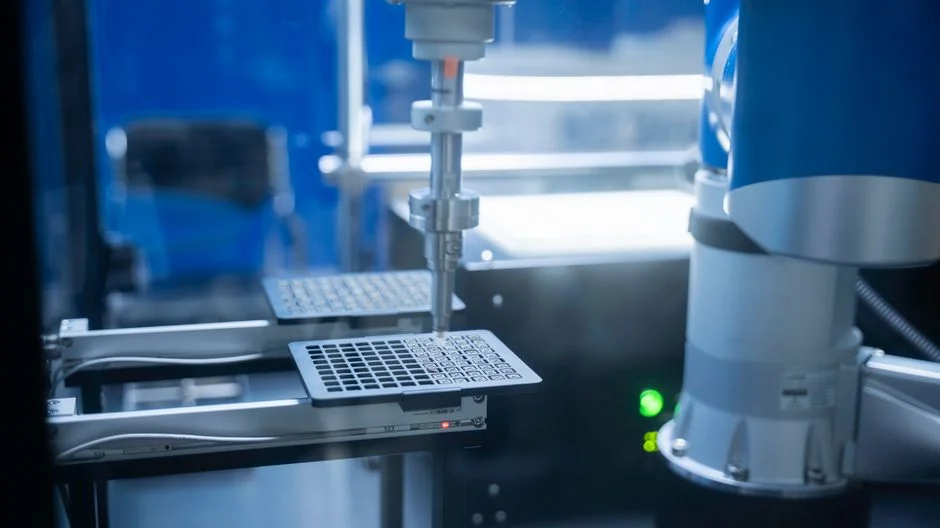
The 2026 industry rule of thumb is roughly 1.5–2.5 m³ of process wastewater per MWh of cell capacity. ESS cells — LFP or LMR prismatic — sit toward the upper end of that band because formation cycling is slower than for EV cells and humidity-control condensate adds an extra stream that does not exist at an EV-only plant. Applied to LG Energy Solution's 2026 North American ESS target of more than 50 GWh (Wards Auto, 2026), the implied design flow for a multi-gigawatt ESS hub reaches the multi-million-gallon-per-day range at full ramp — well beyond what a conventional OWTF can carry and well into the territory where an APP and AZPDES individual permit are mandatory.
Sanitary design flow is a separate stream and is sized off headcount rather than production. The 1,600-job benchmark from the New Carlisle plant (Wards Auto, 2026) is the right order of magnitude for a wholly-owned North American gigafactory; at typical 25–35 gal/employee/day design flow plus cafeteria and lab load, the sanitary stream on its own is in the 40,000–60,000 gal/day range, which routes through a separate OWTF (under ADEQ's >600,000 OWTF inventory statewide, azdeq.gov, 2026) or to a municipal connection. The 2026 rulemaking on A.A.C. Title 18, Chapter 9 could change onsite disposal eligibility for sanitary streams during pilot operations, so this stream deserves its own diligence track in parallel with the process train.
For benchmarking against a peer deal, the GM Texas plant wastewater compliance guide walks through a similar mass-balance for a Sun Belt auto-transformation site, and the Korean-OEM ETP due-diligence guide shows how legacy ETP audits feed into the same water-budget arithmetic. For cross-checking TSS and BOD ceilings against other jurisdictions, the global BOD and TSS discharge limits comparison is the cleanest reference set.
90-Day Compliance Roadmap After Closing
Days 0–30 are for discovery. Run a Phase I ESA, pull five years of APP and AZPDES correspondence, baseline-sample every drain for Ni, Co, Li, F, NMP, COD, TSS, O&G, and pH, and request an APP eligibility pre-meeting with ADEQ so the agency confirms the discharge classification before any design money is committed.
Days 31–60 are for applications and delegated authorizations. Submit the APP and AZPDES individual-permit packages; if sanitary or pilot wastewater will be disposed onsite, engage the delegated county — in Maricopa County for any Phoenix-area site — under A.A.C. Title 18, Chapter 9 (azdeq.gov, 2026). In parallel, start the POTW pretreatment conversation with the receiving utility, which for the metro Phoenix area is the 23rd Avenue WWTP service area.
Days 61–90 are for equipment commitment and pretreatment negotiation. Lock in the DAF, MBR, dosing, and sludge-dewatering equipment package, finalize the POTW pretreatment permit, and run a value-engineering pass on ion-exchange resin selection for the Li/Co/Ni/F polishing step. Beyond day 90 the focus shifts to commissioning, shakedown testing, and the first ADEQ self-monitoring report on the cadence specified in the issued permit — typically monthly for major parameters once the plant is in routine operation, but the design engineer should defer to the language of the final permit rather than any general rule of thumb.
Frequently Asked Questions
Did Samsung SDI actually acquire a plant in Arizona in 2026?
No. The August 11, 2026 Samsung SDI press release confirms acquisition of GM's 49.99% stake in the SynergyCells joint venture in New Carlisle, Indiana — the company's first wholly-owned North American plant (samsungsdi.com, 2026-08-11). No Arizona acquisition is publicly confirmed as of that date.
What Arizona permit regulates battery-plant wastewater discharge?
An ADEQ Aquifer Protection Permit under A.A.C. R18-9, plus an AZPDES discharge permit under A.A.C. R18-9-A901. If the discharge goes to a municipal sewer, POTW pretreatment applies on top of those two. A.A.C. Title 18, Chapter 9 governs onsite disposal for domestic or pilot streams without sewer access (azdeq.gov, 2026).
Does an Arizona battery plant need pretreatment if it discharges to a sewer?
Yes. POTW pretreatment applies for heavy metals, NMP, and pH. In metro Phoenix, the 23rd Avenue WWTP service area runs citywide categorical standards consistent with 40 CFR Part 433 (metal finishing) and 40 CFR Part 421 (battery subcategory).
What wastewater treatment does a lithium-ion cell plant need?
The 2026 baseline is equalization + DAF + MBR + ion-exchange or selective adsorption + disinfection + sludge dewatering. The DAF protects the membranes; the MBR oxidizes NMP; the ion-exchange step polishes for Li, Co, Ni, and F; chlorine dioxide or UV handles reuse streams; and a plate-and-frame filter press dewaters the metal-bearing sludge.
How much wastewater does an ESS gigafactory produce?
On the order of 1.5–2.5 m³ of process wastewater per MWh of cell capacity. ESS cells sit at the higher end of that range because of slower formation cycling and humidity-control condensate. Applied to a multi-GWh North American ESS hub, the design flow reaches the multi-million-gallon-per-day range at full ramp.