Why Angola's Housing Boom Needs Decentralized Residential Treatment
Approximately 60% of Luanda's population lacks reliable clean water (World Bank 2023, per hydropurewater.com Angola MBR briefing 2025), and the city's sewer expansion is not keeping pace with housing delivery — central trunk lines in new Luanda, Benguela, and Lubango districts typically lag occupancy by 18–36 months. For single-family homes, gated estates, apartment blocks, and worker camps tied to oil, mining, or agri projects, the practical answer in 2026 is a decentralized packaged plant sized to the local population and audited against Decreto Presidencial 200/18, which caps BOD at 30 mg/L, TSS at 35 mg/L, and ammonia at 10 mg/L and carries fines of up to 2% of annual revenue for non-compliance (per hydropurewater.com Angola MBR briefing 2025). Three Angolan land-use contexts drive the technology choice: dense Luanda peri-central districts with high land cost (above $200/m²) and severe plot constraint; peri-urban Talatona, Camama, and Vila Flor with intermittent power and intermittent water; and rural Bengo, Huambo, and Cuando Cubango villages with no grid, no sewer, and no trained operator. For a comparative African residential flowsheet, see the parallel Residential Wastewater Treatment in Egypt 2026: Engineering Guide, Costs & Compliance write-up, which uses the same ASTM E2717-18R25 framework and similar Decreto-style effluent caps.
Angola's Residential Wastewater Load — How to Size It Right
ASTM E2717-18R25 provides a defensible per-capita residential load framework, but the standard explicitly notes its U.S. defaults "would need to be modified if used elsewhere" — and Angola is one of those elsewhere. The 200 L/p·d flow and 50–60 g BOD/p·d typical of a U.S. single-family villa should be reduced to 130–180 L/p·d and 35–50 g BOD/p·d for a Luanda middle-income home, with even lower flows (90–120 L/p·d) in low-income bairros where standpipe supply and intermittent cutoffs dominate. The table below summarizes an Angola-adapted per-capita load for three occupancy classes; values are derived from ASTM E2717-18R25, scaled down for documented Angolan household water use, and cross-checked against typical design manuals for Sub-Saharan urban residential flows.
| Parameter | Single-family villa (Angola) | 4-story apartment (Angola) | Rural village household |
|---|---|---|---|
| Flow (L/p·d) | 130–180 | 110–150 | 90–120 |
| BOD (g/p·d) | 35–50 | 30–45 | 25–40 |
| TSS (g/p·d) | 20–30 | 18–25 | 15–22 |
| TKN (g/p·d) | 4–6 | 4–5 | 3–4 |
| NH₃ (g/p·d) | 2.5–3.5 | 2–3 | 1.5–2.5 |
A 200-home Luanda community at 5.2 residents per household and 150 L/p·d lands at approximately 156 m³/day and 50–55 kg BOD/day — a flow that fits cleanly inside the buried WSZ A/O package plant 1–80 m³/h envelope when operated 18–20 h/day, without over-sizing the aeration tank or the equalization basin. Two peak factors must be designed in: residential hydraulic peaks are typically 2.5–3.0× daily average (morning and evening), and biological peaks run 1.5–1.8×. For Muslim-majority districts, weekend and Ramadan-period peaks can reach 1.4–1.8× the weekday mean because household cooking, laundry, and guest entertaining concentrate in the evening hours. The biological stage must absorb those peaks without ammonia breakthrough; equalization volume should be at least 25–35% of daily flow. For a Mediterranean parallel that uses the same E2717 framework, see the Residential Wastewater Treatment in Morocco 2026: Engineering Guide.
Decreto Presidencial 200/18 — What the Numbers Mean for a Residential Plant
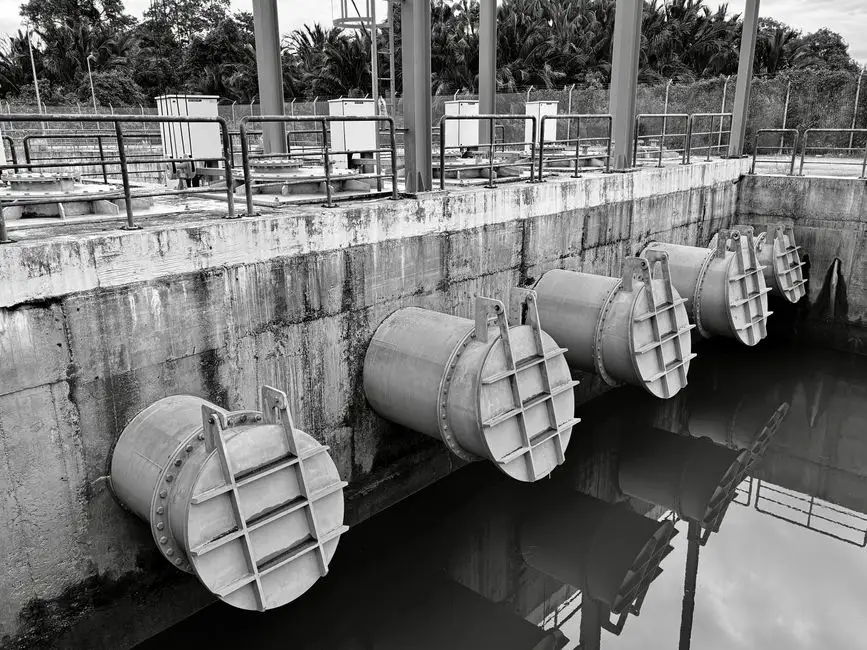
Decreto 200/18 is the binding instrument for any residential plant discharging to a receiving water in Angola, and ANGOP (the Angolan water authority) runs quarterly site audits that combine a flow-weighted 24-hour composite sample with a TSS and ammonia spot check (per hydropurewater.com Angola MBR briefing 2025). For the residential flowsheet, the design engineer must hold the table below as a non-negotiable floor under all peak conditions, not just under steady state.
| Parameter | Decreto 200/18 limit | WHO 2023 unrestricted irrigation |
|---|---|---|
| BOD | 30 mg/L | <10 mg/L |
| COD | 150 mg/L | — |
| TSS | 35 mg/L | <10 mg/L |
| NH₃ | 10 mg/L | — |
| Total N | 15 mg/L | — |
| Fecal coliforms | <200 CFU/100 mL | E. coli <10 CFU/100 mL |
The 200/18 caps are the legal floor; the WHO 2023 unrestricted-irrigation reuse benchmarks (BOD <10 mg/L, TSS <10 mg/L, E. coli <10 CFU/100 mL) are the design stretch target for any new Luanda or Benguela district where the developer plans to reuse effluent on internal landscaping, which closes a meaningful share of the 60% water-access gap. Hitting that reuse target on a residential budget usually means adding a tertiary polishing step (typically a DF-series PVDF flat-sheet membrane module followed by UV or an on-site chlorine dioxide generator) and installing on-line NH₃ and TSS probes so the plant can alarm before a 200/18 excursion, not after. Residential plants are most often audited on a 95-percentile basis over 24-hour composite samples, so the design must hold the limits under the morning biological peak of 1.5–1.8×, not just under steady state.
Three Process Trains That Work for Angolan Residential Projects
For 2026, three process trains are the realistic shortlist for Angolan residential work; everything else is a niche variant. Option 1 is the buried WSZ A/O package plant — anoxic + aerobic contact oxidation + sedimentation + chlorination in a single FRP or carbon-steel tank, fully buried, with PLC auto-restart after power failure. Footprint is negligible because the tank sits under the lawn or parking lot, and the unit is sized for 1–80 m³/h. It is the default for 50–1,000-home communities and for any site where zoning or aesthetics rule out above-ground equipment. Option 2 is a containerized or skid-mounted MBR with submerged 0.1 µm PVDF membranes operating at 8,000–12,000 mg/L MLSS and 0.6–1.2 kWh/m³ (per hydropurewater.com Angola MBR briefing 2025). It delivers about 60% smaller footprint than CAS (per the same source) and is the right answer when reuse is required or when plot area is below about 500 m². Option 3 is a septic tank + constructed wetland or trickling filter for rural villages with no grid power and no trained operator. Effluent is typically 40–60 mg/L BOD, which does not meet 200/18 on its own; a polishing reed bed, intermittent sand filter, and disinfection step are mandatory before any reuse or surface discharge. The comparison below is the working matrix for an RFQ shortlist.
| Criterion | Buried WSZ A/O | Containerized MBR | Septic + wetland |
|---|---|---|---|
| Footprint (relative) | Negligible (buried) | ~60% of CAS | Large; needs land |
| Energy (kWh/m³) | 0.3–0.5 | 0.6–1.2 | 0.05–0.1 |
| Effluent BOD (mg/L) | <20 | <5 | 40–60 (pre-polish) |
| Effluent NH₃ (mg/L) | <10 | <2 | 15–25 |
| Operator skill | Low (PLC) | Medium (membranes) | Low |
| CAPEX ($/m³·d) | 350–600 | 800–1,200 | 150–300 |
| OPEX ($/m³) | 0.08–0.15 | 0.25–0.45 | 0.03–0.06 |
For a 1,000-home community, the buried WSZ train typically carries the lowest total installed cost; for a 200-home Luanda infill site, the containerized MBR system is often the only technology that fits the plot.
Choosing Between Buried A/O and MBR for a 500-Home Luanda Community
Worked example: 500 homes × 5.2 residents × 150 L/p·d ≈ 390 m³/day, with a BOD load of roughly 100 kg/day and an NH₃ load of about 13 kg/day. Three decision branches drive the technology choice. (a) Is the discharge to a sensitive receptor (the Atlantic coastal lagoon at Corimba, a tributary used downstream for drinking-water intake) or to a reuse loop (estate irrigation, cooling, or toilet flushing)? If yes, pick MBR — only a flat-sheet or hollow-fiber membrane stage will hold BOD below 5 mg/L and TSS below 1 mg/L consistently under Luanda's 25–35°C ambient regime. (b) Is the available plot larger than 600 m² and is the developer cost-sensitive, with no reuse obligation? Pick a buried WSZ A/O package plant; it will meet 200/18 with a clear safety margin and is roughly one-third the CAPEX of an equivalent MBR. (c) Is grid power available less than 20 hours per day with frequent brownouts? Pick WSZ A/O with VFD-protected blowers and on-site chlorination, because MBR membranes foul rapidly when aeration is interrupted for more than 30–60 minutes. Footprint at this scale: WSZ needs about 120 m² of buried footprint plus a 40 m² chlorination contact tank; MBR in a 40-ft container needs about 30 m² of slab plus 15 m² of UV bank. Energy at Angola's $0.12–$0.18/kWh tariff: WSZ at ~0.35 kWh/m³ runs $0.05/m³; MBR at ~0.9 kWh/m³ runs $0.14/m³ — a $32/day delta on a 390 m³/day plant, which is small relative to the reuse-value uplift of MBR effluent. For the engineering detail that drives the membrane choice, see the MBR Common Problems and Solutions: 2026 Engineering Troubleshooting Guide.
Costs, Payback, and 2026 CAPEX Reality in Angola
For a residential project in 2026, the CAPEX benchmark that holds in Luanda is $800–$1,200 per m³/day for an industrial-grade MBR (per hydropurewater.com Angola MBR briefing 2025) and $350–$600 per m³/day for a residential WSZ A/O package inclusive of civil works for 50–500 m³/day plants. The discount on WSZ is driven mainly by simpler civil work and the absence of a membrane step. For the 500-home / 390 m³/day WSZ example, total CAPEX lands at approximately $140K–$235K; for the MBR equivalent, $470K–$700K including membranes, blowers, and UV. OPEX is dominated by chlorine dosing (~$0.02/m³) and periodic sludge hauling for WSZ, and by membrane CIP chemicals plus 5–8-year membrane replacement at $0.10–$0.20/m³ for MBR (per the same source). The table below is the 2026 Luanda cost block a developer or municipal finance officer can paste into a board paper.
| Cost line | WSZ A/O (390 m³/d) | Containerized MBR (390 m³/d) |
|---|---|---|
| CAPEX total | $140K–$235K | $470K–$700K |
| CAPEX ($/m³·d) | 360–600 | 1,200–1,800 |
| Energy ($/m³) | 0.05 | 0.14 |
| Membrane replacement ($/m³) | — | 0.10–0.20 |
| Sludge & chemicals ($/m³) | 0.05–0.08 | 0.06–0.10 |
| Total OPEX ($/m³) | 0.10–0.15 | 0.30–0.45 |
| Payback (reuse case) | 5–7 years | 3–4 years |
Payback math: in Luanda, where municipal water can exceed $2.50/m³, a reuse-equipped MBR typically pays back the CAPEX premium in 4–6 years; for irrigation-only reuse inside the estate, payback often drops to 3–4 years because the developer controls both sides of the water balance. The automatic chemical dosing system and the on-site chlorine dioxide generator are usually the two retrofit items that push a borderline WSZ project across the reuse line.
2026 Procurement Checklist and Angola-Specific Commissioning Risks
The RFQ checklist that survives an ANGOP audit in 2026 looks like this: ISO 9001 manufacturer, membrane warranty of 5+ years, factory acceptance test video, a spare-membrane set, a Portuguese-language O&M manual, on-site commissioning in Angola, and a reference list of at least three Sub-Saharan residential plants of similar size. The Angola-specific failure modes are predictable and they show up every project: 25–35°C ambient temperature accelerates MBR fouling, so chemical CIP must be scheduled every 3–6 months rather than the 9–12 months typical of European installations (per hydropurewater.com Angola MBR briefing 2025); non-EAC equipment carries 10–15% import duty (per the same source); rural feeder voltage sags to 180–210V, so VFDs on blowers and pumps are mandatory, not optional; and intermittent water supply means the plant must handle long idle periods without sludge washout, which points to a separate sludge holding zone and a low-level float on the aeration tank. The permit pathway is to register with the municipal water authority (EPAL inside Luanda, the provincial Direcção Provincial das Águas elsewhere), submit the design memorandum with 200/18 compliance calculations, and schedule a joint inspection before discharge commissioning. Plan for a 6–12 month parts buffer — membrane modules, blower bearings, and chlorine dioxide precursor chemicals all face 8–14 week lead times into Angola. Two engineering references that help on the commissioning side are the MBR Common Problems and Solutions: 2026 Engineering Troubleshooting Guide and the 2026 foam control guide for activated-sludge bulking, which is a recurring startup issue on Angolan residential plants that receive high-carbohydrate restaurant or cassava-processing effluent.
Frequently Asked Questions
What are the residential wastewater discharge limits in Angola?
Decreto Presidencial 200/18 caps effluent BOD at 30 mg/L, COD at 150 mg/L, TSS at 35 mg/L, ammonia at 10 mg/L, total nitrogen at 15 mg/L, and fecal coliforms below 200 CFU/100 mL. ANGOP audits on a 95-percentile basis using 24-hour composite samples, and non-compliance fines can reach 2% of annual revenue (per hydropurewater.com Angola MBR briefing 2025).
What is the typical cost of a packaged residential sewage treatment plant in Angola?
In 2026 Luanda, a buried WSZ A/O package runs $350–$600 per m³/day for 50–500 m³/day plants, while an industrial-grade MBR runs $800–$1,200 per m³/day. A 390 m³/day WSZ plant for a 500-home community lands at roughly $140K–$235K CAPEX; the MBR equivalent runs $470K–$700K (per hydropurewater.com Angola MBR briefing 2025).
Can residential wastewater be reused for irrigation in Angola?
Yes, and the 60% Luanda water-access gap is pushing developers to it. Decreto 200/18 is the legal floor; the WHO 2023 unrestricted-irrigation stretch target is BOD <10 mg/L, TSS <10 mg/L, and E. coli <10 CFU/100 mL, which a containerized MBR with UV or an on-site chlorine dioxide generator can meet consistently.
How do you choose between a buried A/O plant and an MBR for a residential community?
Use three branches: pick MBR if the discharge is to a sensitive receptor or to a reuse loop; pick WSZ A/O if the plot is above 600 m² and the developer is cost-sensitive with no reuse obligation; pick WSZ A/O with on-site chlorination if grid power is below 20 h/day. In Luanda, the CAPEX delta is roughly 3× and the OPEX delta is roughly 3×, but MBR pays back in 3–4 years under a reuse case.
How often must the plant be serviced in Angola's climate?
For MBR, plan chemical CIP every 3–6 months because 25–35°C ambient accelerates membrane fouling, and membrane replacement every 5–8 years (per hydropurewater.com Angola MBR briefing 2025). For WSZ A/O, plan a quarterly inspection of blowers, diffusers, and the chlorination contact tank, and annual sludge wasting based on a 30–40 day sludge age target.