Why Yeast Wastewater Is a Special Case for MABR
MABR (membrane aerated biofilm reactor) is most often pitched for municipal and decentralized flows, but the technology is technically viable for yeast fermentation wastewater as a post-equalization biological step, with reported aeration energy savings of up to 90% versus conventional activated sludge (CAS) and simultaneous nitrification-denitrification (SND) in a single tank (Fluence MABR product brief, 2026). The reason yeast effluent is a special case — and the reason the top SERP pages on MABR do not address it — is that a baker's yeast or bio-ethanol plant discharges a stream fundamentally different from the 200–800 mg/L COD envelopes MABR is typically designed around. Typical bakers-yeast and ethanol-yeast plant effluents run COD 8,000–25,000 mg/L with BOD/COD around 0.55, TKN 400–1,200 mg/L, sulfate 1,000–3,500 mg/L from molasses or SO₄-based pH control, pH 4.5–6.5, and temperature 30–45 °C. The sulfate load is the silent risk: sulfate-reducing bacteria (SRB) can establish inside the anoxic core of the MABR biofilm, generating H₂S that inhibits nitrifiers and corrodes downstream infrastructure. High temperature accelerates biofilm kinetics but pushes above the 28–32 °C nitrifier optimum, so summer peaks above 40 °C start to erode ammonia removal. At these OLRs, passive oxygen transfer through the membrane approaches its flux ceiling — oxygen is delivered by diffusion, not by bubble stripping, so the system has a hard upper bound on loading (Fluence "What Is MABR" technical page). Residual yeast cells, glycerol, and melanoidin color precursors make a DAF system for suspended yeast cell removal non-negotiable upstream of any MABR module — raw fermenter centrate will foul the membrane envelope within days, not weeks.
MABR Process Design Parameters for Yeast Effluent
A yeast plant designing an MABR should size the module to operate at or below 1.0 kg COD/m³·d on the biofilm carrier; for raw yeast strength that means either two-stage aerobic treatment with the MABR as a polishing step, or a recycle loop diluting the MABR feed to COD 1,500–2,500 mg/L. The design envelope below is sized for a post-DAF secondary biological train, not for raw fermenter centrate. HRT runs 12–24 h, SRT is effectively uncoupled from HRT because biomass is attached to the membrane envelope, and bulk-liquid DO is held near zero to sustain the counter-diffusion biofilm (aerobic on the membrane side, anoxic on the bulk side) that enables SND (Fluence MABR product page, 2026). Membrane configuration in commercial MABR products such as Fluence's Aspiral and SUBRE lines is a spirally wound self-respiring envelope with biofilm growth on the wastewater side and passive O₂ delivery at near-atmospheric pressure. Mixing is provided periodically by coarse-bubble diffusers fed from existing blowers, while a separate low-pressure, low-flow blower supplies membrane aeration. For a yeast stream with high temperature and variable TKN, the F/M ratio on the attached biomass is best controlled by recycling — fixed-film F/M becomes a function of biofilm areal density rather than MLSS, so a "F/M" cell is reported as OLR per square meter of membrane.
| Parameter | Design Range (post-DAF yeast effluent) | Notes |
|---|---|---|
| HRT | 12–24 h | Raw fermenter centrate needs dilution or two-stage train |
| OLR (on MABR module) | ≤ 1.0 kg COD/m³·d | Passive O₂ flux ceiling; respect this or expect anoxic collapse |
| OLR (after dilution / two-stage) | 0.3–0.7 kg COD/m³·d | Typical operating band on high-strength industrial streams |
| SRT | Effectively infinite (attached) | Decoupled from HRT; protects slow-growing nitrifiers |
| Bulk-liquid DO | ~0.0–0.3 mg/L | Counter-diffusion biofilm sustains SND |
| Temperature | ≤ 35 °C preferred | Cool fermenter condensate if influent > 40 °C |
| pH (in-module) | 6.8–7.5 | Sulfate reduction will pull pH down if anoxic zone is too large |
| Expected effluent COD | < 300 mg/L | For post-DAF feed; raw centrate cannot meet this |
| Expected effluent TN | 3–10 mg/L | On low/moderate-strength feed after SND |
MABR vs SBR vs MBR on a Yeast Wastewater Train
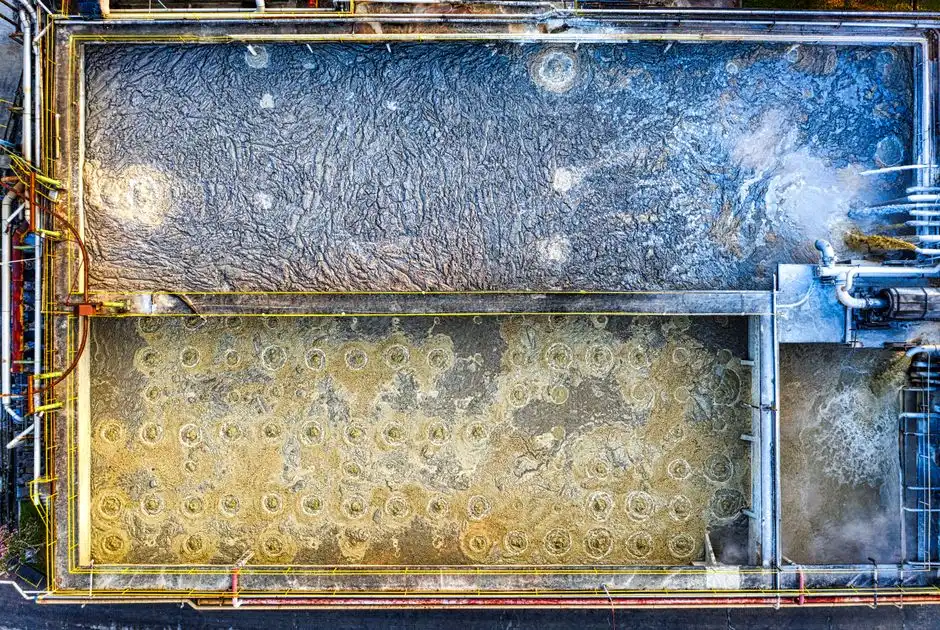
The honest head-to-head is what an ETP designer actually needs, because each of these technologies has been specified for yeast plants and each has a different failure mode. MABR wins on energy and footprint but is the most fouling-sensitive on raw yeast strength. SBR is the conservative default for batch fermentation with shock loads and has the deepest installed base on yeast plants (see the SBR for yeast wastewater engineering guide). MBR is the only option that produces reuse-quality water but is the most expensive and energy-hungry. Pilot data from the CENTA research center in Spain recorded TN as low as 4.1 mg/L and TP as low as 0.4 mg/L on a Fluence Aspiral S1 unit, and the Stanford CR2C pilot reached TN < 3 mg/L and TP < 0.3 mg/L (Fluence, 2026) — but these results were generated on municipal-strength and low-strength decentralized streams, not on 8,000–25,000 mg/L yeast centrate, and the article should be read with that envelope in mind. MABR also cuts overall plant energy by up to 30% in a SUBRE-style retrofit within one to three weeks of installation (Fluence MABR product page, 2026), and overall MABR aeration energy is up to 90% lower than CAS in packaged deployments. MBR is typically 30–60% more energy-intensive than CAS due to fine-bubble scour and permeate pumping, and PVDF replacement dominates lifecycle cost. The matrix below captures the trade-off in a form a procurement meeting can use.
| Axis | MABR | SBR | MBR |
|---|---|---|---|
| Footprint | Smallest (single-tank SND) | Largest (batch volume + equalization) | Moderate (replaces clarifier) |
| Aeration energy vs CAS | −90% (passive O₂) | ~CAS baseline | +10–30% (membrane scour) |
| Effluent COD | 200–400 mg/L (post-DAF) | 150–300 mg/L | < 50 mg/L |
| Effluent TN | 3–10 mg/L via SND | 5–15 mg/L (via cycle) | < 5 mg/L with post-anoxic |
| Effluent TSS | 20–60 mg/L | 20–40 mg/L | < 5 mg/L |
| OLR tolerance (raw yeast) | Poor — needs DAF + dilution | Good — handles shock | Moderate — high COD fouls membranes |
| Fouling / scaling risk | Biofouling, SRB sulfide, Ca scaling | Foaming, bulking | PVDF fouling, CIP frequency |
| Operator skill required | Moderate (membrane integrity) | Moderate (cycle tuning) | High (membrane chemistry) |
| Best fit on a yeast plant | Post-DAF polishing + energy retrofit | Batch fermenter with shock load | Water reuse / boiler feed |
Pretreatment, Fouling Control, and Operating Risks
This is the section most MABR marketing avoids. On a yeast stream, pretreatment is not optional — it is the difference between a six-month and a six-week membrane life. The mandatory upstream chain is a rotary bar screen for headworks protection, flow equalization (24 h residence minimum to damp batch fermenter dumps), pH adjustment to 6.8–7.5, and a DAF cell sized for 30–50% of the peak hourly flow to strip suspended yeast cells, emulsified glycerol, and the bulk of particulate COD. Three fouling modes have to be designed for. First, extracellular polymers from stressed yeast cells accumulate on the membrane and shrink the effective transfer area; DAF removes most of these but residual EPS loading still needs monitoring. Second, sulfate-reducing bacteria colonize the anoxic core of the biofilm at SO₄ > 1,500 mg/L and generate H₂S that inhibits nitrifiers at the aerobic/anoxic interface; a small COD:SO₄ check on the inlet is worth running during commissioning. Third, calcium carbonate scaling appears when pH excursions push above 7.8 in the membrane boundary layer; CO₂ stripping from the off-gas is the most reliable proxy for biofilm respiration, and bubble-point testing on a monthly cadence is the standard integrity check (Fluence MABR operating guidance, 2026). Temperature management is the other non-obvious lever — cooling fermenter condensate to ≤ 35 °C before it enters the MABR basin keeps nitrifier activity in band and reduces sulfide stress. Spent biofilm sloughing events still produce a waste activated sludge that has to be dewatered, and a belt filter press maintenance protocol is a useful reference for the downstream dewatering stage on MABR off-gas.
Retrofit Economics: SUBRE-Style Module Drops into an Existing Aeration Basin

For a yeast plant that already runs a CAS train, the cheapest path to MABR is a SUBRE-style drop-in rather than a greenfield basin. SUBRE modules are designed to be submerged in the anoxic zone of an existing activated sludge basin, suitable for basin depths 1.5–6 m and capacities 2,000–100,000 m³/d (0.5–22 MGD), aerated by a separate low-pressure low-flow blower with periodic coarse-bubble mixing from existing blowers (Fluence MABR product page, 2026). The retrofit is staged one basin at a time, with a measurable energy reduction of up to 30% in one to three weeks of operation and minimal interruption to upstream fermenter throughput. In regulatory terms, MABR retrofits typically classify as process-equipment changes rather than new basin construction, which compresses the environmental permitting timeline from 12–18 months to 3–6 months in most jurisdictions. The retrofit pays back inside three years under three conditions: electricity cost above US$0.10/kWh, a tight effluent TN limit (≤ 10 mg/L), and an existing basin with 20–30% spare volume. The retrofit does not pay back when the plant already has an MBR polishing step (MABR's energy and reuse gains are partly redundant) or when DAF pretreatment is missing and has to be added to the scope (HydropureWater field observations, 2026).
Decision Framework: Is MABR the Right Answer for Your Yeast Plant?
The decision tree is short and should be applied to the post-DAF stream, not the raw centrate — DAF is the universal pretreatment gate across all three biological options, not a technology choice. If the plant has stable 24/7 flow, post-DAF COD below 2,000 mg/L, an effluent TN limit at or below 10 mg/L, and a strategic concern about energy cost, MABR is the right answer. If the plant runs batch fermentation with extreme diurnal load swings, has skilled operators, and has no DAF in the current scope, stay with the SBR baseline already specified. If the primary driver is water reuse for boiler feed or process water and the budget can absorb PVDF replacement on a 5–8 year cycle, choose an MBR system (see the MBR product reference) for the highest effluent quality. The three-by-three matrix below maps influent strength against driver to make the branch explicit.
| Plant Driver | Stable 24/7 flow, post-DAF COD < 2,000 mg/L | Batch flow, no DAF, shock loads | Reuse water required (boiler/process) |
|---|---|---|---|
| Low energy cost (< $0.08/kWh) | MABR (greenfield) or SBR | SBR | MBR |
| High energy cost (> $0.10/kWh) | MABR (greenfield or SUBRE retrofit) | SBR + energy audit | MBR + energy recovery |
| Tight TN limit (≤ 10 mg/L) | MABR with SND | SBR with post-anoxic | MBR with reject-water side stream |
Frequently Asked Questions
Is MABR suitable for high-COD yeast fermentation wastewater?
Yes, but only as a post-DAF polishing step with OLR held at or below 1.0 kg COD/m³·d on the membrane module. Raw fermenter centrate at 8,000–25,000 mg/L COD will foul MABR membranes within days; DAF and either dilution or a two-stage aerobic train upstream of the MABR are non-negotiable (Fluence MABR product page, 2026).
How much energy does MABR save compared to SBR or MBR?
Up to 90% on aeration versus CAS, and up to 30% on overall plant energy within one to three weeks of a SUBRE retrofit (Fluence, 2026). MBR typically runs 30–60% higher than CAS, so MABR is the clear winner on energy and SBR is the conservative baseline.
What pretreatment does MABR require on a yeast plant?
Bar screening, 24-hour flow equalization, pH adjustment to 6.8–7.5, and DAF for suspended yeast cells and emulsified glycerol. Without DAF, the membrane biofouling rate is incompatible with a 5–8 year operating life (HydropureWater field data, 2026).
Can MABR replace a sequencing batch reactor on a baker's yeast plant?
Only if the plant has stable 24/7 flow and DAF pretreatment. For batch fermentation with sharp load swings, SBR remains the more forgiving option because its cycle absorbs shock; MABR's passive O₂ transfer has a narrow operating window and tolerates load spikes poorly.
Related Equipment
- MBR system for high-effluent-quality polishing — specifications, capacity range, and technical data
- plate and frame filter press for MABR waste sludge — specifications, capacity range, and technical data