Why LA Fabricated Metals Shops Are Re-thinking Primary Clarification in 2026
Hyperion Water Reclamation Plant and the LA-Glendale Water Reuse Plant have tightened industrial pretreatment enforcement through 2024-2026, with metals limits on copper, zinc, nickel, and total chrome now sitting in the 1-5 mg/L range and oil and grease caps at 100-200 mg/L. These requirements exceed the federal categorical standards often cited in equipment datasheets. For a Los Angeles fabricated metals factory, an out-of-the-box clarifier sized from a 2022 spec sheet will fail an LA POTW load check on its first slug discharge.
The typical LA basin influent is not the clean matrix that vendor brochures assume. A stamping or machining cell sends free and emulsified oil from cutting fluids and stamping lubricants into the equalization tank; a passivation line drops hex chrome into the same stream; a plating rinse dump arrives as a slug load on top of the continuous machining flow. Swarf and grinding dust add a settleable solids fraction, and dissolved Cu, Zn, Ni, and Cr add a hydroxide-precipitation problem that must be solved with chemistry, not hydraulics. Temperature swings of 25-45°C across day and night shifts alter the oil-in-water equilibrium, and pH excursions between 5.5 and 9.0 are routine in small LA job shops running without tight chemistry control. The combination of variable flow, emulsified oil, and dissolved metals is the operating envelope any primary clarifier must survive. For the broader pretreatment decision tree, the EV/auto plant POTW pretreatment guide covers a similar flow-sheet approach for a related industry segment.
How DAF and Clarifiers Actually Work on an Oily Metals Stream
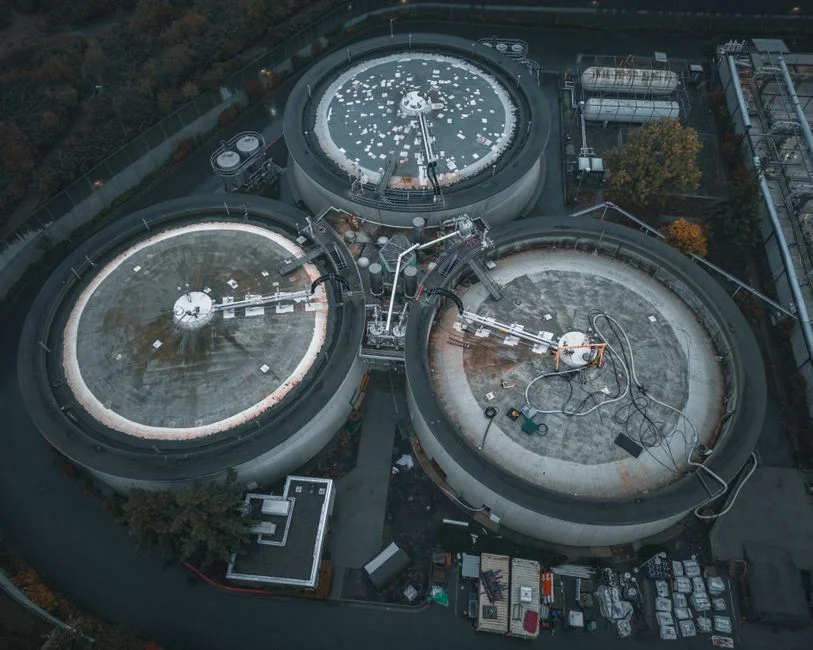
A dissolved air flotation (DAF) unit clarifies wastewater by attaching micro-bubbles to contaminants and floating them to the surface for removal by a skimmer. The mechanism is straightforward: a side stream of clarified water is pressurized to 60-80 psig in a saturation tank with dissolved air, then released through a relief valve into the main flotation cell. The pressure drop nucleates a cloud of 20-40 micron bubbles that attach to oil droplets and metal hydroxide floc to carry them upward. The standard aeration package—a Sulzer-style aeration pump, a saturation tank with rotameters, and a breakout valve—is well documented in vendor installations; VanAire's 150-450 GPM modular aeration skid, for example, occupies approximately 6 ft x 4 ft of plan area and stands 6 ft tall (VanAire, 2025). A representative skid-mounted design for this duty class is the dissolved air flotation system.
A conventional or lamella clarifier is a gravity-settling tank where denser solids drop to a sludge hopper and clarified water overflows a peripheral or outlet weir. Lamella designs compress the equivalent settling area into a small footprint by stacking inclined plates at 55-60°, achieving surface loading rates of 20-40 m³/m²·h, which is why a high-efficiency lamella sedimentation tank fits where a traditional circular clarifier cannot.
DAF systems outperform clarifiers on fabricated metals streams because the micro-bubbles overcome the limitations of Stokes' law. Conventional settling relies on gravity; a 20-micron oil droplet rises too slowly to be captured in a standard residence time. A 20-40 micron air bubble provides the buoyancy needed to lift that droplet in seconds. The practical result, per DAF Corp's FC Maximizer line, is 92-98% total suspended solids (TSS) removal on round units and 85-90% on rectangular RC UniMax units, with effluent TSS consistently below 20 ppm and float thickened to 2-4% solids (DAF Corp, vendor spec, cited via the Santa Ana pretreatment guide, 2025). The 50-70% clarifier ceiling on swarf streams collapses to 20-40% once emulsified oil enters the matrix, because oil droplets rise too slowly to be captured by the upward overflow rate. This is a structural physics limit that no plate pack can resolve.
DAF vs Clarifier: 2026 Head-to-Head Metrics for LA Plants
The table below summarizes the metrics that drive a buy decision for a 50-300 GPM LA fabricated metals shop. These figures are drawn from vendor specifications and standard metals-plant operating ranges and should be confirmed against current POTW local limits before final sizing.
| Parameter | Round DAF (e.g., DAF Corp FC Maximizer) | Rectangular DAF (e.g., DAF Corp RC UniMax) | Conventional / Lamella Clarifier |
|---|---|---|---|
| TSS removal on metals stream | 92-98% | 85-90% | 50-70% on swarf; 20-40% on emulsified oil |
| Effluent TSS | <20 ppm achievable | 20-40 ppm typical | 30-80 ppm typical on metals streams |
| Float / underflow solids | 2-4% float | 2-4% float | 1-2% underflow |
| Hydraulic range | 48-450 GPM skid; up to 11,000 GPM engineered | Scales across similar flow bands | Scales across similar flow bands; chemistry-limited |
| Footprint per 100-450 GPM module | Aeration skid ~6 ft x 4 ft x 6 ft tall plus tank | Larger plan area, lower height | Compact with lamella plates; taller tank depth required |
| Chemistry requirement | pH adjust + coagulant + flocculant standard | Same chemistry | Often flocculant only; coagulant if polishing |
| Sludge handling | Float to dewatering; lower volume | Float to dewatering; lower volume | Underflow pumping; higher hauling volume |
| Operator attention | Moderate — chemistry + skimmer adjustment | Moderate | Low for settling; higher for lamella plate fouling |
| Best-fit duty | Oily, variable-flow fabricated metals streams | Same chemistry, space-constrained sites | Low-oil swarf settling; polish after DAF |
The gap in TSS removal and oil handling is the difference between meeting a 100 mg/L TSS / 100 mg/L oil and grease limit on the first pass and sending a non-compliant stream to the Hyperion or LA-Glendale headworks.
LA-Specific Chemistry: Sequencing DAF Around Hex Chrome and Zinc
DAF units require hydroxide precipitation of dissolved metals either before or after the flotation step, depending on whether the target metals are in particulate or dissolved form. The standard flow sheet for hex chrome is to reduce it to trivalent chrome under acidic, reducing conditions (typically with sodium metabisulfite or ferrous sulfate at pH 2.0-3.0) and then precipitate Cr(OH)₃ at pH 8.5-9.5. That sequencing determines whether the DAF unit sits upstream of the reduction tank (capturing oils and particulates first) or downstream (floating the precipitated metal floc). In plating-heavy LA shops, the DAF unit is almost always placed after reduction and precipitation so the float captures the metal hydroxide floc. The reduction step is typically fed by a PLC-controlled chemical dosing skid that holds pH and ORP in the target band.
The 2026 California POTW trend reflects tighter zinc limits and emerging PFAS parameters. An engineer should confirm current local limits with the receiving POTW (Hyperion, LA-Glendale, Burbank, or LASAN) before final equipment sizing. For a peer comparison on how AI process control is being applied to plating wastewater sequencing, the AI process control for plating wastewater guide walks through a working flow sheet.
CAPEX, OPEX, and Pilot Options for a 50-300 GPM LA Shop
Order-of-magnitude CAPEX for a packaged 50-100 GPM DAF skid lands in the USD 150,000-350,000 range for a complete system with chemistry feed, controls, and installation; an engineered 300+ GPM DAF moves into the USD 400,000-900,000+ band. A lamella clarifier of equivalent hydraulic capacity is 40-60% cheaper upfront, but it does not solve the emulsified oil problem, often leading to permit non-compliance.
OPEX on a DAF unit is driven by the recycle pump, aeration pump, and coagulant/flocculant doses. On a clarifier, OPEX is mostly sludge hauling and polymer use. DAF float at 2-4% solids versus clarifier underflow at 1-2% means roughly half the hauling volume and tonnage for the same captured contaminant load, which can swing annual disposal costs by USD 20,000-80,000 for a 200 GPM LA shop. Downstream, a plate and frame filter press takes float or underflow to 25-35% cake solids before hauling.
| Cost line | Round DAF (50-100 GPM skid) | Engineered DAF (300+ GPM) | Lamella Clarifier (matched flow) |
|---|---|---|---|
| CAPEX (installed) | USD 150,000-350,000 | USD 400,000-900,000+ | 40-60% of comparable DAF |
| Energy driver | Recycle + aeration pump | Recycle + aeration pump (larger) | Sludge pump only |
| Chemistry | Coagulant + flocculant + pH adjust | Coagulant + flocculant + pH adjust | Flocculant only in most duties |
| Sludge handling | 2-4% float, lower hauling volume | 2-4% float, lower hauling volume | 1-2% underflow, higher hauling volume |
| Annual sludge hauling delta (200 GPM) | Baseline | Baseline | USD 20,000-80,000 higher |
| Pilot option | Mobile DAF trailer, 4-12 week rental | Same trailer path for sub-scale | Rare; lamella is not rented at scale |
Mobile DAF rental is a viable 2026 option for pilot testing, plant shutdowns, or short-term capacity gaps; WesTech cites single-day deployment on a 47'-6" to 51'-7" trailer footprint (WesTech, 2025). Rental CAPEX is a fraction of a permanent install and allows shops to validate removal numbers against actual LA POTW local limits before committing to a purchase.
The 2026 Decision Rule for LA Fabricated Metals Plants
The decision process simplifies once the chemistry is defined. Pick a DAF as the primary clarifier if the stream carries free or emulsified oil, if flow varies with batch rinse dumps, or if discharge TSS must consistently land below 100 mg/L. Pick a lamella clarifier as the primary only when the stream is genuinely low-oil and the local permit is lenient. Pick DAF followed by a lamella in series when metals precipitation produces a fine floc, when footprint constraints require a compact DAF plus a small lamella for redundancy, or when tight metals limits necessitate a second-stage solids capture. An LA fabricated metals shop in 2026 should not rely on a clarifier alone for compliance; the combination of emulsified oil, dissolved metals, and tightening pretreatment limits almost always necessitates a flotation step.
Frequently Asked Questions
When is a clarifier acceptable as primary treatment for an LA fabricated metals shop?
A clarifier alone is acceptable only on a low-oil stream—such as a dedicated grinding swarf settling
Frequently Asked Questions
Should an LA metal stamping shop use DAF or a clarifier as primary treatment in 2026?
For most metal stamping shops in Los Angeles facing increasingly stringent 2026 local limits, a Dissolved Air Flotation (DAF) unit is superior to a gravity clarifier. While clarifiers rely on sedimentation for particles with specific gravity >1.0, DAF systems utilize micro-bubbles to float low-density oils, greases, and metal fines, which are prevalent in stamping waste streams. Given that LA POTW (Publicly Owned Treatment Works) requirements often mandate Oil and Grease (O&G) levels below 100 mg/L, DAF provides the necessary separation efficiency that gravity clarifiers lack for emulsified contaminants.
Can a lamella clarifier meet LA POTW oil and grease limits on emulsified cutting fluid?
No, a standard lamella clarifier cannot effectively remove emulsified cutting fluids to meet LA sewer discharge standards. Emulsions typically require chemical demulsification—using coagulants and flocculants—followed by air-induced flotation to break the oil-water bond. A clarifier lacks the mechanism to capture these buoyant, sub-micron droplets, which will likely result in an effluent O&G concentration exceeding the 100 mg/L limit, risking municipal non-compliance fines and discharge permit revocation.
Where should the DAF sit relative to hex chrome reduction at pH 2-3?
The DAF must be positioned downstream of the hexavalent chromium reduction and subsequent neutralization stages. Hexavalent chromium (Cr6+) must first be reduced to trivalent chromium (Cr3+) at a low pH of 2.0–3.0 using a reducing agent like sodium metabisulfite, followed by pH adjustment to 8.5–9.5 to precipitate the chromium as metal hydroxide solids. The DAF unit acts as the final solids-liquid separation point, floating the precipitated metal hydroxides and any residual oils from the waste stream before final discharge.
How much does a packaged 50-100 GPM DAF system cost installed in California?
In the California market, a turnkey 50-100 GPM packaged DAF system typically ranges from $180,000 to $350,000. This cost includes the DAF vessel, saturation pump, air compressor, chemical feed skids, and control panel. Installation costs in Los Angeles can add an additional 30% to 50% to the total project price due to seismic anchoring requirements, specialized plumbing for industrial wastewater, electrical permitting, and integration with existing facility management systems.
Can a mobile DAF trailer be rented for a 4-week pilot in Los Angeles?
Yes, mobile DAF trailers are readily available for rent from industrial wastewater equipment providers serving the Los Angeles basin. A 4-week pilot study typically costs between $8,000 and $15,000, excluding mobilization, demobilization, and chemical consumables. These pilot units allow shops to generate performance data and bench-test effluent quality against specific local limits before committing to a permanent capital expenditure.