
Why Airport Wastewater Is a Three-Stream Problem
Airport STPs receive three hydraulically and chemically distinct waste streams that almost never arrive at the plant in proportion. Terminal sanitary sewage is the most predictable: typical BOD sits between 200 and 400 mg/L, flows follow a diurnal terminal-occupancy curve, and ammonia is the principal nitrogen species. Aircraft wash water is intermittent and aggressive — detergent and degreasing agents push COD into the 2,000–6,000 mg/L range during a wash event, then the flow drops to near zero. Deicing fluid runoff is the worst offender: glycol-based Type I/IV fluids can drive COD above 30,000 mg/L, and the load only appears between roughly October and April at northern hubs. Conventional activated sludge (CAS) struggles with this combination because the mixed-liquor suspended solids population that performs well on steady domestic sewage gets washed out or intoxicated when a wash-rig discharge or a deicing pulse hits the aeration tank. MBBR sidesteps that vulnerability by holding the active biomass on free-floating HDPE carriers, so the biofilm is anchored and survives both hydraulic surges and toxic spikes. Ali et al. (2021) flagged the "wide range in daily wastewater discharge rate" as a defining design constraint at Soekarno-Hatta, and the global MBBR installed base — more than 700 plants in over 50 countries, including airport deployments — confirms that the technology is a standard answer to that constraint.
How an MBBR Treats Airport Wastewater
Moving bed biofilm reactors rely on a basin filled with small, free-floating HDPE biofilm carriers to treat wastewater. Prof. Hallvard Ødegaard and his team at the Norwegian University of Science and Technology (NTNU) developed this technology in the late 1980s, with the first full-scale plant starting up in Norway in 1985. The four design components are: (1) the basin itself, (2) the carriers at 20–70% volumetric fill, (3) a fine-bubble aeration grid that supplies dissolved oxygen and provides the mixing energy to keep carriers in continuous motion, and (4) an outlet sieve with mesh apertures smaller than the smallest carrier dimension, so no plastic escapes with the effluent.
The biofilm colonizing each carrier performs the actual treatment. Formation follows four stages: initial adhesion of planktonic cells to the plastic surface via weak van der Waals and electrostatic forces, irreversible anchoring through secretion of extracellular polymeric substances (EPS), microcolony growth as cells divide within the EPS matrix, and finally maturation into a stratified 3D structure. That stratification provides engineering leverage: the outer aerobic layer hosts heterotrophs that consume BOD/COD and autotrophic nitrifiers that oxidize ammonia, while the inner anoxic/anaerobic layers host denitrifiers. A single MBBR tank drives BOD removal, nitrification, and partial denitrification simultaneously — the treatment train an airport needs for its blended terminal, wash, and deicing stream. Mixing energy is critical: the rolling-boil pattern created by the diffusers sloughs excess biofilm and keeps the active layer thin enough for substrate to diffuse in.
The Soekarno-Hatta Precedent: MBBR at a Major Hub Airport
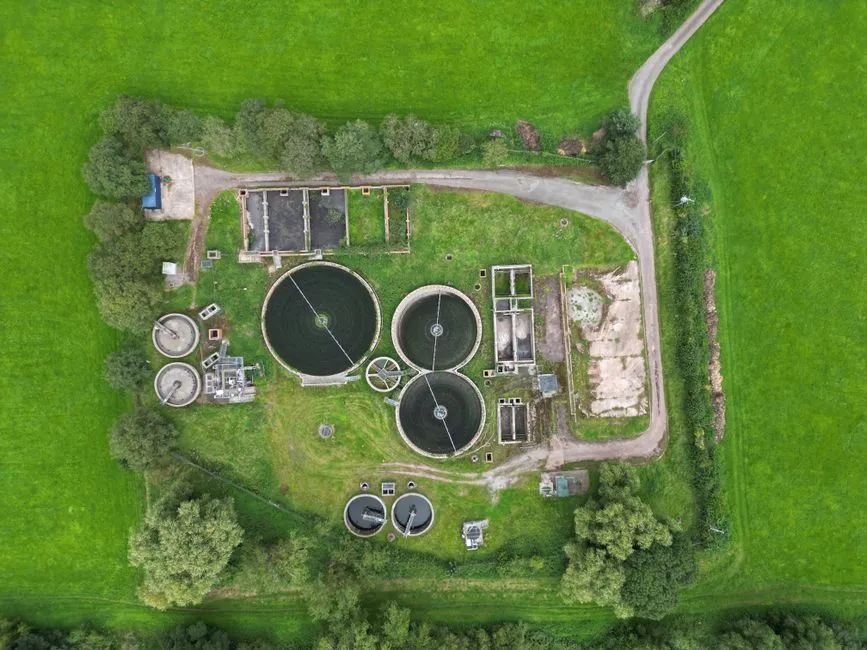
Soekarno-Hatta International Airport in Jakarta utilizes a full-scale MBBR deployment to manage high-strength variable loads. Ali et al. (2021), writing in Chemical Engineering Transactions, document that a MBBR with adjustable media filling capacity was implemented at the airport's WWTP specifically to handle the wide daily swings in wastewater discharge between peak and off-peak operations. The adjustable-fill design — operators can add or remove carriers as the load profile changes — is the direct response to slug loads from aircraft washing and seasonal glycol runoff that would otherwise require massive equalization basins. The downstream train at Soekarno-Hatta runs MBBR → water recycle loop → sludge treatment, with a constructed-wetland polishing step to bring the effluent into compliance with the Indonesian national wastewater quality standard. The project was implemented by the Indonesia Water Institute (IWI), which gives EPC consultants a credible regional reference. Hub-scale MBBR has been proven under real airport loading, not just municipal sewage-strength conditions.
2026 Design Parameters for an Airport MBBR
A workable basis-of-design set for an airport MBBR in 2026 starts with the Kusuma et al. (2019) dataset from Tanjungpura University, which validated Kaldnes K1 carriers at 20% fill and recorded 91% BOD removal and 93.8% COD removal on a high-strength surfactant-laden feed. That 20% fill is a defensible starting point for airport mixed streams; it can be dialed upward toward 40–70% when SALR and ammonia targets demand more biofilm surface area. The K1 carrier geometry falls inside the 10–25 mm HDPE carrier band typical of AnoxKaldnes installations. Hydraulic retention time for a blended terminal + aircraft-wash stream should land in the 6–10 hour range as a starting envelope — the Kusuma tests ran 6, 8, and 10 days of contact, so engineers should treat 6–10 hours as a conservative starting value and validate through piloting on the actual airport waste. Dissolved oxygen in the aerobic zone should be controlled at 2–4 mg/L, which is enough to support both heterotrophic carbon oxidation and autotrophic nitrification. SALR — the g BOD/m² carrier surface area per day — is the tank-sizing master variable alongside HRT and should be checked against both the diurnal terminal curve and the wash-event peak.
Effluent targets for an airport MBBR designed to the Kusuma envelope and tuned for ammonia: BOD below 30 mg/L, COD below 75 mg/L, and NH4-N below 5 mg/L — values consistent with both Kusuma's measured removals and the typical 2026 compliance band. The outlet sieve rule is non-negotiable: mesh opening must be smaller than the smallest carrier dimension, and in multi-compartment MBBRs (separate BOD-removal and nitrification cells) staged sieves are needed between compartments whenever carrier type or fill fraction changes. Engineers who want a turnkey packaged approach for small terminal flows can review the compact underground sewage treatment plant offering, which integrates MBBR biology into a buried skid for apron-adjacent installations.
| Parameter | Recommended 2026 Value | Source / Basis |
|---|---|---|
| Carrier type | Kaldnes K1 (HDPE, 10–25 mm) | Kusuma et al. 2019; Wikipedia |
| Carrier fill | 20% starting, up to 40–70% | Kusuma et al. 2019; microbenotes |
| HRT (mixed stream) | 6–10 h (engineering starting value) | Extrapolated from Kusuma et al. 2019 |
| DO (aerobic zone) | 2–4 mg/L | microbenotes |
| BOD removal | ~91% | Kusuma et al. 2019 |
| COD removal | ~93.8% | Kusuma et al. 2019 |
| Effluent BOD target | <30 mg/L | 2026 airport compliance band |
| Effluent COD target | <75 mg/L | 2026 airport compliance band |
| Effluent NH4-N target | <5 mg/L | 2026 airport compliance band |
| SALR | Sizing master variable (verify per stream) | microbenotes |
| Outlet sieve | Mesh < smallest carrier dimension | microbenotes; Wikipedia |
MBBR vs. IFAS vs. CAS for Airport Projects
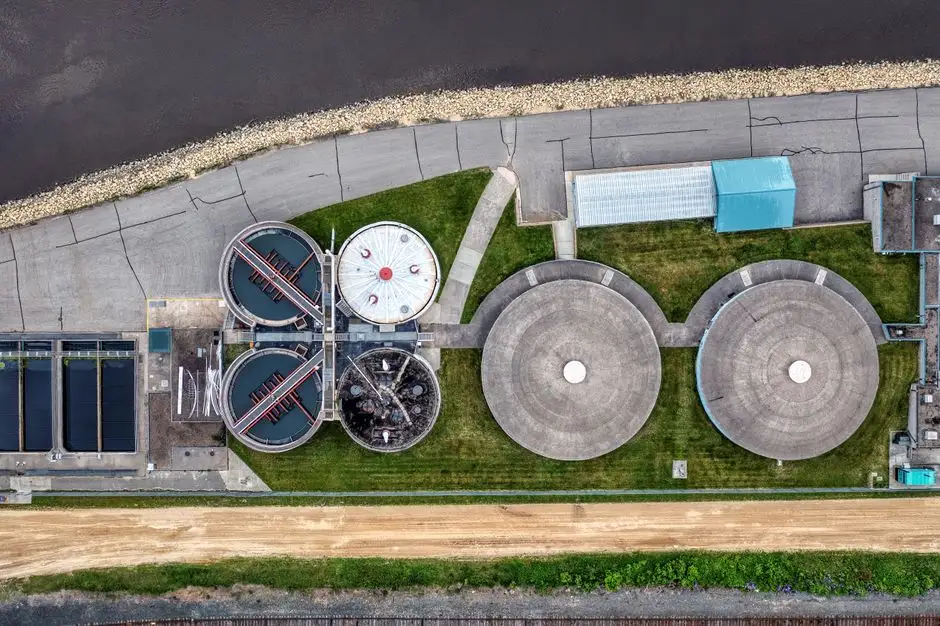
Three technologies compete for the airport STP slot, and the right answer depends on whether the project is a retrofit or a greenfield. MBBR's defining advantages are no sludge recycle, flexible retrofits into existing aeration tanks, and tolerance for the hydraulic and toxic swings that aircraft-wash and deicing streams inflict on a plant. IFAS (Integrated Fixed-Film Activated Sludge) keeps suspended activated-sludge biomass alongside the carrier biofilm, which gives it a measurable energy edge on nitrogen removal: Ødegaard (2014), cited in Ali et al. (2021), reported 1.2 kWh/kg NH4-N removed after conversion from MBBR to IFAS. That makes IFAS the better default for a greenfield airport plant with a tight ammonia limit and a stable flow profile. CAS remains the lowest-CAPEX option where land is available, but its large footprint and intolerance of slug loads from aircraft washing make it a poor fit when wash water is routed to the same headworks as terminal sewage.
The decision rule for a 2026 airport project: retrofit an existing aeration tank → MBBR with adjustable fill; greenfield build with ammonia priority and stable influent → IFAS; tight capex with a large land parcel and modest ammonia target → CAS with equalization. A DAF pre-treatment unit upstream of any of the three is a sensible add when deicing runoff enters the headworks, because removing entrained glycol and oil before the biological stage protects biomass and stabilizes SALR. For deeper parameter context, the MBBR for high-strength industrial wastewater guide covers overlapping design logic, and the MBBR design parameters reference walks through comparable SALR and HRT trade-offs.
| Criterion | MBBR | IFAS | CAS |
|---|---|---|---|
| Sludge recycle | No | Yes | Yes |
| Footprint | Compact | Compact | Large |
| Hydraulic surge tolerance | High (Soekarno-Hatta) | High | Low–moderate |
| N-removal energy | Higher | ~1.2 kWh/kg NH4-N (Ødegaard 2014) | Moderate |
| Retrofit ease | Excellent (drop-in carriers) | Moderate | Poor |
| Best fit | Retrofit, variable load | Greenfield, ammonia priority | Large land, capex-driven |
Compliance, Energy, and Operating Cost in 2026
Electricity is the dominant OPEX line for any aerobic biological plant, and Ali et al. (2021) put it at 50–60% of total MBBR operating cost, with the aeration blower as the single largest consumer. At airports, that fraction can climb during the deicing season when colder mixed-liquor temperatures and higher COD loading force the blowers to work harder. The standard mitigation is DO-linked variable-frequency drives on the blowers, which trim aeration intensity during low-load hours and ramp it during wash and deicing events. Effluent compliance for terminal discharge typically tracks a BOD <30 mg/L and TSS <30 mg/L band — a reference point consistent with ICAO Annex 14 expectations for airport waste facilities and with most national airport environmental permits in 2026. The AnoxKaldnes installed base of 700+ plants across 50+ countries is the practical assurance point for spare parts, carrier replacements, and OEM support through a 20-year airport asset life. Compliance pathways for water reuse — for aircraft wash-down make-up, landscape irrigation, or toilet flush — are easier to defend when the upstream MBBR is already producing <30 mg/L BOD; a polishing stage (sand filter, membrane, or UV) then handles the specific end use.
Frequently Asked Questions
Can MBBR handle aircraft-wash detergent spikes?
Yes. Adjustable media fill and continuous mixing absorb slug loads from intermittent wash events, as proven at Soekarno-Hatta International Airport. Pre-treatment with a DAF unit is recommended when oil and surfactant concentrations are high.
What is the typical effluent BOD and COD from an airport MBBR?
When sized to the Kusuma et al. (2019) design envelope with 20% K1 fill and 6–10 hour HRT, expect BOD below 40 mg/L and COD below 60 mg/L, comfortably inside the 2026 airport compliance band.
Is MBBR cheaper than MBR for airports?
MBBR has lower CAPEX and roughly 60% smaller energy footprint than MBR. MBR is the right choice only when the airport has a binding near-reuse effluent requirement that justifies the membrane cost.
How long does airport MBBR commissioning take?
Biofilm seeding typically