
Why Gelatin Wastewater Is a Hard Stream for Conventional Biology
Gelatin and collagen processing generates a wastewater profile that breaks conventional activated sludge. A typical gelatin plant effluent runs COD 2,000–10,000 mg/L, BOD 1,500–6,000 mg/L, TSS 500–2,500 mg/L, total nitrogen 100–500 mg/L, pH swings of 5–11 across acid and alkaline wash stages, and temperatures of 25–55 °C depending on the upstream process (HydropureWater field data, 2026). The fat, protein, and starch fractions create two specific failure modes for suspended-growth biology: bulking sludge from high FOG loading, and foaming in the aeration tank from surfactant carryover in CIP rinse water.
MBBR sidesteps both problems because the working biomass is attached to free-floating HDPE biocarriers rather than kept in suspension. A bulking event in the clarifier has no effect on biofilm retention; a 2-hour pH excursion from a CIP dump only partially sloughs the outer biofilm layer, while the underlying carrier population recovers within one or two HRTs. For a process engineer writing the basis-of-design, this is the single argument that justifies MBBR over CAS for a gelatin retrofit: the biofilm is decoupled from the settler, and that decoupling is what lets the plant ride out a wash-stage upset without losing the biological stage.
How MBBR Works and Why It Fits Gelatin Effluent
Moving bed biofilm reactor (MBBR) technology was developed at the Norwegian University of Science and Technology in the late 1980s by Professor Hallvard Ødegaard and commercialized by Kaldnes Miljöteknologi (now AnoxKaldnes under Veolia) (per Wikipedia/S3). The process uses an aeration tank filled with free-floating plastic carriers — almost always high-density polyethylene (HDPE) for durability and density near 0.95 g/cm³ — that provide protected surface area for biofilm growth. An aeration grid keeps the carriers mixed and a perforated sieve at the outlet retains them in the basin.
Three characteristics of biofilm carriers make them a good match for gelatin plant effluent. First, the biofilm's effective solids retention time is weeks rather than hours, which supports the slow-growing nitrifiers needed to handle the 100–500 mg/L TKN that comes from collagen hydrolysate. Second, the protected interior of the carrier shields biomass from toxic spikes — acid and alkali CIP dumps, sulfides from acid wash, and intermittent formaldehyde or peroxide sanitization. Third, the absence of sludge recycle eliminates the clarifier as a failure point: there is no return activated sludge pump to lose, and no bulking event to chase. Theoretically, carriers can occupy up to 70% of the tank volume (per Wikipedia/S3), but for high-strength industrial streams the practical operating envelope is 20–40% fill, balancing oxygen transfer efficiency against carrier-collision wear at the sieve.
The closest published MBBR dataset for a surfactant- and organic-rich industrial stream is the Kaldnes K1 laundry trial from Tanjungpura University (S1, 2019). At 20% Kaldnes K1 fill and 10-day HRT, the authors measured COD removal of 93.81% (910 mg/L to 56.3 mg/L) and BOD removal of 91% (441 mg/L to 39.67 mg/L) on a stream dominated by surfactants, phosphates, and bleaching agents. Gelatin wastewater is chemically different but behaves similarly in terms of COD/BOD ratio and organic complexity, so the S1 numbers serve as a defensible conservative benchmark for the design table that follows.
Design Parameters for Gelatin Wastewater MBBR
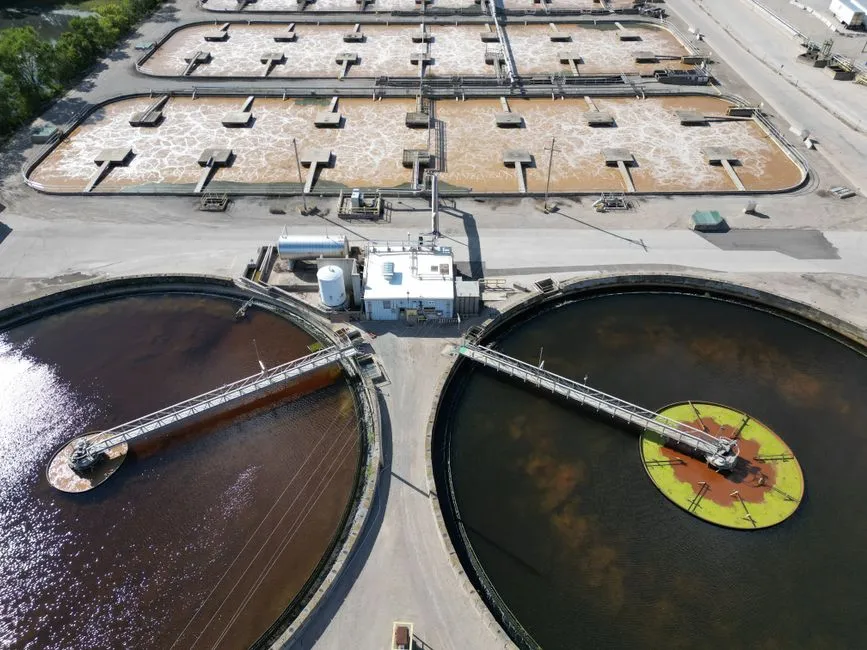
The table below is the working envelope I would hand to procurement. Values are derived from the S1 Kaldnes K1 dataset, AnoxKaldnes design guidelines, and HydropureWater field data on protein/starch effluent (2026). S1 is the conservative anchor: 91% BOD and 93.81% COD removal at 20% fill and 10-day HRT. Real gelatin streams reach similar removal at shorter HRT once the biofilm is acclimated, but the S1 numbers are what you quote when an EPC asks for the published basis.
| Parameter | Typical range for gelatin MBBR | Design recommendation | Source / justification |
|---|---|---|---|
| Hydraulic retention time (HRT) | 8–24 h | 12–18 h for a single aerobic stage; 18–24 h if nitrification is required | S1 used 240 h; industrial high-strength streams scale down once biofilm is established |
| Volumetric organic loading rate (OLR) | 0.5–2.5 kg COD/m³·d | 1.0–1.5 kg COD/m³·d for a single aerobic reactor at 30% fill | AnoxKaldnes design guidelines; S1 effluent implies <0.1 kg COD/m³·d at 10-day HRT |
| Carrier fill ratio | 20–40% | 30% HDPE Kaldnes K1 (or equivalent) for most gelatin streams; 40% when footprint is constrained | S1 used 20% fill; industrial practice pushes to 30–40% to cut tank volume |
| Dissolved oxygen (DO) | 2–4 mg/L aerobic, <0.5 mg/L anoxic | 2.0–2.5 mg/L aerobic; intermittent aeration for denitrification | Standard biofilm design; S1 used continuous aeration |
| Temperature | 30–38 °C mesophilic | No external heating required when influent is >30 °C | Gelatin wash water typically arrives at 30–55 °C |
| Reactor pH | 6.5–8.0 | 6.8–7.4 in aerobic stage | Equalization upstream is required to flatten 5–11 swings |
| Carrier specific surface area | 500–800 m²/m³ | Kaldnes K1: ~500 m²/m³; structured media: up to 800 m²/m³ | AnoxKaldnes product data |
| Expected effluent (MBBR alone) | COD 200–500 mg/L, BOD 50–150 mg/L, TSS 100–300 mg/L | COD ≤500 mg/L for sewer discharge to a municipal plant | Interpolated from S1; insufficient for direct reuse without MBR/RO polish |
For design defensibility, treat the S1 Kaldnes K1 numbers — 20% fill, 10-day HRT, 91% BOD and 93.81% COD removal — as the conservative floor. A well-acclimated gelatin plant MBBR at 30% fill and 18-hour HRT will exceed those numbers, but the S1 dataset is the peer-reviewed evidence you cite when a permitting reviewer pushes back.
Pretreatment and Post-Treatment Train Around the MBBR
MBBR is a biological stage, not a complete plant. The process train for a gelatin or collagen line should be: rotary bar screen → equalization (24 h) → DAF for fat, oil, and protein removal → MBBR → sedimentation or MBR polish → disinfection. Each step has a defensible job.
A rotary bar screen at 3–5 mm openings protects the downstream equalization tank and pumps from bone fragments, packaging, and large solids. Equalization at 24-hour HRT flattens the pH 5–11 swing and the COD shock from intermittent wash-water dumps; it also brings temperature toward the 30–35 °C mesophilic window. DAF for fat and protein removal ahead of the MBBR is the single most protective pretreatment: a well-designed DAF removes 60–90% of FOG and a meaningful fraction of emulsified protein, both of which would otherwise coat the biofilm carriers and kill oxygen transfer. HydropureWater's DAF catalog covers 4–300 m³/h, which matches the 100–500 m³/d flow range typical of mid-sized gelatin plants.
For polishing, an MBR polishing stage (submerged PVDF, 0.1–0.4 µm) drops TSS below 1 mg/L and pushes COD below 100 mg/L, which is the threshold for in-process rinse-water reuse or RO feed. Where reuse is not targeted, a simple settling tank followed by ClO₂ disinfection to meet a ≤200 CFU/100 mL fecal coliform limit is sufficient. The MBR option also gives a smaller footprint than a settling tank because no clarification stage is needed downstream of the MBBR.
Case Benchmark: What a 100 m³/d Gelatin Line Needs
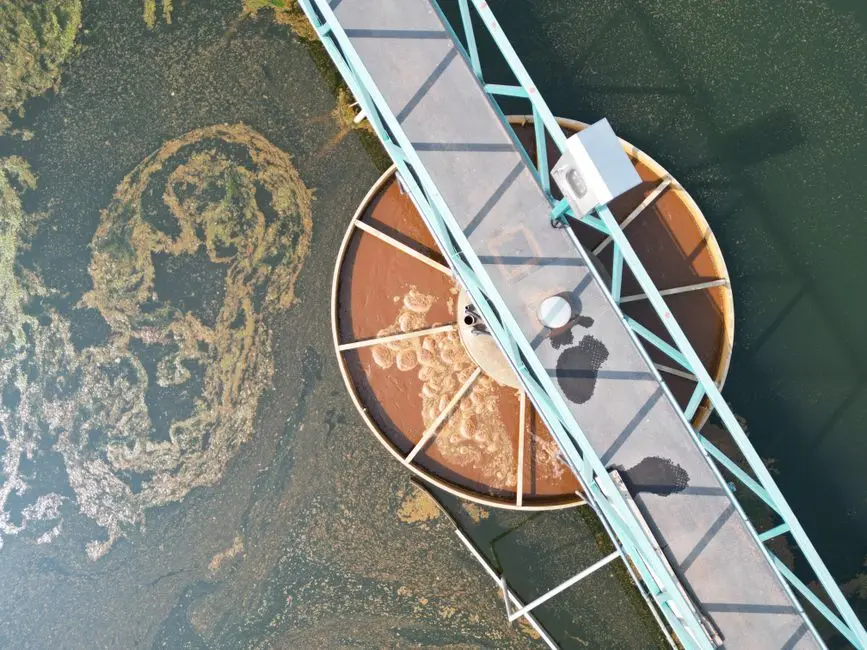
The following worked example turns the parameter table into a procurement-ready sizing. Assume a 100 m³/d gelatin line with influent COD 6,000 mg/L and a discharge target of COD ≤500 mg/L to the municipal sewer. Apply a 30% Kaldnes K1 fill and an OLR of 1.5 kg COD/m³·d (mid-range from the design table).
| Sizing parameter | Calculation | Result |
|---|---|---|
| Daily COD load | 100 m³/d × 6 kg COD/m³ | 600 kg COD/d |
| Aerobic reactor volume | 600 kg COD/d ÷ 1.5 kg COD/m³·d | ≈ 17 m³ working volume |
| HRT at 100 m³/d | 17 m³ ÷ (100 m³ ÷ 24 h) | ≈ 4.1 h — too short for nitrification, fine for roughing |
| HRT for full nitrification | Reduce OLR to 0.8 kg COD/m³·d | Volume ≈ 31 m³, HRT ≈ 7.4 h |
| Carrier volume at 30% fill | 0.30 × reactor volume | 5.1 m³ (roughing) or 9.3 m³ (with nitrification) |
| Blower duty | 1.5–2.0 kg O₂ per kg COD applied at DO 2–4 mg/L | ≈ 60–80 kg O₂/d, ~5–7 Nm³/h at standard blower efficiency |
| Post-MBBR effluent | 92% COD removal (interpolated from S1 at shorter HRT) | COD ≈ 480 mg/L — meets sewer target without MBR |
| Effluent temperature | Influent 35–40 °C, ambient cooling 2–4 °C in basin | 30–36 °C — mesophilic, no heater required |
Two design notes from this example. First, at 100 m³/d the reactor is small enough that a single packaged MBBR skid with 30–35 m³ working volume and a 7.5 kW blower is a defensible budget line item. Second, the high influent temperature (35–40 °C) actually reduces aeration cooling duty relative to municipal plants — there is no need for external basin heating in most climates, and the mesophilic 30–38 °C window is met passively for nine or ten months of the year.
Comparing MBBR With Other Biological Options for Gelatin Plants
For a procurement decision, MBBR sits between conventional activated sludge (CAS) and anaerobic UASB. The table below is a short, decision-oriented comparison; for a deeper read on the MBBR-vs-CAS trade-off in food plants, the MBBR for distillery wastewater design guide applies the same logic to a different high-strength stream.
| Criterion | MBBR | Conventional activated sludge (CAS) | UASB anaerobic |
|---|---|---|---|
| Relative footprint | Medium (no recycle, no large clarifier) | Large (aeration basin + clarifier + RAS pumping) | Small (upflow reactor, no aeration) |
| Energy use | Medium (1.5–2.0 kg O₂/kg COD) | High (1.5–2.5 kg O₂/kg COD plus sludge recycle) | Low (no aeration; biogas credit possible) |
| COD removal (single stage) | 85–95% | 85–95% | 60–80% (polishing required) |
| Sensitivity to load swings | High tolerance — biofilm retained on carriers | Low — washouts and bulking common on gelatin streams | Medium — slow recovery from temperature or pH shocks |
| Biogas credit | No (unless hybrid with anaerobic MBBR per S3, 2019 reference) | No | Yes — 0.3–0.4 m³ biogas per kg COD removed |
| O&M skill required | Low — no MLSS control, no clarifier tuning | High — MLSS, F/M, SVI, RAS must be managed daily | Medium — granular sludge requires careful seeding |
For a gelatin plant that wants biogas recovery, a hybrid anaerobic MBBR (roughing) followed by an aerobic MBBR (polishing and nitrification) is an emerging option — the 2019 reference cited in Wikipedia/S3 confirms the configuration is technically viable, though published gelatin-specific operating data is still thin. For a plant that prioritizes operational simplicity and tolerance to CIP and wash-stage swings, a single aerobic MBBR with DAF pretreatment is the most defensible choice today. For background on installation and commissioning scope, the MBR installation and commissioning guide covers the mechanical and I&E steps that overlap with MBBR skids.
Frequently Asked Questions
What HRT does an MBBR need for gelatin wastewater?
For a single aerobic MBBR targeting 90%+ COD removal, design for 12–18 hours HRT. Push to 18–24 hours if combined carbon oxidation and nitrification are required. The S1 Kaldnes K1 dataset reached 91% BOD and 93.81% COD removal at 240 h (10 days), but acclimated industrial biofilm typically delivers similar removal at one-tenth that HRT.
What carrier fill ratio works for a gelatin plant MBBR?
Run 30% HDPE Kaldnes K1 fill as a baseline, accepting 20–40% depending on footprint constraints. The S1 trial validated 20% fill; pushing to 30–40% trades oxygen transfer efficiency for tank volume reduction. Above 40% the aeration grid cannot keep the carrier bed fluidized without excessive blower power.
Can an MBBR handle the temperature swings from gelatin wash water?
Yes. Gelatin influent at 30–55 °C falls inside the mesophilic 30–38 °C window that biofilm carriers tolerate well; no external heating is required for most of the year. The risk is not heat but cooling — below 20 °C nitrification rates drop sharply, so plants discharging to a cold municipal sewer in winter may need a covered basin or a reduced winter OLR setpoint.
Does an MBBR replace a DAF for fat and protein removal?
No. DAF upstream of the MBBR is strongly recommended because FOG and emulsified protein coat biofilm carriers and reduce oxygen transfer. A well-designed DAF removes 60–90% of FOG before the water reaches the MBBR; without it, carrier performance drops measurably within weeks. For plants that already have an existing flotation unit, this is rarely the bottleneck — for new builds, the DAF is non-negotiable.