What MABR Is and Why the Energy Numbers Look So High
MABR advantages and disadvantages center on bubble-less oxygen transfer into an attached biofilm. Versus activated sludge, data show up to 90% aeration energy savings and up to 50% overall energy cut, with pilots at TN below 3 mg/L and TP below 0.3 mg/L via single-tank SND. Trade-offs are fouling, C/N sensitivity, higher CAPEX, and commercial history only since 2016.
The physical driver is counter-diffusion. In a conventional aeration basin, oxygen and organic substrate (BOD) both diffuse inward through bulk liquid toward the floc. In MABR the geometry is inverted: oxygen moves bubble-less through the wall of a hollow-fiber gas-transfer membrane at near-atmospheric pressure (typically <0.3 bar gauge), while substrate diffuses inward from the bulk liquid. The two concentration gradients point in opposite directions. Aerobic nitrifiers colonize the oxygen-rich membrane surface; heterotrophic denitrifiers occupy the anoxic outer layer where BOD is high and oxygen is already consumed. Because both populations coexist on one biofilm, simultaneous nitrification-denitrification (SND) occurs in a single tank without a separate anoxic zone or internal mixed-liquor recycle (Fluence, fluencecorp.com/what-is-mabr).
That mechanism explains the energy gap. Fine-bubble diffused aeration typically reaches 20-35% oxygen-transfer efficiency (OTE) per meter of submergence in clean water, and standard oxygen demand (SOTR) values of 1.2-1.8 kg O₂/kWh assume much of the paid oxygen leaves the tank unused. Passive membrane transfer removes the bubble plume, drops driving pressure to near atmospheric, and pushes effective oxygen utilization above 90% under design loading. The mechanical energy that remains is a small intermittent air-scour cycle used to control biofilm thickness, not continuous aeration.
One clarification that saves spec-meeting confusion: an MABR membrane is a gas-transfer membrane, not a filtration membrane. MABR does not separate solids, does not produce reuse-grade permeate, and has no pore-size rating in the UF/MF sense. It grows a biofilm on the outside and breathes air into it from the inside. Most plants we size for retrofit duty still need a clarifier, DAF, or MBR downstream when solids or reuse limits bind.
Advantages: Where MABR Genuinely Wins
MABR's largest documented benefit is energy: up to 90% reduction on aeration and up to 50% on overall plant energy versus legacy aerobic treatment, anchored on Fluence's published Aspiral™ and SUBRE datasets (Fluence, fluencecorp.com/what-is-mabr). For a 10,000 m³/d municipal plant spending roughly 0.4-0.6 kWh/m³ on aeration, that translates to 1,600-2,400 kWh/d saved — enough to pay back the membrane premium in 3-7 years at industrial electricity tariffs above 0.10 USD/kWh. Where kWh is cheap or carbon intensity is not priced, the payback stretches and the case softens.
Single-tank SND is the second structural win. Conventional BNR (biological nutrient removal) trains stack an anoxic basin, an aerobic basin, and an internal mixed-liquor recycle of 200-400% — three or four vessels with pumps, mixers, and blowers between them. MABR collapses that train into one basin with one intermittent blower and one set of membrane cassettes. Footprint reductions of 50-75% versus equivalent CAS-BNR trains are routinely quoted in containerized Aspiral™ installations, and eliminating the recycle stream cuts both CAPEX and OPEX.
Effluent quality from full-scale pilots is strong. The Stanford University Codiga Resource Recovery Center (CR2C) yearlong MABR pilot in California recorded TN <3 mg/L and TP <0.3 mg/L, meeting California Title 22 water-reuse criteria. The Andalusian CENTA yearlong test in Spain, run across climate swings and multiple effluent types, recorded TN as low as 4.1 mg/L and TP as low as 0.4 mg/L — slightly above Title 22 but comfortably inside EU UWWTD (Urban Waste Water Treatment Directive) nutrient limits for sensitive catchments (Fluence pilot data, 2019-2020).
Modularity and decentralization are operational advantages. Aspiral™ units ship in standard ISO containers and can be redeployed when a worker camp moves or a disaster recovery window opens. The 80-unit Hubei highway rest-area deployment — one container every 50 km — and the 300 m³/d Taiping village plant installed in Henan inside a 10-day window both exploit that plug-and-play profile. At a Carlsbad, New Mexico worker camp, low-odor, low-noise operation converted a regulatory complaint into approval from local inspectors; the same traits suit beach resorts and tourist districts where conventional aeration would be a nuisance.
Resilience under stress is documented rather than theoretical. The Bordeaux plant on St. Thomas restarted on generator power after Hurricane Irma before the island grid recovered, and the CENTA S1 demonstration unit ran unattended for nearly two months during the 2020 COVID lockdown with no measurable treatment degradation (Fluence, 2019-2020). For retrofit duty, SUBRE towers drop into existing basins sized 2,000-100,000 m³/d (0.5-25 MGD) and tighten TN/TP discharge without methanol dosing for denitrification — useful for plants facing tighter permit renewals without civil-works budget.
Disadvantages and Real Engineering Limitations

Counter-diffusion biofilm has a failure mode that conventional activated sludge does not. The biofilm grows outward from the membrane; if thickness is not actively managed, the inner layer is starved of substrate, the outer layer sloughs in large clumps, and oxygen transfer drops sharply. Operators control thickness with intermittent air-scour cycles and hydraulic shear — typically alternating aeration on/off every 15-60 minutes. Get the cycle wrong and the membrane fouls; get it right and the system runs at design loading. The control logic is more nuanced than a CAS basin, and operators used to MLSS-based process control need a different mental model.
Long-term field history is thin. Commercial MABR deployment began in 2016 (Fluence, fluencecorp.com/what-is-mabr), so the public domain has at most 9-10 years of operating data on full-scale membrane modules. Membrane lifespan, replacement frequency, failure-mode statistics, and end-of-life membrane disposal pathways are still being established. Activated sludge, by contrast, has 50+ years of full-scale data and a deep operator skill base. For a municipal utility with a 20-year asset depreciation horizon, that maturity gap matters and should be priced into the risk model.
Influent C/N sensitivity is real. SND works best within a defined COD:N window — typically COD:N between 6:1 and 15:1 for municipal-strength wastewater. Outside that window, denitrification rates fall and residual nitrate climbs. Very high-strength streams (COD > 2,000 mg/L) or highly variable industrial loads need upstream equalization, carbon dosing, or a hybrid front-end. MABR is not a drop-in for every wastewater — it is a tuned biological process that tolerates less variability than brochure claims imply.
Unit CAPEX is higher than conventional diffused aeration. Gas-transfer membrane modules and proprietary cassettes cost more per m³ of treatment capacity than drop-in fine-bubble diffuser grids. Payback depends entirely on energy savings being realized at the buyer's tariff — at 0.05 USD/kWh the simple payback stretches past 10 years; at 0.15 USD/kWh it can drop below four. No public CAPEX benchmark is currently available in the SERP data, and buyers should request vendor-specific quotes tied to kWh tariffs and finance cost of capital.
MABR is not a filter. Plants targeting Title 22 reuse, cooling-tower makeup, or irrigation reuse still need a downstream MBR, UF, or polishing clarifier. MABR cuts aeration energy; it does not cut solids-separation CAPEX. Cold-weather performance is also under-documented — biofilm metabolic rates slow at low temperature, and most published full-scale data comes from Mediterranean and subtropical installations (CENTA, Carlsbad, Hubei, Bordeaux). Northern-climate full-scale MABR reference plants remain sparse.
Finally, vendor concentration is a procurement risk. Most commercial MABR systems are anchored to a small number of technology providers, creating supply-chain and spare-parts exposure for buyers who want multi-vendor bidding. Lock-in should be evaluated alongside energy savings.
MABR Advantages and Disadvantages Versus Competing Aerobic Processes
Placing MABR against the three competing aerobic technologies on a single parameter table is the most efficient way to see where it wins and where it loses. The table below is built from Fluence's published MABR figures, standard MBR/MBBR/CAS engineering references, and the design parameters summarized above.
| Parameter | MABR (Aspiral™ / SUBRE) | MBR (submerged PVDF) | MBBR | Conventional Activated Sludge (CAS) |
|---|---|---|---|---|
| Oxygen transfer mechanism | Passive diffusion through gas-transfer membrane | Fine-bubble diffused aeration into mixed liquor | Coarse/fine-bubble aeration around free-floating carriers | Fine-bubble diffused aeration into mixed liquor |
| Typical aeration energy | 0.05-0.15 kWh/kg BOD removed | 0.4-0.7 kWh/kg BOD removed | 0.5-0.8 kWh/kg BOD removed | 0.5-0.9 kWh/kg BOD removed |
| Effluent TN capability | < 3-5 mg/L (SND in single tank) | < 5-10 mg/L (with anoxic zone + recycle) | 5-15 mg/L (depends on carrier fill) | 5-15 mg/L (with separate anoxic zone) |
| Solids separation | None — biofilm process only | Reuse-grade (TSS < 1 mg/L, turbidity < 1 NTU) | Secondary clarification required | Secondary clarification required |
| Footprint vs CAS | 25-50% | 30-50% | 50-70% | 100% (baseline) |
| Typical MLSS / biomass form | Attached biofilm, 2,000-6,000 mg/L MLSS in bulk | 8,000-12,000 mg/L mixed liquor | Attached biofilm on free carriers, 1,500-4,000 mg/L MLSS | 2,000-4,000 mg/L mixed liquor |
| CAPEX rank (1 = lowest) | 3-4 (membrane cassettes) | 4 (membrane modules + civil) | 2-3 (carriers + sieves) | 1 (diffusers + tanks) |
| OPEX rank (1 = lowest) | 1 (lowest energy) | 3-4 (membrane cleaning + aeration) | 2-3 | 3-4 |
| Commercial maturity | Since 2016 (10-year data horizon) | Since 1990s (30+ years) | Since 1990s (30+ years) | Since 1914 (110+ years) |
| Typical plant size range | Decentralized 50-5,000 m³/d; SUBRE retrofit 2,000-100,000 m³/d | 1,000-100,000+ m³/d | 500-50,000 m³/d | Unlimited (small to 1,000,000+ m³/d) |
The honest reading: MABR is the most energy-efficient of the four on aeration, but it is also the least proven at scale, the only one with no solids separation, and the most CAPEX-elastic to membrane cost. MBR remains the right answer when reuse-grade effluent is the binding constraint — pairing a HydropureWater MBR membrane bioreactor system downstream of an MABR basin is a common hybrid that captures MABR's aeration savings and MBR's separation performance. Where a smaller-footprint biofilm option with simpler operation is preferred, an MBBR with a dissolved air flotation system polishing stage remains a lower-risk choice. The 2026 SBR energy-efficiency engineering guide covers the related sequencing-batch option in detail.
Where MABR Fits Best: A Decision Framework
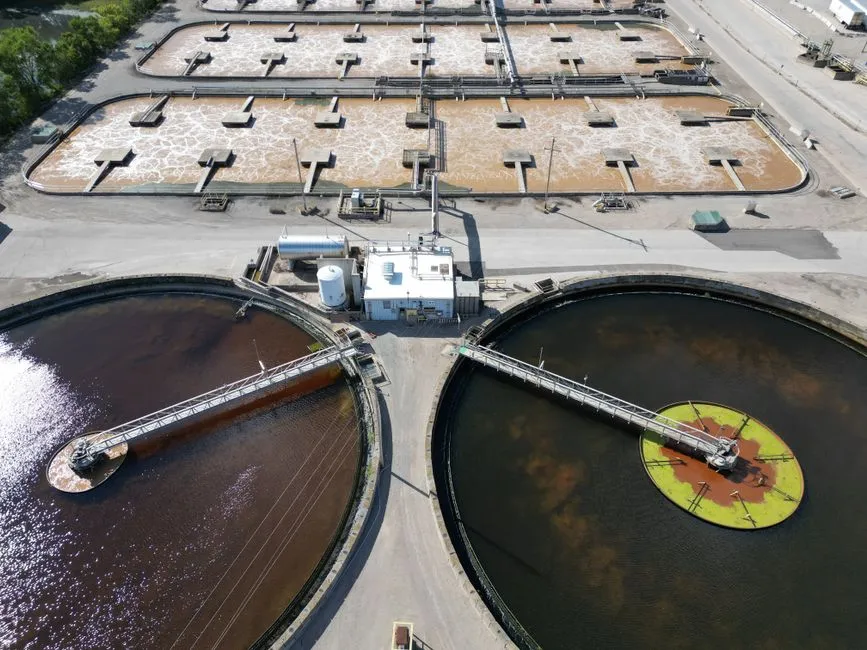
The hardest part of a MABR evaluation is translating the technology comparison into a defensible go/no-go for a specific project. The decision matrix below maps MABR fit against four industrial scenarios commonly seen at EPC and utility level.
| Scenario | Plant size & profile | MABR fit | Why |
|---|---|---|---|
| Decentralized remote site | < 5,000 m³/d, containerized, worker camp / resort / highway rest area / remote village | Strong fit | Plug-and-play ISO containers; no pipeline or pumping station CAPEX; low odor/noise for tourist and residential adjacency; generator-compatible for off-grid or post-disaster service |
| Retrofit of existing CAS basin | 2,000-100,000 m³/d, conventional activated sludge, permit tightening on TN/TP | Strong fit | SUBRE towers drop into existing basins; no new civil works; TN/TP tightening without methanol dosing; payback driven by kWh tariff and discharge-fee avoidance |
| Industrial park / municipal mid-size | 5,000-50,000 m³/d, Title 22 or EU UWWTD nutrient limits, possible reuse target | Conditional fit | Justifiable on energy ROI if kWh tariff is high; pair with a HydropureWater MBR membrane bioreactor system or DF series PVDF flat sheet membrane module downstream if reuse-grade effluent is required; otherwise DAF + MBBR may be a simpler route |
| High-strength industrial / cold-climate greenfield | Chemical, petrochemical, landfill leachate, or northern-climate new build with high influent variability | Weak fit | SND breaks down outside COD:N 6:1-15:1; cold-weather full-scale reference data is thin; equalization, carbon dosing, and heating erase much of MABR's energy advantage; conventional MBR or MBBR is lower-risk |
The decision rule of thumb: if your binding constraint is energy OPEX, decentralized deployment, or single-tank nutrient removal, MABR is a serious option worth a vendor-specific quote. If your binding constraint is reuse-grade solids, lowest first-cost CAPEX, or extreme influent variability, conventional MBR, MBBR, or packaged CAS remains the safer specification. For sites where packaged or underground civil works are constrained, a WSZ underground package sewage treatment plant paired with a polishing MABR stage is a workable hybrid.
Before you freeze a process train, run this selection checklist against site data:
- Confirm COD:N stays inside roughly 6:1-15:1 across the design week, not only the average day.
- Price energy at the actual delivered tariff (USD/kWh), including demand charges if applicable.
- Decide whether solids separation or reuse turbidity is a hard permit limit; if yes, budget MBR/UF downstream.
- Check operator staffing for biofilm-thickness control (15-60 min air-scour cycles) versus MLSS-based CAS habits.
- Require vendor membrane life, replacement cost, and spare-parts lead time in the bid form.
- Ask for cold-climate or high-variability references if your site sits outside Mediterranean/subtropical envelopes.
- Compare lock-in risk across at least two MABR suppliers when multi-vendor bidding is required.
Who This Is For and Next Step
Who this is for: EPC and utility engineers evaluating decentralized packages, CAS retrofits that must tighten TN/TP without methanol, or mid-size plants where energy OPEX above about 0.10 USD/kWh dominates life-cycle cost. Who should look elsewhere: projects whose binding constraint is reuse-grade solids, lowest first-cost CAPEX, COD > 2,000 mg/L with unstable C/N, or northern greenfield sites without full-scale MABR references. Next step: send influent COD/N/TSS, flow (m³/d), discharge limits, and local kWh tariff with a short process note — we will map whether MABR, MBR, or a hybrid train fits before you spend bid hours. Request a site-specific sizing review through our wastewater treatment quote request.
Frequently Asked Questions
What does MABR stand for in wastewater?
MABR stands for Membrane Aerated Biofilm Reactor. It is a gas-transfer membrane process — the membrane delivers oxygen bubble-less to an attached biofilm. It is not a filtration membrane and produces no solids separation on its own. Designers still need secondary clarification or an MBR/UF stage when TSS or reuse turbidity limits apply.
How much energy does MABR save vs conventional activated sludge?
Up to 90% on aeration energy and up to 50% on overall plant energy, based on Fluence's published Aspiral™ and SUBRE performance data. Realized savings depend on influent loading, kWh tariff, and how well biofilm thickness is managed at the specific site. At tariffs below about 0.05 USD/kWh, simple payback often stretches past ten years.
What is the main disadvantage of MABR?
Membrane fouling and biofilm-thickness control are the leading operational disadvantages, and long-term operating data is limited because commercial MABR deployment only began in 2016. The process is also more sensitive to influent C/N ratio than conventional activated sludge and carries higher unit CAPEX. The counter-diffusion mechanism that delivers the energy savings is covered in detail in our 2026 MABR working-principle explainer.
Is MABR the same as MBR?
No. MABR is a gas-transfer biofilm reactor; MBR (membrane bioreactor) is a submerged filtration membrane (typically 0.1-0.4 μm PVDF) coupled to activated sludge. MABR delivers oxygen passively; MBR separates solids. They are often combined in hybrid trains — MABR for biological treatment and aeration savings, MBR downstream for reuse-grade effluent.
What influent conditions favor MABR?
Moderate-strength municipal or industrial wastewater with a stable C/N ratio (typically COD:N 6:1-15:1), low FOG, and low total suspended solids. High-FOG or high-solids streams need upstream pre-screening and a DAF stage; very high-strength or highly variable industrial streams usually need equalization or carbon dosing before MABR sees them.