
Why Abu Dhabi Data Centers Need a CTBD Strategy in 2026
A 100 MW hyperscale data center in Abu Dhabi can withdraw up to 2 million liters of water per day, and the operating envelope is shaped less by IT load than by Gulf feed chemistry, marine-discharge constraints, and an overlapping set of 2026 regulatory instruments (S3). Potable makeup in the emirate is a blend of multistage flash and reverse-osmosis desalination, typically 200–500 mg/L TDS; blended Treated Sewage Effluent (TSE) feed for cooling or irrigation runs 600–1,200 mg/L TDS with elevated chloride and sulfate. Either way, baseline TDS sits one to three times higher than the temperate-region numbers used in most vendor cut-sheets, and that gap drives every downstream scaling calculation.
The regulatory perimeter now has three named pillars. The Abu Dhabi Environment Agency (EAD) Liquid Discharge Technical Guideline sets temperature, pH, TSS, BOD, COD, total nitrogen, total phosphorus, oil and grease, and TDS/chloride caps for marine and stormwater outfalls. Federal Decree-Law No. 45/2021 on environmental protection codifies ambient and discharge quality obligations, monitoring frequency, and penalties nationwide. Estidama Pearl — the Abu Dhabi urban sustainability rating run by the Department of Municipalities and Transport — awards water credits (notably Pearl 2 and Pearl 4) for cooling-tower blowdown (CTBD) reuse, TSE substitution, and reduction in potable demand. Heated blowdown above ~35 °C and TDS above the EAD marine limit (~2,000 mg/L TDS in many stormwater pathways, stricter near marine outfalls) will fail the permit, which is why discharge-to-sea is no longer the default sink for a 2026 design.
What Flows Through the Site: CTBD, Process Water, and Domestic Waste
CTBD is the dominant stream by volume: 20–40% of cooling-tower makeup leaves the system as blowdown, enriched in silica (typically 30–80 mg/L as SiO₂ after concentration), calcium (200–600 mg/L as CaCO₃), magnesium, and treatment-chemical residuals (S4). At a 100 MW site, that translates into 400,000–800,000 L/day of recoverable water — too large to send to drain when potable makeup costs real money in Abu Dhabi.
Secondary streams add complexity that a P&ID must show. Humidification bleed-off carries similar ionic loading to CTBD but at lower cycles. Once-through non-contact cooling water, where still used, is low-TDS and warm. Diesel-generator jacket-cooling flushes arrive in slug flows with corrosion-inhibitor residues. Reverse-osmosis reject from the makeup water train (typically 25–35% of the desalinated feed) is the highest-TDS stream on site, often 8,000–12,000 mg/L. Domestic wastewater from staff blocks is small — 1–3% of total volume — but is regulated separately under EAD and municipality codes and usually segregated through a black-water collection system.
Cycles of Concentration (CoC) — the ratio of dissolved solids in circulating water to dissolved solids in makeup water — define the operating ceiling. The blowdown ratio equals 1/(CoC − 1), so moving from 4 CoC to 6 CoC drops blowdown from 25% to 20% of makeup, a real but often over-stated gain. Above 5–6 CoC, silica, calcium carbonate, and calcium sulfate scaling plus microbiological fouling accelerate non-linearly (S4), which is why most Abu Dhabi operators cap CTBD at 4–5 CoC without side-stream polishing.
Recommended Process Train for Abu Dhabi CTBD in 2026
The defensible 2026 train for an Abu Dhabi hyperscale site runs in four stages, sized to feed either cooling-tower makeup, district cooling, or third-party irrigation reuse, with brine routed to a crystallizer only when true ZLD is contractually required.
Stage 1 — Pretreatment. A multi-media filter loaded with anthracite over sand over garnet, followed by a 5-micron cartridge guard, takes raw CTBD to Silt Density Index (SDI) < 5 and turbidity < 1 NTU. In Gulf service, media selection should target silica-laden feeds: garnet or ilmenite bottom layers improve fines capture, and automatic backwash on differential pressure (typically 0.7 bar) prevents biological blinding during the humid summer months when cycles climb fastest. An automatic chemical dosing system injects non-oxidizing biocide and a threshold antiscalant ahead of the media filter to keep the bed from fouling.
Stage 2 — Side-stream softening. Weak-acid cation (WAC) or lime softening strips calcium and magnesium, drops hardness from ~600 mg/L as CaCO₃ to < 20 mg/L, and stabilizes the Langelier Saturation Index in the negative range before RO. In a high-TDS Abu Dhabi feed, this is preferred over high-dose antiscalant because antiscalant residuals accumulate in the brine loop, raise downstream ZLD OPEX, and can violate irrigation reuse limits on phosphorus-bearing products.
Stage 3 — High-recovery RO. A brackish industrial RO system operates at 75–80% recovery as the baseline, with permeate TDS < 50 mg/L (S3). For sites pursuing < 5% liquid discharge or aggressive Pearl credits, the upgrade path is a controlled-precipitation desalter (e.g., a fluidized-bed reactor ahead of the second-stage membranes) that runs at ~95% overall recovery with permeate silica ~1 mg/L — proven in industrial service on similar brackish streams (S3).
Stage 4 — Brine minimization and reuse polish. Permeate is blended into cooling-tower makeup, district cooling, or landscape irrigation; if the latter, an inline ClO₂ disinfection step holds total coliforms below the reuse threshold. Concentrate is sent to a brine concentrator plus crystallizer for ZLD sites, or to EAD-permitted outfall where marine discharge is available. A side-stream evaporator-crystallizer is the practical choice for small brine flows in mission-critical facilities (S5).
| Stage | Equipment | Key Parameter | Target |
|---|---|---|---|
| 1. Pretreatment | Multi-media filter + cartridge | SDI / turbidity | < 5 / < 1 NTU |
| 2. Softening | WAC or lime softener | Hardness (as CaCO₃) | < 20 mg/L |
| 3a. Baseline RO | BWRO 2-stage | Recovery / permeate TDS | 75–80% / < 50 mg/L |
| 3b. High-recovery upgrade | Brine desalter + RO | Recovery / permeate silica | ~95% / ~1 mg/L |
| 4. Reuse / brine | ClO₂ + crystallizer or outfall | Reuse path | CT makeup, district cooling, irrigation |
Side-Stream Reuse vs. Closed-Loop ZLD: Decision Matrix for Abu Dhabi
The choice between side-stream RO reuse and closed-loop ZLD in Abu Dhabi is driven by three local inputs: industrial electricity tariff, TSE availability, and whether the site sits inside an EAD zero-discharge zone.
Side-stream RO reuse is the lower-CAPEX path. With 80–95% recovery and permeate fed back as cooling-tower makeup, freshwater intake drops by 40–60% and Pearl water credits are unlocked. Closed-loop ZLD delivers a 99%+ liquid-discharge ratio but carries high CAPEX and OPEX, with thermal energy as the dominant variable cost. At Abu Dhabi's industrial electricity tariff of AED 0.27–0.32/kWh (roughly USD 0.073–0.087/kWh), a 50 m³/day brine concentrator draws 60–90 kWh/m³ of distillate before the crystallizer, and that heat is the line item that decides the project. Where the host site can recover low-grade waste heat — a common case next to a gas-fired district cooling or generator skid — thermal ZLD economics shift sharply; without it, OPEX erodes the payback.
The 15 MW case in the field literature shows $200,000 CAPEX and a headline 6.7-year simple payback at 60% blowdown recovery, improving to 3–5 years once hidden cost avoidance (discharge fees, freshwater scarcity premiums, Pearl credit valuation) is included (S4). At Gulf scale, the same model with a 95%-recovery desalter typically compresses payback further because freshwater offset is larger and TSE substitution qualifies for additional credits.
| Criterion | Side-Stream RO Reuse | Closed-Loop ZLD |
|---|---|---|
| CAPEX (relative) | Low–Medium | High (evaporator + crystallizer) |
| Recovery | 80–95% | 99%+ |
| OPEX driver | Membrane replacement, antiscalant | Thermal energy at AED 0.27–0.32/kWh |
| Best fit | Marine outfall available, Pearl credits claimed | Zero-discharge zone, water-positive ESG target |
| Payback range | 3–5 years (with Pearl + discharge savings) | 7+ years without waste-heat recovery |
Decision rule: if a marine outfall is available and Estidama Pearl water credits will be claimed, side-stream RO reuse wins. If the site sits in a zero-discharge zone, pursues net-positive water, or is a flagship sustainability site, route brine to a crystallizer — and price the thermal load at the local tariff before signing the EPC contract.
Compliance Pathway: EAD, Federal Decree-Law 45/2021, and Estidama Pearl
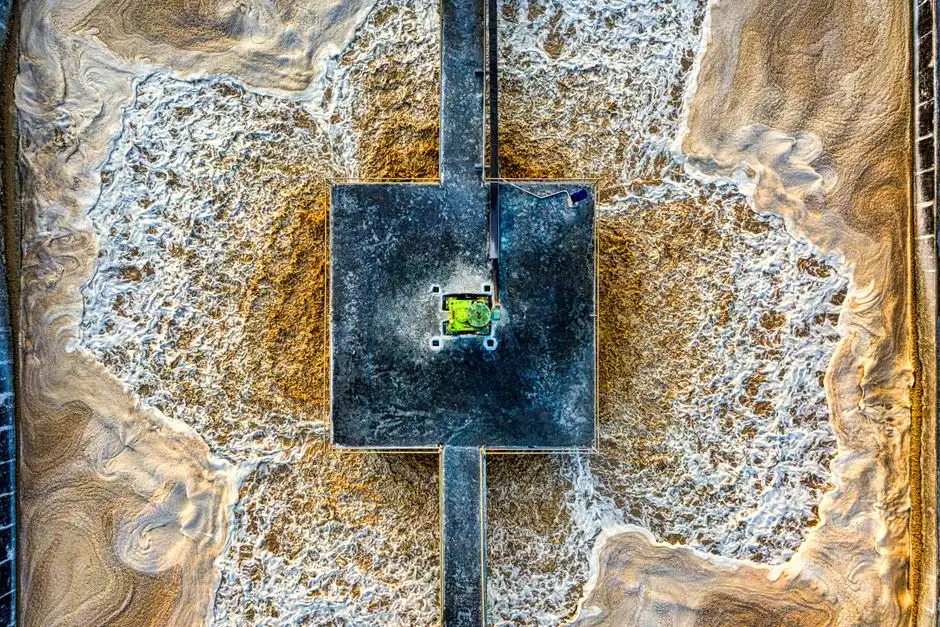
The EAD Liquid Discharge Technical Guideline is the operational document: it lists numeric limits for temperature (typically < 35 °C at the discharge point for marine outfalls), pH (6–9), TSS (< 50 mg/L), BOD (< 25 mg/L), COD (< 150 mg/L), total nitrogen, total phosphorus, oil and grease, and chloride/TDS caps that vary by receiving environment. The Abu Dhabi marine outfall TDS limit is commonly 2,000 mg/L; stormwater pathways are tighter. A discharge that exceeds any one of these triggers non-compliance action under Federal Decree-Law No. 45/2021, which sets the national ambient- and discharge-quality obligations, mandates monitoring, and aligns with the UAE National Climate Change Plan 2050.
Estidama Pearl is where the design choice pays back. Pearl 2 (villa/small building) and Pearl 4 (community/precinct) both reward cooling-tower blowdown reuse, TSE substitution, and reductions in potable demand. Configurations that generate the strongest credits pair high-recovery RO with a documented freshwater offset, on-site TSE use where available, and a metering chain that the Pearl assessor can audit quarterly.
Monitoring must be continuous on the CTBD line: 24/7 flow, conductivity, and pH, with quarterly third-party lab confirmation against the full EAD parameter list. Without that data stream, neither the EAD permit nor the Pearl submission will close.
Frequently Asked Questions
What TDS limit applies to cooling-tower blowdown discharged to a marine outfall in Abu Dhabi?
EAD's Liquid Discharge Technical Guideline sets site-specific TDS and chloride caps for marine outfalls, commonly ~2,000 mg/L TDS; stormwater pathways are tighter, and heated blowdown above ~35 °C typically fails the thermal-pollution clause regardless of chemistry.
How high can cooling-tower cycles of concentration run in Abu Dhabi without side-stream treatment?
On a Gulf feed (200–1,200 mg/L TDS makeup), most operators cap CTBD at 4–5 CoC; above 5–6 CoC, silica, calcium carbonate, and microbiological fouling accelerate non-linearly, forcing blowdown rate back up (S4).
What is the baseline recovery target for a high-recovery RO on Abu Dhabi CTBD?
A conventional brackish RO system delivers 75–80% recovery on CTBD (S3); a controlled-precipitation desalter upgrade raises overall recovery to ~95% with permeate silica of ~1 mg/L (S3).
Which Estidama Pearl credits are unlocked by cooling-tower blowdown reuse?
Pearl 2 and Pearl 4 both award water credits for CTBD reuse, TSE substitution in cooling, and demonstrated reductions in potable demand; a metered high-recovery RO train with audited freshwater offset is the cleanest path to claiming them under Federal Decree-Law No. 45/2021 compliance reporting.
For Abu Dhabi sites ready to move from concept to P&ID, the engineering starting point is a brackish industrial RO system fronted by a multi-media filter, scaled to the desalinated makeup TDS and Pearl credit target — and benchmarked against the side-stream-reuse-vs-ZLD decision matrix above. For a comparable Gulf-process reference, see the Data Center Cooling Blowdown Treatment in Dammam 2026 process and compliance walkthrough, and the Industrial Reverse Osmosis Systems 2026 buyer's guide for RO sizing detail.