
Why desizing effluent is a special case for MBBR design
Desizing wastewater is the hot alkaline wash water generated when sizing agents — starch, modified starch, carboxymethyl cellulose (CMC), or polyvinyl alcohol (PVA) — are washed off woven fabric after the loom. It is one of the highest-strength streams inside a textile mill ETP: 2,000–15,000 mg/L COD, 800–6,000 mg/L BOD, 60–95°C, and pH 10–13. The combination of high organic load, low nitrogen (<50 mg/L TN) and low phosphorus (<10 mg/L TP) puts it in the textbook "high BOD/COD, nutrient-starved" category documented in the PMC review of industrial effluents (source: Comprehensive review of industrial wastewater treatment techniques, PMC11374848). Elsevier dedicates an entire edited-volume chapter to the stream — The Anaerobic Digestion of Textile Desizing Wastewater — which is the strongest signal that desizing is treated as a distinctly characterized wastewater class, not folded into "textile effluent" (source: ScienceDirect, B9781845692148500163).
Three consequences for MBBR design. First, the high temperature forces a cooling step to <40°C or biofilm kinetics collapse; biological activity roughly halves every 10°C above 30°C. Second, the high pH forces neutralization to 6.5–8.5 before biology. Third, the high COD at low flow makes the volumetric loading rate, not the tank footprint, the binding constraint. The K1-media MBBR that handles 400–800 mg/L laundry COD comfortably at 20% fill (Kusuma et al., Universitas Tanjungpura, 2024) is the same reactor type, but the desizing envelope demands a tighter, more conservative design margin.
Desizing effluent — typical influent parameters you must measure first
Before any sizing math, fix the influent envelope with site-specific sampling. The table below is a representative 2024–2025 textile-mill desizing envelope — confirm with composite sampling per the UPC MBBR-MBR characterization protocol (source: UPC thesis, 2021).
| Parameter | Unit | Typical range | Design implication |
|---|---|---|---|
| Flow (Q) | m³/d | 50–500 | Sizes equalization, MBBR, and air systems |
| pH | — | 10–13 | Neutralize to 6.5–8.5 upstream of biology |
| Temperature | °C | 60–95 | Cool to <40°C via equalization + heat exchanger |
| COD | mg/L | 2,000–15,000 | Drives volumetric loading and tank volume |
| BOD₅ | mg/L | 800–6,000 | BOD/COD ratio sets biodegradability assumption |
| BOD/COD | — | 0.4 (PVA) – 0.7 (starch) | Lower ratio → harder to biodegrade, may need pre-hydrolysis |
| TSS | mg/L | 200–1,500 | Settle or DAF upstream to protect biofilm carriers |
| Total nitrogen (TN) | mg/L | <50 | Supplement with urea or ammonium dosing (target C:N:P = 100:5:1) |
| Total phosphorus (TP) | mg/L | <10 | Same — supplement with phosphoric acid dosing |
| Surfactant / wetting agent | mg/L | 20–200 | Drives foaming risk; can be partially biodegraded in MBBR (Kusuma et al., 2024) |
Sizing-agent chemistry is the single biggest variable. A PVA-bearing desizing liquor gives BOD/COD ≈ 0.4 and biodegrades slowly, so an anoxic or hydrolysis pre-stage is often justified to lift the ratio. A starch-bearing liquor gives BOD/COD ≈ 0.7 and is readily biodegradable in a single aerobic stage. Either way, the hot alkaline influent means equalization with cooling and pH correction is a non-negotiable prerequisite before the MBBR.
The six-step MBBR sizing calculation for desizing effluent
The worked example below uses Q = 200 m³/d and COD = 8,000 mg/L — a mid-range desizing stream. Open it in Excel and you can re-run the whole chain by changing the two input cells.
- Fix design flow and influent COD. Q = 200 m³/d, COD = 8,000 mg/L = 8.0 kg/m³. Daily load = Q × COD = 200 × 8.0 = 1,600 kg COD/d.
- Select volumetric organic loading rate (VLR). For aerobic MBBR on desizing, use VLR = 1.5–3.0 kg COD/m³·d (engineering rule-of-thumb consistent with MBBR design practice; not a single-source citation).
- Calculate MBBR working volume. V = COD load ÷ VLR = 1,600 ÷ 1.5 = 1,067 m³ (low end) to 1,600 ÷ 3.0 = 533 m³ (high end). Use the conservative midpoint: V ≈ 800 m³ at VLR = 2.0 kg COD/m³·d.
- Select media and fill fraction. Kaldnes K1 HDPE biofilm carrier at 20–40% fill. At 30% fill, media volume = 0.30 × 800 = 240 m³. K1 carrier specific surface area is ~500 m²/m³, giving ~120,000 m² of biofilm area. Kusuma et al. (2024) showed that 20% K1 fill already delivers meaningful COD and BOD reduction, so 30% is a defensible conservative design point.
- Check hydraulic retention time. HRT = V ÷ Q × 24 = 800 ÷ 200 × 24 = 9.6 h, inside the 6–10 h target window. Flag the design as under-sized if HRT falls below 4 h — biofilm sloughing and washout risk become unacceptable.
- Air demand. 0.5–1.0 Nm³ air per kg COD removed via coarse-bubble diffusers, sized to hold DO at 2–3 mg/L. Assume 90% COD removal → 1,440 kg COD/d removed → air = 720–1,440 Nm³/h, or roughly 1,000 Nm³/h at 10°C standard conditions.
| Step | Input / formula | Worked value (Q=200 m³/d, COD=8,000 mg/L) |
|---|---|---|
| 1. Daily COD load | Q × COD | 1,600 kg COD/d |
| 2. VLR assumption | kg COD/m³·d | 2.0 (range 1.5–3.0) |
| 3. Working volume V | Load ÷ VLR | 800 m³ |
| 4. Media volume at 30% fill | 0.30 × V | 240 m³ of K1 carriers |
| 5. HRT check | V ÷ Q × 24 | 9.6 h (target 6–10 h) |
| 6. Air demand at 90% removal | 0.5–1.0 Nm³/kg COD | ~1,000 Nm³/h |
Front-end protection of the biofilm carriers matters. A rotary mechanical bar screen for textile-mill headworks removes lint and fiber that would otherwise blind the carrier surface, and a DAF unit for desizing-E pretreatment strips residual surfactant and TSS before the MBBR.
Design sanity checks — HRT, F/M, and biofilm stability
Three second-order checks should fail any design that the six-step math alone would let through.
| Check | Target / threshold | Failure mode if missed |
|---|---|---|
| HRT | 6–10 h aerobic | <4 h → biofilm sloughing and washout; >14 h → wasted CAPEX |
| F/M ratio | 0.2–0.5 kg BOD/kg biofilm-day | Too low → starving biofilm; too high → poor floc, high effluent BOD |
| Temperature | ≤40°C into MBBR | >40°C → kinetics collapse; MBBR removal drops to <40% |
| Residual surfactant | <50 mg/L into MBBR | Excess → foaming in aeration tank and carrier fouling |
The F/M check uses the attached biomass on the carriers, typically estimated at 3–5 g TSS/m² of carrier surface. For the worked example, ~120,000 m² of carrier × 4 g/m² = 480 kg of attached biomass. At BOD load = 1,600 × 0.55 = 880 kg BOD/d, F/M = 880 ÷ 480 = 1.83 d⁻¹ — high. In practice this means a higher fill fraction (40%) or a longer HRT is needed to land inside the 0.2–0.5 target. The Kusuma et al. study also flagged surfactant as a parameter that MBBR with K1 media reduces, but only when the influent concentration is already moderate; raw desizing liquor at 200 mg/L surfactant will still foam.
Upstream and downstream unit operations around the MBBR
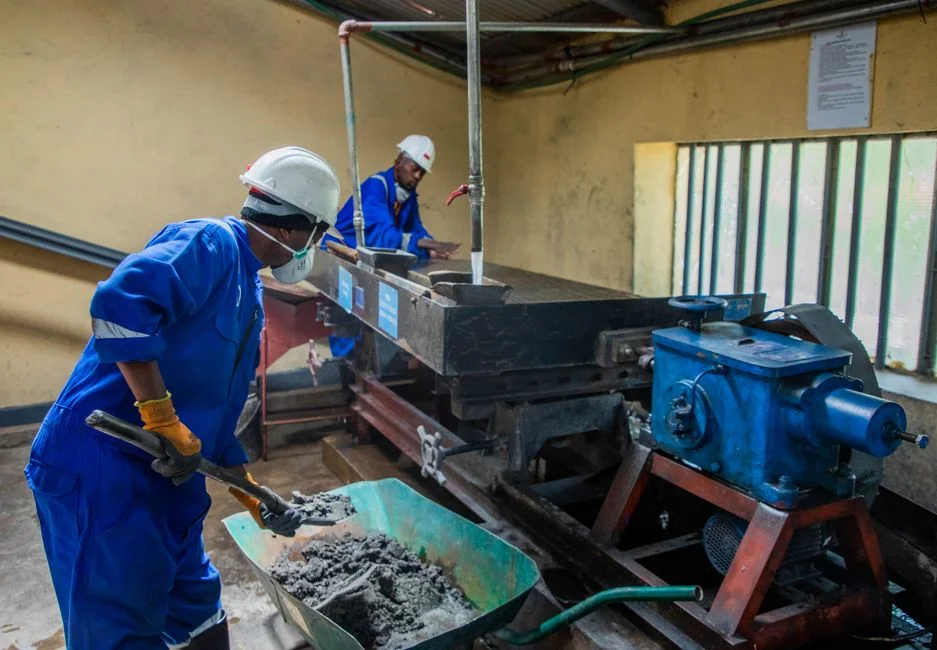
The MBBR is one stage inside a full train, not a standalone solution. The desizing stream needs a headworks that handles the heat and the alkalinity, and a tail-end that handles biomass carryover.
Upstream of the MBBR: rotary bar screen (GX series) for lint and fiber → equalization basin sized at 8–12 h of flow with cooling coils or a plate heat exchanger to bring temperature to <40°C → automatic chemical dosing for pH correction and nutrient balancing using sulfuric acid for pH, urea for nitrogen, and phosphoric acid for phosphorus → optional DAF for residual surfactant and TSS. For PVA-bearing liquor with BOD/COD <0.5, a small anoxic or hydrolysis pre-tank (4–6 h HRT) substantially improves downstream MBBR biodegradability — the same logic the UPC thesis uses to justify the MBBR-MBR hybrid's lower OPEX versus conventional activated sludge (source: UPC, 2021).
Downstream of the MBBR: settling or DAF for biomass carryover → optional MBR polish downstream of the MBBR for reuse-grade effluent. The MBBR-MBR combination has lower CAPEX/OPEX than CAS for textile reuse because the high-quality effluent eliminates extra decolorizing agent (UPC, 2021). For related design chains on the same mill, the MBBR sizing for factory white water discharge, MBR sizing for textile white water, and DAF sizing for white water guides cover the lower-strength streams in the same plant. Waste biological sludge is dewatered on a plate-and-frame filter press to 22–28% DS before disposal.
Frequently Asked Questions
What VLR should I use for MBBR on desizing effluent?
Use 1.5–3.0 kg COD/m³·d for aerobic MBBR on desizing, with 2.0 as the conservative midpoint. PVA-bearing liquor with BOD/COD ≈ 0.4 should sit at the low end (1.5 kg COD/m³·d) to avoid kinetic overload.
What HRT does an MBBR need for hot alkaline desizing wastewater?
Target 6–10 h aerobic HRT after equalization, cooling to <40°C, and pH correction to 6.5–8.5. Below 4 h the biofilm sloughs; above 14 h the tank is oversized and CAPEX is wasted.
Do I need to cool desizing liquor before the MBBR?
Yes. Desizing effluent leaves the wash range at 60–95°C, and biofilm activity roughly halves every 10°C above 30°C. Without equalization cooling to ≤40°C, MBBR removal collapses to <40% even with correct media fill.
Why is the BOD/COD ratio critical for desizing MBBR design?
It sets the biodegradable fraction. Starch desizing gives BOD/COD ≈ 0.7 and runs well in a single aerobic MBBR; PVA desizing gives BOD/COD ≈ 0.4 and usually needs a 4–6 h anoxic or hydrolysis pre-stage to lift the ratio before aerobic polishing.