What Finnish and EU Rules Mean for Helsinki Hospital Effluent in 2026
Hospital wastewater treatment in Helsinki in 2026 must satisfy Finnish Government Decree 6/2014 (Valtioneuvoston asetus yhdyskuntajätevesistä, STERV) and EU Urban Waste Water Directive 91/271/EEC, with treated effluent typically routed to HSY's Viikinmäki or Blominmäki WWTPs. Standard designs combine screening, equalization, biological treatment (MBR or activated sludge), and disinfection (chlorine dioxide or UV) to achieve COD <125 mg/L, BOD7 <15 mg/L, and fecal coliform <100 CFU/100 mL before discharge.
STERV 6/2014 is technically a municipal-plant decree, but its Annex 1 numerical limits and HSY's tiedosto (case-specific) acceptance criteria govern what any discharger — including a hospital — must hit before its stream enters the HSY sewer. For a 400-bed Helsinki hospital generating 200–500 m³/d, the hospital is below the UWWTD 2,000 p.e. agglomeration threshold and therefore does not need its own UWWTD-compliant biological plant; what it does need is pretreatment that meets HSY's industrial-discharge limits, which mirror STERV Annex 1: BOD7 ≤15 mg/L, COD ≤125 mg/L, TSS ≤35 mg/L, total P ≤1.0 mg/L, total N ≤15 mg/L, and fecal coliform <100 CFU/100 mL in a 24-hour composite.
Pharmaceutical residues, contrast media (iodinated X-ray compounds), and antibiotic-resistant bacteria (ESBL-producing E. coli, MRSA, VRE) are not yet numerically regulated in STERV. They are monitored under the EU Strategic Approach to Pharmaceuticals in the Environment, which entered its 2026 implementation review in Q1 2026 and is widely expected to push watch-list substances into HSY tiedosto limits by 2027. Hospitals that design to today's STERV numbers alone will be retrofitting within five years; the defensible 2026 spec treats pharmaceuticals as a design driver, not a footnote. Operators in other EU jurisdictions face the same shift, as outlined in our 2026 EU wastewater discharge standards brief.
Why Helsinki Hospital Wastewater Cannot Go Straight to the Sewer
HSY's Viikinmäki and Blominmäki plants are designed for municipal COD, nitrogen, and phosphorus — not for the pharmaceutical fingerprint of a 400-bed hospital. A 2019 Springer survey of five Slovak and Czech hospitals (the most-cited European micropollutant dataset available) measured peak concentrations of cotinine at 6,700 ng/L, bisoprolol at 5,200 ng/L, metoprolol at 2,600 ng/L, sulfamethoxazole at 1,500 ng/L, and ranitidine at 1,400 ng/L in raw hospital effluent (Springer 2019, Environ. Sci. Pollut. Res.). Those loads arrive at the HSY sewer in slug pulses tied to surgery schedules, dialysis shifts, and laundry cycles, and they pass through primary clarification largely intact.
Antibiotic-resistant organisms present a second, sharper problem. The same Springer study reported complete removal of ESBL and MRSA only by advanced oxidation — modified Fenton, boron-doped diamond electrode, or ferrate(VI) — at oxidation costs that a municipal activated-sludge plant cannot absorb. Blominmäki, funded by a EUR 115 million NIB loan in November 2015, is sized for 400,000 p.e. of municipal flow with biological nutrient removal, but it was not designed as a healthcare-contaminant polishing step. Relying on it to absorb hospital micropollutants is technically and legally fragile.
Helsinki hospital flow is also operationally awkward for a sewer: 50–500 m³/d depending on bed count, with diurnal peaks during morning surgical blocks and outpatient clinics, plus hot discharges of 40–60°C from sterilizer condensate and instrument washers. Without on-site equalization and biological treatment, those pulses hit HSY's trunk sewer as thermal and hydraulic shocks that compromise the downstream MBR and UV stages at Viikinmäki. The case for on-site pretreatment is therefore regulatory, microbiological, and hydraulic — three independent reasons, any one of which is enough to justify the equipment.
A 2026 Process Train for Helsinki Hospital Wastewater
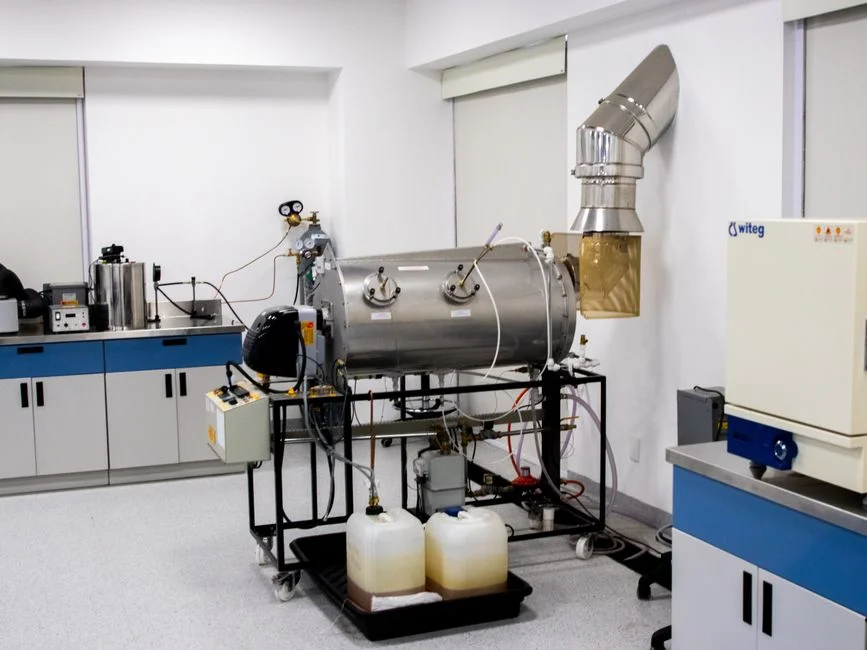
The defensible 2026 train for a 100–300 m³/d Helsinki hospital runs: rotary bar screen (6 mm aperture) → flow equalization tank (HRT 8–12 h, with 4–6 cm PU foam insulation and a 2 kW mixer) → MBR aeration basin (mixed liquor suspended solids 8,000–12,000 mg/L, HRT 6–10 h, dissolved oxygen 2.0–2.5 mg/L) → membrane cassette (0.1–0.4 µm PVDF, flux 15–25 L/m²·h) → ClO₂ contact tank (CT 15 mg·min/L) → HSY sewer. A pre-engineered compact hospital wastewater treatment system packages screening through disinfection in a single skid; the upstream rotary mechanical bar screen is usually installed separately for service access.
| Stage | Key parameter | 2026 design target |
|---|---|---|
| Bar screen | Aperture | 6 mm |
| Equalization | HRT | 8–12 h |
| MBR basin | MLSS / HRT / DO | 8,000–12,000 mg/L / 6–10 h / 2.0–2.5 mg/L |
| Membrane | Pore / Flux | 0.1–0.4 µm PVDF / 15–25 L/m²·h |
| ClO₂ contact | CT / Dose | 15 mg·min/L / 0.5–1.0 mg/L residual |
| Sludge dewatering | DS after plate press | 18–22% |
MBR effluent in this train consistently hits COD <50 mg/L, BOD7 <10 mg/L, NH₃-N <5 mg/L, turbidity <1 NTU, and TSS <5 mg/L. A 200 m³/d pilot in the published literature reported COD and NH₃-N of less than 50 mg/L and 10 mg/L respectively on the same biological-contact-oxidation/MBR/Numerical-Disinfectant architecture (Scientific.Net, 200 m³/d MBR pilot). For a Helsinki installation, two design notes matter more than anywhere in southern Europe: equalization and biological tanks require 4–6 cm external PU insulation and buried or trace-heated piping, because basin temperatures below 10 °C cut nitrification rates by roughly 50% and below 5 °C stall them. The MBR aeration basin should be held at 12–18 °C year-round, which in practice means drawing heat from the hospital's sterilizer condensate and CHP reject loop rather than electric heating.
Footprint for a packaged 100 m³/d unit is roughly 25 m² excluding the equalization tank; containerized systems below 50 m³/d can drop to under 10 m². Waste activated sludge is wasted at 0.8–1.2% of throughput, thickened on a small plate-and-frame press to 18–22% dry solids, and consigned as healthcare-adjacent waste per HSY jätehuolto määräykset. An MBR membrane bioreactor system rated for hospital duty handles steps 2–4 in one frame.
Disinfection in 2026: Chlorine Dioxide, Ozone, UV, or Sodium Hypochlorite?
Disinfection is where hospital projects fail audit most often, because each of the four common options trades a different set of compromises. The four-way comparison below is calibrated to Helsinki hospital effluent after MBR (turbidity <1 NTU, COD ~50 mg/L, pH 7–8) and to the 2026 compliance environment — including the EU Drinking Water Directive 98/83/EC for any stream that re-enters the building water system.
| Parameter | ClO₂ | O₃ | UV (254 nm) | NaOCl |
|---|---|---|---|---|
| Log reduction, fecal coliform | ≥4–5 | ≥4–5 | 3–4 (post-MBR only) | ≥4 |
| Dose at typical effluent | 0.5–1.0 mg/L residual | 5–10 mg/L | 30–40 mJ/cm² | 2–5 mg/L free Cl₂ |
| THM / AOX formation | Negligible | Low; bromate risk | None | High with pharma organics |
| Operating cost (€/m³, 2026) | 0.04–0.08 | 0.10–0.18 | 0.02–0.05 | 0.05–0.10 |
| Footprint | Small | Medium (contactor + DRE) | Small | Tank only |
| Cold-water efficacy (≤10 °C) | Maintained | Reduced ~30% | Strongly reduced | Maintained |
| Residual for HSY sewer | Stable 24 h | None | None | Declining; forms THMs |
Chlorine dioxide is the default for sub-300 m³/d Helsinki hospitals: 99.9% bacterial kill at 0.5–1.0 mg/L residual, no trihalomethane formation with the pharmaceutical organics common in hospital streams, and stable residual through the 4–6 km run to HSY's interceptor. An on-site chlorine dioxide generator sized on 2–3 g ClO₂ per m³ of flow handles the demand with sodium chlorite and 9% HCl precursors. UV is added when the hospital reuses effluent for toilet flushing or landscape irrigation under the 2026 water reuse outlook, because UVT in hospital effluent often sits at 50–70% and temperature drops below 10 °C halve lamp output — UV is therefore a polishing step after MBR, not a stand-alone barrier. NaOCl is discouraged for Finnish hospital drains by HSY tiedosto guidance because THM formation with iodinated contrast media and ranitidine-class compounds routinely exceeds 100 µg/L at the dosing needed for >4-log reduction.
Decision rule: specify packaged MBR + ClO₂ for any Helsinki hospital below 300 m³/d, add UV only if reuse is in scope, and reject NaOCl unless the project budget cannot support a generator room. Comparable EU hospital projects, such as the French reference design covered in our hospital wastewater treatment in France guide, have moved to the same conclusion.
2026 Cost Ranges and Equipment Selection for Helsinki Hospitals
Capital and operating cost ranges for a turnkey hospital wastewater treatment system installed in southern Finland in 2026, sized on a packaged MBR + ClO₂ train with civil works, instrumentation, and HSY permit engineering included:
| Hospital size (flow) | CAPEX (EUR, 2026) | OPEX (EUR/m³) | Footprint |
|---|---|---|---|
| 20 m³/d (clinic / day-surgery) | 80,000–140,000 | 0.50–0.80 | 8–12 m² |
| 100 m³/d (small general hospital) | 180,000–320,000 | 0.40–0.65 | 25–35 m² |
| 200 m³/d (mid-size hospital) | 320,000–650,000 | 0.35–0.55 | 45–60 m² |
| 500 m³/d (university / central hospital) | 700,000–1,400,000 | 0.30–0.50 | 90–130 m² |
OPEX in 2026 is dominated by electrical consumption for MBR aeration (roughly 1.2–1.8 kWh/m³) and ClO₂ chemical cost; membrane replacement is a five-to-seven-year reserve item at €30–€55 per m² of cassette. A 100 m³/d hospital running 330 d/yr at 0.50 €/m³ lands at about €16,500/yr OPEX before membrane replacement, against a CAPEX amortization of roughly €25,000–€45,000/yr on a 10-year straight-line basis. Selection should be filtered on four non-negotiable criteria: (1) a declaration of conformity referencing STERV 6/2014 limits, not generic CE; (2) factory acceptance test records including a 72-hour pilot run on site- or hospital-analogous wastewater; (3) a service network in southern Finland with <8 h on-site response; (4) PLC telemetry with BACnet/Modbus gateway to the hospital's building management system so that facilities staff see the WWTP on the same dashboard as the boilers. The compact hospital wastewater treatment system and the MBR membrane bioreactor system meet these criteria for sub-200 m³/d projects; for larger hospitals, civil design and MBR sizing need to be tendered separately.
Frequently Asked Questions
Does STERV 6/2014 apply to a Helsinki hospital, or only to municipal WWTPs?
STERV 6/2014 governs municipal plants directly, but its Annex 1 limits are enforced indirectly on hospitals through HSY's tiedosto industrial-discharge acceptance criteria. A 200-bed hospital must hit BOD7 ≤15 mg/L, COD ≤125 mg/L, and fecal coliform <100 CFU/100 mL before its stream joins the HSY sewer (per HSY tiedosto, 2026).
What is the smallest hospital flow rate that still needs on-site biological treatment?
Hospitals above roughly 50 m³/d — equivalent to about 30 in-patient beds with full surgical and sterilization throughput — generally need on-site MBR or activated-sludge biological treatment to keep thermal and pharmaceutical slugs out of HSY's interceptor.
How is the MBR sized for a 200 m³/d hospital?
The published 200 m³/d MBR pilot reached COD <50 mg/L and NH₃-N <10 mg/L at HRT 6–10 h and MLSS 8,000–12,000 mg/L (Scientific.Net, 200 m³/d MBR pilot dataset). A 200 m³/d Helsinki design should use 6–8 h HRT with a 25–30 m³ aeration basin plus a 15 m² PVDF cassette.
What cold-climate design margin is required for Helsinki winters?
Equalization and biological tanks require 4–6 cm PU external insulation, MBR aeration basins must be held at 12–18 °C year-round, and outside piping needs electrical heat-trace sized for –26 °C ambient (Helsinki climatology, 2026 mean minimum –20 °C, design minimum –26 °C).
Why is chlorine dioxide preferred over sodium hypochlorite for Helsinki hospitals?
ClO₂ does not form trihalomethanes with pharmaceutical organics at the 0.5–1.0 mg/L residual needed for >4-log fecal-coliform reduction, while NaOCl at the equivalent dose routinely exceeds 100 µg/L THM with iodinated contrast media — a result HSY tiedosto guidance treats as non-compliant for hospital drains.
Related Equipment
- on-site chlorine dioxide generator — specifications, capacity range, and technical data