Why a Digital Twin for Municipal Wastewater Plants Is a 2026 Compliance Decision, Not a 2030 One
A digital twin for a municipal wastewater plant is a live, AI-driven virtual replica of the physical MWTP that ingests SCADA, IIoT sensor, and lab data to simulate hydraulics and biological processes in real time. The 2026 business case is driven by EU UWWTD (EU) 2024/3019, which requires energy neutrality for plants above 10,000 PE by 2040. Published retrofits on 50,000–200,000 m³/day MWTPs report 12–22% aeration-energy reduction and 8–15% OPEX savings, typically paying back in 24–36 months when deployed on top of existing SCADA rather than replacing it.
Most utility engineering teams still treat the energy-neutrality clock as a 2030–2040 horizon planning exercise. The revised directive compresses that timeline. Article 5 of (EU) 2024/3019 mandates energy audits beginning in 2026 for plants above 10,000 PE, with full energy balance reporting by 2028 and net-zero operational energy by 2040 — a four-year window between audit obligation and binding target that does not allow for a greenfield capacity build. The ASCE 2025 editorial on MWTP digital twins frames this correctly: municipal plants are critical but aging infrastructure, and incremental optimisation on existing assets is the only compliance path that fits the clock.
Aeration is the single line item a digital twin attacks first. Activated-sludge aeration accounts for 40–60% of total MWTP electricity (industry baseline; ASCE 2025 cites comparable figures), and the EU UWWTD energy-neutrality math is essentially an aeration-intensity problem measured in kWh per kg BOD removed. The Singapore Changi Water Reclamation Plant remains the most-cited municipal benchmark — a 1.5 million m³/day works where the twin co-optimises blowers, DO setpoints, and return activated sludge rates in real time. Changi's success is replicable on conventional activated-sludge plants with IIoT retrofits, not just on the membrane bioreactor trains most engineering teams assume. Per ParyAI's deployment guidance, retrofitting digital twins onto existing SCADA is now standard practice — the "rip and replace" objection procurement teams raise is obsolete.
Digital Twin vs SCADA: What Actually Changes for Plant Operators
SCADA is event-logging and set-point control. A digital twin is predictive simulation layered on top of it. The distinction matters because non-technical management hears "we already have a control system" and stops the conversation; engineers need a one-sentence translation that lands. SUEZ's positioning of digital twins as a process-optimisation tool captures the gap: SCADA records what happened and executes what an operator told it; a twin predicts what will happen and recommends what to do next.
In operator terms, the difference is concrete. SCADA tells you the dissolved oxygen in Aeration Basin 3 is 1.8 mg/L right now. A digital twin predicts that, given the current inflow of 18,200 m³/h and the incoming NH4-N load, DO will drop to 0.6 mg/L in 35 minutes, and tells the blower VFD to ramp down now to avoid an overshoot later. That 30-minute forward look is what saves energy and prevents effluent ammonia excursions during diurnal peaks — neither of which a SCADA historian can do because it has no process model and no inflow forecast.
The four enabling technologies named in the ASCE 2025 editorial — advanced sensors, IoT, big data, AI — map to specific MWTP use cases rather than functioning as a generic stack. AI drives the influent forecast and the setpoint recommender. IoT provides distributed TSS, NH4-N, and NO3-N probes that legacy SCADA wiring cannot economically reach. Big data holds the 12–24 months of historical operating records needed to calibrate an ASM2d model. Advanced sensors — optical DO, ion-selective NH4-N, ultrasonic sludge blanket — supply the input signal quality the model requires. ParyAI confirms digital twins integrate with PLCs, SCADA, IIoT, and operational databases, so existing OT infrastructure is preserved and not replaced.
| Capability | SCADA (Existing) | Digital Twin (Layered) |
|---|---|---|
| Data direction | Operator → PLC, PLC → HMI | Sensor → historian → bioprocess model → setpoint recommendation → operator |
| Time horizon | Real-time (present state) | Real-time + 15–60 min predictive |
| Aeration control | Fixed DO setpoint or PI loop | Model-predictive control on DO, NH4-N, and airflow simultaneously |
| Influent variability | Reacted to after the fact | Forecast 1–6 h ahead via ML on weather + SCADA flow |
| Data sources | Hard-wired instruments | SCADA + IIoT + lab + CMMS + weather + energy meters |
| Operator role | Manual override of loops | Approves / rejects twin recommendations; policy-defined |
The 5-Layer Reference Architecture for a Municipal WWTP Digital Twin
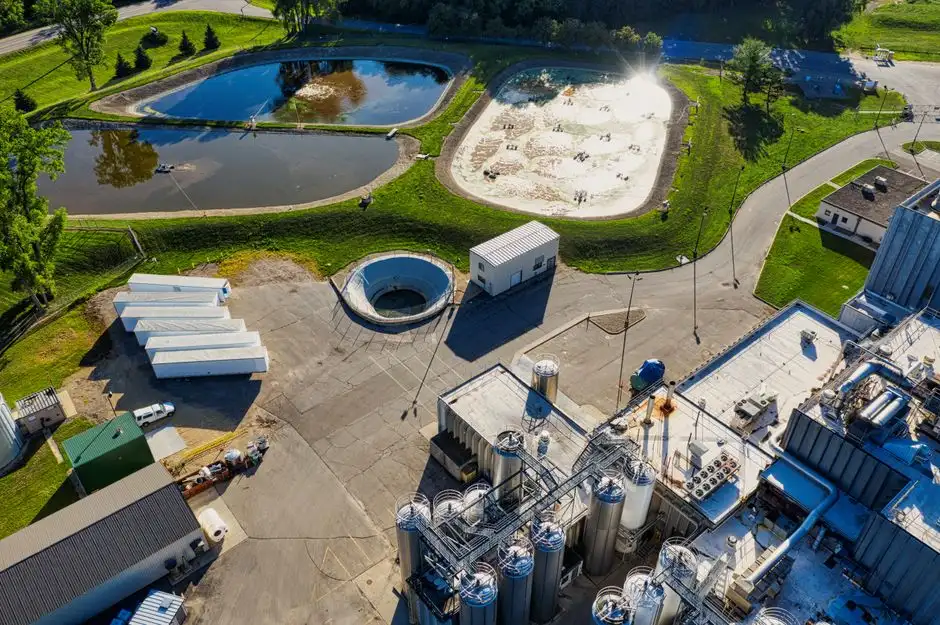
The architecture below is the version a vendor RFP should be benchmarked against. If a proposal cannot map its deliverables to all five layers, the buyer is being sold a dashboard, not a twin.
Layer 1 — Physical assets. Aeration tanks, final clarifiers, blowers, UV banks, sludge thickening and dewatering trains, and the influent lift station. Skidded packaged units — including an integrated MBR membrane bioreactor system for plants tightening effluent limits or a packaged domestic treatment unit for smaller works — sit at this layer as the physical objects the twin mirrors. The twin does not need a 3D model of every pipe; it needs a hydraulically connected graph of unit processes with volume, surface area, and recycle-stream topology.
Layer 2 — Instrumentation. Online sensors for dissolved oxygen, mixed liquor suspended solids, ammonia, nitrate, total suspended solids, flow, pH, and temperature. Typical IIoT sensor density is 15–40 instruments per 50,000 m³/day biological train when retrofitting brownfield MWTPs that were originally designed for minimal instrumentation. The point is not raw sensor count but coverage of the model state variables — you cannot calibrate an activated-sludge model without NH4-N and NO3-N signals at the basin outlets, not just at the influent.
Layer 3 — Connectivity. Industrial protocols carry the data northbound. Modbus TCP and OPC UA are the workhorses for legacy PLC integration; MQTT is the standard publish-subscribe protocol for newer IIoT gateways; IEEE 1588 precision time sync is required when the twin runs model-predictive control with sub-second alignment between DO probes and blower VFDs. A vendor that cannot name the protocol per data source is going to stall at the integration stage.
Layer 4 — Edge compute. Pre-processing, data validation, outlier rejection, and model inference at sub-second latency so control loops do not depend on a cloud round-trip. The edge computing for wastewater monitoring approach keeps time-critical control local and pushes only cleaned, aggregated data to the cloud historian. This is also where the cybersecurity segmentation per IEC 62443 lives — the edge gateway is the OT/IT boundary.
Layer 5 — Cloud + AI. Process models (ASM2d, Mantis, GPS-X, WEST, BioWin) run the biokinetic simulation; ML pipelines run the influent forecast and energy-optimisation layer; the visualisation layer is what operators see on screen. Cloud is not mandatory — on-prem servers are equally valid for utilities with data-residency constraints — but the data historian, model registry, and MLOps tooling should sit on infrastructure the utility owns or contractually controls.
Process Variables a Municipal Digital Twin Must Hold
The parameter table below is the model-scoping checklist. If a vendor's proposal cannot populate every row, they are underscoping the model and the savings claim that follows is not defensible.
| Variable Group | Specific Parameters | Source / Measurement | Why It Matters |
|---|---|---|---|
| Influent flow & load | Q (m³/h), COD, BOD₅, TSS, NH4-N, PO4-P, temperature | Flowmeters + online analysers + lab composite | Drives the entire mass-balance; infeed forecast is the highest-leverage ML model |
| Aeration | DO (mg/L), oxygen uptake rate (OUR, mg O₂/L·h), airflow (Nm³/h), pressure | Optical DO probes + blower telemetry | OUR is the leading indicator of load arrival; enables pre-emptive DO ramp |
| Activated sludge | MLSS (g/L), SVI, RAS flow, WAS flow, SRT, F/M ratio, net yield | Lab + on-line TSS + flow | SRT and F/M drive energy and compliance; frequently omitted by thin twins |
| Clarifier | Sludge blanket level, surface overflow rate, effluent TSS | Ultrasonic blanket sensor + TSS probe | Prevents washout events during wet weather |
| Energy & chemical | kWh/m³ treated, kWh/kg BOD removed, polymer dose (mg/L), chlorine dose | Energy meters + PLC-controlled automatic chemical dosing system telemetry | The KPI layer for ROI verification and UWWTD energy audit reporting |
The influent forecast is the highest-leverage ML model in the stack because it lets the twin pre-position blower setpoints, return rates, and chemical dosing hours before a wet-weather event or diurnal peak arrives. SUEZ's reference architecture confirms the twin must ingest data from SCADA, sensors, IoT, CMMS, and EDM (energy data management) to be operationally useful; if any of those feeds are missing, the model is operating on a partial state and the savings claim should be discounted accordingly.
Retrofit Cost, ROI, and Payback: What Utilities Are Actually Seeing in 2026
The retrofit cost band for the digital-twin stack alone — sensors, edge gateways, cloud or on-prem historian, process models, ML pipelines, and integration labour — runs USD 80–250 per m³/day of design capacity, excluding civil works. The methodology behind the band: bottom-up build of a 50,000 m³/day reference plant priced against 2024–2025 municipal tenders, with the wide range driven by sensor density choice and whether the process-model licence is recurring (SaaS) or perpetual. Plants choosing 15 instruments per train land near the low end; plants instrumenting to 40 instruments per train and buying perpetual model licences land at or above the high end.
Documented 2024–2025 municipal retrofits on 50,000–200,000 m³/day plants report 12–22% aeration-energy reduction and 8–15% total OPEX reduction. Exact figures vary with influent variability (high-variability plants see the larger gains) and existing control sophistication (plants already running DO cascade control capture less headroom than those on fixed setpoints). When energy is the dominant saving line, payback lands at 24–36 months at typical European industrial electricity tariffs of EUR 0.12–0.18/kWh. Adding chemical-dosing optimisation — for example, by linking a remote monitoring system for chemical wastewater plants into the twin's polymer and coagulant models — extends the savings stack and shortens payback toward the 18-month end.
For procurement, the relevant comparison is not against doing nothing but against greenfield capacity expansion. Digital-twin capex is 5–10% of greenfield capacity-expansion cost per m³/day on a like-for-like basis, which makes it the cheaper compliance lever against the UWWTD 2040 energy target. A 100,000 m³/day plant spending USD 1.5M on a digital twin to avoid a USD 20–30M capacity addition is the financial frame that survives a utility board review.
Phased Migration Path: From Existing SCADA to Live Digital Twin in 9–14 Months
The timeline below is the version a utility board or city council can approve against, with each phase having a defined deliverable that procurement can sign off on independently.
Phase 1 (Months 1–3) — Instrument and integrate. Complete an instrument audit against the parameter table; gap-fill with IIoT sensors where hard-wired coverage is missing; stand up a data historian; integrate existing PLCs via OPC UA so all live signals land in a single time-series store. Deliverable: historian populated with 12+ months of cleaned historical data.
Phase 2 (Months 4–7) — Edge and baseline model. Deploy edge gateways for pre-processing and OT/IT segmentation; calibrate the baseline process model (ASM2d or platform-native equivalent) against the historical data; commission the influent-forecast ML model. Deliverable: validated steady-state and dynamic model that matches historical plant behaviour within agreed tolerances.
Phase 3 (Months 8–11) — Pilot on the aeration train. Run the twin in shadow mode on the aeration train first; A/B test setpoint recommendations against current SCADA control; measure kWh per kg BOD removed on both paths. Deliverable: a quantified energy-savings report that justifies full-plant rollout without further vendor claims.
Phase 4 (Months 12–14) — Full-plant rollout and integration. Extend the twin to clarifiers, sludge handling, and chemical dosing; train operators on the human-in-the-loop policy; integrate CMMS and EDM per the SUEZ reference architecture so maintenance work orders and energy reports close the loop. Deliverable: a live digital twin in operational use with documented energy and OPEX performance.
Failure Modes Vendors Will Not Put in the Proposal
Sensor drift is the silent killer of digital-twin value. If DO probes are not auto-cleaned on a defined cycle and recalibrated at least monthly against a Winkler titration or a factory-calibrated reference, the twin trains on biased data and optimises toward wrong setpoints. The result looks like energy savings in month one and a quietly deteriorating effluent quality by month six. Require the sensor maintenance schedule to be a contract deliverable, not a footnote.
Model overfitting on dry-weather only is the second common failure. A twin calibrated on a summer data set will fail the first major storm event if the influent-forecast model is not retrained on wet-weather data and the hydraulic model does not include the stormwater surcharge path. The fix is operational — a quarterly retraining cadence with a defined trigger when influent variability exceeds a threshold — but it must be specified in the RFP.
Governance gap is the failure mode that gets twins turned off. If it is not defined in advance who overrides the twin's recommended setpoint and under what conditions, operators will ignore the recommendations and the system will be quietly abandoned. A human-in-the-loop policy — with named roles, escalation paths, and a logged override reason — must be in place before go-live.
Cybersecurity is non-negotiable. A digital twin expands the OT attack surface because it ingests data from PLCs and pushes setpoint recommendations back toward the control layer. Require IEC 62443 zone-conduit segmentation between IT and OT in the RFP, and review the environmental compliance through digital monitoring framework for the regulatory evidence trail the data architecture must preserve.
Build, Buy, or Hybrid: The 2026 Decision Framework by Plant Size
| Plant Size (PE) | UWWTD Scope (2026 Onward) | Recommended Deployment | Rationale |
|---|---|---|---|
| Under 10,000 PE | No energy-audit mandate (but national rules may apply) | Buy — packaged vendor twin | In-house data-science capacity rarely justified; vendor SaaS amortises over many small plants |
| 10,000–100,000 PE | Energy audit from 2026; full balance by 2028 | Hybrid — vendor platform, utility-owned models and data | Retains control of calibration, IP, and process know-how while avoiding ground-up platform build |
| Above 100,000 PE or multi-site utilities | Full UWWTD energy-neutrality binding by 2040 | Build — in-house with selective vendor modules | Defensible when amortised across a portfolio; vendor modules limited to model libraries and MLOps tooling |
The framework maps directly to the regulatory trigger. Only plants above 10,000 PE are energy-audit-mandated from 2026 under EU Urban Wastewater Treatment Directive compliance obligations, so the build/buy choice effectively rephrases as: how much regulatory exposure do you carry, and how much in-house engineering capacity do you have to absorb the model-ownership burden.
Frequently Asked Questions
What is a digital twin for a municipal wastewater plant? A live, AI-driven virtual replica of the physical MWTP that ingests SCADA, IIoT, and lab data to simulate hydraulics and biological processes in real time. It predicts state 15–60 minutes ahead and recommends setpoints, unlike SCADA which records and executes only.
How does EU UWWTD 2024/3019 create a 2026 compliance driver for digital twins? The revised directive requires energy audits from 2026 and net-zero operational energy by 2040 for plants above 10,000 PE, with aeration at 40–60% of total MWTP electricity. A digital twin is the documented retrofit lever delivering 12–22% aeration-energy reduction.
What does a municipal digital twin cost to retrofit in 2026? The digital-twin stack alone runs USD 80–250 per m³/day of design capacity excluding civil works, which is 5–10% of greenfield expansion cost. Typical payback is 24–36 months at 8–15% OPEX reduction on 50,000–200,000 m³/day plants.
Can a digital twin be deployed on top of existing SCADA without rip-and-replace? Yes. Per ParyAI and SUEZ deployment guidance, digital twins integrate with existing PLCs, SCADA, IIoT, and operational databases, so OT infrastructure is preserved and the retrofit runs on top of it rather than replacing it.
Which failure modes do digital-twin vendors typically omit from proposals? Sensor drift on unmaintained probes, model overfitting on dry-weather data only, undefined human-in-the-loop governance causing operator rejection of recommendations, and IEC 62443 OT/IT segmentation gaps that expand the cybersecurity attack surface.