What a Total Phosphorus Online Monitoring System Actually Measures
A total phosphorus online monitoring system continuously measures every form of phosphorus in water — orthophosphate (PO4³⁻), polyphosphate, and organic P — by first converting all species to orthophosphate through acid-persulfate digestion at roughly 120°C, then detecting the resulting orthophosphate with the molybdenum-blue colorimetric reaction read at 700-880 nm. Modern units hit detection limits of 0.01-0.05 mg/L on a 30-60 minute analytical cycle, and stream the result to plant SCADA as 4-20 mA or Modbus TCP for real-time compliance with TP discharge limits typically set at 0.5-2.0 mg/L in 2026 permits.
This is fundamentally different from an online orthophosphate analyzer, which skips digestion and only measures reactive P. Specifying an ortho-only unit for a TP permit is a recurring procurement mistake: the analyzer passes the bench test (because the calibration standard is orthophosphate), then the plant misses 30-60% of true TP load because polyphosphate and organic P pass through untouched. Three reference methods anchor the measurement globally — EPA Method 365.1 / 365.3, ISO 6878, and China HJ 670 — all of which use an ascorbic-acid molybdenum-blue finish on the digested sample.
Application scope in 2026 covers municipal WWTPs reporting under NPDES or GB 18918-2002, surface-water intake monitoring, and industrial effluents where phosphorus is a permit driver: semiconductor (phosphating rinse water), fertilizer manufacturing, food and beverage, and pulp/paper. For plants pursuing a closed-loop water cycle, continuous TP feedback is also the basis for an effective phosphating zero liquid discharge control loop, since chemical precipitation only works if the residual PO4 is measured in real time.
How the Measurement Works: Three Principles Compared
Three measurement principles compete for the same job. The dominant one — acid-persulfate digestion plus molybdenum-blue spectrophotometry — is what 80-90% of compliance-grade analyzers on the 2026 market use. UV-promoted digestion with colorimetric finish is the low-reagent alternative, and online ICP-OES/ICP-MS is the trace-analytical exception for sub-ppb work.
The chemistry of the dominant method runs in a fixed sequence: the sample is mixed with potassium persulfate and sulfuric acid, heated to 120°C in an autoclave-style digester for 15-20 minutes to oxidize all P species to orthophosphate, then cooled and combined with ammonium molybdate, antimony potassium tartrate, and ascorbic acid in a flow-through reactor. The ascorbic acid reduces the phosphomolybdate to a heteropoly blue complex, and absorbance in a 10-30 mm flow cell at 700-880 nm is proportional to the original TP concentration (HydropureWater field data, 2026).
Interferences to flag in the field: silica above ~5 mg/L, arsenate, sulfide, and high turbidity or color bodies can bias colorimetric readings by 5-15% if not compensated — most 2026 units add an auto-zero on filtered reagent blank and a turbidity-correction factor in firmware. The table below compares the three principles head-to-head.
| Parameter | Persulfate + Mo-Blue (dominant) | UV digestion + colorimetry | Online ICP-OES / ICP-MS |
|---|---|---|---|
| Detection limit (TP) | 0.01-0.05 mg/L | 0.02-0.10 mg/L | 1-10 µg/L (ppb) |
| Cycle time | 30-60 min | 15-30 min | 2-5 min per stream |
| Reagent use | 1-2 L/month | 0.2-0.5 L/month | Argon + internal std only |
| CAPEX (2026) | USD 8,000-15,000 | USD 10,000-18,000 | USD 60,000-150,000 |
| Matrix tolerance (turbidity) | Up to ~100 NTU with auto-correction | Degrades above 50 NTU | Excellent; uses internal std |
| Best fit | Compliance monitoring 0.1-5 mg/L | Low-P, low-turbidity surface water | Trace work, R&D, ultra-pure |
For 95% of compliance work the persulfate molybdenum-blue method is the right call. UV digestion cuts reagent cost by 70-80% but loses accuracy when the digester is challenged with high organic load or particulates — a real problem in mixed-industrial effluents. ICP is 4-8x the CAPEX and is wasted on a 1.0 mg/L permit.
2026 TP Discharge Limits and What They Mean for Your Spec
Permit limits vary by a factor of 10x across jurisdictions in 2026, and the right analyzer spec follows the most stringent limit the plant will ever face — not the average. A detection limit of 0.1-0.3 mg/L covers roughly 95% of current regimes; anything weaker fails in the most-regulated catchments.
| Jurisdiction / Regime | TP Limit (mg/L) | Typical Plant Type |
|---|---|---|
| China GB 18918-2002, Grade IA | ≤ 0.5 | Municipal, surface-water discharge |
| US EPA secondary treatment / general NPDES | ≤ 1.0 | Most US municipal WWTPs |
| US Chesapeake Bay states (MD, VA, PA) | 0.3-0.5 (seasonal) | Bay-tributary dischargers |
| EU UWWTD 91/271/EEC (2024 update), sensitive areas 10k-100k p.e. | ≤ 2.0 | Inland/estuarine municipal |
| EU UWWTD, sensitive areas >100k p.e. | ≤ 1.0 | Large municipal WWTPs |
| India CPCB general effluent (surface water) | ≤ 2.0 | Industrial + combined effluent |
| India zero-liquid-discharge sectors | No discharge (P recycled) | Fertilizer, some chemical plants |
Rule of thumb for spec'ing the analyzer: resolution should sit at 0.2-0.3x the permit value, accuracy at ±5% of reading or ±0.02 mg/L (whichever is greater), and the linear range must reach 2x the permit so a single over-range event doesn't blind the loop. Always verify the current limit with the local authority before locking the spec — both the EU and Chinese coastal provinces tightened their TP provisions in 2024, and additional catchments (Yangtze basin, parts of the Rhine) are scheduled for further cuts through 2027.
Selection Criteria: What to Put in the Technical Datasheet Request
A datasheet that only lists "TP, 0-5 mg/L, 4-20 mA" is not enough to compare vendors. The block below is a copy-paste RFQ specification covering the parameters that actually drive accuracy, O&M cost, and integration risk on a 2026 compliance project. Vendors that cannot answer all of these with a number, a standard, or a published curve are not yet at spec.
| Parameter | Spec to write into the RFQ | Why it matters |
|---|---|---|
| Measurement range | 0-5 mg/L TP, auto-range | Covers 2x most permits without re-range |
| Accuracy | ±5% of reading or ±0.02 mg/L, whichever is greater | Resolves 0.3x below a 0.5 mg/L permit |
| Cycle time | 30-60 min; dual-stream optional | Dual-stream halves CAPEX per point |
| Reagent on-board | ≥30 days at 1-hour cycle (most 2026 units: 60-90 days) | Drives site visit frequency |
| Outputs | 4-20 mA isolated, RS-485 Modbus RTU, Modbus TCP; optional Ethernet/IP | At least two of these are required for SCADA |
| Enclosure | IP65 minimum (IEC 60529); NEMA 4X in North America | Outdoor / wet-headworks survivability |
| Data logging | ≥12 months raw + QC, USB or remote download | Audit trail for compliance reviews |
| MTBF | ≥18,000 hours (per vendor published data) | Basis for service-contract scope |
| Reference method | EPA 365.1 / ISO 6878 / HJ 670 equivalent | Defensibility in an inspection |
Major TP online analyzer vendors in 2026 include HORIBA, Endress+Hauser, Hach, and Chinese makers serving the GB 18918-2002 market; all quote MTBF in the 18,000-30,000 hour range and offer Modbus TCP on the top-tier SKUs. For plants that need the analyzer to drive a coagulant dosing loop, the automatic chemical dosing system downstream of the analyzer should accept a 4-20 mA or Modbus setpoint directly from the SCADA tag, with the analyzer's H-H alarm triggering a dosing step-change rather than a hard shutdown.
Installation, Calibration, and Integration with Plant SCADA
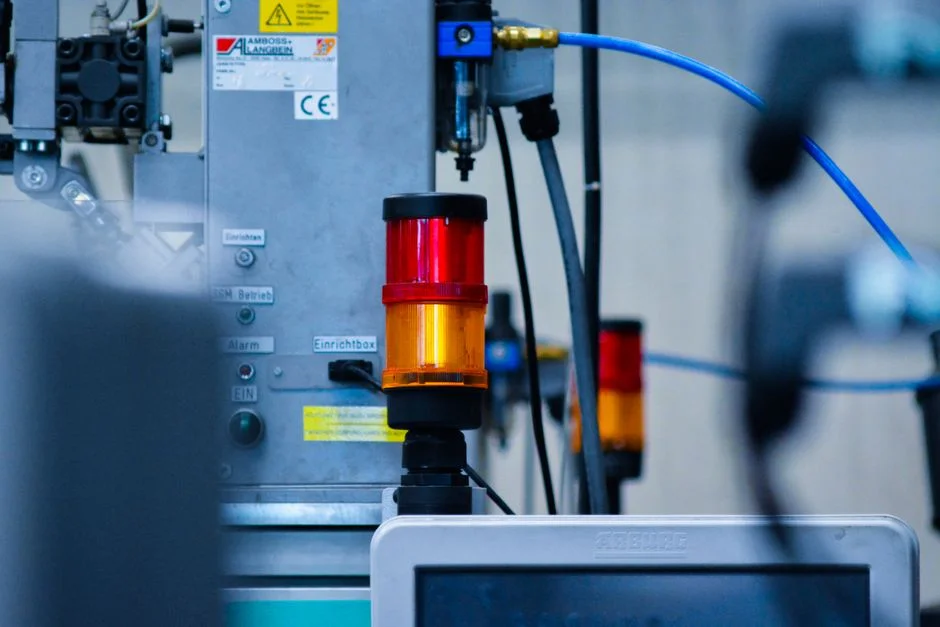
Sample conditioning is where most field installations go wrong. The analyzer needs a clean, representative, low-pressure side-stream — not a raw tap off the final clarifier weir. The standard arrangement is a 100-200 µm self-cleaning Y-strainer followed by a low-flow (~5-10 L/h) bypass loop with a rotameter and a needle valve for flow trim, and the sample should be held at 5-40°C before entering the digester. Anything hotter degrades the persulfate; anything colder slows digestion and stretches the cycle beyond 60 min.
- Calibration schedule. Run a 2-point calibration (zero + mid-range, typically 0.5 mg/L and 2.0 mg/L certified TP standard) every 7-14 days. Add an automatic verification using an internal standard if the unit supports it — this catches drift between operator visits.
- Reagent replenishment. Weekly visual check on the reagent reservoir; full replacement per vendor schedule (typically 30-60 days). Track on the SCADA's asset-management screen via a TP_REAGENT_LOW tag.
- SCADA tags per analyzer. Plan 8-12 tags: TP_MEAS (mg/L), TP_STATUS (word), TP_CAL_FLAG (bool), TP_REAGENT_LOW (bool), TP_RANGE (int), TP_LAMP_HRS (int), TP_FAULT (word), and 3-4 alarm bits.
- Alarm logic. Warning at 0.8x permit, High at 1.0x, High-High at 1.2x. Trip the dosing system or diversion only after High-High persists for 2 consecutive cycles — this filters out a single digestion-bubble spike and prevents false shutdowns. The 4-20 mA loop should be tied to a redundant PLC input for fail-safe behavior.
Plants modernizing the control layer in 2026 are consolidating the TP analyzer, the dissolved air flotation system, and the chemical dosing skid onto a single Modbus TCP segment — see the broader SCADA system for municipal wastewater plants guide for the tag-naming convention and the network architecture. For the wider IoT/AI trend that is pulling TP data into plant analytics platforms, the smart water monitoring 2026 outlook covers edge gateways, OPC UA bridges, and predictive calibration.
Cost, Maintenance, and Lifecycle Expectations for 2026
Procurement usually focuses on the sticker price and misses the lifecycle. A defensible 2026 budget needs CAPEX, a full OPEX stack, and a labor estimate — all summarized in the 5-year table below. The 5-year TCO lands at 1.5-2x the purchase price, which is the right number to put in front of finance when justifying the analyzer as a permit-risk mitigation asset rather than a measurement cost.
| Cost / Activity Line | Wall-mount single-stream | Dual-stream with auto-clean | Frequency |
|---|---|---|---|
| CAPEX (instrument + install) | USD 8,000-15,000 | USD 18,000-40,000 | One-time |
| Reagents (consumables) | USD 1,200-2,500/yr | USD 2,000-3,500/yr | Continuous |
| Standards + QC | USD 600/yr | USD 800/yr | Per batch |
| Service contract | USD 1,500-3,000/yr | USD 2,500-5,000/yr | Annual |
| Lamp + tubing replacement | USD 400-700 every 12-18 mo | USD 600-1,000 every 12-18 mo | Scheduled |
| Routine labor | 2-4 h/week | 3-5 h/week | Weekly |
| Annual service (scheduled) | 8-16 h/yr | 12-20 h/yr | Yearly |
Common failure modes and their service-call share (HydropureWater field data, 2026): clogged digestion tube ~40%, pump diaphragm wear ~25%, lamp drift or failure ~15%, PCB or touchscreen ~10%, other ~10%. Stock the digestion tube, two pump heads, and a spare lamp in the warehouse — it turns a 3-day service-call into an afternoon.
Frequently Asked Questions

How often should a TP online monitor be calibrated? Every 7-14 days with a 2-point calibration (zero + mid-range, typically 0.5 mg/L and 2.0 mg/L certified TP standard), plus an automatic verification using an internal standard if the unit supports it. This balances drift control against reagent and labor cost.
What is the difference between TP and orthophosphate online analyzers? TP analyzers include an acid-persulfate digestion step that converts polyphosphate and organic P to orthophosphate before detection. Orthophosphate analyzers skip digestion and only measure reactive PO4³⁻. Spec'ing an ortho-only analyzer for a TP permit is a common procurement error and typically under-reports TP by 30-60%.
Can one TP analyzer serve two sampling points? Yes — most 2026 dual-stream units can sequence between two sample streams with a 30-60 min cycle on each. The CAPEX delta vs. two single-stream units is roughly +60-80% for one analyzer versus +100% for two, so dual-stream is the cheaper option when both points have similar matrices.
What detection limit do I need to meet a 0.5 mg/L permit? Spec the analyzer to resolve 0.2-0.3x below the permit value — so 0.1-0.15 mg/L detection limit for a 0.5 mg/L permit. Anything weaker risks sitting close to the limit and triggering false alarms from noise; anything tighter is wasted budget unless you're chasing the 0.3 mg/L Chesapeake Bay seasonal floor.
Does the analyzer need a temperature-controlled housing outdoors? The sample itself must be held at 5-40°C, which usually means a heated sample line or an insulated enclosure with a small thermostatically-controlled heater. The enclosure should be IP65 (IEC 60529) or NEMA 4X equivalent in North America; active cooling is rarely needed below 35°C ambient.