Define the reuse application before choosing equipment
For a wastewater treatment and water reuse system in Benin, compare a membrane bioreactor with a WSZ integrated wastewater package plant by matching both to the wastewater flow, available land, reuse target, operator resources and verified discharge requirements. MBR offers a compact activated-sludge process with submerged PVDF membrane filtration and capacities from 10 to 2,000 m³/day, making it relevant where land is constrained or advanced separation is required. WSZ combines A/O biological contact oxidation, sedimentation and disinfection in a buried package unit, handles 1–80 m³/h, and can suit decentralized sites with limited staffing. No supplied evidence establishes universal superiority or Benin-specific limits, so final selection requires local flow, effluent and permit data.
The reuse decision must come first because the destination determines the required treatment train, monitoring and operator duties. The National Academies’ Water Reuse study identifies drinking water, non-potable urban uses, irrigation, industrial process water, groundwater recharge and environmental purposes as separate reuse categories, while also treating technology performance, monitoring, regulation, cost and institutional capacity as linked project questions (National Academies Press, 2008).
Irrigation should not be treated as an automatic use for biologically treated effluent. A review in Water Air & Soil Pollution identifies documented health concerns, references the need for water-quality standards and guidelines, and notes that irrigation with industrial wastewater, directly or mixed with domestic wastewater, can present higher risk. The same review reports that agriculture accounts for nearly 70% of global water usage and that treated wastewater is used extensively for agricultural irrigation (Water Air & Soil Pollution, 2021).
| Application screen | Information required from the owner | Equipment-selection implication |
|---|---|---|
| Non-potable reclaimed water | End uses, daily and hourly demand, permitted quality parameters and user responsibilities | Define the required solids separation, disinfection and monitoring before comparing MBR and WSZ |
| Industrial process water or industrial effluent reuse | Process-water fraction, contaminant profile, temperature, salinity and downstream process limits | Assess whether biological treatment alone is sufficient or additional unit operations are required |
| Irrigation | Crop, exposure method, irrigation system, public-health controls and applicable water-quality requirements | Do not infer suitability from biological treatment alone; obtain the confirmed health and discharge route |
| Combined discharge and reuse | Seasonal reuse demand, discharge route, flow variation and monitoring obligations | Size for the applicable flow and quality duties rather than headline treatment capacity |
Before requesting an integrated MBR membrane bioreactor or a WSZ underground package sewage treatment plant, record the intended reuse volume, hourly and daily peaks, required quality parameters, downstream users and who will monitor each parameter. The World Bank’s Wastewater Treatment and Reuse guidance specifically frames technology choice around local scale, institutional capacity, financial resources and operating needs (World Bank, 2021).
Build the design-basis and verification checklist
A defensible selection starts with a signed design basis, not a package name. Request average and peak wastewater flow, the catchment or population basis, process-water fractions, storm-water exclusions and the treatment capacity required for each flow component. For a decentralized sewage treatment application, the sewer versus package-plant decision is also relevant because collection assumptions affect the flow arriving at the treatment works.
- Owner or operator: provide flow records, population and production forecasts, process-water changes and excluded inflows.
- Laboratory: characterize COD, BOD5, suspended solids, oil and grease, pH and salinity. Add industry-specific contaminants before evaluating suitability.
- Design team: confirm available land, burial depth, maintenance access, drainage, power supply, sludge-handling route and budget status.
- Operations lead: document operator availability, routine attendance, remote-control capability and access to spare parts and service support.
- Permitting authority, local utility or client: confirm the applicable discharge and reuse route in writing.
Wastewater characteristics can alter biological-process performance. The review’s UASB–AS example treated low-strength domestic wastewater with a BOD5 of 340 mg/L and reported reductions of 81% in COD and 75% in TSS; that example demonstrates the importance of influent characterization, but it does not establish performance for either MBR or WSZ at a Benin site (Water Air & Soil Pollution, 2021).
| Required input | Owner to provide | Status before selection |
|---|---|---|
| Flow basis | Average flow, peak flow, operating calendar, catchment basis and excluded storm water | Verified / assumption / missing |
| Wastewater profile | COD, BOD5, TSS, oil and grease, pH, salinity and process-specific contaminants | Verified / assumption / missing |
| Reuse specification | End use, volume, water-quality limits, users and sampling plan | Verified / assumption / missing |
| Site and utilities | Land, burial depth, access, drainage, power, sludge route and maintenance access | Verified / assumption / missing |
| Institutional capacity | Operators, laboratory support, budget approval and service agreement | Verified / assumption / missing |
| Regulatory route | Applicable discharge and reuse requirements confirmed by the responsible authority | Verified / assumption / missing |
The supplied research contains no numerical Benin discharge or reuse limits. The accessible Benin-specific material was blocked by a security check, so no requirement from it is used here (ResearchGate, 2026). Record the source, date and responsible author for every project input. Leave unresolved information as a clearly identified assumption; do not convert it into a design value.
Compare MBR and WSZ treatment architectures
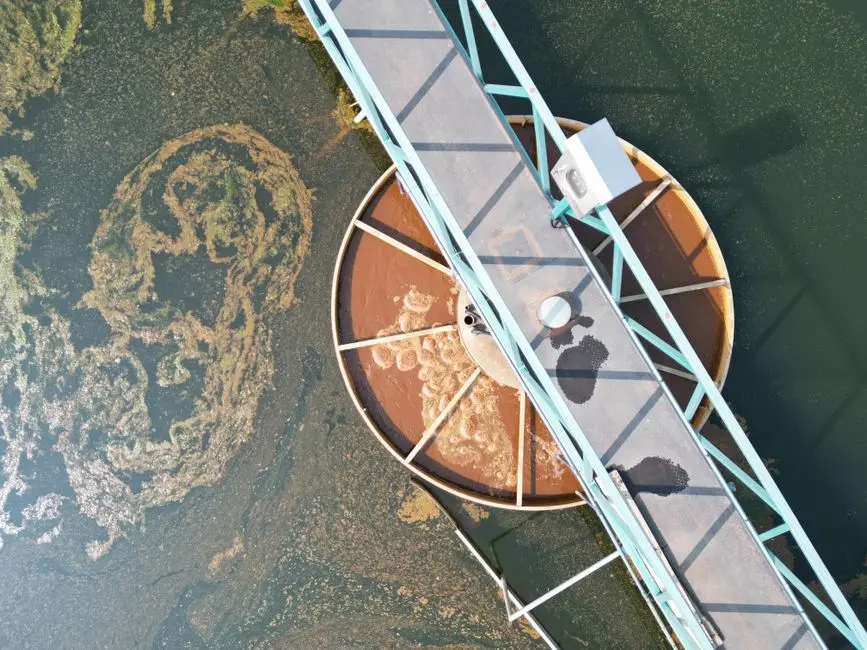
MBR and WSZ are not interchangeable labels for the same treatment result: they combine different biological and solids-separation processes, and their deployment conditions differ. The choice should follow the binding project constraint—reuse quality, available land, buried construction, automation or treatment capacity—rather than a general claim that one technology is more advanced.
The specified MBR combines activated sludge with submerged PVDF membrane filtration. Its product information states filtration below 1 μm, a footprint 60% less than conventional systems and capacity from 10 to 2,000 m³/day. This architecture is relevant when membrane separation, land reduction or a higher-grade reuse route materially improves the project case; the required effluent specification still has to be established during engineering design. An integrated MBR membrane bioreactor should therefore be evaluated against the complete treatment objective, including pretreatment, disinfection and sludge management.
The specified WSZ combines anoxic/aerobic contact oxidation, sedimentation and disinfection in one buried package unit. Its product specification gives an operating range of 1–80 m³/h, full automation and no required operator. These features support decentralized sewage treatment where below-grade installation and automatic operation are decisive, but they do not remove the need for suitable influent characteristics, routine inspection and a confirmed discharge route. The WSZ underground package sewage treatment plant therefore fits projects where the treatment route and wastewater profile are compatible with that architecture.
| Decision criterion | MBR | WSZ | Buyer action |
|---|---|---|---|
| Biological and separation architecture | Activated sludge with submerged PVDF membrane filtration | Anoxic/aerobic contact oxidation, sedimentation and disinfection | Compare the required treatment sequence, not only the reactor type |
| Stated capacity | 10–2,000 m³/day | 1–80 m³/h | Convert project flow into daily and peak-hour duties |
| Footprint and installation | Product information states 60% less footprint than conventional systems | Bury below grade | Confirm usable land, excavation, access and groundwater conditions |
| Operation | Requires operator, maintenance and membrane lifecycle management | Fully automated; product specification states no operator required | Check local attendance, maintenance and remote-support arrangements |
| Reuse potential | Use membrane separation when the confirmed specification supports the intended reuse route | Use the integrated biological, settling and disinfection train where it meets the route | Obtain the required quality parameters before selecting |
| Principal risks | Land constraint may be reduced, but membrane and lifecycle requirements must be priced | Burial may preserve surface land, but site compatibility and influent suitability must be demonstrated | Include pretreatment, equalization and sludge routes where required |
Headline capacity cannot settle the comparison. Convert daily flow to peak hourly flow, then test whether equalization, pretreatment, disinfection and sludge handling must be added. MBR capacity is stated per day, while WSZ capacity is stated per hour; the buyer therefore needs a complete flow and duty profile before either figure is used.
Match the selected route to local execution constraints
The main package should be supported by unit operations justified by the wastewater profile and reuse route. A wastewater-treatment technology cannot compensate for inappropriate pretreatment, uncontrolled inflows or an undefined receiving route.
- DAF: use dissolved air flotation where suspended solids, oil and grease, FOG or colloidal matter require high-efficiency separation. The supplied catalog range is 4–300 m³/h and includes municipal pretreatment applications. An DAF pretreatment machine should be assessed against the measured oil, grease and solids characteristics.
- UF: use ultrafiltration where bacteria, colloids and suspended solids must be removed before RO or another sensitive downstream process. The specified UF water treatment system includes 2,000–40,000 L/h capacity, 0.03 μm PVDF membranes and automatic backwash.
- Mechanical screening: use a rotary mechanical bar screen where rags, plastics, fibrous debris and suspended solids could overload downstream biological processes, pumps or membranes. The rotary mechanical bar screen is an available pretreatment option for evaluation.
These ranges are equipment specifications, not proof that a module is suitable for a particular Benin flow. Match each module to the completed design basis, including equalization and the method for managing off-design wastewater.
Reuse decisions also require more than treatment hardware. The National Academies study identifies effective monitoring, control systems and the regulatory framework as central to assuring reclaimed-water safety and reliability, alongside institutional and social implementation issues (National Academies Press, 2008). The agricultural review similarly connects reuse practice with health risk and the need for standards and guidelines (Water Air & Soil Pollution, 2021). The project owner must therefore identify who samples the effluent, what action follows a non-compliant result, how downstream users are controlled and how reuse records will be maintained.
Keep the reference solution modular where evidence does not support a Benin-specific performance claim. Validate each stage against the design basis and retain the ability to add pretreatment, disinfection or solids handling without changing the core selection logic.
Issue a conditional recommendation and acceptance plan
The current recommendation is conditional: select MBR if verified flow fits its stated 10–2,000 m³/day range and land or reuse quality is the binding constraint; select WSZ if verified peak flow fits its stated 1–80 m³/h range and decentralized deployment, burial and automatic operation are the decisive conditions. Neither recommendation is valid until the flow, wastewater analysis, reuse specification and applicable Benin route are confirmed.
| Procurement package | Minimum requested commitment | Acceptance evidence |
|---|---|---|
| Technical offer | Guaranteed process flow, treated-water quality, duty basis and treatment sequence | Signed design basis and compliant guaranteed values |
| Commercial offer | Installation scope, exclusions, O&M assumptions, membrane or consumables costs and spare-parts pricing | Clarified offer with lifecycle costs and exclusions |
| Documentation | Drawings, manuals, electrical data, control narratives, training plan and maintenance schedule | Complete document register before handover |
| Commissioning | Tests for flow, process performance, controls, alarms and non-compliant wastewater response | Commissioning protocol, results and signed acceptance record |
| Operations and compliance | Operator training, monitoring plan, local service arrangements and confirmed regulatory route | Training records, calibration records and written authority confirmation |
Ask suppliers to guarantee process performance under the agreed design wastewater and flow envelope, not only equipment availability. Include installation and O&M documentation, operator training, monitoring, maintenance, spare parts, membrane or consumables management, and a written response procedure for off-design wastewater. A WSZ or MBR comparison for a decentralized project provides a useful secondary reference, but the procurement decision remains controlled by the Benin facility’s verified inputs.
Frequently Asked Questions
Which system is cheaper to buy and operate: MBR or WSZ?
Do not select either system from headline purchase price. MBR buyers must price membrane replacement or rehabilitation, pumping, cleaning and specialist maintenance; WSZ buyers must price installation, access arrangements, inspection, service visits and any added pretreatment. No supplied evidence provides comparable quotations for Benin, so request itemized capital costs, annual O&M costs, consumables, expected replacement intervals and exclusions using the same design flow and wastewater profile.
How should MBR or WSZ capacity be sized for a facility in Benin?
Start with verified average flow and peak hourly flow, including process-water fractions, storm-water exclusions and seasonal variation. Check MBR against its stated 10–2,000 m³/day range and WSZ against its stated 1–80 m³/h range, then add equalization, pretreatment, disinfection and sludge-management duties where required. Obtain the applicable Benin route before freezing the capacity or reuse specification.
Which documentation should a wastewater equipment supplier provide?
Require a process and mass-balance basis, guaranteed flow and effluent performance, fabrication and installation drawings, electrical and control documentation, O&M manuals, maintenance schedules, spare-parts lists, operator training materials and commissioning protocols. Also request evidence that the proposed treatment route complies with the discharge and reuse requirements confirmed by the responsible authority, plus a clear procedure for managing non-compliant wastewater.
Can treated wastewater from either system be reused for irrigation or industrial processes?
Not on the basis of biological treatment alone. The reuse category, required water-quality parameters, public-health controls, downstream users and monitoring responsibilities must be established first. The agricultural review identifies health concerns and the need for standards and guidelines (Water Air & Soil Pollution, 2021), while the National Academies study treats irrigation and industrial process water as distinct reuse applications (National Academies Press, 2008). MBR or WSZ can form the treatment core, but additional treatment and site-specific controls may be necessary.