Start with Colombo's sewer and regulatory context
For domestic sewage treatment in Colombo, compare three routes: connect to the public sewer, install an underground A/O package plant, or use an MBR system. Public sewerage remains the preferred route where capacity, connection approval and a compliant discharge point are available, but Colombo Municipal Council describes the network as old and limited in coverage. Package treatment is practical where sewer access is unavailable or unsuitable. HydropureWater's WSZ combines A/O contact oxidation, sedimentation and disinfection in an underground unit handling 1–80 m³/h, while MBR is suited to tighter footprints and higher-quality reuse objectives. The final choice depends on verified flow, peak demand, land area, discharge destination, sludge handling and authority requirements.
The Greater Colombo public sewerage system should not be assumed to be available simply because the property is within Colombo. Colombo Municipal Council states that the existing system is old and limited in coverage, with technical, institutional, managerial and operational problems. The Greater Colombo Wastewater Management Project was designed to improve wastewater services for approximately 838,000 residents within its project area, according to the Colombo Municipal Council project information. That figure describes the project area and expected service coverage; it does not establish connection availability for an individual parcel or building.
The wider sanitation picture reinforces the need for a site-specific check. The Central Environmental Authority's 2023 presentation, Updates on Domestic Wastewater Management in Sri Lanka, cites the 2012 Sri Lankan census: piped sewerage covered 2.4% of the population, onsite sanitation covered 84.0%, other sanitation covered 11.9%, and sanitation type was unknown for 1.7%. These are national census statistics, not a Colombo property-level feasibility result.
Institutional responsibilities also span more than one body. The CEA presentation identifies the Central Environmental Authority, National Water Supply and Drainage Board, local authorities, provincial councils, Marine Environment Protection Authority and Urban Development Authority as relevant institutions. Their exact involvement depends on the site and proposed route, so a buyer should not infer approval authority from the equipment category. A comparison of sewer and package plants for domestic sewage in Sri Lanka should be read together with written confirmation from the relevant local authority and, where sewerage is involved, the NWSDB.
Screen the site before choosing a treatment route
Site screening determines whether the project can use public sewerage and, if not, whether the land and discharge route can support an onsite treatment system. The first technical request is not an equipment selection; it is the wastewater demand basis. Obtain average daily flow, peak-hour flow, design population or occupancy equivalents, and the water-demand basis used by the developer or facility operator. For residential, hospitality, hospital and mixed-use projects, the occupancy and usage pattern matter because they affect both hydraulic loading and treatment requirements.
Confirm the physical and operational constraints: land available for treatment and access, soil and groundwater conditions, access for maintenance and sludge removal, power reliability, odour and noise constraints, and the intended effluent destination. The receiving point must be identified and tested against the applicable discharge route rather than assumed. The Sri Lankan residential wastewater treatment comparison provides a useful starting point, but the decision must remain tied to the particular property.
| Site check | Information to obtain | Decision affected |
|---|---|---|
| Wastewater demand | Average flow, peak-hour flow, occupancy or design population, water-demand basis | Hydraulic and process sizing for sewer, A/O or MBR |
| Sewer availability | Connection point, network capacity, receiving-point confirmation and approval pathway | Whether public sewerage is a viable route |
| Land and access | Available area, access routes, soil, groundwater and maintenance access | Feasibility of package equipment and civil works |
| Discharge | Final destination, discharge approval, reuse intention and sludge route | Process selection and operating obligations |
| Operations | Power, odour, noise, staffing and remote or local service support | Long-term operability and owner responsibility |
The CEA's 2023 presentation identifies several practical weaknesses in onsite sanitation: inadequately sized package plants, no space or facility for wastewater discharge or soakage, haphazard gully-sucker disposal, unclear responsibility for operating a wastewater treatment plant, and poor sludge management. These are reasons to put capacity, discharge, access, sludge management and operating responsibility into the procurement scope before selecting equipment.
Compare sewer, underground A/O and MBR treatment
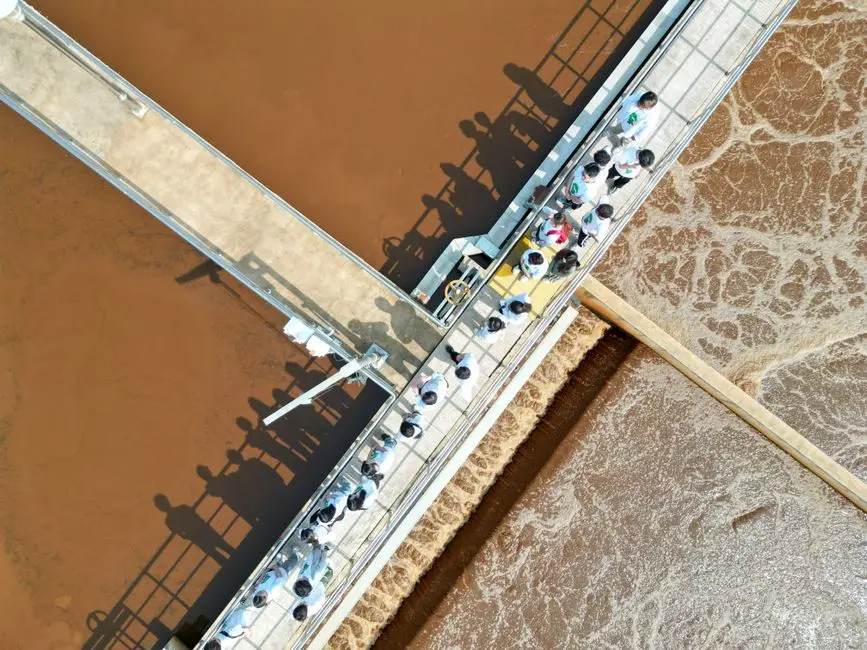
Public sewerage is the network-based route where connection approval, hydraulic capacity and a compliant receiving point can be secured. Its advantage is that the treatment and collection network are not created within the property boundary. The limitation is that the Colombo Municipal Council documents an old system with limited coverage and operational problems, so a nearby manhole does not prove that the downstream sewer or treatment system can accept the proposed load.
For sites without dependable sewer access, the choice becomes a process-and-site decision. An underground WSZ A/O sewage treatment plant combines anoxic/aerobic biological contact oxidation, sedimentation and disinfection in one buried package unit. HydropureWater's verified catalogue states that the WSZ series is fully automated, requires no operator and handles 1–80 m³/h. That stated range does not replace site-specific hydraulic design.
An integrated MBR wastewater treatment system combines activated sludge with submerged PVDF membrane filtration. The catalogue states an application range of 10–2,000 m³/day for municipal sewage and reuse applications, and states that the footprint is 60% smaller than conventional systems. The applicable design flow and installation conditions still need to be checked against the project basis.
| Decision factor | Public sewer | Underground A/O package plant | MBR |
|---|---|---|---|
| First requirement | Verified connection, capacity and compliant receiving point | Verified demand, land, access and discharge route | Verified demand, land, access, reuse target and higher treatment requirement |
| Treatment train | Provided by the network operator, subject to confirmation | Anoxic/aerobic contact oxidation, sedimentation and disinfection in a buried unit | Activated sludge with submerged PVDF membrane filtration |
| Stated equipment coverage | Not an equipment capacity | 1–80 m³/h, per the verified WSZ catalogue | 10–2,000 m³/day, per the MBR catalogue |
| Footprint and reuse | No onsite treatment footprint, subject to connection terms | Buried installation with landscaping above | Catalogue states 60% smaller footprint than conventional systems; evaluate reuse objectives |
| Main buyer check | Confirm network and downstream acceptance in writing | Confirm hydraulic basis, civil works, controls, sludge route and O&M responsibility | Confirm process suitability, membrane scope, performance basis and service support |
Use A/O where the process, footprint and reuse requirements fit the verified basis. Use MBR where the required treatment performance, reuse objective or site constraint justifies the additional process complexity and where the operator can maintain it. No supplied source establishes a universal Colombo effluent specification or package-plant price, so neither a discharge guarantee nor a budget allowance should be invented.
Build the sizing and procurement package
A comparable proposal starts with a common data package, not a product name. Request wastewater flow data, design population, peak demand, wastewater characteristics, site survey results, required discharge point, land area, utilities, and proposed operation and maintenance responsibilities. Then ask each supplier to show how its design responds to those inputs. A supplier that quotes only a nominal capacity has not demonstrated that the unit can handle the site's peak demand or provide the required treatment performance.
The request for information should include the treatment train, hydraulic basis, performance guarantees, drawing package, installation requirements, controls scope, commissioning tests, training, spare parts, warranty and local service support. Make sludge handling, odour control, access, power requirements and maintenance responsibility contractual deliverables. The CEA's 2023 presentation identifies unclear plant operation responsibility and poor sludge management as specific onsite-sanitation weaknesses; a procurement document should prevent those issues from being transferred to the owner after handover.
| Information package | Minimum item to request | Reason for inclusion |
|---|---|---|
| Design basis | Average and peak flow, design population or occupancy, wastewater characteristics and operating schedule | Prevents selection from a generic flow assumption |
| Site basis | Survey, land area, groundwater and soil conditions, access, utilities and discharge point | Tests physical and utility feasibility |
| Technical submission | Process train, hydraulic calculations, guarantees, drawings, controls and commissioning tests | Allows technical and commercial comparison |
| Operations submission | Odor control, sludge handling, maintenance, training, spare parts, warranty and local service support | Defines long-term accountability |
| Commercial submission | Equipment, civil works, installation, commissioning, utilities, maintenance and consumables | Allows comparison of total installed and lifecycle scope |
Ask for the decentralized sewage treatment selection for Sri Lanka to be framed around the site's discharge and sludge arrangements, not simply the lowest equipment quotation. The supplied research contains no standard Colombo package-plant cost. A buyer should request a total installed and lifecycle proposal with the exclusions and recurring obligations identified.
Verify approvals and operating ownership
Confirm the route with the relevant local authority and the NWSDB where sewerage is involved. The CEA's 2023 presentation states that local authorities and the NWSDB have defined sewerage functions, while noting that more than one institution has responsibility for proper sanitation. For an onsite plant, identify who will own the system, who will operate it, who will remove sludge, and which authority must approve the discharge point.
The CEA presentation identifies the National Environmental Act, the National Water Supply and Drainage Board Law, the Urban Development Authority Act and the Marine Environment Protection Act within the domestic-wastewater regulatory framework. It also describes environmental assessment or approval for prescribed large projects, environmental recommendations for apartment siting, and procedures concerning discharge standards, gully-bower registration and sludge disposal. These are framework references, not a site-specific approval decision. The proposed project still needs confirmation from the competent authority for its location, scale and discharge route.
Do not treat a package unit as regulatory permission. A treatment unit does not replace environmental approval, sewer connection approval, building or site requirements, or a named operating and maintenance responsibility. Before ordering, obtain written confirmation of the required approvals, the approved effluent destination, applicable standards, inspection or commissioning requirements, and the party responsible for sludge disposal and ongoing compliance.
Frequently Asked Questions
How should I size domestic sewage treatment for a Colombo property?
Size from verified average and peak wastewater demand, design population or occupancy, the treatment process, the required effluent quality and the available operating window. Request flow data from the developer or facility operator and do not use a generic Colombo flow assumption. Confirm that the selected unit's hydraulic basis covers the peak condition and that the supplier explains how demand changes affect operation.
What should I request when comparing package-plant prices?
Request a total installed and lifecycle proposal covering equipment, civil works, installation, commissioning, utilities, sludge handling, maintenance and consumables. The supplied evidence does not establish a standard package-plant cost, so a price should not be selected without a defined scope and exclusions. Ask suppliers to identify replacement items, service visits, power requirements and who pays for each recurring item.
Which supplier checks matter when selecting an A/O or MBR system?
Evaluate process suitability, design data, drawings, performance guarantees, installation record, commissioning evidence, training, spare parts, warranty and local service capability. Ask the supplier to demonstrate how the proposal handles peak demand, sludge, odour, access and power. A nominal capacity without a design basis or an identified service responsibility is not enough for a site comparison.
Do I need approvals before ordering an onsite treatment system?
Confirm approval and discharge obligations with the relevant authorities before ordering. A package unit does not replace environmental approval or responsible owner and operator arrangements. Obtain written confirmation of the discharge point, applicable requirements, sludge route, commissioning or inspection expectations and the operating party, using the applicable local authority, NWSDB, CEA or other institution identified for the site.