
Start with the discharge route and hospital wastewater streams
For a Liechtenstein hospital, select a treatment route by matching separate wastewater streams, required discharge quality, available space, and reuse needs to verified performance data. A compact multi-stage filtration and ozone system may suit smaller medical facilities; an MBR is relevant where biological treatment and membrane filtration are required; and a package sewage plant combines biological contact oxidation, sedimentation, and disinfection for a broader treatment train. Hospital wastewater may contain pharmaceuticals, pathogens, and antibiotic residues, so selection must include site-specific analysis and current permit verification rather than reliance on generic specifications.
The receiving route comes first. A sewer-bound project may require pretreatment before connection, while direct environmental discharge requires a more complete treatment and discharge-control basis. Any planned reuse—such as irrigation, cooling, toilet flushing or washing—adds an intended water-quality specification that must be agreed separately from the sewer or environmental discharge route.
The Newster hospital treatment sequence provides a useful process pattern: mechanical pretreatment followed by disinfection before discharge to the environment or sewer, subject to local legislation. It does not establish the Liechtenstein permit route by itself. Healthcare wastewater from infectious-disease wards, pathology and autopsy areas may contain chemical, pharmaceutical, biological or radioactive contaminants, so those streams should be identified during the wastewater survey and assessed separately where necessary.
Separate general sewage from laboratory or pathology drainage, pharmacy and pharmaceutical residues, cleaning chemicals, and any radioisotope or infectious-disease ward streams. The No Harm resource on pharmaceutical residues in hospital wastewater focuses on pharmaceutical loads and resistant bacteria, including their potential link with antibiotic residues. Incoming pharmaceutical and antibiotic exposure therefore belongs in the design brief, not in an assumption that hospital wastewater can be treated as ordinary domestic sewage.
Do not infer a permit route from general country pages. Request the current Swiss and local requirements for discharge, sewer connection and pretreatment in writing, including the applicable authority’s position on indirect discharge. The available Liechtenstein wastewater guide states that country-specific discharge standards and cost guidance are still being prepared, which makes formal confirmation essential.
Compare compact medical, MBR, and package-plant routes
These three routes solve different treatment scopes: compact medical equipment focuses on physical filtration and disinfection, MBR adds biological treatment with membrane separation, and a package sewage plant provides a broader below-grade biological train.
| Route | Product-based treatment scope | Published capacity or configuration | Decision point for the hospital |
|---|---|---|---|
| Compact medical wastewater treatment system | Multi-stage filtration and ozone disinfection | HydropureWater’s verified product catalog, accessed 2026-07, lists a footprint as small as 0.5 m², a 99%+ kill rate and no chemical dosing. | Potentially appropriate for a smaller facility or a defined pretreatment application, subject to project-specific wastewater analysis and confirmed discharge requirements. |
| MBR wastewater treatment system | Activated sludge with submerged PVDF membrane filtration | The verified product catalog, accessed 2026-07, lists a capacity range of 10–2,000 m³/day, filtration below 1 μm and a 60% smaller-footprint claim than conventional systems. | Consider where biological treatment and membrane separation are required; demand project-specific hydraulic loading, effluent guarantees and footprint confirmation. |
| WSZ package sewage treatment plant | Anoxic/aerobic biological contact oxidation, sedimentation and disinfection | The supplied research lists a capacity range of 1–80 m³/h and identifies hospitals as a suitable application. | Consider for a broader sewage-treatment train, particularly where below-grade or mobile package configurations are useful; confirm suitability for the receiving route and local installation conditions. |
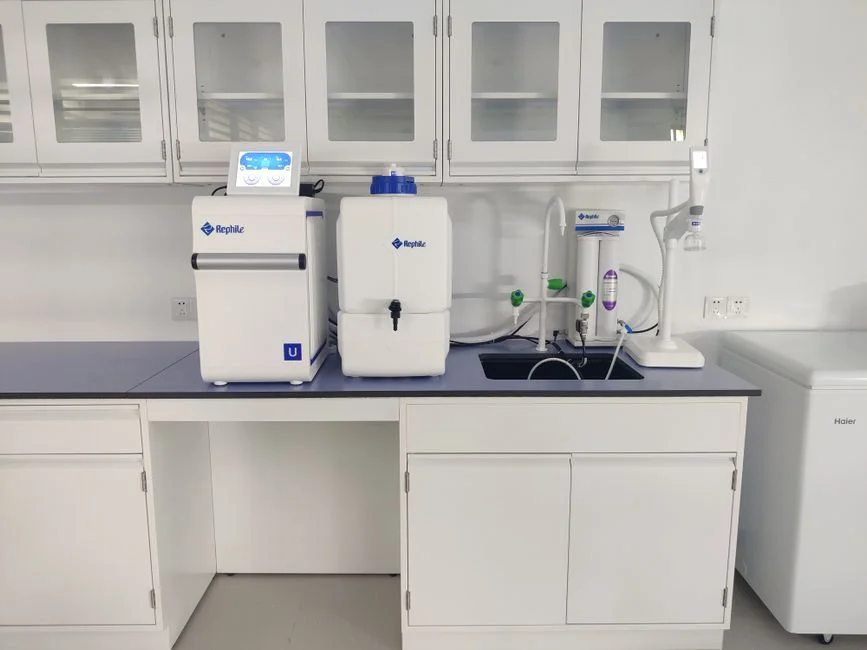
The compact medical route is engineered for clinics, dental offices, veterinary hospitals and small medical facilities. Its catalog cites EPA and EU Urban Waste Water Directive 91/271/EEC as a discharge basis, but that statement does not replace confirmation of the current requirements applicable to a Liechtenstein hospital. Ask the supplier to identify which part of the system is intended for pretreatment, which part provides final treatment, and how performance is demonstrated at the actual design flow and wastewater composition.
The MBR route is relevant when the design basis calls for activated sludge, membrane filtration and a defined biological treatment objective. The published figures are selection-screening values, not automatic project sizing. The hospital’s peak flow, organic load, nutrients, solids, pharmaceutical exposure, operating availability and required analytical results must still be reconciled with the supplier’s process design.
The WSZ route combines anoxic/aerobic biological contact oxidation, sedimentation and disinfection in a package arrangement. Its published flow range should be checked against both average and peak conditions, not just average daily flow. Installation depth, access, utilities, noise, sludge removal and the receiving-sewer requirements should be resolved before it is treated as a complete solution.
Build the design basis before requesting a price
A quotation becomes comparable only after the hospital, design team and suppliers work from the same flows, analyses, receiving route and operating assumptions.
- Define the discharge and reuse route. Identify whether the treated flow will enter a municipal sewer, receive direct environmental discharge, undergo further treatment, or be reused. Obtain the current written specification and identify which authority must confirm it.
- Build the wastewater survey. Separate streams and record their discharge points, operating schedules and contamination risks.
- Quantify flow and load. Provide daily flow, peak-hour flow and seasonal variation, plus occupancy or bed-related generation data where it can be supported.
- Provide representative analysis. Use site-specific samples and methods rather than generic domestic-sewage values.
- Confirm the site and operating constraints. Define footprint, below-grade conditions, maintenance access, power, noise limits, reuse objectives and sludge handling.
No Liechtenstein-specific hospital flow values are supplied in the research, so a defensible design flow cannot be calculated here. Request daily and peak flows for each stream, together with occupancy and generation assumptions. The design should distinguish average flow used for biological loading from peak flow used for hydraulic and equipment checks.
Request representative analyses for COD, BOD, suspended solids, pH, nutrients and pathogens, with pharmaceutical and antibiotic exposure evaluated against the receiving route and treatment objectives. Add laboratory, pathology, cleaning-chemical and radioisotope parameters where the stream survey identifies them. Some analytical requirements must be confirmed by the competent authority or receiving sewer; suppliers should distinguish those jurisdictional requirements from the parameters they use for equipment design.
| Fillable design input | Information to provide or obtain | Supplier response required |
|---|---|---|
| Flow and occupancy basis | Daily flow, peak-hour flow, seasonal variation, occupancy or bed-related generation data, and separate flows for each stream | Stated design flow, peak-flow treatment method and operating assumptions |
| Influent characterization | Representative COD, BOD, suspended solids, pH, nutrients, pathogens and relevant stream-specific contaminants | Process stages, hydraulic and organic loading, pretreatment requirements and sampling plan |
| Effluent and reuse target | Confirmed sewer or environmental-discharge specification, analytical acceptance criteria and any reuse objective | Guaranteed effluent values, test methods, monitoring scope and compliance boundary |
| Site and utilities | Available footprint, below-grade conditions, access, power, noise limits, drainage and sludge-handling route | Equipment dimensions, civil-work boundary, utilities, access arrangement and site constraints |
| Delivery and operation | Delivery location, required date, operating responsibility and service expectations | Delivered and excluded scope, commissioning, training, maintenance plan, spares and warranty |
Every supplier should state the design flow, process stages, hydraulic loading, analytical acceptance criteria, monitoring scope, redundancy, installation boundary, commissioning tests, operator training, maintenance plan and delivered-versus-excluded scope. If these are absent, the quotations are not yet technically comparable.
Set supplier acceptance criteria and commercial boundaries
Performance guarantees should be tied to the hospital’s actual wastewater analysis and confirmed discharge requirements, rather than to catalog kill-rate or filtration claims alone.
Ask each bidder to explain how the proposed system responds to the confirmed peak flow and wastewater composition. Require written acceptance criteria for each controlled parameter, with test methods, sampling points, frequency, startup conditions and consequences of non-compliance. Treatment performance must not be separated from hydraulic performance: an outlet that meets an analytical limit but cannot pass peak flow is not an acceptable design.
For the compact medical system, request documentation supporting the stated 99%+ ozone kill rate, the intended application of the equipment and the basis for the cited EPA and EU Urban Waste Water Directive 91/271/EEC requirements. For the MBR, request evidence supporting filtration below 1 μm, including how that claim is measured and whether it describes solids separation, particle removal or another metric. These are verified product claims, not substitutes for project-specific acceptance criteria.
Compare scope boundaries line by line. Itemize the equipment package, installation, civil works, power and control connections, laboratory access, sampling, sludge or filter disposal, operator training, commissioning tests, spare parts, warranty and ongoing service. Clarify whether a quoted discharge target includes only equipment performance or also permits, local design review, sewer-connection approval, operator staffing and waste handling.
The Liechtenstein country guide states that local standards and cost guidance are still being prepared and invites project-specific compliance checks when flow, influent data and discharge targets are supplied. Treat that as the starting point for verification, not as a substitute for the competent Swiss or local authority’s decision. Require suppliers to identify which items they verify, which items require owner confirmation and which assumptions remain open.
A shortlist should survive three tests: it can be sized from the submitted flow and analysis; it can meet the confirmed discharge or reuse specification with defined test methods; and its commercial boundary shows what the buyer must still deliver. If one bidder cannot complete any of those tests, the quotation is incomplete regardless of its headline treatment claim.
Frequently Asked Questions
What inputs control the cost of a hospital wastewater treatment system in Liechtenstein?
The principal controls are design flow, wastewater analysis, treatment route, receiving route, reuse target, site conditions and required scope. Ask each supplier to itemize equipment, installation, civil works, utilities, controls, commissioning, training, monitoring, maintenance, consumables and waste disposal separately. No defensible local price can be stated without a quotation based on the project inputs, so request a budgetary and a compliance-basis quotation without relying on an invented price range.
How should the hospital wastewater treatment system be sized?
Match the route to the peak flow and wastewater character. The compact medical unit is a candidate where its filtration-and-disinfection scope addresses the defined stream and project performance can be demonstrated. The WSZ package plant is a candidate for a broader biological train, subject to flow and site verification. The MBR is a candidate where activated sludge and membrane separation are required. Submit average and peak flows, separate stream estimates and representative analyses rather than selecting solely from a published capacity range.
Which criteria should be used to select a supplier?
Require project-specific guarantees for flow and treatment performance, supported by drawing and process information, test methods, commissioning acceptance tests, defined service scope and clear responsibilities for training and maintenance. Also check references for comparable hospital applications, controls and monitoring capability, response time for technical support, spare-parts availability and warranty exclusions. Do not shortlist solely on a catalog kill-rate or filtration claim.
Do the supplied product claims prove Swiss wastewater discharge compliance?
No. The compact medical system’s cited discharge basis and the MBR’s filtration claim describe product capabilities; they do not establish the current permit, sewer-connection or environmental-discharge requirements for the project. Obtain the applicable Swiss and local requirements in writing, including the receiving sewer’s pretreatment conditions and any analytical or monitoring obligations. The supplier should then map each confirmed requirement to its proposed equipment, performance guarantee and contractual responsibility.
