Start with the project route, not the equipment catalogue
For domestic sewage treatment in Nice, the practical decision is usually between connection to the public sewer and an onsite treatment plant. A public sewer can reduce on-site process complexity, but connection availability, capacity, pretreatment requirements and charges must be confirmed with the responsible Nice authority and water operator. An onsite route may be more practical for remote, phased, hospitality or water-reuse projects. The WSZ A/O package plant combines biological contact oxidation, sedimentation and disinfection in one buried unit, handles 1–80 m³/h, and needs no operator. The supplied research does not establish Nice-specific tariffs, permit limits or reuse rules, so those items require local verification before equipment selection.
Decide whether the site can connect to a public sewer and whether that sewer has capacity for the development. The connection route must also be defined: discharge to the sewer, direct discharge to a receiving water, or reuse after treatment. A public sewer may be unsuitable where the connection point is remote, the development is phased, land at the treatment site is constrained, or reuse is required.
The US EPA distinguishes sanitary sewers, which collect wastewater only, from combined sewers, which also collect stormwater. That separation is a planning concept here, not a Nice legal requirement; EPA’s US discharge rules and sewer classifications do not govern a French project (US EPA, Municipal Wastewater, accessed 2026).
Record at least daily sewage flow, peak demand, wastewater load, land availability, reuse objectives, operating responsibility and development phasing. These are screening inputs, not a final design basis. The public sewer versus package plant decision method provides a useful structure, but the local answers must come from Nice.
| Decision input | Public-sewer route | Onsite domestic wastewater treatment |
|---|---|---|
| Connection or treatment capacity | Confirm available sewer capacity and any connection constraints | Match the selected treatment route to the design flow and load |
| Land and site constraints | Confirm connection route, easements and required pretreatment | Confirm footprint, access, installation depth and power |
| Discharge or reuse objective | Confirm the permitted discharge route and any pretreatment | Confirm the applicable discharge or reuse requirements |
| Development phasing | Check whether staged connection is feasible | Check whether modular or phased operation is required |
| Operating responsibility | Identify the authority or utility responsible for the network | Assign maintenance, monitoring, sludge handling and emergency response |
Screen the WSZ A/O package plant against the project duty
The WSZ series covers a stated hydraulic capacity of 1–80 m³/h, but that range is not a substitute for project-specific sizing. The unit is described for residential communities, hotels, hospitals, factories and rural areas, so the relevant screening test is whether the selected configuration matches the project’s flow, organic load, site conditions and operating model (HydropureWater verified product catalog, accessed 2026).
The treatment train combines anoxic/aerobic A/O biological contact oxidation, sedimentation and disinfection in a single buried package unit. It is fully automated and described as requiring no operator. The unit can be installed below grade with landscaping above or mounted on a trailer for mobile deployment (HydropureWater verified product catalog, accessed 2026).
That configuration gives the WSZ a compact process footprint, but the supplied product excerpt does not state the selected unit’s duty cycle, hydraulic and organic loading basis, effluent guarantees, installation constraints, maintenance scope or commissioning requirements. Those items must remain open in the design and quotation documents. “No operator required” should also be tested against the project’s actual obligations: remote supervision, routine inspection, laboratory monitoring, residual handling and response to alarms still need named responsibility.
For the WSZ underground A/O package treatment plant, request confirmation of the design flow, peak-flow treatment approach, load basis, treated-effluent characteristics, civil requirements, utilities, maintenance exclusions and acceptance tests. A supplier should state whether the price covers only the package or also site-specific works.
| WSZ screening item | Evidence available | Information still required |
|---|---|---|
| Treatment process | A/O biological contact oxidation, sedimentation and disinfection in one buried unit | Process performance against the project’s applicable limits |
| Stated capacity | 1–80 m³/h across the WSZ series | Exact model duty and treatment of peak demand |
| Installation | Below-grade installation or trailer mounting for mobile deployment | Excavation, access, soil, groundwater, landscaping and lifting constraints |
| Operation | Fully automated; described as requiring no operator | Monitoring, maintenance, residual handling and emergency-response allocation |
| Performance basis | Not specified in the supplied excerpt | Hydraulic and organic loading basis, guarantees, commissioning tests and criteria |
Compare A/O, MBR and passive research with the actual decision
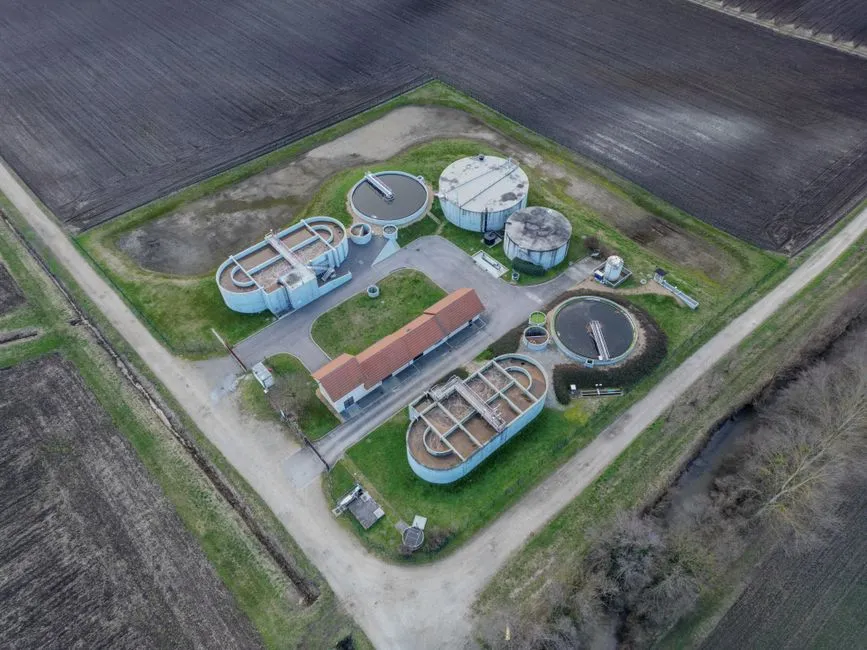
A compact A/O package plant and an MBR should be compared against the same project constraints, not separated into unrelated product categories. The WSZ offers integrated A/O biological contact oxidation, sedimentation and disinfection across a stated 1–80 m³/h series capacity. Its suitability still depends on matching the selected unit to the project’s design flow, load and installation constraints (HydropureWater verified product catalog, accessed 2026).
The MBR catalogue option combines activated sludge with submerged PVDF membrane filtration, provides filtration below 1 μm, occupies 60% less floor space than conventional systems, and serves 10–2,000 m³/day. The excerpt does not state Nice-specific effluent compliance (HydropureWater verified product catalog, accessed 2026). These are supplied product facts, not evidence that either route satisfies a particular French discharge authorisation or reuse rule.
Passive research provides a third line of design evidence rather than a turnkey specification. A passive pilot combining a septic tank, anaerobic up-flow filter and planted wetland reported more than 95% organic-load removal in preliminary monitoring (Water, High-Strength Domestic Wastewater Treatment and Reuse with Onsite Passive Methods, 2020). A separate Nordic study examined nine systems comprising a septic tank, aerobic pre-treatment biofilter and saturated-flow grass-covered filter (Ecological Engineering, Filter bed systems treating domestic wastewater in the Nordic countries – Performance and reuse of filter media, 2010). These results cannot be transferred directly to Nice without site, climate, loading, seasonal and regulatory analysis.
Use the A/O package plant versus MBR selection as a technical comparison framework, then test each route against discharge compliance, reuse quality, land, phasing and lifecycle responsibility. The integrated MBR membrane bioreactor may be considered where its process output is required, but comparison must use verified project loads and guarantees rather than catalogue capacity alone.
| Route | Supplied technical basis | Decision conditions for Nice |
|---|---|---|
| Public sewer | Sewer collection and treatment are described in general municipal-wastewater guidance (US EPA, accessed 2026) | Available capacity, connection route, pretreatment, charges, discharge route and phasing |
| WSZ A/O package plant | 1–80 m³/h; integrated A/O contact oxidation, sedimentation and disinfection (HydropureWater verified product catalog, accessed 2026) | Design flow and load match, installation access, power, maintenance responsibility and effluent guarantees |
| MBR | 10–2,000 m³/day; activated sludge with submerged PVDF membranes; filtration below 1 μm; stated 60% floor-space saving (HydropureWater verified product catalog, accessed 2026) | Required effluent or reuse quality, actual footprint, membrane maintenance, power and replacement responsibility |
| Passive research | Pilot reported more than 95% organic-load removal in preliminary monitoring (Water, 2020) | Treat as research evidence only; verify site performance, loading, climate, discharge rules and reuse eligibility |
Build a procurement-ready inputs and verification checklist
A procurement comparison becomes usable only when the same design inputs, authority confirmations and commercial exclusions appear in every quotation. Issue one request containing wastewater flow, peak factor, COD/BOD and nutrient loads, temperature, pH, solids, and fats, oils and grease where relevant. Add the discharge or reuse target, site constraints, development phasing and required operating reliability. Where a value is unknown, identify it as an investigation item rather than substituting an assumption.
Ask the project designer or civil contractor to confirm available sewer capacity, the connection route, charges, pretreatment requirements, surface-water or groundwater constraints, access for tanker disposal and available power. The contractor should also identify who owns the connection works, who handles residual removal and where the measured wastewater sample can be taken.
Ask the responsible Nice authority and relevant water, public-health and environmental bodies to confirm the applicable discharge route, authorisations, sampling requirements and whether reuse is permitted. The supplied research contains no Nice-specific permit limits, sewer tariffs or wastewater-reuse rules. A generic statement that equipment “meets standards” is therefore not an acceptable compliance answer.
Require quotations to separate equipment, civil works, installation, commissioning, utilities, routine maintenance, sludge or residual handling, monitoring and replacement items. This prevents a low equipment price from concealing the costs that determine the operating route. The containerized MBR wastewater treatment sizing guide provides a useful format for separating sizing inputs from supplier scope.
- Complete the design-input sheet: document daily flow, peak factor, loads, wastewater characteristics, land, access, power, phasing and reuse or discharge objectives.
- Verify the public-sewer route: obtain written confirmation of capacity, connection point, pretreatment, charges, ownership and commissioning conditions.
- Verify the onsite route: confirm discharge consent, applicable effluent limits, monitoring, residual handling, access, power and reuse permissions.
- Issue comparable quotations: use the same duty, performance criteria, site information and commercial-breakdown schedule for A/O and MBR suppliers.
- Check delivery and acceptance: define manufacturing or delivery timing, installation sequence, testing, training, spare parts, warranty exclusions and performance tests.
- Record unresolved items: assign an owner and deadline to every unconfirmed tariff, permit, reuse rule, loading value and commercial price.
Frequently Asked Questions
What is the cheapest option in Nice?
No supplied source gives a Nice-specific tariff, equipment price or civil-works quotation, so the lowest-cost route cannot be identified from the research. Compare the public sewer with A/O and MBR proposals on a common basis: connection and pretreatment, civil works, equipment, commissioning, power, maintenance, monitoring, residual disposal and replacement items. Obtain the applicable connection charges directly from the responsible Nice authority or water operator before accepting a price comparison.
How do I size a domestic sewage treatment plant?
Size against the project’s wastewater duty, not the catalogue’s broadest capacity. Supply the daily flow, peak factor, COD/BOD and nutrient loads, temperature, pH, solids, fats/oils/grease where relevant, and the discharge or reuse target. Ask the designer and equipment supplier to state the hydraulic and organic loading basis, selected configuration, peak-flow approach and acceptance criteria. The WSZ series covers 1–80 m³/h, while the MBR catalogue option covers 10–2,000 m³/day, but neither range proves suitability for a given site (HydropureWater verified product catalog, accessed 2026).
Should I choose a WSZ A/O package plant or an MBR?
Choose WSZ when a compact, integrated A/O route fits the verified duty, site and operating model and the supplier provides project-specific performance evidence. Investigate MBR where the required effluent or reuse quality, footprint and maintenance provisions justify its higher process complexity. Compare both routes using the same load data, guarantees, civil scope, utilities, monitoring, residual handling and lifecycle obligations rather than comparing catalogue capacity alone.
What should I request from a wastewater equipment supplier?
Request a technical and commercial offer that identifies the selected unit, design flow and load basis, process guarantees, installation requirements, utilities, commissioning tests, maintenance scope, residual handling, replacement items, delivery timing, warranty and training. Ask for all exclusions and recurring costs to be stated separately. A supplier should also confirm how performance will be demonstrated under the project’s specified