
Establish the binding Carlisle discharge requirements
Fabricated-metals plants near Carlisle generally meet pretreatment limits through equalization, pH correction, metal precipitation, solids separation, polishing and sludge dewatering, with disinfection only where the sewer-use ordinance requires it. The governing route is indirect discharge to Carlisle Region WPCF under Clean Water Act §307(b) and 40 CFR Part 403; Part 433 may also apply to plating or other metal finishing. Federal categorical standards are minimums, while site-specific Carlisle limits control the design. Engineers should verify the current ordinance and PA DEP Chapter 92 letter, characterize the wastewater, then select DAF for oily or colloidal streams or lamella for dense hydroxide flocs.
A sewer discharge follows the indirect-discharge pathway governed by Clean Water Act §307(b) and 40 CFR Part 403; a direct surface-water discharge follows Clean Water Act §402 instead. The same facility may have both pathways, so each outfall must be mapped separately. The Carlisle Region WPCF administers the sewer program through the Borough’s sewer-use ordinance, with PA DEP review under 25 Pa. Code Chapter 92, according to HydropureWater’s Carlisle pretreatment article.
Federal categories depend on what the plant actually does. HydropureWater identifies 40 CFR Parts 436 and 437 for mineral-mining and aggregate-related activities, and Part 433 where plating, pickling, anodizing, etching or chromate conversion coating occurs. The excerpt states that Carlisle-area aggregate operations generally fall under Part 436 rather than Part 437; that classification should still be confirmed against the facility’s regulated activities.
For Part 433 processes, the cited federal values are copper at 3.38 mg/L daily maximum and 2.07 mg/L monthly average, and total chromium at 2.77 mg/L daily maximum and 1.71 mg/L monthly average. These federal values do not displace the site-specific sewer limit. Before purchasing equipment, obtain four items: the current Borough sewer-use ordinance, the industrial-user permit, monitoring and reporting requirements, and the current PA DEP Chapter 92 letter.
The Carlisle article says local limits are typically tighter for zinc and copper than the federal categorical minimums, but its examples are not a substitute for the current ordinance. Treat every proposed numerical target as a permit-verification item until the controlling document, averaging basis, monitoring frequency and compliance period are confirmed.
Map each wastewater stream to its treatment objective
Separate mixed shop-floor wastewater before selecting equipment because oil, cutting-fluid carryover, dump-and-rinse flows and metal-treatment wastewater impose different separation and chemical-control requirements. The chemical needs of a plating line, fabrication wash and aggregate wash should not be averaged into one “site wastewater” design basis.
Get Chem Ready’s metal-fabrication wastewater article identifies tanks, pipelines, valves, pumps and clarifiers as components used in industrial pretreatment systems, while also noting corrosion-resistant materials such as stainless steel. Material selection must follow the actual chemistry: metal concentrations, pH, oxidants, cleaning chemicals and temperature. Permit requirements and corrosion resistance are separate checks.
Safety-Kleen’s fabricated-metals services page identifies used oil, paint-related waste and metal-treatment or preparation wastewater as distinct managed waste streams. Their disposal status does not establish that they may be discharged to the sewer. Segregate regulated waste from metered wastewater and document the destination of each stream.
For each source, collect flow, batch and dump-leach volumes, pH, copper, zinc, chromium and other applicable metals, TSS, oil and grease, toxicity and process data. Then assign the objective before selecting equipment: equalization for hydraulic surges, precipitation for dissolved metals, DAF or lamella for solids, polishing for residual solids and sludge dewatering for residuals. The fillable matrix below turns that characterization into a design handoff.
| Decision field | Enter or attach evidence | Design consequence | Status |
|---|---|---|---|
| Discharge route | Carlisle Region WPCF, direct surface water, or separate outfalls | Select §307(b)/Part 403, §402, or parallel compliance paths | Open |
| Applicable category | Part 436, Part 437, Part 433 or a verified alternative | Confirm parameter list, limits and monitoring basis | Open |
| Local limits | Current ordinance and permit, with averaging period | Set the binding design target | Open |
| Wastewater source | Fabrication wash, plating, pickling, cutting fluid, dump-leach, aggregate wash | Segregate streams and establish treatment objectives | Open |
| Wastewater character | Flow profile, pH, metals, TSS, oil and grease, toxicity, batch volumes | Size equalization, dosing, separation and polishing | Open |
| Equipment train | Equalization, pH/coagulant dosing, precipitation, DAF or lamella, polishing, sludge handling | Develop final mass balance and site layout | Open |
| Permit evidence | Industrial-user permit, Chapter 92 letter, monitoring plan, accepted sampling point | Confirm compliance, redundancy and acceptance testing | Open |
Size equalization and chemical control around peak discharges

Equalization must dampen batch and dump discharges before they reach chemical feed or solids separation. HydropureWater’s Carlisle article specifies 8–24 hours of average daily flow and identifies 12–16 hours as the typical Carlisle aggregate or quarry design point; these are design references, not confirmed site capacities. The basin must be sized from actual average flow, peak discharge, batch volume and operating strategy.
A dump-and-rinse flow can overwhelm a clarifier even when the daily mass load appears manageable. Construct the hydraulic profile from production records and the largest credible batch event, then check whether the selected basin can contain that event while maintaining the permitted discharge route. Include upset, off-line and return-flow conditions in that calculation.
The Carlisle article gives a pH target of 6.5–9.0 and states that PLC-controlled automatic dosing can maintain pH within a ±0.2 band. It also recommends staging precipitation in two reactors when influent pH changes exceed 2 pH units. Those figures come from HydropureWater’s Carlisle article, not from the Carlisle permit; permit confirmation remains necessary.
Specify an automatic PLC-controlled pH and coagulant dosing skid with flow-paced or concentration-paced reagent control, high/low-pH alarms, tank-level interlocks and a documented calibration method. Lime and caustic are identified by the source as common pH chemicals; the final choice should reflect reagent availability, sludge generation, chemical storage and site safety controls.
Do not use the published equalization range as a substitute for engineering. Require the supplier to state design flow, working volume, turndown, batch-discharge response, reactor arrangement, chemical consumption assumptions and performance conditions against the signed proposal.
Select DAF or lamella for the metal solids
DAF is the stronger candidate when oil, grease, cutting-fluid carryover or fine colloidal material dominates; lamella is the stronger candidate for dense metal-hydroxide flocs, especially where available footprint is constrained. The decision should follow wastewater character and site geometry rather than a standard model.
HydropureWater’s Carlisle article reports DAF hydraulic loading of 5–25 m/h, TSS removal of 90–98%, and oil and grease removal of 85–95% across a product range of 4–300 m³/h and 13 models. These figures describe the cited commercial product scope and require confirmation against the selected equipment and final proposal. For the application where oil or colloidal metals are significant, review a DAF system for oily metal-fabrication wastewater.
For the same source, lamella surface loading is 20–40 m/h, with a footprint roughly one-third that of a conventional clarifier and lower chemical consumption associated with a denser sludge blanket. Lamella does not float free oil and does not remove colloidal fines as effectively as DAF. For an oil-free aggregate wash dominated by settled metal hydroxides, that trade-off can favor lamella; for fabrication wastewater with cutting-fluid carryover, DAF is usually the safer starting point.
Residual-metal polishing may change the treatment architecture. The Carlisle article reports sulfide residuals of 0.01–0.05 mg/L versus 0.5–2.0 mg/L for hydroxide precipitation, while sulfide reagent cost is 2–4× higher and sealed reactors with hydrogen sulfide scrubbing are required. It describes hydroxide precipitation with sulfide polishing on a slipstream as a cost-effective compromise. Use that configuration only if the verified limit and residual-metal mass balance justify it.
| Selection factor | Favors DAF | Favors lamella | Evidence needed |
|---|---|---|---|
| Dominant contaminant | Oil, grease, fine colloids | Dense metal-hydroxide flocs | Oil and grease, TSS and particle characterization |
| Separation mechanism | Microbubble flotation | Lamella plate settling | Supplier process description and guarantee |
| Source performance | 5–25 m/h hydraulic loading; 90–98% TSS removal; 85–95% oil and grease removal | 20–40 m/h surface loading | HydropureWater Carlisle article; verify selected model |
| Footprint | Larger than lamella at equivalent flow | Roughly one-third of a conventional clarifier | HydropureWater Carlisle article; verify site layout |
| Sludge behavior | Floated sludge requiring separate collection | Dense sludge blanket | Residual moisture, volume and cake handling assessment |
| Selection outcome | Prefer when oil or colloidal carryover controls performance | Prefer for dense hydroxide solids where footprint governs | Signed proposal against site data and local limits |
For another application-level comparison, see the guide to compare DAF and lamella for sewer pretreatment, while keeping Carlisle-specific permit limits as the controlling criterion.
Complete the compliance train through polishing and sludge handling
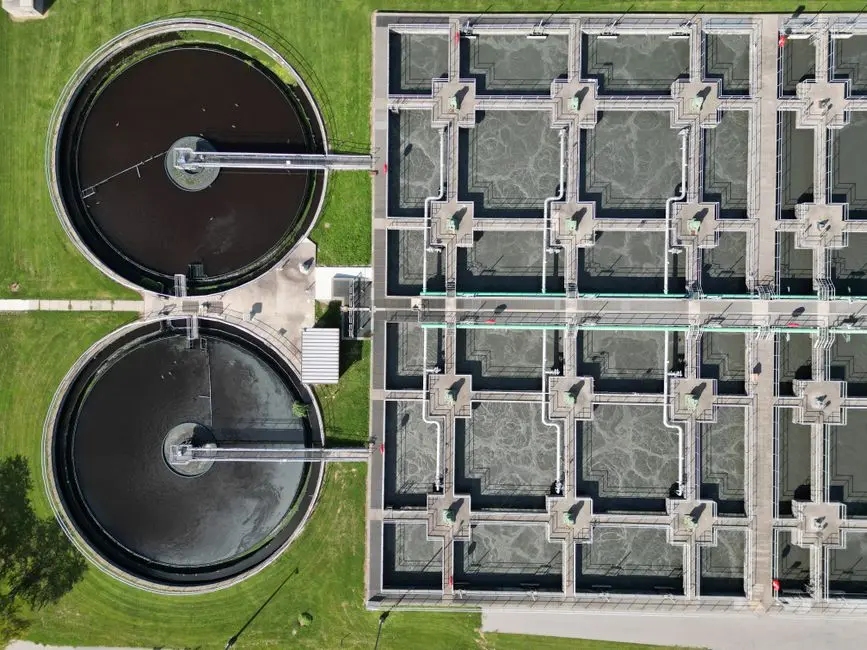
Polishing and sludge handling close two compliance gaps: residual solids can still exceed the permitted limit after clarification, and concentrated metals remain in the waste stream if the cake is not tracked from generation to final disposition. Acceptance therefore must address both filtrate and sludge, not just discharge turbidity.
HydropureWater’s Carlisle article describes multi-media filtration at 1–2 m/h, with residual TSS below 10 mg/L, and requires backwash capacity for peak flow. Confirm the filter medium, underdrain, headloss instrumentation, differential-pressure trigger, backwash destination and treatment of backwash wastewater. A filter cannot be credited as reserve capacity unless its backwash cycle has been included in the plant hydraulic balance.
For sludge dewatering, the same source reports plate-and-frame filter-press cake at 25–35% dry solids. Require a target dry-solids consistency rather than accepting the range without qualification. Define filtrate-return routing, cake collection, odor and dust controls, storage time, transportation, and the disposal or recovery route. Where metals may be recoverable, characterize the cake before assigning it to a smelter; the comparison of sludge dewatering equipment options provides a separate equipment-selection reference.
Disinfection is conditional, not automatic. HydropureWater’s Carlisle article states that chlorine dioxide can be dosed at 1–5 mg/L without forming the trihalomethanes associated with chlorine. Include UV or chlorine dioxide only if the current ordinance or permit requires it. The equipment proposal should therefore distinguish required treatment from optional features.
Set final acceptance around verified local limits, sampling methods, compliance periods and demonstration of stable operation. Tie performance guarantees to the same analytes, averaging bases and flow conditions that the permit uses.
Build the procurement and compliance acceptance checklist
A treatment train should not be released for final sizing until the permit references, source-by-source hydraulic profile, wastewater characterization, chemical consumption estimate, sludge route and equipment guarantees form one traceable package. The checklist below can be issued to suppliers and completed by the owner’s engineer and EHS lead.
| Procurement item | Minimum evidence required | Responsible party | Acceptance condition |
|---|---|---|---|
| Regulatory basis | Current ordinance, industrial-user permit, Chapter 92 letter, applicable category | EHS/legal/permit consultant | Signed applicability and limit memorandum |
| Wastewater basis | Source diagram, average and peak flow, batch profile, laboratory results | Plant engineer/laboratory | Representative sampling protocol and accepted dataset |
| Equipment proposal | Mass balance, process narrative, materials, controls, guarantees and exclusions | Equipment supplier | Proposal matches verified limits and site data |
| Controls and redundancy | PLC I/O, alarms, interlocks, duty-standby strategy, bypass prevention | Supplier and controls engineer | Factory and site acceptance tests completed |
| Monitoring | Sample taps, flow meter, pH records, laboratory access, compliance reporting plan | EHS/operations | Representative continuous monitoring and successful compliance samples |
| Sludge acceptance | Cake dry-solids target, filtrate routing, characterization, disposal acceptance | Operations/waste contractor | Disposal route documented and performance demonstrated |
| Final authorization | Equipment list, approved drawings, O&M manual, training and spare parts | Owner and supplier | Conditional on site-specific design data and final signed proposal |
Specify automatic controls, alarms, duty-standby arrangements, sampling access, bypass prevention, operator training and documentation. The Carlisle article cautions that technical values must be verified against site-specific design data and the final equipment proposal. Make the purchase order conditional on that verification rather than allowing catalog performance to become an unexamined design assumption.
Frequently Asked Questions
Why does a federal categorical standard not replace the Carlisle sewer-use limit?
Because an indirect discharger must satisfy both the applicable federal categorical requirements and the more stringent conditions imposed through the local pretreatment program. HydropureWater’s Carlisle article identifies the Borough’s current sewer-use ordinance and PA DEP Chapter 92 letter as the documents needed to establish the binding local limit. Obtain the actual limits, averaging periods and monitoring conditions before sizing.
When is DAF preferable to lamella for fabricated-metals wastewater?
Prefer DAF when oil, grease, cutting-fluid carryover or fine colloidal solids control the wastewater character; prefer lamella when dense metal-hydroxide flocs dominate and footprint is constrained. The practical purchasing check is to require each bidder to demonstrate that its proposed loading and performance data match the characterized stream rather than the average plant effluent.
What information should a supplier receive before quoting the treatment train?
Provide the discharge route, applicable federal category, current permit and local limits, source-by-source flow diagram, batch and dump volumes, pH, metals, TSS, oil and grease, toxicity data, chemical information, available footprint and sludge-disposal route. Then require a mass balance, equipment sizing basis, control narrative, performance guarantee and clearly stated exclusions.
Why might hydroxide precipitation alone not meet the lowest residual-metal target?
Hydroxide precipitation does not necessarily produce the lowest residual metals. HydropureWater’s Carlisle article reports sulfide residuals of 0.01–0.05 mg/L versus 0.5–2.0 mg/L for hydroxide, but the sulfide option costs 2–4× more and requires sealed reactors with hydrogen sulfide scrubbing. Check this trade-off only after confirming the local limit and residual-metal mass balance.
What should a buyer request to compare pretreatment cost and budget?
Request an itemized proposal covering equalization, chemical storage and dosing, precipitation reactors, DAF or lamella equipment, polishing, controls, sludge dewatering, installation, commissioning, training, maintenance and consumables. Do not compare equipment prices alone: require each bidder to state design flow, duty or standby arrangement, performance basis, chemical consumption assumptions and exclusions so the proposals cover the same compliance scope.