Set the Acceptance Decision Before Testing
A chemical dosing skid should be commissioned as a controlled handoff, not accepted merely because power is on. Verify approved drawings, installation, piping, drains, electrical supply, alarms, interlocks, instrument calibration and chemical compatibility before introducing chemicals. Then prime and test the pumps, validate controls and safeguards, confirm actual feed rate, and demonstrate the required treatment result under representative process conditions. Record baselines, photographs, test results, deficiencies, operator training and final acceptance. Commissioning is complete only when agreed flow and quality requirements are met, controls and safeties function correctly, deficiencies are closed and operations personnel can run the skid safely.
Define the acceptance decision before the first test. The City of Winnipeg commissioning plan separates pre-commissioning, commissioning, process testing and verification, and operation-and-maintenance documentation (City of Winnipeg, May 2022). That sequence prevents an installation-only sign-off from being mistaken for operational acceptance. Each inspection, functional test, process test, deficiency and training action needs an owner, a due date, recorded evidence and a checked-by signature.
Agree the acceptance criteria before work starts: required flow, chemical dose and treatment result; alarm and interlock performance; leakage criteria; required operating information; and operator training completion. Complete Water Solutions states that acceptance may occur when the system meets agreed flow and quality requirements, controls and safeties function properly, leaks and installation deficiencies are resolved, and the facility has received necessary operating information (Complete Water Solutions, Water Treatment Commissioning Checklist for Plants). Use the following release form for each stage.
| Stage | Required evidence | Release condition | Sign-off |
|---|---|---|---|
| Acceptance basis | Approved criteria, drawings, manuals, P&ID and responsibility matrix | Scope, test methods and acceptance values approved | Performed by: ______ Checked by: ______ Date: ______ |
| Pre-startup inspection | Inspection forms, photographs, deviation list and instrument calibration records | No unresolved defect affecting safety, compatibility or startup | Performed by: ______ Checked by: ______ Date: ______ |
| Wet functional testing | Pump output, leakage checks, PLC sequence, alarm and interlock results | All required functions pass without bypassing safeguards | Performed by: ______ Checked by: ______ Date: ______ |
| Process effectiveness | Feed-rate comparison, consumption records, analyzer and treatment-response results | Agreed dose and process result demonstrated under representative conditions | Performed by: ______ Checked by: ______ Date: ______ |
| Handover | Closed deficiency log, baselines, photographs, manuals and training record | Documentation complete, deficiencies closed and operators demonstrated safe operation | Owner: ______ Commissioning lead: ______ Date: ______ |
Complete the Pre-Startup Inspection
Pre-commissioning must establish that the skid is installed and documented consistently before chemicals or full control power are introduced. Review approved drawings, equipment submittals, operating manuals and facility requirements together, then record every installed deviation and assess its effect on capacity, water quality, safety and maintenance access (Complete Water Solutions, Water Treatment Commissioning Checklist for Plants).
Walk the full chemical path from storage through transfer, metering, injection and return or drain lines. Confirm supports, valve labels, reachable unions and access points, flow direction and the intended sequence of tanks, pumps, filters and injection assemblies. Check that the installed metering pumps and controls correspond to the approved design and that a skid-mounted automatic chemical dosing system has the documented arrangement and service clearances.
Before introducing chemical, confirm its identity, concentration, feed rate, injection point, tubing compatibility, backpressure protection and safety-data availability. Verify that discharge-pressure instrumentation is compatible with the chemical, concentration and temperature; a gauge case material alone does not establish compatibility (Manogauge, Chemical Dosing Skid Pressure Gauge: Selection Checklist).
Confirm electrical voltage, phase, disconnects, grounding and control power against the equipment requirements. Function-test emergency stops, interlocks, pressure cutoffs, switches, level controls, leak detection and alarm annunciation. A panel that energizes is not evidence that its logic or field signals are correct.
Check drain capacity and routing for flushing, regeneration and neutralization duties. Confirm required air gaps, containment, ventilation and service clearances. Do not release the skid to wet testing while a drain, alarm, interlock or chemical-compatibility issue remains unresolved.
| Inspection item | Acceptance check | Evidence | Result / deficiency no. |
|---|---|---|---|
| Documents and deviations | Approved drawings, submittals, manuals and facility requirements reviewed; deviations assessed | Document index and deviation register | Pass / Fail: ______ |
| Mechanical installation | Supports, labels, flow direction, equipment sequence and service access verified | Inspection form and photographs | Pass / Fail: ______ |
| Chemical compatibility | Chemical, concentration, tubing, seals, gauges, injection point and backpressure protection confirmed | Material and application check | Pass / Fail: ______ |
| Electrical and controls | Supply, phase, disconnect, grounding and control power verified; safety devices function-tested | Electrical checklist and I/O record | Pass / Fail: ______ |
| Drainage and access | Drain routing and capacity, air gaps, containment, ventilation and clearances verified | Site photographs and inspection record | Pass / Fail: ______ |
| Instrument readiness | Calibration status, measuring point and compatibility confirmed | Calibration certificates and instrument list | Pass / Fail: ______ |
Stage gate: the commissioning lead signs the pre-startup release only after every failed item has an owner, corrective action and retest requirement.
Wet-Test Pumps, Controls and Safety Devices

Wet testing proves that the metering equipment and control system operate under real conditions without bypassing protections. Begin with flushing and leak checks, then follow the equipment manufacturer’s startup procedure; initial discharge must not automatically enter production, storage or a critical process (Complete Water Solutions, Water Treatment Commissioning Checklist for Plants).
Prime each chemical feed pump carefully. Compare pump output with the programmed feed rate and base initial settings on water analysis, process requirements, manufacturer guidance and the approved treatment program. Do not use startup operation to guess the dose. A calibration chamber or column test, measured chemical consumption and the relevant process analyzer should be used as complementary evidence.
Review PLC setpoints, timer sequences, pump lead-lag logic, automatic-flush settings and remote-monitoring connections. Verify every signal point rather than assuming the communication map is correct. Test manual and automatic commands, displayed values, alarm acknowledgement, trips, restart behavior and the configured operating modes.
Verify gauge zero, response and leakage using the approved chemical or a compatible test medium. Record the baseline at normal stroke rate and again after the skid reaches temperature, and confirm the gauge can be isolated safely before flushing or decontamination (Manogauge, Chemical Dosing Skid Pressure Gauge: Selection Checklist). Do not use an unverified gauge indication to override a relief or interlock setting.
Do not bypass alarms or protective devices to complete startup. Correct failed low-flow, high-pressure, level, leak or divert functions before placing the skid in service.
| Functional test | Method | Required record | Result / deficiency no. |
|---|---|---|---|
| Pump start and priming | Prime each pump; check for air lock, leakage and stable discharge | Stroke setting, runtime and observations | Pass / Fail: ______ |
| Metering pump calibration | Measure output against programmed feed rate using the approved test method | Calculated and measured feed rates | Pass / Fail: ______ |
| PLC control sequence | Exercise setpoints, timers, lead-lag, flush sequence and commands | Step-by-step I/O and sequence record | Pass / Fail: ______ |
| Alarm and interlock function | Simulate each permitted trip without bypassing the device | Trigger, annunciation, action and reset result | Pass / Fail: ______ |
| Pressure-instrument check | Check zero, response, leakage and isolation with approved medium | Reference, indication, temperature and condition | Pass / Fail: ______ |
| Leak and flushing verification | Inspect chemical and process connections under operating conditions | Leak-check record and disposition of initial discharge | Pass / Fail: ______ |
Stage gate: approve wet testing only when pumps, PLC logic, instruments, alarms and safeguards have passed and every failed function is closed or formally restricted from service.
Verify Dosing Accuracy and Process Performance
Dosing accuracy cannot be inferred from discharge pressure because a local pressure gauge cannot prove pump calibration, chemical concentration, residual chlorine, pH endpoint or compliance (Manogauge, Chemical Dosing Skid Pressure Gauge: Selection Checklist). Pair pressure readings with calibration-column tests, stroke settings, chemical-consumption records, flow signals, analyzer data and inspection of check valves and injection points.
Confirm the chemical concentration, injection-point condition, check-valve operation and process feedback before comparing calculated feed rate with the expected treatment response. The verification record should distinguish equipment output from treatment effectiveness. A pump may deliver the calculated volume while the chemical is diluted, the injection point is fouled or the process load is outside the tested conditions.
The City of Winnipeg plan provides a useful structure: test each relevant chemical, adjust the dosing point, perform effluent testing and continue effluent monitoring. Its schedule assigns 10 days to each dosing-point adjustment and 30 days to each process-effectiveness phase (City of Winnipeg, May 2022). Those durations describe that project, not a universal commissioning period; the owner should set the monitoring duration required by the actual treatment process.
Record feedwater source, temperature, pressure, conductivity, hardness, chlorine or chloramine where relevant, and production demand. These conditions make the commissioning result usable during later troubleshooting. Document any limitation caused by changing incoming water or production demand rather than assigning it to the dosing skid without context (Complete Water Solutions, Water Treatment Commissioning Checklist for Plants).
For pH-controlled applications, use the accepted analyzer feedback and control response as acceptance evidence rather than treating a stable pump discharge as proof of the endpoint. See pH and ORP controller selection for dosing systems for the instrument and control interface that must be defined before testing.
- Establish the condition: record source water, demand, temperature, pressure and chemical concentration.
- Verify delivery: compare the programmed feed rate with measured pump output and consumption.
- Verify response: record flow and relevant analyzer results before and after dose adjustment.
- Verify outcome: confirm the agreed treatment result under representative conditions.
- Release or repeat: pass only when both delivery and treatment-result criteria are met; otherwise retain the deficiency and repeat the relevant test.
Close Deficiencies and Complete the Handover
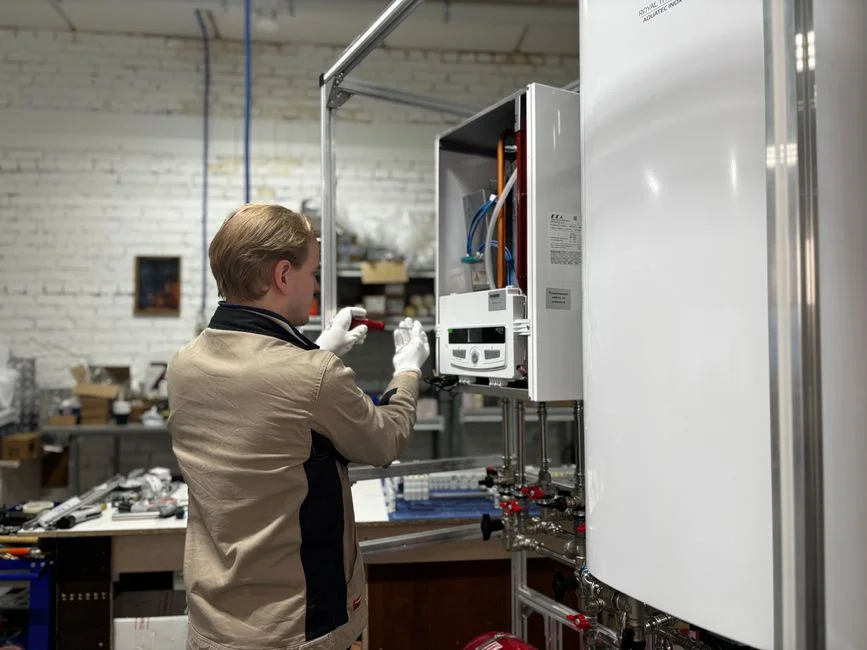
Final acceptance requires an operational baseline and closed corrective actions, not merely a signed commissioning sheet. The City of Winnipeg package explicitly includes a commissioning deficiency log (City of Winnipeg, May 2022). Each entry should identify the issue, responsible party, corrective action, retest result, final close-out and documentary evidence.
Record baseline flow, pressure, differential pressure, water quality, chemical feed, pump amperage, regeneration settings, alarm setpoints and totalizer values. Photograph the installed skid, control-panel screens, sample points and unusual field conditions, and retain technician notes in retrievable service documentation (Complete Water Solutions, Water Treatment Commissioning Checklist for Plants).
Deliver operator turnover training at the installed system. Cover startup, shutdown, daily checks, alarm response, chemical handling, sampling, maintenance triggers and service escalation. Require operators to identify isolation valves and sample points, acknowledge an alarm and locate the operating log. That practical walkthrough exposes gaps that a classroom explanation can miss.
Issue final acceptance only when agreed performance has been demonstrated, controls and safeties function correctly, leaks and deficiencies are resolved, documentation is complete and operators are trained. If the process involves an overall wastewater treatment train rather than an isolated skid, coordinate the handover with the wider industrial wastewater treatment process selection and operating interfaces.
| Handover record | Required content | Acceptance check | Sign-off |
|---|---|---|---|
| Commissioning deficiency log | Issue, owner, action, retest and close-out reference | All safety and performance items closed | Responsible manager: ______ Date: ______ |
| Operating baseline | Flow, pressure, water quality, feed rate, amperage, setpoints and totalizers | Complete and traceable to test conditions | Commissioning lead: ______ Date: ______ |
| As-built documentation | Drawings, manuals, calibration records, photographs and technician notes | Indexed, retrievable and issued to operations | Document controller: ______ Date: ______ |
| Operator turnover training | Practical walkthrough, alarm response and operating-log use | Each operator completed the demonstrated tasks | Trainer: ______ Operators: ______ Date: ______ |
| Final acceptance | Agreed flow and quality requirements, safety functions, leaks, deficiencies and training | No outstanding condition prevents safe release | Owner: ______ Commissioning lead: ______ Date: ______ |
Frequently Asked Questions
How much should commissioning and acceptance testing cost?
Request a written quotation separating the skid, installation, electrical work, controls integration, wet functional testing, process-effectiveness monitoring, documentation, training and retesting. No supported unit price is available from the supplied research, so the buyer should require the scope and acceptance deliverables behind each price rather than accept a lump sum without boundaries. Also ask what site work, chemical, utilities, analyzer testing and extended monitoring are excluded. The quotation should state who bears the cost of correcting defects attributable to installation, workmanship or equipment failure.
How do I select and size a chemical dosing skid supplier?
Require the supplier to define the chemical, concentration, expected operating range, required feed rate, pressure conditions, control interface, chemical-contact materials and proposed acceptance evidence before quotation. Ask for the metering-pump duty basis, injection method, backpressure arrangement, instrument ranges, wetted-material compatibility and site-specific test method. Factory testing does not remove the need to verify site power, process connections, controls, chemical compatibility, feed performance and treatment results (HydropureWater, Automatic Chemical Dosing System; Complete Water Solutions, Water Treatment Commissioning Checklist for Plants).
Can a successful pump run prove that the dosing skid is ready?
No. A pump run proves only that the pump operated under the conditions encountered. It does not establish calibrated feed rate, chemical concentration, correct check-valve operation, analyzer response or the required treatment result. Complete Water Solutions separates equipment startup from commissioning of the complete system within the facility (Complete Water Solutions, Water Treatment Commissioning Checklist for Plants). Use the staged sequence: physical inspection, wet functional test, dosing-accuracy verification, process-effectiveness test, deficiency close-out and handover.
What is the difference between a signed commissioning record and completed handover?
A signed commissioning record shows that assigned tests were performed; a completed handover demonstrates that the skid is ready for operations. The handover package must contain accepted test results, closed deficiencies, operating baselines, retrievable documentation and practical operator turnover training. If any agreed flow, quality, safety or documentation criterion remains open, retain the deficiency, assign corrective action and repeat the affected test before issuing final acceptance.