
What residential wastewater treatment means in Bangladesh
Residential wastewater treatment in Bangladesh consists of decentralized sewage-treatment systems for houses, housing developments, hotels or small communities. A packaged A/O plant is generally suitable for standard domestic sewage, while MBR is more appropriate where compact footprints, reliable solids separation or effluent reuse justify added membrane complexity. Equipment selection must begin with verified flow and wastewater analysis, especially where residential premises may receive small-scale industrial discharge.
Three project boundaries should be distinguished before quotations are requested. An individual residence needs a treatment arrangement matched to its occupied rooms, fixtures, pumping conditions and effluent route. A clustered housing or hospitality site requires a shared design based on development flow, usage patterns, access and maintenance arrangements. A community-scale decentralized sewage-treatment plant needs a collection system, treatment process, residual-management route and operating organisation, not merely a packaged reactor.
The Cleaner Energy Systems study published in December 2023 estimated Bangladesh domestic wastewater generation at 4,874 million m³/year. That national context figure is not a design flow for one household or housing project. The same study identifies the absence of a reliable national inventory of wastewater generation, composition and attributes, so project-specific evidence must replace blanket assumptions.
Selection should be tested against verified project wastewater, available footprint, effluent destination, reuse goals, power supply and operating responsibilities. The Mirpur study by Environmental Monitoring and Assessment documents small-scale textile industries operating in residential areas. Where such discharges enter the same sewer, the flow is mixed residential-industrial wastewater and cannot safely be assigned a domestic treatment design without characterization and stream separation.
The housing or hospitality project remains the controlling boundary for any site-specific installation: its users, wastewater, site and receiving environment determine the treatment requirement.
Bangladesh wastewater conditions to account for
Bangladesh lacks a reliable national inventory of wastewater generation, composition and attributes, according to the Cleaner Energy Systems study published in December 2023; project-specific sampling is therefore more defensible than importing an unverified national average.
The study estimated domestic wastewater at 4,874 million m³/year and industrial wastewater at 452 million m³/year. It also assessed UASB, anaerobic digestion and micro-hydropower approaches for energy recovery. UASB performed best among those three assessed technologies for biogas generation and simultaneous COD reduction. That energy-recovery result does not establish UASB as the preferred process for a residential site: the treatment objective, effluent route, footprint, operation and reuse requirements must be evaluated separately.
The Mirpur academic study documents the discharge of wastewater from emerging small-scale textile industries within residential areas. This is a direct warning against treating any incoming flow as domestic sewage. Textile or other non-domestic discharge should be isolated where practicable; otherwise, characterize its flow, composition and variability and determine whether upstream pretreatment is required.
| Project input | What must be verified | Why it affects design |
|---|---|---|
| Project wastewater | Flow, peaks, composition and non-domestic contributions | Determines the treatment process and loading basis |
| Site conditions | Soil, groundwater, flood exposure, access and burial constraints | Controls arrangement, excavation and maintainability |
| Power and controls | Supply reliability, aeration demand and backup provisions | Identifies operating and continuity risks |
| Effluent destination | Discharge route, reuse purpose and approving body | Sets the required treatment and compliance pathway |
Compare A/O package plants and MBR systems
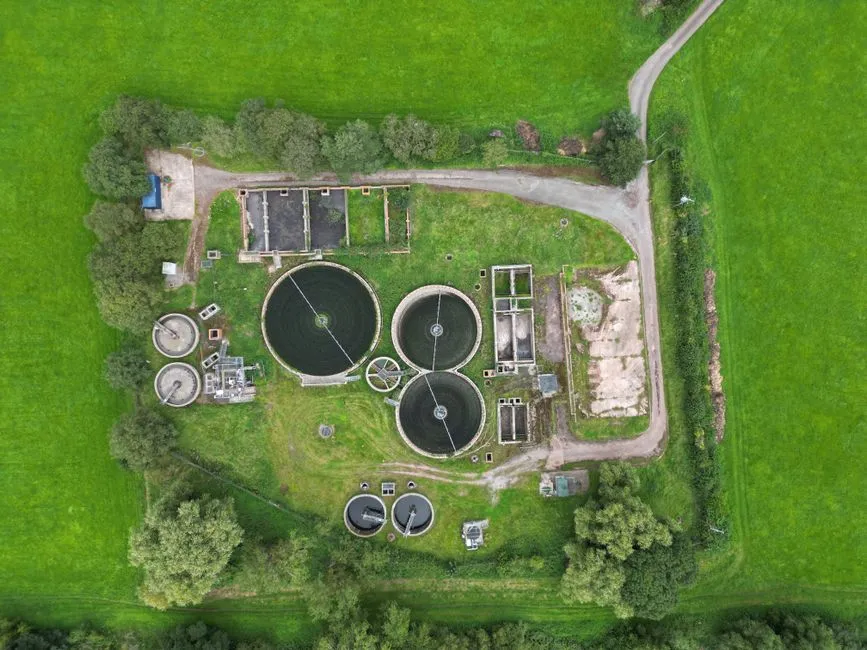
A packaged A/O biological treatment system combines anoxic and aerobic contact oxidation with sedimentation and disinfection in one buried unit, while an MBR combines activated-sludge treatment with submerged PVDF membrane filtration.
The underground A/O package sewage treatment plant has a stated capacity range of 1–80 m³/h and is identified for residential communities, hotels, hospitals, factories and rural applications. Its integrated arrangement can suit conventional domestic sewage where a practical, below-grade package is preferred. The buyer must still confirm the process basis, loading, duty limits, installation requirements and effluent objectives.
The integrated MBR wastewater treatment system has a stated capacity range of 10–2,000 m³/day, filtration below 1 μm and a footprint stated to be 60% smaller than conventional systems. Those supplier specifications make MBR a relevant option for compact sites, stringent solids separation or reuse preparation. They do not establish project-specific costs, approval requirements or compliance outcomes; those depend on the design basis and receiving route.
| Decision point | A/O package plant | MBR system |
|---|---|---|
| Process | Anoxic and aerobic contact oxidation, sedimentation and disinfection | Activated sludge with submerged PVDF membrane filtration |
| Stated capacity range | 1–80 m³/h | 10–2,000 m³/day |
| Main fit | Conventional domestic sewage and practical below-grade deployment | Compact sites, stringent solids separation or reuse preparation |
| Procurement focus | Verified loading, excavation, access and effluent objectives | Verified daily basis, membrane maintenance, controls and reuse requirements |
| Common selection error | Assuming the package can absorb mixed industrial loading | Choosing membrane performance without an authorised reuse or discharge route |
Neither technology serves as a substitute for an industrial pretreatment process. The Mirpur textile case shows why dilution into a residential sewage stream is not a defensible design strategy.
Build the treatment train around the actual wastewater
ASTM E2717-18R25 provides a framework for estimating residential wastewater environmental load from fixture numbers and types, household chemicals and occupancy; for Bangladesh, its parameters require modification because they reflect North American averages.
Begin with an inlet assessment and sampling plan that distinguishes sanitary sewage from commercial or industrial contributions. ASTM E2717-18R25 also supports aggregate estimates for multi-unit buildings by adjusting home parameters for building size, occupancy and fixtures. The standard warns that actual environmental load can vary with the chemicals used and the number of occupants, so monitoring may be needed where the estimate is material to design.
- Inlet and source control: identify sanitary, commercial and industrial inflows and prevent unsuitable discharges from entering the residential stream.
- Screening and primary solids control: remove material that should not pass into biological treatment. A rotary mechanical bar screen is an equipment option where the verified wastewater requires mechanical screening.
- Biological treatment: apply A/O biological treatment or another process justified by the verified loading and treatment objectives.
- Solids separation: use sedimentation or membrane filtration according to the selected process and effluent requirements.
- Disinfection: apply the required final treatment before discharge or reuse.
- Residual management: provide access for sludge removal, inspection and disposal or authorised reuse.
Oils, grease and colloidal material should be addressed upstream rather than assumed to be manageable by the biological stage. Where sludge dewatering is required, the treatment train must also include access and a disposal route; a plate-frame filter press may be considered as part of that residual-management train. Main-reactor outlet quality alone is not evidence that the whole system is complete.
Size the system with verified project inputs

A defensible residential treatment size is based on the project’s verified flow and loading, not Bangladesh’s national domestic-wastewater estimate or a supplier’s headline capacity.
The design team should document average and peak residential wastewater flow, occupancy assumptions, fixture profile, wastewater characteristics, treatment objectives and the authorised effluent destination. The 4,874 million m³/year figure reported by the Cleaner Energy Systems study in December 2023 is a national context statistic; it must not be allocated directly to a building, household or development.
For A/O, compare the verified design flow with the WSZ range of 1–80 m³/h. For MBR, compare the verified daily design basis with the stated 10–2,000 m³/day range. Catalogue ranges establish a screening point only; they do not prove that a unit has adequate process capacity, hydraulic capacity or redundancy.
| Input to document | Procurement question | Required deliverable |
|---|---|---|
| Average and peak flow | What method and data establish the design flow? | Hydraulic calculation and stated duty basis |
| Organic and solids loading | What wastewater data and safety factors were used? | Process calculations with assumptions |
| Equalization and redundancy | How are peak flow, maintenance and unit outage handled? | Process drawings and operating strategy |
| Power and controls | What electrical load, backup and control interface are required? | Electrical and controls data |
| Sludge and maintenance | Where is residual sludge removed, stored and treated? | Residual-management plan and access drawings |
| Commercial conditions | What performance is guaranteed and under which duty limits? | Offer, guarantee conditions, commissioning tests and warranty |
Foul-weather and flood conditions must be resolved as site-specific engineering questions. Do not insert rainfall, flood or peak-factor values that have not been verified locally. The quotation should state the design basis, installation requirements, commissioning tests, operating support, warranty and deliverable dates so that offers can be compared on the same scope.
Plan installation, compliance and handover
A below-grade treatment package remains a site-integrated installation: soil, groundwater, flood level, access, burial depth and landscaping constraints must be assessed before the arrangement is fixed.
Confirm the intended effluent destination and reuse plan with the relevant Bangladesh authority or approving body. The supplied research does not establish a universal residential effluent-limit table, so the project must identify the applicable review pathway rather than assume that a packaged system is approved by specification.
Power, aeration, controls, odour control, noise, routine inspection and emergency access should be included in the design review. They are operating requirements, not optional additions after installation.
| Stage | Supplier or contractor deliverable | Buyer verification |
|---|---|---|
| Design | Process drawings, hydraulic calculations and equipment data | Assumptions and capacity match the project inputs |
| Installation | Civil works, piping, electrical, controls and materials information | Excavation, access, levels and services are coordinated |
| Commissioning | Startup and performance-verification method | Agreed tests and acceptance criteria are demonstrated |
| Handover | Operator training, manuals, maintenance intervals and warranty | Responsibilities, spares and support arrangements are recorded |
| Review | Applicable authority documentation and approved route | Effluent destination and reuse plan are confirmed |
Specify local support and responsibility for corrective work in the supply contract. The Bangladesh wastewater-treatment guide hub provides additional industrial and municipal context, but the procurement file should still contain project-specific drawings, calculations, test records and handover documentation.
Frequently Asked Questions
How do I size a residential sewage treatment system in Bangladesh?
Size the system from verified average and peak flow, loading, occupancy, treatment objectives and effluent destination. The WSZ A/O range is 1–80 m³/h, while the MBR range is 10–2,000 m³/day; these catalogue limits are screening references, not proof of capacity. Request the supplier’s hydraulic and process calculations and compare them with the documented project inputs.
What information is needed for a comparable residential treatment quotation?
Provide the verified flow basis, process route, footprint, excavation and site works, piping, power, controls, commissioning scope and sludge-handling requirement. Ask each supplier to state exclusions and recurring operating requirements separately. No supported Bangladesh price is available in the supplied research, so a defensible budget requires site-specific quotations rather than an assumed package rate.
How should I select a wastewater-treatment supplier?
Check the process basis, design drawings, hydraulic calculations, performance guarantees, installation scope, commissioning evidence, operator training, warranty and local support. A useful acceptance check is whether the supplier will stand behind a stated duty limit and a documented test method, rather than offering only a nominal capacity.
Can a residential system treat mixed textile or industrial wastewater?
Do not assume that dilution makes mixed effluent suitable for residential treatment. The Mirpur study by Environmental Monitoring and Assessment documents small-scale textile wastewater discharges in residential areas. Characterize the non-domestic stream and separate it where practicable; determine whether upstream pretreatment is needed before accepting a residential process design.
What compliance evidence should be requested before purchase?
Request confirmation of the intended discharge or reuse route, the applicable Bangladesh review pathway and the evidence required by the approving body. The supplied research does not support a single national residential effluent limit, so procurement should identify the project-specific requirement