Why Car Wash Wastewater Needs a Treatment Decision
A DAF system for car wash wastewater uses pressurized, dissolved air to create microbubbles that attach to suspended solids, oil, grease, and emulsions. The contaminated solids rise and are removed by surface skimming, making DAF suitable as a pretreatment stage before discharge or water recycling. For higher-quality reuse, DAF can be combined with ultrafiltration: one commercial design uses 0.1-micron UF membranes after DAF. Proper selection depends on measured peak flow, oil and grease, suspended solids, detergents, pH, and reuse or discharge requirements—not flow alone.
Commercial car wash wastewater is not a single, uniform stream. Wash type, vehicle traffic, detergents, pre-rinse practices, floor drainage, and episodic wash events can change both the flow and contaminant load. The Global NEST Journal study, Combining Dissolved Air Flotation (DAF) and Modified Moving Bed Biofilm Reactors (MMBBR) for Synthetic Oily Wastewater Treatment, identifies car washes among industrial processes that generate oily wastewater. That makes oil and grease central to the application rather than incidental pollutants.
Before selecting equipment, answer four buyer questions:
- What contaminants are present, including oil and grease, suspended solids, emulsified hydrocarbons, and detergent-related effects?
- What flow must the treatment train handle during normal operation and the highest observed wash or vehicle event?
- Where will the treated water go: a permitted discharge point, a reuse header, or another process?
- What physical, chemical, or operational quality is required at that endpoint?
Representative sampling should cover the operating conditions that matter, not only an average day. Ask the supplier to request, at minimum, the flow range, peak-event flow, oil and grease, suspended solids, pH, detergent or chemical use, and the intended discharge or reuse endpoint. The 2026 DAF selection and cost framework provides the broader decision structure, but the model and treatment train should be tied to your site data.
How DAF Removes Oil, Grease, and Suspended Solids
Dissolved air flotation removes suspended solids, oils, and other contaminants through air-bubble flotation, according to GTS Enviro’s DAF explanation. The mechanism is a sequence of physical steps rather than a generic claim of “oil removal.”
- Air dissolves into the wastewater under pressure in the saturation or recirculation system.
- The pressurized stream returns to the flotation tank and is released, producing microbubbles.
- The bubbles contact suspended solids, oil droplets, grease, and emulsified contaminants and increase their buoyancy.
- The floated material is concentrated at the tank surface and removed mechanically by skimming.
This arrangement makes dissolved air flotation a suspended-solids clarification stage and a practical oil-and-grease removal step. GTS Enviro says its commercial skid-mounted DAF plus UF arrangement is designed for fats, oils and grease, suspended solids, hydrocarbon oils and emulsions, and other contaminants. Those are supplier claims about the proposed application, not guaranteed outputs for every car wash.
Conditioning can improve the separation result when wastewater testing shows that particles or droplets need altered surface properties. The industrial DAF system for car wash wastewater should therefore be evaluated as a treatment train, including any chemical-conditioning stage, rather than as a tank and pump skid in isolation.
Electrolyte concentration is another design consideration. The 2025 Modern Applied Science paper, Intensification Dissolved Air Flotation Treatment of Oil-Containing Wastewater, reports that changing electrolyte concentration affects bubble coalescence, particle charge, and flotation efficiency in the wastewater studied. The paper reports that increased concentration can increase flotation efficiency, but it does not establish a universal electrolyte dose for commercial car wash wastewater. Any coagulant or flocculant basis should therefore come from the actual wastewater and jar or pilot testing.
Build the Right Car Wash Treatment Train
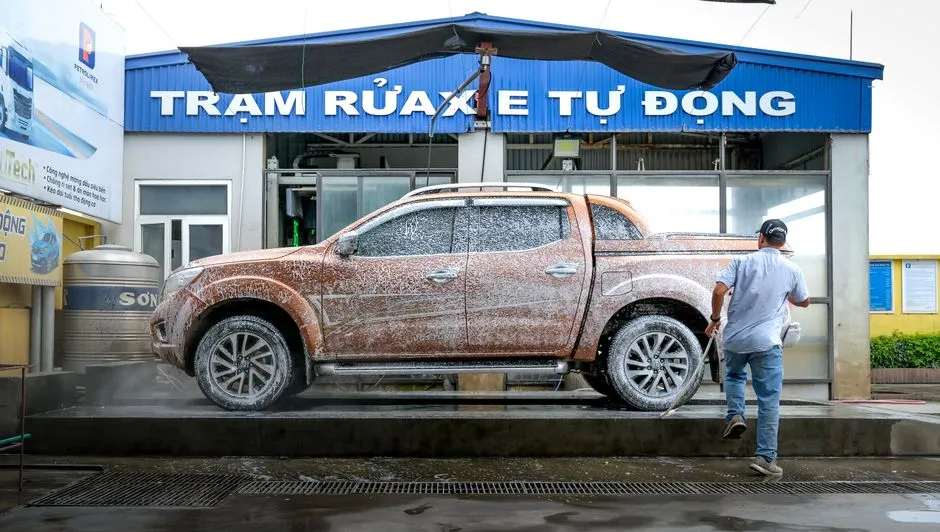
DAF belongs after flow equalization and any necessary screening, but before biological polishing, membrane treatment, or the point of reuse. It removes the oil, grease, suspended-solids, and colloidal material that can interfere with downstream processes. Skimming controls the floating contaminant load; sludge withdrawal then handles the separated solids.
| Treatment stage | Primary function | Decision input |
|---|---|---|
| Equalization and screening | Balances variable wash flow and removes material that should not enter the treatment equipment. | Peak-event flow, drainage arrangement, and screening needs. |
| DAF with conditioning where required | Removes floatable oil, grease, suspended solids, and conditioned colloidal material through microbubble flotation and skimming. | Oil and grease, suspended solids, pH, detergent use, and required removal result. |
| Sludge and recovered-oil handling | Separates collected float and sludge from the treatment loop. | Expected sludge characteristics, collection method, and disposal route. |
| Optional biological polishing | Addresses biodegradable contaminants that remain after physical separation. | Measured organic load and the downstream endpoint. |
| UF where required | Provides further physical separation before reuse. | Required final quality and whether membrane feed meets the supplier’s limits. |
GTS Enviro describes a skid-mounted DAF plus UF configuration for car-wash effluent treatment and recycling. A UF system for car wash water recycling should therefore be assessed as the downstream component of a combined package, not as an automatic replacement for DAF. If oil, grease, and suspended solids are not sufficiently controlled before the membrane, the whole train must be considered.
Biological treatment is another possible route, but it must be selected from the wastewater rather than from a process label. The Global NEST Journal study combined DAF with modified moving bed biofilm reactors for synthetic oily wastewater prepared with starch, diesel oil, and finely ground soil. It demonstrates a possible DAF-plus-biological treatment concept, not performance for detergent-bearing commercial car wash wastewater.
The DAF FOG interception case study can help frame a physical FOG-removal stage around an overloaded drainage system. However, the biological or membrane stage should follow only when measured wastewater data and the final discharge or reuse criteria support it.
Compare DAF Alone with DAF Plus UF
DAF alone is the appropriate starting point when the objective is clarification and removal of oil, grease, suspended solids, and colloidal material before discharge, sludge handling, or a downstream biological process. DAF plus UF becomes more relevant when the project requires another physical separation barrier before reuse.
| Decision point | DAF alone | DAF plus UF |
|---|---|---|
| Primary role | Oil, grease, suspended-solids, and colloidal-material removal through flotation and skimming. | DAF pretreatment followed by membrane separation. |
| Best fit | Clarification before an approved discharge route, biological process, or other defined treatment stage. | Projects requiring additional physical separation for a reuse application. |
| UF separation boundary | Not applicable. | GTS Enviro specifies 0.1-micron membranes; larger species and suspended solids are retained, while water, salts, and small-molecular-weight constituents pass through. |
| Chemical claim | Depends on measured conditioning needs. | GTS Enviro states that its commercial design needs minimal pretreatment chemicals; project validation is still required. |
| Sludge claim | DAF produces separated float and sludge requiring project-specific handling. | GTS Enviro describes higher-density sludge with low water content; actual characteristics require confirmation. |
| Reuse claim | Does not by itself establish suitability for a defined reuse application. | GTS Enviro states that its design can provide water recycle and zero-liquid-discharge capability, subject to the complete treatment train and site requirements. |
The membrane does not solve every contaminant problem. According to GTS Enviro, water, salts, and small-molecular-weight constituents pass through the 0.1-micron UF membrane. Dissolved salts, detergents, and low-molecular-weight contaminants therefore should not be described as removed merely because UF is present. They require separate evaluation against the reuse or discharge endpoint.
The practical distinction is the required degree of physical separation. If the project needs clarification only, adding UF may add capital, footprint, controls, and maintenance without answering the actual compliance or reuse requirement. If the reuse specification requires the separation barrier represented by the proposed membrane, DAF alone may not be an adequate package.
Size the System from Real Wastewater and Flow Data
Size around hydraulic duty, not a generic “commercial car wash” category. Average flow describes the continuing load; peak wash or vehicle events determine whether equalization, treatment capacity, and controls can prevent an overload. A model should be selected only after the supplier has reviewed both conditions and the quality of the water leaving the system.
The HydropureWater verified product catalog provides a candidate range of 4–300 m³/h across 13 standard models for an industrial DAF system handling suspended solids, FOG, oil and grease, and colloidal matter. That is a catalog range, not proof that any model is correctly sized for a particular car wash. The supplier must explain how the selected model handles the supplied average flow, peak event, contaminant load, and operating sequence.
| Sizing parameter | Buyer input or study condition | Use in selection |
|---|---|---|
| Average and peak flow | Measured operating range, including peak wash or vehicle events. | Defines hydraulic duty, equalization requirements, and the operating capacity basis. |
| Wastewater quality | Oil and grease, suspended solids, pH, detergent use, and required effluent or reuse quality. | Determines whether DAF alone is sufficient and whether conditioning or downstream treatment is required. |
| Catalogue candidate range | 4–300 m³/h across 13 standard models, from the HydropureWater verified product catalog. | Provides candidate equipment to evaluate, not a final selection. |
| Experimental DAF condition | 10-minute flotation time and 72 L/min air flow, reported as optimum by the Global NEST Journal study for its synthetic oily wastewater. | Useful as study-specific evidence only; not a default car-wash setting. |
| Experimental MBBR condition | 23.5-hour hydraulic retention time; mixing times of 13 minutes for MBBR1 and 23 minutes for MBBR2, reported by the Global NEST Journal study. | Relevant only if the project evaluates that biological route and the actual wastewater differs from the study feed. |
The Global NEST Journal’s 10-minute flotation time and 72 L/min air flow were obtained through experiments using synthetic oily wastewater composed with starch, diesel oil, and finely ground soil. They should not be copied into a commercial car-wash specification as universal settings. The same study’s 23.5-hour hydraulic retention time and specified MBBR mixing times describe its biological reactors, not a default car-wash treatment train.
Require the supplier to show how internal recirculation, hydraulic retention, air supply, solids capture, skimming, sludge withdrawal, and peak-flow operation are calculated for your wastewater. Also ask how automatic controls respond to changing influent quality and flow. A catalog capacity figure does not disclose all of those design calculations.
Evaluate Installation, Maintenance, and Reuse Claims
A skid-mounted package can simplify delivery and installation, but the quotation must show whether the proposed arrangement fits the available footprint and access routes. GTS Enviro lists full prefabricated delivery, minimal space requirements, easy cleaning and maintenance, and higher-density sludge with low water content among the benefits of its commercial DAF design. These are commercial claims that require confirmation against the supplier’s actual scope and your site conditions.
Review access for:
- DAF tank and surface-skimming equipment cleaning;
- recirculation and saturator pump maintenance;
- air-system service;
- automatic skimming control;
- chemical dosing maintenance, if required;
- collection and removal of recovered oil and DAF sludge; and
- UF membrane cleaning or replacement, where UF is included.
Define how recovered water will be used and ask which water-quality tests will demonstrate suitability. The supplied sources do not provide universal commercial car-wash reuse standards or guaranteed output values, so a supplier’s generic “reuse-ready” statement is not enough. Require a stated endpoint, test list, sampling method, and acceptance basis.
If treatment testing shows that conditioning is necessary, an automatic chemical dosing system may form part of the train. Specify the chemical, control basis, storage requirements, and dosing verification through wastewater testing rather than adopting a generic dose.
Plan the waste stream early. GTS Enviro describes its skid as producing higher-density sludge with low water content, but the recovered oil, sludge volume, moisture content, and handling route remain project-specific. A plate-frame filter press may need evaluation for sludge dewatering, but its suitability and inclusion in the skid must be justified by the actual sludge characteristics and handling plan.
Request a Supplier Quote Using This Checklist
Start with an analysis-based model recommendation. The supplier should identify the proposed DAF model from influent characterization, average and peak flow, operating sequence, and the required recovery or discharge objective. A model selected only from nominal flow is not yet a defensible proposal.
Require the quotation to identify included and excluded scope explicitly:
- equalization and screening, where applicable;
- DAF tank, recirculation or saturation system, and air supply;
- controls, instrumentation, piping, and wiring;
- surface skimming and sludge withdrawal;
- chemical conditioning and dosing, if required;
- optional biological polishing or UF;
- recovered-oil and sludge handling;
- commissioning, training, and performance testing; and
- site preparation, installation, utilities, freight, and local delivery.
Ask for skid dimensions, utility requirements, the basis of installed capacity, operating sequence, maintenance schedule, delivery scope, and installation responsibilities. Require the supplier’s performance basis and test protocol. Generic removal claims should be connected to the submitted wastewater data or identified as unverified.
Compare standard catalogue equipment with a custom skid only after the flow, contaminant, footprint, and reuse requirements are defined. The industrial DAF system for car wash wastewater can then be evaluated as a candidate package against a documented design basis. This approach exposes missing scope before quotations become hard to compare.
Frequently Asked Questions
Can I select a DAF model using average wash flow alone?
No. The selected system must also address measured peak-event flow, oil and grease, suspended solids, pH, detergent use, and the required discharge or reuse endpoint. Ask the supplier to show how those inputs affect the hydraulic duty, conditioning, sludge capture, and operating sequence before accepting a model recommendation.
When is DAF plus UF more relevant than DAF alone?
DAF plus UF is more relevant when the reuse application requires an additional physical separation stage. GTS Enviro’s commercial design uses 0.1-micron UF membranes after DAF. DAF alone remains the primary clarification and oil, grease, suspended-solids, and colloidal-material removal option when that is sufficient. Note that UF does not retain dissolved salts or small-molecular-weight constituents merely because it is present.
What should I request when budgeting for a car-wash DAF package?
The supplied research does not establish a universal price. Request a scope-defined quotation covering the DAF equipment, optional UF, utilities, controls, skid delivery, installation, commissioning, and sludge handling. Ask for exclusions and site-specific costs to be shown separately so standard and custom configurations can be compared on the same basis.
What should I verify before choosing a DAF supplier?
Require the supplier to identify the wastewater basis, capacity definition, treatment objective, delivery scope, and validation method. Ask how peak flow is managed, what performance testing applies to the submitted wastewater, and what maintenance and operating conditions are included. A credible proposal should make these assumptions visible rather than rely on generic removal claims.
Should I use a published 10-minute flotation time and 72 L/min air flow?
Not as universal car-wash settings. The Global NEST Journal reported those conditions as optimum results for synthetic oily wastewater prepared with starch, diesel oil, and finely ground soil. They are experimental results for that study, not design defaults. Require the equipment supplier to calculate and validate operating conditions from the actual car-wash wastewater and treatment objective.