Start With a Source-Specific Wastewater Inventory
Wastewater from an LG Energy Solution battery-plant expansion in Mexico should be handled as segregated industrial streams, not one mixed effluent. Battery production can generate process rinses, coating and cleaning wastewater, laboratory drainage, cooling-water blowdown, oily wash water, and domestic sewage, each with different contaminants and discharge routes. The design basis must come from measured flows, concentrations, operating sequences and legally permitted destinations—not from the assumption that “battery wastewater” has a uniform composition.
Build the inventory around the expansion’s actual production and support systems: electrode and cell production rinses, cleaning and coating operations, HVAC or cooling-water blowdown, equipment washing, laboratory drainage, contaminated stormwater where applicable, and sanitary sewage. For each stream, request flow duration, batch or continuous discharge, pH, COD, biochemical oxygen demand, total suspended solids, oil and grease, conductivity, metals, toxicity and temperature. Label every value as measured data, supplier literature, regulatory requirement or design assumption. A useful reference for the broader Mexican context is this Mexico battery-gigafactory wastewater guide.
Do not infer plant-wide effluent limits from the battery label alone. Equipment selection must reflect the waste’s origin, production chemistry, concentration and permitted destination. The Frontiers systematic review published on February 13, 2023 included 31 Mexican studies covering industrial and domestic wastewater; it also shows why treatment must be matched to substrate and operating conditions rather than applied as a generic process.
| Candidate stream | Design-basis information required | Initial routing question |
|---|---|---|
| Electrode or cell production rinses | Batch frequency, volume, production chemistry, pH, COD, solids, metals, toxicity and temperature | Is the stream compatible with biological treatment, or does it require controlled pretreatment? |
| Cleaning and coating wastewater | Chemical inventory, discharge duration, concentration, segregation and permitted destination | Does it require local containment or a dedicated treatment route? |
| HVAC or cooling-water blowdown | Flow, chemistry, temperature, treatment chemicals and reuse intent | Can it be reused or discharged separately instead of entering the industrial effluent plant? |
| Equipment washing and oily wash water | Oil and grease, emulsification tendency, solids, surfactants and batch discharge pattern | Is DAF or another physical pretreatment justified? |
| Laboratory drainage | Used reagents, metals, toxicity, segregation controls and analytical profile | Can it be safely combined with another stream? |
| Contaminated stormwater | Drainage area, exposure pathway, seasonal rainfall, pollutants and collection controls | Which storm-water rules apply to the specific site? |
| Sanitary sewage | Population and flow pattern, local requirements and treatment objective | Should a packaged sewage system serve this stream independently? |
Segregate the Streams Before They Reach the ETP
Segregation protects treatment performance because it prevents incompatible chemistry and high-concentration discharges from compromising a shared process. Route high-concentration cleaning chemicals, solvent-bearing rinses, metal-bearing process water, oil and grease, cooling blowdown and sanitary sewage through controlled, segregated routes until characterization establishes the appropriate treatment path. The industrial DAF pretreatment for suspended solids and oil removal is a candidate for suitable industrial streams, not a substitute for source control.
Provide containment, local collection and controlled release for incompatible streams. The drainage register should identify the production area, drain-isolation status, chemical inventory, discharge frequency, responsible operator and response required for an accidental release. That register is also a prerequisite for chemical dosing design: the automatic chemical dosing system should be selected for a defined wastewater chemistry and control response, not installed merely to compensate for uncontrolled segregation.
Cooling-water blowdown should follow its actual chemistry and intended reuse. It may require heat exchange, filtration, pH correction or limited chemical treatment, and automatic routing to the industrial effluent treatment plant could add unnecessary hydraulic load and treatment complexity. Whether such water can be reused also depends on process requirements and the site’s water balance.
For complex industrial wastewater, DAF is a candidate pretreatment where suspended solids, colloids, oil and grease or FOG are present. HydropureWater states that its DAF systems cover 4–300 m³/h across 13 standard models; these are supplier catalog ranges, not a selection for this project. Actual sizing and performance require source-water characterization and project-specific verification.
Anaerobic treatment also requires proof rather than assumption. The Frontiers review found the up-flow anaerobic sludge bed reactor to be the principal methane-production technology in the Mexican literature reviewed. If anaerobic treatment is proposed for a compatible LG Energy Solution stream, substantiate methane recoverability, inhibition risk, mixing requirements, residual-solids handling and downstream polishing.
| Segregation decision | Required evidence | Design consequence |
|---|---|---|
| Keep cleaning chemicals isolated | Chemical inventory, concentration, compatibility and disposal authorization | Dedicated containment and controlled treatment or disposal |
| Keep oil-bearing wash water separate | Oil and grease, solids, surfactant and emulsion characterization | DAF and sludge handling may be required |
| Keep cooling blowdown separate | Flow, temperature, chemistry, treatment chemicals and reuse plan | Potentially lower-cost reuse or dedicated conditioning |
| Keep sanitary sewage separate | Flow, fixture loads and applicable site requirements | Dedicated biological package or approved connection |
| Merge compatible industrial streams | Chemical compatibility, peak coincident flow, concentration envelope and treatment response | Only after the combined stream is characterized and equalization is defined |
Choose a Treatment Train by Function
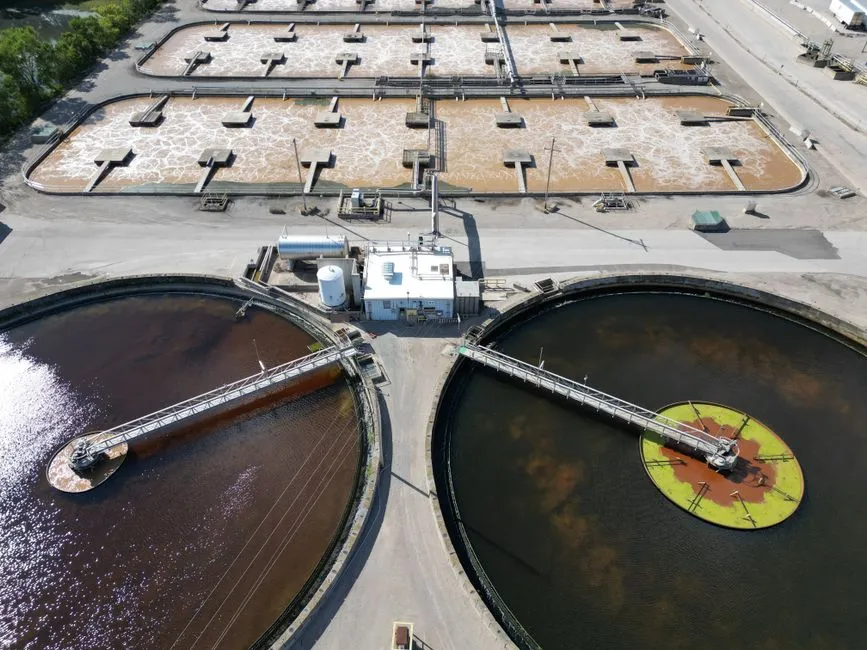
A purchase-ready treatment train should assign each unit process to a specific contaminant-removal duty. The design divides into physical removal, equalization and chemical conditioning, biological treatment where biodegradable organics justify it, membrane or advanced polishing, and disinfection. Each process needs a defined design flow, contaminant loading, inlet envelope, outlet objective, bypass condition and control response.
Use DAF for oil, grease, FOG, suspended solids and colloids when wastewater characterization supports that function. Add coagulation and flocculation where the destination requires lower suspended solids or turbidity. Where compact biological treatment, solids separation and reuse-oriented effluent quality justify the additional membrane requirements, evaluate an integrated MBR wastewater treatment system.
HydropureWater states a 10–2,000 m³/day MBR range and filtration below 1 μm. These are catalog specifications, not evidence that any LG stream will meet a discharge or reuse standard. Membrane selection still depends on biodegradability, fouling potential, soluble organics, nutrients, salinity, temperature, operating hours and the required outlet quality.
Where project chemistry supports nutrient-rich, biodegradable organic treatment, anaerobic methane recovery may precede polishing. The 2023 Frontiers review reports more energy per kilogram of COD removed from methane-recovering technologies than from the hydrogen and electricity alternatives studied in Mexican peer-reviewed papers. That result concerns energy recovery, not automatic suitability for battery-process rinses.
Every train that generates solids needs a controlled sludge route. Evaluate conditioning and plate-and-frame dewatering, including concentrate handling. The plate-and-frame filter press range stated by HydropureWater is 1–500 m² of filtration area, with manual, hydraulic or fully automatic PLC-controlled configurations. These options still require cake-moisture, polymer, filtrate and disposal criteria.
Use UV or another validated disinfection method where the risk assessment and receiving requirements justify it; a UV disinfection system should follow validated dose and fouling considerations rather than being selected solely because it is described as chemical-free.
| Function | Applicable condition | Key acceptance evidence |
|---|---|---|
| Physical removal | Oil, grease, FOG, solids or colloids are present | Removal across the verified loading envelope and managed sludge route |
| Equalization and conditioning | Batch discharges or chemical variability require control | Peak-flow behavior, residence time, mixing and controlled return |
| Biological treatment | Organic load is sufficiently biodegradable and non-inhibitory | Reaction kinetics, effluent response and resilience to upset conditions |
| Membrane or advanced polishing | Required quality or reuse justifies membrane operation | Fouling rate, cleaning demand, integrity controls and permeate quality |
| Disinfection | Microbiological risk or receiving requirement applies | Validated dose, fouling monitoring and downstream residual or UV intensity requirements |
| Sludge handling | The process generates separable solids or concentrates | Volume, moisture, filtrate quality, chemical use and authorized destination |
Verify Capacity Against Expansion and Ramp-Up Risk
Hydraulic capacity must be based on measured and forecast peak concurrent flows, not annual-average effluent. The calculation should show cleaning cycles, batch dumps, stormwater inputs, production changeovers and the method used to derive coincidence. Include startup and commissioning wastewater; stabilized production data alone will not describe ramp-up conditions.
Size contaminant loading from conservative mass loads using measured concentrations and operating hours. Keep flow and load calculations separate: a stream may have a manageable daily mass load but a damaging short-duration discharge. The capacity and sizing guide for wastewater dewatering illustrates why nameplate area alone is not a sufficient design basis.
Provide equalization and controlled return to treatment, then define the downstream response if a discharge exceeds the permitted envelope. That response may include isolation, diversion to a contained holding route, load curtailment, alarm escalation or another engineered action. A generic bypass is not an acceptable answer because it can transfer the compliance problem from the ETP to the receiving environment.
Specify corrosion-resistant materials, odor control, confined-space controls, chemical storage, isolation and bypass prevention according to the actual plant footprint and operating risks. Future production modules and treatment trains should appear in the design basis, including utilities, control architecture, access, sludge handling and expansion interfaces.
Delivery uncertainty, cost escalation, delay, underperformance and mismatch between promised and realized capability repeatedly weaken energy-transition infrastructure investment outcomes, according to the 2026 academic review When Adoption Stalls but the Frontier Expands. That finding is not a battery-wastewater design criterion, but it supports the owner’s decision to verify realized treatment capability rather than accept projected performance without contractual evidence.
Build the Mexican Compliance and Due-Diligence File
Equipment selection does not establish legal authorization to discharge. Confirm the applicable federal, state and municipal requirements for the specific discharge point, including authorization to connect, discharge limits, monitoring, sampling, reporting and hazardous-waste management. Use the Mexico plant wastewater requirements and due-diligence guide as a diligence structure, with current project-specific confirmation by qualified Mexican specialists.
Require every proposal to include a permit and contaminant crosswalk. It should identify which party owns pretreatment compliance, who monitors each intermediate stream, what happens if chemistry changes, and which party bears the consequences of nonconforming discharge. The responsibility matrix should extend to chemical storage, hazardous residues, sludge and sampling records; equipment operation alone does not satisfy those obligations.
System-level planning matters in Mexico. The International Climate Initiative’s Guanajuato case study reports that two wastewater companies using the WaCCliM approach increased treatment coverage from 48% to 81% and improved pumping-station energy efficiency. This is a regional efficiency precedent, not an LG Energy Solution compliance precedent, and it does not establish the legal requirements for the expanded plant.
The 2023 Frontiers review notes that wastewater treatment in Mexico can address pollution and energy needs together. However, its systematic review covered studies published from 2000–2022, so it cannot substitute for current permit analysis.
Place pilot testing, startup acceptance, operator training, control narratives, emergency response, bypass prevention, sampling points, redundancy and lifecycle service in the procurement scope. Require the supplier to state which results are measured, which are calculated, which depend on owner utilities and which remain exclusions. This converts a treatment concept into a purchase-ready compliance file.
Compare Equipment Options by Project Deliverable
Compare treatment bids by verified performance at the design loading, footprint, utilities, automation, chemical demand, sludge production, maintainability, expansion provisions and delivered scope. A comparison of supplier claims and project-specific requirements prevents a packaged unit with a broad product description from being mistaken for an engineered process solution.
HydropureWater’s WSZ underground integrated sewage treatment system uses anoxic and aerobic biological contact oxidation, sedimentation and disinfection in a buried package. Its stated capacity is 1–80 m³/h for factories and decentralized applications, making it more relevant to segregated sanitary sewage than to concentrated battery-process rinses.
HydropureWater states that its DAF range is 4–300 m³/h across 13 models and its MBR range is 10–2,000 m³/day. Use those values only as supplier-screening bands, not as a final selection. The DAF system and MBR treatment system must still be matched to measured source-water characteristics and the selected treatment objective.
Every bid should state guaranteed flow, load, effluent or reuse target, test method, guarantee condition, commissioning criterion, spare-parts scope, response time and exclusions. Ask the supplier to identify the reaction chemistry, downstream fate of treatment chemicals and responsible handling of concentrated residues. A vendor unable to answer those questions has not demonstrated the technical basis for its offer.
| Comparison criterion | Evidence required in the bid | Reason for acceptance or rejection |
|---|---|---|
| Design basis | Source-water characterization, peak flow, mass load and operating hours | Confirms that the proposed capacity is relevant to the actual stream |
| Performance | Guaranteed result, test method and tested operating condition | Separates demonstrated performance from a catalog claim |
| Delivered scope | Civil works, equipment, controls, utilities, start-up, training and exclusions | Identifies gaps and avoids assigning them to the owner after award |
| Sludge and chemicals | Generation rate, conditioning need and disposal responsibility | Links treatment performance to secondary waste management |
| Expansion | Interfaces, future hydraulic and load capability | Tests whether the installation can follow the plant ramp-up |
| Service | <>Commissioning support, spares, response time and local capabilityDetermines whether performance can be sustained after handover |
Commission Through Staged Performance Tests
Baseline sampling should precede the final design freeze and cover normal production, peak cleaning, low production and upset conditions. The sampling plan must define locations, flow-weighted or event-based collection, holding times, analytical methods, chain of custody and operational activities during each sample. This dataset becomes the reference against which startup and ramp-up performance are judged.
Use pilot or temporary treatment trials where biodegradability, inhibitory chemistry, emulsified oils, variable metals or membrane fouling behavior remains uncertain. Trials should test the relevant water, including batch cleaning wastewater, and measure the selected process’s removal performance, chemical consumption, sludge generation, energy use and control response. A clean synthetic test does not establish performance with plant wastewater.
Set acceptance tests around mass loading, peak hydraulic flow, treated-water quality, sludge generation, chemical use, energy use and automatic-control response. Specify the analytical methods, sample frequency, acceptance conditions, retest rights and remedy for failed performance. The relationship between equipment startup and production ramp-up should be written into the commissioning plan rather than left to site interpretation.
Train operators on sampling, chemical dosing, DAF or membrane maintenance, alarm response, bypass prevention and chain-of-custody requirements. The MBR maintenance and performance protocol provides a useful maintenance structure, but the final program must reflect the selected equipment and site hazards.
Tie acceptance to expansion phases. Demonstrate performance during early operation, peak cleaning, changing production mixes and progressively higher loads. Any capacity reservation for future modules should remain conditional on revised characterization and confirmation that the treatment train still satisfies the permitted envelope.
Frequently Asked Questions
How much will wastewater treatment cost for the LG Energy Solution expansion in Mexico?
No defensible total-cost figure is available from the supplied research because stream flows, pollutant loads, treatment objectives, site utilities, civil work and residue routes remain undefined. Separate the equipment platform from site-specific costs, including excavation, chemical storage, power distribution, sludge disposal, monitoring and commissioning. Request itemized supplier pricing against a common design basis, then evaluate each bid using the same hydraulic and contaminant loads.
Which wastewater treatment supplier should LG Energy Solution select?
Select against a wastewater characterization package, not a product name. Require pilot or validated reference performance under comparable chemistry, a delivered-scope boundary, enforceable guarantees, defined commissioning criteria and local service capability. Also verify responsibility for treatment chemicals, sludge, hazardous residues and permit documentation. A supplier that cannot connect its guarantee to measured source-water conditions has not supplied a complete technical offer.
How should DAF, MBR and packaged sewage equipment be sized?
Size from peak flow, mass loading, operating hours, expansion phases, discharge or reuse objective and pilot data. DAF may fit an oily or solids-bearing industrial stream; an MBR may fit a stream requiring biological treatment and solids separation; a packaged sewage system may fit segregated sanitary sewage. These assignments must be confirmed by characterization rather than inferred from capacity ranges or product descriptions.
Does selecting treatment equipment satisfy Mexico discharge-permitting requirements?
No. Equipment selection is an engineering decision; authorization depends on the applicable discharge route, permit conditions, monitoring duties and waste classifications. Require qualified Mexican specialists to confirm federal, state and municipal requirements, connection authorization and hazardous-waste obligations before design freeze. Place those obligations and responsibilities in the permit crosswalk and supplier contracts rather than assuming discharge after treatment is authorized.
Related Equipment
- industrial DAF pretreatment for suspended solids and oil removal — specifications, capacity range, and technical data