Separate cooling blowdown from sanitary wastewater
A Saltillo data center needs two wastewater trains: a cooling-tower blowdown system for concentrated, chemically treated water and a separate biological system for sanitary wastewater. Cooling blowdown can contain elevated TDS, silica, hardness, corrosion products, residual biocides and treatment chemicals; reused water may require additional pretreatment. A side-stream filtration and UF/RO train can recover permeate for suitable reuse when the concentrate has a lawful discharge path. MVC or full ZLD should be considered where discharge volume is constrained. Final design requires 12 months of site-water data, flow measurements, local discharge terms and confirmation of current Mexican permits.
Cooling-tower blowdown is the concentrated residual removed to control accumulated solids, scale, corrosion and biological growth. Water leaves the cooling system mainly through evaporation, while dissolved substances and treatment chemicals remain and become concentrated. Water Utility Report, last updated April 14, 2026, identifies possible elevated salts, heavy metals, biocides, corrosion inhibitors and altered pH in blowdown. Those constituents determine whether the stream can be reused, treated for discharge or routed to a more intensive recovery process.
Sanitary wastewater has a different contaminant profile. It carries biological loading and variable solids rather than the concentrated dissolved-solids load associated with the cooling loop. HydropureWater reports sanitary wastewater at 80–120 L/person/day and directs it to a parallel biological train rather than mixing it with high-TDS blowdown. The two streams should not share an RO feed because a sanitary upset can overload membranes and disturb the cooling-water chemical program.
The sanitary train may use an MBR membrane bioreactor for sanitary wastewater, sized from measured flow and load rather than cooling-system demand. Cooling blowdown needs a separate pretreatment, separation and desalination or recovery train. This separation also preserves traceability: operators can characterize and discharge each stream under its own applicable conditions instead of creating a blended wastewater with the worst characteristics of both.
Build the Saltillo water balance before selecting equipment
Genesis Water Technologies gives the theoretical blowdown ratio as 1 divided by cycles of concentration minus one, making the blowdown calculation auditable instead of dependent on a generic facility assumption. At 4 cycles, the stated blowdown is 25% of makeup; at 6 cycles it is 20%. The reduction is therefore 20%, not 50%, although the higher concentration can increase scaling, corrosion and biological-control demands.
- Measure makeup water, cooling-tower evaporation, blowdown, sanitary wastewater and every other process discharge separately.
- Reconcile emergency dumps, unmeasured losses, cooling makeup and reclaimed-water returns in the data center water balance.
- Record operating cycles of concentration alongside conductivity, pH, suspended solids and chemical additions.
- Use seasonal flows and chemistry to size pretreatment, RO, MVC or crystallization rather than relying on peak cooling demand alone.
Request at least 12 months of site-water data covering TDS, hardness, silica, chloride, sulfate, iron and manganese before sizing RO, NF, MVC or a crystallizer. Water Utility Report, updated April 14, 2026, states that source-water chemistry, the chemical program and cycles of concentration determine the quality of the stream leaving the cooling system. For Saltillo, the buyer must also obtain the actual local supply and discharge conditions rather than treating climate assumptions as site data.
| Water-balance input | Engineering use | Evidence or required verification |
|---|---|---|
| Makeup, evaporation and blowdown flow | Establishes the hydraulic design flow | Measure separately; do not infer from facility load |
| Cycles of concentration | Sets blowdown volume and concentration risk | Genesis: 25% blowdown at 4 cycles and 20% at 6 cycles |
| Twelve months of source and blowdown chemistry | Determines pretreatment and recovery limits | TDS, hardness, silica, chloride, sulfate, iron and manganese |
| Sanitary wastewater flow and load | Sizes the separate biological train | HydropureWater: 80–120 L/person/day |
| Emergency dumps and unmeasured losses | Prevents undersizing treatment and storage | Site log and metering review |
Higher cycles can reduce blowdown, but the economic case depends on avoiding additional chemical dose, cleaning and loss of operating margin. Use the cooling-tower blowdown treatment with reverse osmosis as a technical reference, then require every bidder to base its sizing on the Saltillo measurements and analytical record.
Protect membranes and control scaling in the cooling loop
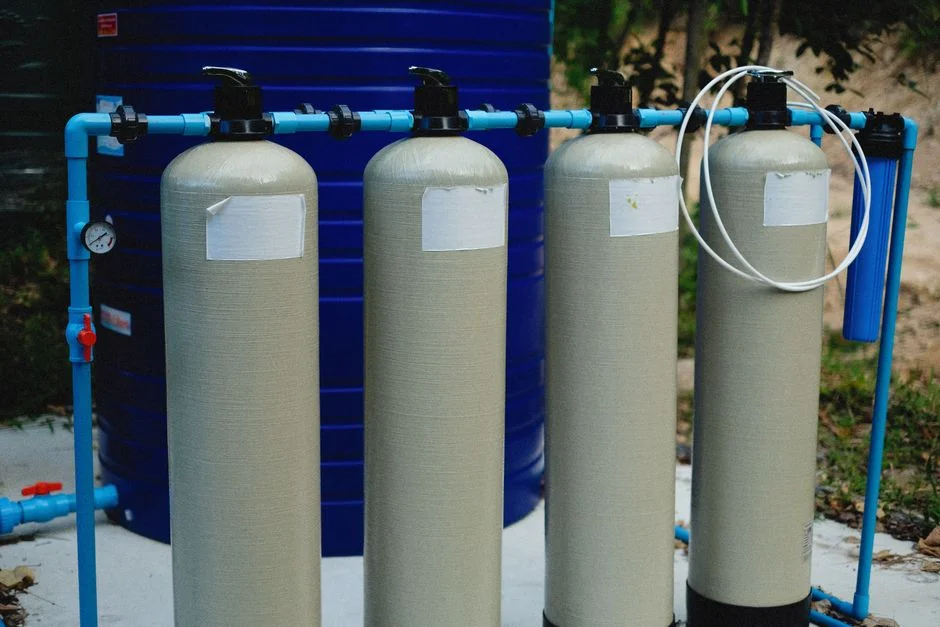
Reverse-osmosis pretreatment must address both the solids that foul membranes and the dissolved constituents that limit recovery. HydropureWater cites blowdown at 1,200–6,000 mg/L TDS and 4–8 times the makeup-water concentration in its Ecatepec regional engineering article, published in 2025. These are comparative data-center values, not Saltillo site requirements; the local analytical record remains the controlling basis.
HydropureWater also cites suspended solids of 10–50 mg/L despite basin filtration and recommends reducing solids to below 10–15 micrometres before membranes. A multi-media filter can remove suspended solids, turbidity and colloidal matter ahead of RO. Where biological protection is required, UF pretreatment for cooling-tower blowdown provides a defined barrier before the desalination step.
| Process element | Supplied comparative performance | Design implication |
|---|---|---|
| Multi-media filtration | Removes suspended solids, turbidity and colloidal matter | Use as the first solids-control stage before UF or RO |
| Ultrafiltration | HydropureWater cites 0.01–0.1 micron pores, 10–30 psi, 90–95% recovery and cleaning every 1–3 months | Confirm feed and permeate limits with the selected supplier |
| Reverse osmosis | HydropureWater cites 95–99% dissolved-solids rejection, 10–50 mg/L permeate TDS, 50–85% blowdown recovery and 150–400 psi operating pressure | Size recovery around site chemistry and concentrate disposal |
| Chemical control | Antiscalant, biocide and pH control are tied to the cooling-water program | Coordinate dosing with cooling chemistry and membrane warranties |
IDE reports that conventional brackish-water RO typically plateaus at 75–80% recovery because silica, calcium carbonate and calcium sulfate reach scaling limits. That result cannot be transferred automatically to Saltillo: hardness, silica, sulfate, alkalinity and the chemical program determine the local saturation envelope. The supplied research supports a site-specific pilot or guaranteed performance test rather than adoption of a universal recovery percentage.
Integrate biocide, antiscalant and pH control with the cooling-water program instead of treating them as downstream accessories. A controlled automatic chemical dosing system can maintain the required feed chemistry and provide a measurable record of treatment. The final train should place multi-media filtration ahead of UF and RO where the feed analysis justifies it, and use industrial RO for blowdown recovery and reuse only with an agreed concentrate route.
NF should be evaluated where actual hardness or sulfate data show a benefit. It may provide partial softening before RO or serve as an alternative where permeate quality and permitted discharge make RO uneconomic. Existing UF or RO membranes should be evaluated for compatibility, but reused elements do not replace site testing or a validated pretreatment design.
Choose a discharge route that matches site constraints
The defensible treatment train depends on whether the project has a permitted liquid-discharge route, a restricted sewer connection, or no acceptable liquid discharge. Side-stream filtration plus RO is appropriate when a permitted outfall exists and the objective is meaningful reuse with manageable concentrate. The supplied research does not establish a universal Saltillo recovery target, so recovery must follow measured feed chemistry, concentrate limits and discharge economics.
| Site condition | Indicative treatment train | Decision that remains site-specific |
|---|---|---|
| Permitted sewer or other liquid discharge and cooling reuse objective | Side-stream filtration, optional UF, then RO | Permit limits, available sewer capacity, concentrate chemistry and tariff |
| Hard or sulfate-rich source water | NF before or instead of RO, subject to testing | NF permeate quality, pressure and effect on overall recovery |
| Restricted liquid-discharge volume | RO followed by MVC as partial ZLD | Concentrate feed, distillate use and residual brine route |
| No acceptable liquid discharge | RO, MVC and crystallizer as full ZLD | Current permits and solid-waste handling acceptance |
HydropureWater cites RO-plus-MVC partial ZLD at 85–95% overall recovery without a crystallizer. It cites MVC at 95–98% recovery, distillate below 10 mg/L TDS and 15–25 kWh per 1,000 US gallons. These are comparative research figures and do not establish the energy use or recovery of a Saltillo plant.
HydropureWater also cites full ZLD with crystallizer at 95–99% overall recovery, $3–8 million capital cost and $5–15 per thousand gallons operating cost. These are comparative research figures, not a Saltillo quotation. SaltWorks describes modular evaporator-crystallizers with self-diagnosis, self-cleaning and advanced automation for minimal or true liquid discharge, but the buyer must confirm whether that configuration satisfies the project’s discharge condition.
Reuse does not remove the concentrate obligation. Permeate can return to the cooling tower, while rejected salts still require lawful treatment or disposal. Compare each option against actual sewer capacity, concentration limits, water cost, discharge cost and solid-waste handling. Current limits and tariffs must be obtained from the relevant authority; the supplied research does not provide them.
Also resolve where MVC distillate will go. It may support cooling make-up, but its chemistry and intended use must be checked before design. Equipment selection should include the valves, filter media and other treatment parts required for isolation and service, because a recovery percentage without a dependable concentrate route is not an executable design.
Verify compliance, monitoring and vendor guarantees
The supplied research does not provide current numeric effluent limits for Saltillo, so the permit file cannot be completed from generic equipment descriptions. Verify the current NOM-001-SEMARNAT requirements for the selected discharge path with local counsel and the permitting authority. Confirm the receiving sewer or other authority’s pretreatment conditions, discharge limits, available capacity, monitoring obligations and tariffs before equipment procurement.
Also confirm whether reclaimed water may serve as cooling make-up and whether water-concession or allocation conditions apply. Water Utility Report, updated April 14, 2026, states that recycled water changes rather than removes the chemistry challenge; reused water may require additional pretreatment, corrosion control, scaling control and monitoring. For Mexico-specific context, use the available review of Mexico data-center wastewater and permitting requirements, while obtaining current requirements from the competent authorities.
Procurement packages should require guarantees for design flow, recovery, permeate quality, energy consumption, membrane-cleaning intervals and the fate of the concentrate. A generic equipment quotation does not guarantee the treatment train’s performance. Identify who owns each failure mode: pretreatment, membrane scaling, cooling chemistry, instrument calibration, power availability, operator error or an invalid concentrate assumption.
Use the automatic chemical dosing system for controlled antiscalant, biocide and pH adjustment. For biological control in industrial cooling loops, evaluate the supplied chlorine dioxide generator option and require compatibility with the cooling chemistry, membrane warranty and site safety controls.
Automatic monitoring and records should cover conductivity, pH, flow, differential pressure, recovery and permeate quality. These parameters allow the operator to identify scaling, fouling or an unauthorized discharge condition before it becomes a permit issue. Keep an appropriate RO and UF membrane replacement-element plan, with the frequency supported by the pilot and operating data rather than an unsupported life claim.
A practical Saltillo equipment-selection framework
A Saltillo data-center treatment decision should move from measured water and chemistry to a bounded discharge route, then to equipment. The sequence prevents a high-cost recovery system from being selected without confirming where its concentrate and distillate will go.
| Primary project condition | Recommended sequence for evaluation | Mandatory procurement evidence |
|---|---|---|
| Cooling-blowdown reuse with permitted concentrate discharge | Side-stream filtration, UF where biological protection is needed, then RO | Measured flow, 12-month chemistry, recovery calculation and discharge permit |
| Reduced liquid-discharge volume | RO followed by MVC | Concentrate analysis, energy basis and residual-brine route |
| No acceptable liquid discharge or true ZLD requirement | RO, MVC and crystallizer | Solid-waste route, current permit and mass-balance guarantee |
| Sanitary wastewater generated on site | Separate MBR-based biological train | Measured sanitary flow and load, separate permit and reuse or discharge route |
Require a site-specific pilot or guaranteed performance test before final sizing. The test should use the actual cooling-water chemistry and examine recovery, permeate quality, pressure, cleaning response and concentrate generation. A site-specific data-center blowdown treatment framework can structure that evaluation, but it does not replace Saltillo measurements or authority approvals.
The shortest defensible specification is therefore: separate the streams; meter the water balance; characterize source and blowdown chemistry; confirm the lawful discharge route; then select filtration, UF, RO, NF, MVC or crystallization in that order of constraint. This approach produces a treatment train that can be sized, guaranteed and permitted rather than merely marketed as water-saving.
Frequently Asked Questions
How much should a Saltillo data center budget for cooling-blowdown treatment?
The supplied research provides comparative figures rather than a Saltillo quotation: HydropureWater cites $250,000–$500,000 for a 50,000 GPD RO installation, $1–3 million for a 10,000–30,000 GPD MVC unit, and $3–8 million for full ZLD with crystallizer. Request a bid tied to measured makeup, evaporation and blowdown flows; at least 12 months of source and blowdown chemistry; the permitted discharge route; energy prices; and concentrate handling requirements. Ask bidders to separate pretreatment, RO, MVC, crystallization, civil work, chemical storage, solids removal and long-term operating costs.
What treatment should be selected when no liquid discharge is permitted?
Evaluate pretreatment followed by RO, then MVC and a crystallizer for full ZLD. HydropureWater cites 95–99% overall full-ZLD recovery, but that comparative range does not replace local confirmation. Before procurement, obtain the current permit conditions and written confirmation that the proposed solid residue has an accepted handling route, including the responsible hauler and receiving site.
How should a supplier size the treatment system?
Require measured makeup, evaporation and blowdown flows, separate sanitary wastewater flow, operating cycles of concentration, emergency-dump history, and at least 12 months of TDS, hardness, silica, chloride, sulfate, iron and manganese data. The bidder should then show feed, permeate and concentrate balances and state the recovery assumption for the actual chemistry. Do not size from facility MW alone; thermal demand does not establish water flow, concentration or discharge limits.
Can cooling blowdown and sanitary wastewater be treated together?
No, not as a common membrane feed. HydropureWater’s guidance calls for separate streams because sanitary wastewater introduces biological loading and solids swings that are incompatible with high-TDS blowdown treatment. Route sanitary wastewater to a separate biological train, such as an MBR sized from measured sanitary flow and load, and keep its reuse or discharge approval separate from the cooling-blowdown permit.