Build the Aguascalientes data center water balance first
An Aguascalientes data center should treat cooling tower blowdown and sanitary wastewater as separate systems. Blowdown is concentrated process water containing dissolved minerals, treatment chemicals and suspended solids; published benchmarks indicate 1,200–6,000 mg/L TDS and 10–50 mg/L basin suspended solids. A practical train starts with side-stream filtration, then UF for membrane protection, with RO used when blowdown-to-makeup reuse is justified. Sanitary wastewater requires a parallel biological train, such as MBR, rather than mixing it with high-TDS blowdown. Final sizing must use 12 months of site data, local discharge limits, tariffs and confirmed reuse rules.
Start with separate water-balance lines for cooling tower makeup, evaporation, drift, blowdown and humidification; chiller and adiabatic-cooler discharge; treatment-equipment backwash; floor and vehicle washing; and sanitary wastewater. These streams differ in temperature, solids, dissolved salts and biological load, so a combined nominal flow conceals the governing design condition. Cooling towers also include chiller and adiabatic-cooler discharge that should remain distinct from the sanitary sewer connection.
Cycles of concentration, or CoC, relate circulating-water TDS to makeup-water TDS. Genesis Water Technologies gives the relationship blowdown ratio = 1/(CoC − 1): at 4 CoC, blowdown is 25% of makeup, while at 6 CoC it is 20% (Genesis Water Technologies, 2026). That changes treatment flow, concentrate volume and makeup demand; it does not mean a 50% reduction, as Genesis Water Technologies explains.
A HydropureWater Guadalajara example provides scale context only: a 10 MW facility at 4 CoC uses approximately 15 million gallons, or 57,000 m³, monthly makeup and generates approximately 3.75 million gallons, or 14,200 m³, monthly blowdown (HydropureWater, 2026). Do not apply those values to Aguascalientes without local operating data. The data center cooling blowdown treatment guide explains the water-balance approach, but the site balance must remain project-specific.
Install dedicated metering for makeup, blowdown and major reuse flows. Log conductivity, pH, suspended solids, temperature and cooling-tower chemistry across representative operating cycles. Size equipment for peak, minimum and turndown conditions because seasonal cooling demand changes makeup and blowdown together. Confirm local supply conditions, sewer capacity, tariffs, climate data and reuse rules before selecting the treatment capacity.
Characterize cooling blowdown and sanitary wastewater separately
Cooling blowdown and sanitary wastewater require different sampling plans because their contaminant profiles and acceptable treatment endpoints differ. Published blowdown values are screening benchmarks; Aguascalientes makeup water, cooling chemistry and operating CoC must establish the design basis.
HydropureWater reports a screening range of 1,200–6,000 mg/L TDS for data-center blowdown, commonly 4–8 times makeup TDS, and basin suspended solids of 10–50 mg/L despite effective side-stream filtration (HydropureWater, 2025). Those values support preliminary equipment selection, but they do not establish Aguascalientes feed quality. The same source identifies suspended solids, corrosion products and biofilm fragments as pretreatment concerns requiring particle reduction before membranes.
Establish a representative 12-month sampling program covering TDS, hardness, silica, chloride, sulfate, alkalinity, calcium, magnesium, iron, manganese, pH, suspended solids, temperature and residual cooling chemicals. These results determine RO recovery, antiscalant demand, cleaning frequency and concentrate characteristics. Sampling frequency should reflect changes in cooling load, chemistry rotation and makeup source; the supplied research does not establish a universal sampling frequency for Aguascalientes.
Map the cooling-water chemistry program because biocides, corrosion inhibitors, scale inhibitors and dispersants accumulate in blowdown. HydropureWater identifies low-phosphate, non-chromate programs as more compatible with downstream reuse and permitting (HydropureWater, 2025). Treat that as a design objective to be coordinated with the cooling-system specialist, not proof that the existing program can be changed without operational review.
Route sanitary wastewater to a parallel biological process. HydropureWater identifies MBR as an example for sanitary flows and gives a workforce wastewater generation reference of 80–120 L/person/day (HydropureWater, 2025). Confirm the applicable generation rate using occupancy, shifts and visitors rather than employee count alone.
| Design input | Cooling blowdown | Sanitary wastewater |
|---|---|---|
| Primary concern | Dissolved salts, scale formers, residual chemicals, suspended solids and biological growth | Organic loading, nutrients and variable biological solids |
| Published screening evidence | 1,200–6,000 mg/L TDS; 10–50 mg/L basin suspended solids (HydropureWater, 2025) | 80–120 L/person/day workforce generation reference (HydropureWater, 2025) |
| Required treatment logic | Solids control, membrane protection, dissolved-solids separation and concentrate management | Biological treatment, solids separation, disinfection where required and reuse or discharge assessment |
| Design status | Aguascalientes chemistry, flows, permits and tariffs remain site-specific inputs to verify. | |
Choose a treatment route based on the discharge decision
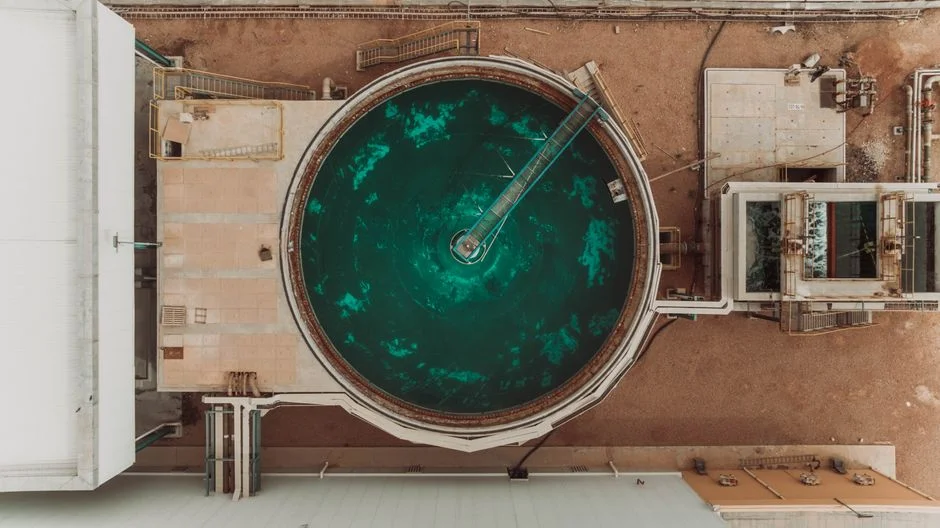
The discharge decision determines whether conventional RO is sufficient or whether concentrate treatment is justified. Select the route after confirming the sewer authorization, reuse objective and local cost of water and discharge.
For a base-path train, side-stream filtration plus UF and RO is appropriate when a permitted sewer discharge exists and permeate can replace part of the cooling-tower makeup. HydropureWater reports 95–99% RO rejection, 10–50 mg/L permeate TDS and 50–85% blowdown recovery (HydropureWater, 2025). Evaluate an industrial RO system for blowdown reuse against measured feed chemistry rather than an assumed recovery.
For a high-reuse route, add controlled brine or concentrate treatment where greater reuse is needed or discharge volume is restricted. HydropureWater reports that RO followed by MVC can deliver 85–95% overall recovery without a crystallizer (HydropureWater, 2025). The same source gives MVC performance of 95–98% recovery, distillate TDS below 10 mg/L, and energy use of 15–25 kWh per 1,000 US gallons (HydropureWater, 2025). These are screening benchmarks, not quotations or guaranteed project results.
Reserve full ZLD for a site with no liquid-discharge route or a water-positive objective that justifies the added equipment. HydropureWater cites 95–99% overall recovery, $3–8 million capital cost and $5–15 per thousand gallons operating cost for full ZLD (HydropureWater, 2025). A bid must identify the cost boundary, concentrate treatment and salt-disposal assumptions.
IDE also reports a controlled-precipitation application for a blended industrial blowdown and brine feed operating at approximately 95% recovery with about 1 mg/L permeate silica (IDE, 2026). That case is not a guaranteed Aguascalientes outcome, but it demonstrates why scaling chemistry must be addressed before increasing recovery.
| Route | Core train | Use when | Principal unresolved input |
|---|---|---|---|
| Discharge with partial reuse | Side-stream filtration, UF and RO | A permitted sewer route exists and permeate can replace some makeup | Local sewer limits, concentrate acceptance and measured feed chemistry |
| High reuse | RO with MVC or controlled brine treatment | Greater reuse is required or discharge volume is restricted | Energy demand, concentrate route and lifecycle cost |
| Full ZLD | RO, MVC and crystallizer | No liquid discharge is permitted or a water-positive objective applies | Residual solids disposal, permit basis and capital operating cost |
Design the modular blowdown treatment train
A defensible blowdown train starts with physical solids control, adds UF where membrane protection is required, uses RO as the principal dissolved-solids barrier and leaves concentrate management as an explicit design package.
Begin with side-stream physical separation. HydropureWater’s Guadalajara article identifies multimedia filtration before RO to reduce particulates below 10–15 microns; treat this as a design objective rather than a guaranteed field result (HydropureWater, 2026). A multi-media filter for water treatment can form the solids-control module, with the final sensitivity selected from measured suspended solids.
Add UF where biological loading and membrane protection justify it. HydropureWater gives 0.01–0.1 micron pore size, 10–30 psi operating pressure, 90–95% recovery and cleaning every 1–3 months for blowdown pretreatment (HydropureWater, 2025). Its UF catalog specifies 0.03-micron PVDF membranes, 2,000–40,000 L/h capacity, automatic backwash and air scour. Review the UF systems for cooling blowdown pretreatment against the site’s actual flow, temperature and flux envelope.
RO then provides the main barrier to dissolved solids. Published parameters include 150–400 psi operating pressure and 50–85% blowdown recovery (HydropureWater, 2025). Protect the membranes with filtration, biological control, antiscalant management and OEM-compatible operating limits. The Guadalajara source cites RO energy use of 0.5–1.0 kWh/m³ of permeate (HydropureWater, 2026). Lifecycle comparisons must also include membrane replacement, antiscalant, clean-in-place chemicals, energy and operator labor.
Define a reuse hierarchy for permeate. Potential destinations include cooling-tower makeup, humidification, equipment washing, floor washing, construction dust control or irrigation, but each use requires confirmation of chemistry and local reuse rules. Do not infer approval from an internal process need.
Provide automatic monitoring and chemical dosing for conductivity, pH, flow, differential pressure and interstage pressure. The automatic chemical dosing system must coordinate with the cooling chemistry program. Include a controlled alternate route for permeate or blowdown when recovery, temperature or quality leaves the operating envelope.
| Module | Published benchmark or specification | Design check required |
|---|---|---|
| Side-stream media filtration | Particulate reduction objective below 10–15 microns (HydropureWater, 2026) | Measured TSS, filtration loading and backwash waste |
| UF pretreatment | 0.01–0.1 micron; 10–30 psi; 90–95% recovery; cleaning every 1–3 months (HydropureWater, 2025) | Temperature, biological loading and guaranteed permeate quality |
| RO | 95–99% rejection; 10–50 mg/L permeate TDS; 50–85% blowdown recovery (HydropureWater, 2025) | Silica, hardness, sulfate, antiscalant and concentrate limit |
| Controls and dosing | Conductivity, pH, flow, differential pressure and interstage pressure monitoring | Automatic isolation, diversion and operator response |
Treat sanitary wastewater on a parallel biological train
Sanitary wastewater should remain hydraulically separate from cooling blowdown because organic loading, nutrients and variable biological solids are incompatible with the high-TDS RO pretreatment train.
Use MBR when required effluent quality supports reuse or the municipal sewer requires low-solids discharge. HydropureWater describes its MBR as activated sludge combined with submerged PVDF membrane filtration and filtration below 1 micron. Its catalog gives a capacity range of 10–2,000 m³/day. Confirm the selected flow against occupancy, shift patterns, visitor load and the applicable wastewater-generation basis rather than sizing from employee count alone.
Define the treated sanitary discharge or reuse destination before selecting the biological train. Coordinate sampling, monitoring and reporting with the blowdown permitting workstream, but do not rely on one combined permit assumption. Temperature, nutrients, residual chemicals and reuse end use can change both the treatment sequence and compliance requirements.
The separate sanitary package should also include flow metering, equalization where the operating study shows it is needed, odor control, disinfection where required, sludge handling and a bypass or contingency plan. The integrated MBR wastewater treatment system should be quoted against a verified sanitary design flow and reuse or sewer-discharge endpoint.
Confirm permits, economics and procurement requirements
Aguascalientes discharge limits, water tariffs and reuse permissions must be verified with the responsible authorities and utility before bids are issued; the supplied research contains no current local numerical limits or tariffs that can responsibly be inserted into the design.
Confirm NOM-001-SEMARNAT applicability, the Aguascalientes sewer or discharge authorization, CONAGUA extraction conditions and local reuse rules with Mexican counsel and the relevant authorities. The Mexico wastewater permit and reuse requirements provides a review framework, but local counsel must establish the project’s legal pathway. Ecatepec and Guadalajara regulatory, aquifer and tariff conditions must not be transferred to Aguascalientes.
Request the 12-month site water analysis, discharge route and current utility tariff before selecting RO, MVC or crystallizer capacity. IDE states that water stress, discharge limits, makeup cost and wastewater cost determine the preferred intervention (IDE, 2026). Use published costs only as screening benchmarks: HydropureWater cites $250,000–$500,000 installed and $1.50–$3.00 per thousand gallons operating cost for a 50,000 GPD RO system, while full ZLD is cited at $3–8 million capital and $5–15 per thousand gallons operating cost (HydropureWater, 2025). These figures are not 2026 Aguascalientes quotations.
A Genesis Water Technologies example reports that a 15 MW facility recovering 60% of blowdown with $200,000 capital cost has a 6.7-year simple payback on water savings alone, improving to 3–5 years when avoided discharge, treatment, pumping and chemical costs are included (Genesis Water Technologies, 2026). Use the case to structure the calculation, not to claim savings for the proposed site.
Require bidders to guarantee permeate flow, recovery, permeate TDS, concentrate volume and quality, membrane life, chemical consumption, energy demand, turndown performance, automatic controls and local service support. Separate base equipment, pretreatment, RO, reuse pumping, disinfection, concentrate management, civil works, instrumentation, redundancy, commissioning and operator training in the industrial wastewater treatment cost benchmarks.
| Bid package | Minimum information to request |
|---|---|
| Design basis | 12-month source-water analysis, measured flow series, CoC, makeup chemistry and reuse destination |
| Permitting | Applicable authorization, discharge route, local limits, extraction conditions and reuse restrictions |
| Equipment guarantee | Flow, recovery, permeate TDS, concentrate quantity and quality, energy and chemical consumption |
| Commercial boundary | Equipment, pretreatment, concentrate management, civil works, controls, commissioning, training, spares and local support |
| Economics | Current local water and discharge tariffs, avoided-cost calculation, sensitivity cases and replacement-cycle assumptions |
Frequently Asked Questions
What treatment train does an Aguascalientes data center usually need for cooling blowdown?
Start with side-stream solids filtration and add UF for membrane protection when the measured feed requires it. Use RO where permeate can replace cooling-tower makeup and a permitted concentrate route exists. Add MVC or full ZLD only after local discharge restrictions and economics justify the additional treatment steps.
How much does data center cooling blowdown treatment cost in 2026?
No defensible 2026 Aguascalientes price can be stated from the supplied research. Ask bidders for a site-specific quotation based on measured flows and chemistry, with pretreatment, RO, pumping, controls, chemicals, maintenance and concentrate management separated. Published RO and ZLD figures are screening benchmarks, not offers or local tariffs.
Should sanitary wastewater and cooling tower blowdown be treated together?
No. Keep them in parallel treatment trains. Blowdown requires solids control and dissolved-solids separation, while sanitary wastewater requires biological treatment. Combining them would change the RO feed chemistry and create a larger biological load than the pretreatment system was designed to handle.
What data should the supplier request before sizing UF or RO equipment?
Require a representative 12-month water analysis, measured makeup and blowdown flows, CoC, temperature, suspended solids and the full cooling chemical inventory. For RO, include hardness, silica, chloride, sulfate, alkalinity, calcium, magnesium, iron and manganese so the supplier can define recovery, antiscalant demand and concentrate characteristics. Provide the discharge authorization and reuse criteria before equipment selection.
When is MVC or full ZLD more appropriate than conventional RO?
Evaluate MVC when higher reuse or a lower-volume discharge route is required and the permitted sewer route cannot accept the RO concentrate. Evaluate a crystallizer when no liquid discharge is permitted or a water-positive objective justifies its capital and operating burden. Confirm both decisions against Aguascalientes discharge limits, utility tariffs, energy availability and solid-disposal arrangements rather than applying Ecatepec or Guadalajara assumptions directly.