When IFAS Is the Right Treatment for MSG Wastewater
IFAS is primarily a biological polishing option for monosodium glutamate wastewater after high-strength COD has been removed, commonly by an existing UASB. HydropureWater’s 2026 guide reports raw COD of 20,000–60,000 mg/L, ammonia-nitrogen of 1,500–3,000 mg/L, sulfate of 2,000–5,000 mg/L and pH of 3.0–4.5 as preliminary screening values. Its reported IFAS envelope is 6–10 hours HRT, 18–25 days SRT, 2.0–3.0 mg/L DO, 3,000–4,000 mg/L MLSS and 30–50% carrier fill. For a 2,000 m³/d retrofit, the guide gives 2026 screening benchmarks of $1.2M–$2.0M CAPEX and $0.10–$0.18/m³ OPEX. Final sizing requires representative wastewater testing, permit review and a site-specific mass balance.
IFAS combines suspended-growth activated sludge with an industrial biofilm carrier in the same basin. Its strongest role is downstream polishing where an existing UASB or equivalent stage has already removed most biodegradable COD and the biological objective is residual carbonaceous polishing and nitrification.
Use the SBR for MSG wastewater design comparison to assess alternatives before releasing an RFQ. IFAS is a weak fit when the feed is highly variable or inhibitory without pretreatment, when a small batch-driven plant needs flexible sequencing, or when reuse requires membrane-quality solids separation. It also needs sufficient footprint for aeration, carrier-retention screens and solids separation.
The cited source does not establish one universal IFAS reactor size, loading rate or full-scale guarantee for every MSG plant. Its figures are engineering screening benchmarks, not substitutes for site characterization or representative wastewater pilot testing.
Characterize the Wastewater Before Selecting Equipment
A daily average will conceal the batch-fermenter dumps and cleaning discharges that can govern equalization and biological capacity. Commission a flow-weighted campaign that captures average and peak flow, production cycles, batch dumps and cleaning events rather than relying on a short laboratory grab-sample program.
For IFAS for monosodium glutamate wastewater, the minimum measurement package should include COD, BOD, ammonium, total nitrogen, phosphate, suspended solids, pH, temperature, alkalinity, oil and grease, colloid behavior and toxicity. These parameters determine oxygen demand, nutrient balance, mixing requirements, inhibition risk and the need for physical pretreatment.
| Input | Why it affects the decision | Evidence status |
|---|---|---|
| COD and BOD | Set organic loading, oxygen demand and the required UASB performance | HydropureWater, 2026: raw COD screening range 20,000–60,000 mg/L |
| Ammonium and total nitrogen | Define nitrification and denitrification duties | HydropureWater, 2026: raw ammonia-nitrogen screening range 1,500–3,000 mg/L |
| Sulfate and pH | Influence alkalinity consumption, biological conditions and corrosion | HydropureWater, 2026: sulfate 2,000–5,000 mg/L and pH 3.0–4.5 |
| Suspended solids, oil, grease and colloids | Determine whether solids or oil removal is required before biology | Site measurements required; no universal pretreatment decision is supported |
| Temperature and alkalinity | Control nitrification rate and neutralization demand | Site measurements required |
Equalization, pH correction, alkalinity management and solids or oil removal are separate engineering duties. Biological treatment does not automatically remove oil, suspended solids, colloids or inhibitory contaminants. If measurements show that these could impair the biological stage, evaluate a DAF system for measured MSG wastewater pretreatment; the supplied research does not establish DAF as a universal requirement.
How the UASB-to-IFAS Process Train Works
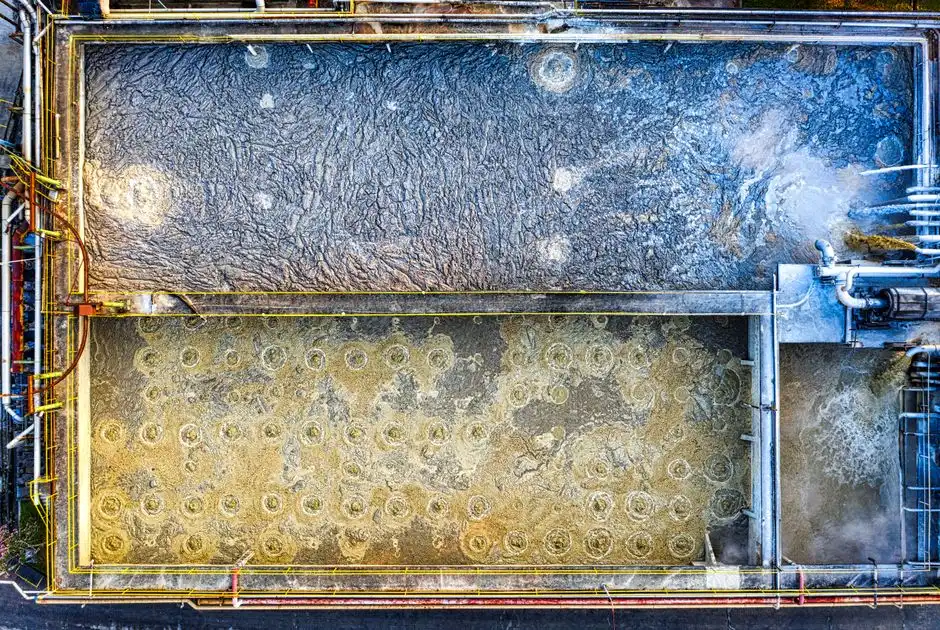
The defensible treatment sequence is equalization, condition-specific pretreatment, anaerobic COD reduction, aerobic IFAS polishing, solids separation and optional reuse polishing. Each stage needs a defined outlet basis; otherwise, an upstream upset can pass directly to the biological reactor.
HydropureWater’s 2026 IFAS guide cites a UASB study on MSG wastewater that reported 97% COD removal at an organic loading rate of 8 g-COD/L/d and methane production of 2.3 L per litre of reactor per day over a 222-day study. The same guide gives an IFAS inlet screening envelope of COD 800–1,500 mg/L and ammonia-nitrogen 200–400 mg/L. Those are the mass-balance conditions to verify at the site, not assumptions to place in a purchase order.
| Process stage | Primary function | Buyer’s verification point |
|---|---|---|
| Equalization and condition-specific pretreatment | Moderate batch discharges and remove measured oil, solids or colloids where needed | Confirm flow, concentration and contaminant reduction at each stage |
| UASB or equivalent anaerobic stage | Remove biodegradable COD and recover methane | Verify current COD removal, loading and effluent consistency |
| IFAS aerobic basin | Nitrify residual ammonium and polish remaining carbonaceous load | Balance suspended biomass and carrier-protected biofilm against aeration demand |
| Solids separation | Recover biomass and control solids carryover | Set project-specific solids-loading and effluent-solids criteria |
| Optional reuse polishing | Meet the specified reuse water quality | Use the current reuse specification rather than a generic permeate claim |
The functional division is straightforward: anaerobic treatment removes biodegradable organic load, while IFAS supplies nitrification and residual carbonaceous polishing through suspended biomass plus carrier-protected biofilm. HydropureWater, 2026, reports an IFAS nitrification benchmark of 0.8–1.5 g-N/m²/d at 20–25°C, described as roughly twice the rate of pure suspended growth at the same MLSS.
Temperature is a design constraint. HydropureWater, 2026, reports a 25–38°C MSG operating range and states that nitrification rate roughly halves below 12°C. Cold-region tanks may therefore need insulation or covers. These findings also provide context for the SBR for MSG wastewater design comparison, but they do not establish SBR sizing.
IFAS Design Parameters and Their Evidence Boundaries
The 2026 design envelope from HydropureWater gives a workable preliminary parameter sheet, but every value remains subject to mass-balance calculations and validation with actual MSG wastewater.
| Parameter | HydropureWater-reported guidance, 2026 | Engineering boundary |
|---|---|---|
| HRT | 6–10 hours | Verify against peak hydraulic and load conditions |
| SRT | 18–25 days | Confirm temperature, nitrifier retention and wasting arrangement |
| Dissolved oxygen | 2.0–3.0 mg/L | Calculate aeration demand and mixing effects |
| MLSS | 3,000–4,000 mg/L | Confirm attainable concentration with the selected solids-separation system |
| SVI | 80–120 mL/g | Verify with site sludge and the proposed wasting system |
| Biological carrier fill fraction | 30–50% by volume | Optimize against protected surface area, mixing and blower demand |
Carrier fill is not an independent capacity adjustment. HydropureWater, 2026, reports that increasing fill from 30% to 50% expands protected surface area, while each 10-percentage-point increase adds 15–25% to blower kW. Above 50%, the source reports declining mixing and increased short-circuiting.
Use PE/PP industrial biofilm carriers and wedge-wire retention screens as a preliminary configuration, subject to vendor calculations. HydropureWater, 2026, describes 6–10 mm screen slots and an annual media-loss target below 1%. Those figures define what to ask bidders to substantiate, not blanket acceptance criteria.
Temperature, DO, alkalinity, mixing, carrier area, screen losses and solids separation must appear in the mechanical and operating review. HRT and carrier fill alone do not specify a functioning process. The related IFAS design for food-processing wastewater offers a method for separating transferable design practice from feed-specific evidence.
All values above come from HydropureWater’s 2026 guide and are not independent MSG-specific guarantees. The 2006 MBBR benchmark cited in HydropureWater’s SBR guide—23–29°C and 2–3 mg/L DO—must not be transferred into SBR sizing or presented as full-scale IFAS proof. Require representative wastewater pilot testing across normal production, peak ammonium, low and high organic loading, temperature variation and cleaning discharges.
Compare IFAS, SBR and MBR for the Project
IFAS is the strongest fit when an existing UASB train is already available, flow is relatively stable and the objective is compliant discharge rather than near-reuse quality. HydropureWater, 2026, reports IFAS nitrification of 0.8–1.5 g-N/m²/d at 2,500–4,000 mg/L MLSS, roughly twice the pure suspended-growth rate at the same MLSS.
SBR deserves consideration where batch-driven sequencing and contained solids handling have priority. HydropureWater’s 2026 SBR guide identifies attractive applications below 500 m³/d, but the supplied MSG-specific studies establish research direction rather than transferable reactor sizing, hydraulic retention time or loading rates.
MBR is justified when near-reuse-quality permeate is required. HydropureWater’s 2026 IFAS guide states that MBR operating costs of $0.25–$0.45/m³ are difficult to justify for discharge-only service against its reported UASB-plus-IFAS target below $0.20/m³. A MBR wastewater treatment system for reuse-quality polishing should therefore be evaluated against an actual reuse specification.
| Decision factor | IFAS | SBR | MBR |
|---|---|---|---|
| Upstream anaerobic treatment | Strong fit where UASB or equivalent COD removal exists | Can be evaluated as an anaerobic-SBR route | Assess biological and membrane duties together |
| Hydraulic variability | Best with relatively stable flow and adequate equalization | Attractive for batch-controlled operation | Requires equalization and membrane-flow control |
| Target water quality | Discharge-oriented polishing | Flexible biological sequencing; site validation required | Near-reuse quality where justified |
| Footprint | Uses carrier area within a combined biomass basin | May suit constrained sites where sequencing is valuable | Adds membrane and solids-handling footprint |
| Membrane requirement | Not inherent to IFAS | Not inherent to SBR | Central to process performance |
| Procurement risk | Aeration, carrier loss, mixing and solids separation | Transferable sizing evidence is limited in the supplied research | Higher equipment, membrane and operating complexity |
None of these configurations can be assumed to satisfy a permit. Selection still requires a site-specific mass balance, pilot evidence and the current applicable discharge or reuse specification.
Budget and Compare 2026 IFAS Retrofit Quotes
HydropureWater’s 2026 benchmark for a 2,000 m³/d IFAS retrofit on an existing UASB is $1.2M–$2.0M CAPEX and $0.10–$0.18/m³ OPEX. This is a screening budget, not universal plant pricing; capacity, influent, UASB condition, temperature, civil scope and reuse requirements can materially change the offer.
The same guide provides a $1.6M mid-range example. It also identifies the operating basis: two parallel aeration tanks, 8 hours HRT and approximately 670 m³ of aeration volume per tank at 2,000 m³/d, 40% carrier fill, 3,500 mg/L MLSS and 2.5 mg/L DO.
| Example CAPEX item | Amount | Scope to verify |
|---|---|---|
| Biofilm carriers and retention screens | $340,000 | Carrier volume, material, protected area, slot size and loss allowance |
| Blowers and aeration grid | $380,000 | Design flow, pressure, redundancy, controls and installed power |
| Civil and retrofit works | $430,000 | Tank modifications, interfaces, foundations and site works |
| Controls and online instrumentation | $160,000 | PLC, DO, NH₃-N and MLSS instruments |
| Engineering and commissioning | $290,000 | Design, pilot support, startup, training and acceptance |
| Total example CAPEX | $1,600,000 | Compare only against offers with equivalent scope |
HydropureWater, 2026, reports that blower power accounts for approximately 50–60% of OPEX and carrier replacement for 15–20%. It gives annual carrier-media replacement of $15,000–$60,000 for a 2,000 m³/d plant. These figures should be checked against the proposed carrier inventory, replacement policy and delivered media price.
Require each bidder to price reactors, carriers, screens, blowers, aeration grid, piping, controls, online instruments, solids separation, electrical work, civil interfaces, commissioning, training, spares and exclusions separately. A reactor price alone will not expose media, aeration or brownfield costs. Use the wastewater plant total cost of ownership framework to test whether energy, media replacement, sludge handling and maintenance assumptions remain valid over the proposed contract.
Specify Equipment, Controls and Acceptance Testing
A defensible bid should trace every major dimension to the site wastewater, treatment objective and operating envelope. Request hydraulic loading, HRT, SRT, oxygen demand, blower duty, mixing, carrier area, screen loss, sludge production and solids-separation calculations.
Request online DO, MLSS and ammonium instrumentation. The HydropureWater example budget includes $160,000 for PLC and online DO, NH₃-N and MLSS instrumentation. The bidder should also specify the carrier and retention-screen design, aeration-grid calculations, blower curves, control narratives, fail-safe provisions, O&M manuals, training, commissioning plan, initial spares and documented exclusions.
Pilot evidence must use representative MSG wastewater and include stage-level sampling. Define the tested envelope for normal production, peak ammonium, low and high organic loading, temperature variation and cleaning discharges. This is more useful than a generic removal percentage because it shows where the selected configuration remains valid and how the system responds outside those conditions.
Any guarantee should state the treatment objective, analytical methods, sampling responsibilities, permitted operating range and remedy for noncompliance. A COD-removal percentage alone is insufficient. Tie guarantees to COD, ammonium, total nitrogen and solids criteria defined against the current site requirement.
Include sludge handling and wasting in acceptance. Biomass separation affects downstream performance and operating cost. Where final solids separation is required, ask bidders to align the high-efficiency sedimentation tank or other proposed separator with site solids loading, and to identify any plate-frame filter press requirements for the resulting waste stream.
Frequently Asked Questions
What does a 2,000 m³/d IFAS retrofit on monosodium glutamate wastewater cost in 2026?
HydropureWater’s 2026 screening benchmark is $1.2M–$2.0M CAPEX and $0.10–$0.18/m³ OPEX for a retrofit on an existing UASB train. Ask bidders for an itemized offer covering carriers, screens, aeration, controls, solids separation, electrical work, civil interfaces, commissioning and exclusions so that prices can be compared on equivalent scope.
What carrier fill fraction and HRT should I specify for an MSG IFAS polishing stage?
HydropureWater, 2026, reports a preliminary envelope of 6–10 hours HRT and 30–50% carrier fill by volume. Do not convert those values directly into an order: require verification using site flow, COD, ammonium, temperature, treatment targets, blower calculations and representative wastewater pilot data. Carrier fill must also be checked against mixing and blower-power effects.
Can IFAS meet the project’s nitrogen limit on MSG effluent?
That depends on the site’s current permit and reuse specification. HydropureWater’s 2026 guide reports a UASB-plus-IFAS case for Chinese conditions, but its COD below 100 mg/L, ammonia-nitrogen below 25 mg/L and total nitrogen below 40 mg/L figures should not be applied outside that cited context. Request the applicable limit, then demonstrate compliance through the site mass balance, pilot and acceptance protocol.
How should I select and verify an IFAS supplier?
Require representative-wastewater pilot results, traceable sizing calculations, itemized pricing and enforceable acceptance criteria. The supplier should identify the tested feed and operating envelope, provide source-specific MSG evidence, submit calculation files and drawings, and state remedies for noncompliance. Ask for written delivery and commissioning commitments; the supplied research does not establish market lead times, so any quoted schedule must be vendor-supported.