Why Hillsboro-area mining and metals plants face a three-layer compliance stack
Mining and metals plants near Hillsboro, Oregon meet sewer pretreatment limits in 2026 by stacking three regulatory layers: the federal floor under 40 CFR Part 436 (Mineral Mining and Processing Effluent Guidelines, incorporated into NPDES permits, with several Pacific Northwest-relevant subparts including Dimension Stone, Lightweight Aggregates, and Lithium still reserved), Oregon DEQ oversight, and Clean Water Services' local pretreatment program for urban Washington County.
Mineral Mining and Processing Effluent Guidelines and Standards (40 CFR Part 436) is the federal floor for any mining or quarrying operation that discharges wastewater in the United States; the EPA promulgated 40 CFR Part 436 in 1975 and amended the regulation in 1976, 1977, 1978, and 1979, and the requirements are incorporated into NPDES permits (EPA, 2026-02). Several Pacific Northwest-relevant subparts remain reserved, including Dimension Stone (Subpart A), Lightweight Aggregates (Subpart H), Lithium (Subpart U), Ball Clay (Subpart AH), Feldspar (Subpart AI), Talc/Steatite/Soapstone/Pyrophyllite (Subpart AJ), and Garnet (Subpart AK) — the operator must confirm whether their mineral falls under an active subpart with numeric limits or a reserved subpart with no current numeric effluent limits before sizing any equipment (EPA, 2026-02).
Clean Water Services is responsible to the Oregon Department of Environmental Quality (DEQ) and EPA for regulating and enforcing pretreatment requirements in urban Washington County and small parts of Multnomah and Clackamas counties, and issues several types of discharge permits and authorizations (Clean Water Services). Local limits are established to protect the Durham, Rock Creek, and Hillsboro water resource recovery facilities and are applied to all Significant Industrial Users and may also be applied to Nonsignificant Users (Clean Water Services). The Hillsboro WRRF runs screening, grit removal, primary clarifiers, advanced biological activated sludge, secondary clarifiers, and UV disinfection on an average wet-weather flow of 6 million gallons per day, so any industrial influent must be compatible with biological treatment before it hits secondary clarifiers (Clean Water Services). The first mistake to avoid is treating the EPA categorical test as a stand-alone pass: a plant can sit comfortably below 40 CFR Part 436 limits and still fail on local metals, pH, or TSS, because the local layer is built to protect the receiving facility, not the federal parameter list.
Getting on the Clean Water Services radar: the survey, the 90-day rule, and SIU vs NSIU
Any business discharging anything other than sanitary or domestic wastewater may need a nondomestic discharge permit, and the first step is to fill out the nondomestic waste survey on cleanwaterservices.org (Clean Water Services). An Environmental Services Specialist will then contact the operator, and the operator may be asked to fill out a Nondomestic Waste Discharge Application. Clean Water Services reviews the application, and a completed application must be submitted at least 90 days before discharging wastewater (Clean Water Services).
Approved applicants are classified as Significant or Nonsignificant Industrial Users, and both classes are required to submit compliance reports; permit compliance is monitored regularly, and significant noncompliance — including the facility name and type — is published annually (Clean Water Services). Compliance is not optional paperwork: Clean Water Services is required to report significant noncompliance each year, and enforcement escalates from a warning letter to an administrative penalty and a potential order to stop discharging under the Enforcement Response Plan for SIUs (Clean Water Services). The Industrial Partners Pretreatment Recognition Program also highlights industrial customers that achieve 100% permit compliance within the last reporting year, which is a tangible community-relations signal for a Tualatin River Watershed operator (Clean Water Services).
The operational consequence is that the engineering work needs to be sequenced behind the permit clock, not in front of it. Influent characterization, basis-of-design numbers, and the unit-operation selection have to land in the hands of the supplier early enough that the proposed train can be defended in the application — and so the 90-day window is not blown on clarifications. A plant that walks into a supplier conversation with a flow number, a representative metal profile, and the relevant local limits already in hand can compress the application review and avoid being flagged for incomplete information.
What a Hillsboro mining influent actually looks like — and which parameters drive the local limits
Mining wastewater is chemically diverse. The four common streams are ore-processing water (flotation, heap leach, cyanide or chlorination circuits — typically high TDS, with cyanide, ammonia, or chloramines depending on the process), tailings pond effluent, dewatering discharge from open pits or underground workings, and acid mine drainage (AMPAC USA, 2025-09). Acid mine drainage is the most prevalent mining water quality problem and shows up wherever sulfide minerals such as pyrite and pyrrhotite are disturbed; oxidation produces sulfuric acid that leaches iron, manganese, copper, zinc, arsenic, and cadmium at concentrations far exceeding regulatory limits (AMPAC USA, 2025-09).
A copper operation, a coal operation, and a dimension-stone quarry produce fundamentally different wastewaters and cannot share a single default treatment train, which is why the influent has to be characterized stream by stream before talking to a supplier (AMPAC USA, 2025-09). The monthly sewer usage fee on the Clean Water Services side includes a high-strength surcharge for high levels of chemical oxygen demand or total suspended solids, so TSS and COD are explicitly on the local program radar even before site-specific local limits are layered on (Clean Water Services). Capacity fees for industrial users are based on average monthly industrial process wastewater volume expressed in Equivalent Dwelling Units, with one industrial EDU equal to 625 gallons per day (Clean Water Services). The buyer therefore needs both the chemistry profile and the hydraulics in front of the supplier before a defensible scope can be written.
| Stream | Typical pH | Key parameters that drive local limits | Failure mode if untreated |
|---|---|---|---|
| Acid mine drainage | 2–5 | Dissolved Fe, Mn, Cu, Zn, As, Cd; sulfate; TSS | Metals breach, low-pH slug damages biological step at the WRRF (AMPAC USA, 2025-09) |
| Ore-processing water (flotation / leach) | 8–11 | Cyanide or chloramines, ammonia, high TDS, process reagents | Reagent pass-through, ammonia load on activated sludge (AMPAC USA, 2025-09) |
| Tailings pond effluent | 6–9 | Fine TSS, residual metals, processing chemicals | TSS surcharge, metals accumulation in biosolids (AMPAC USA, 2025-09) |
| Dewatering / pit drainage | Site-dependent | Variable metals, TSS, sulfate | Metals breach, sulfate load on receiving stream (AMPAC USA, 2025-09) |
| Sanitary baseline at CWS | ~7 | COD and TSS subject to high-strength surcharge | High-strength surcharge applied to monthly sewer usage fee (Clean Water Services) |
A defensible treatment train for 2026 — six unit operations, in order
A defensible unit-operation sequence for a Hillsboro-area mining or metals operation in 2026 has six steps, and each step maps to a specific unit operation. The literature and the commercial SAVMIN® flow sheet point to the same order: pH correction first, then coagulation, then solids separation, then multimedia filtration, then a membrane polish when salts or trace metals persist, with monitoring and reporting on the back end (Genesis Water Technologies; PMC review, 2024-02).
Step 1 raises pH with lime so dissolved metals precipitate as hydroxides and gypsum drops out; specify PLC-controlled dosing on a pre-wired skid that reports through the same HMI as the rest of the train (PMC review, 2024-02). Step 2 uses coagulation and flocculation to aggregate suspended solids and fine metal particles into settleable or floatable flocs, matched to the floc density that drives the next clarification step (Genesis Water Technologies, 2025-11). Step 3 is solids separation: DAF when the floc is buoyant or the influent carries oil or floating fines, and a lamella clarifier when sludge volume and footprint are the binding constraint. Step 4 is multimedia filtration to drop turbidity and colloids to protect downstream membranes; the basis of design should be the target SDI after the filter, not the inlet turbidity. Step 5 is ultrafiltration to remove fine colloids and condition the RO feed; hollow-fiber UF at 0.03 micron accepts up to 300 ppm turbidity with automatic backwash and air scour. Step 6 is reverse osmosis at >99% rejection of dissolved metals and salts, polishing the train to sewer quality, with 50–70% recovery on AMD feed and 70–85% recovery as the RO stage of a ZLD train (AMPAC USA, 2025-09). Monitoring and self-monitoring is a seventh, ongoing step: PLC/HMI with continuous pH, flow, and conductivity tied to the POTW self-monitoring records required under the discharge permit (LiqTech, 2025-08).
| Step | Unit operation | Design intent | Key basis of design |
|---|---|---|---|
| 1 | pH correction (lime) | Precipitate dissolved metals as hydroxides; drop gypsum | Target pH > 10; PLC-controlled dosing (PMC review, 2024-02) |
| 2 | Coagulation / flocculation | Aggregate TSS and fine metals into floc | Match coagulant/flocculant to floc density for next step (Genesis Water Technologies, 2025-11) |
| 3 | DAF or lamella | Bulk solids removal | DAF: buoyant floc, oil/fines. Lamella: sludge volume, footprint (HydropureWater, 2026) |
| 4 | Multimedia filtration | Protect downstream membranes | Target SDI after the filter, not inlet turbidity (HydropureWater, 2026) |
| 5 | Ultrafiltration | Remove fine colloids; condition RO feed | 0.03 µm hollow-fiber; ≤ 300 ppm turbidity; automatic backwash (HydropureWater, 2026) |
| 6 | Reverse osmosis | Reject dissolved metals and salts | > 99% rejection; 50–70% recovery on AMD; 70–85% on ZLD stage (AMPAC USA, 2025-09) |
| 7 | Monitoring / self-monitoring | Maintain setpoints; satisfy permit reporting | Continuous pH, flow, conductivity on PLC/HMI (LiqTech, 2025-08) |
DAF or lamella — the one decision the operator has to make before quoting the train
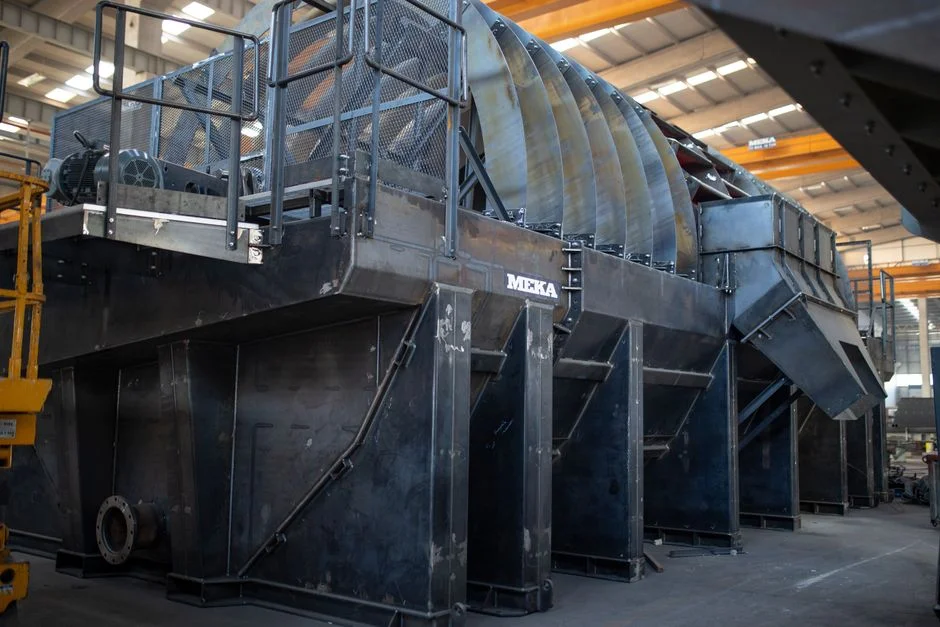
The choice between a DAF system for mining wastewater solids separation and a lamella clarifier for metal hydroxide sludge is the one decision that should be locked before the rest of the train is sized, because the rest of the train can be tuned to either effluent. DAF is the right pick when the floc is buoyant, when the influent carries oil or floating fines, or when air-to-solids ratio and polymer compatibility can be tuned to the stream. A lamella clarifier is the right pick when sludge volume and footprint are the binding constraint, when there is no oil loading, and when plate spacing and underflow solids are the design levers. The detailed side-by-side is in the DAF vs clarifier for mining wastewater 2026 selection guide.
Mining water treatment processes vary significantly between operations in required capacity and wastewater content, which is why suppliers develop customized systems matched to specific needs rather than quoting a published range (LiqTech, 2025-08). A small dimension-stone or sand-and-gravel site typically runs in the low-to-mid two-digit m³/h range, while a process plant with heap leach or milling sits an order of magnitude higher. The operator should size against the highest anticipated daily discharge, not the average, because peak flows are what drive equalization basin volume and pump selection.
| Decision factor | Pick DAF | Pick lamella clarifier |
|---|---|---|
| Floc density | Buoyant floc, fines that float | Heavy floc, settleable solids |
| Oil or floating fines | Present in influent | Not present |
| Footprint constraint | Not binding | Binding constraint |
| Sludge volume | Manageable | Driver of the design |
| Design lever to tune | Air-to-solids ratio, polymer | Plate spacing, underflow solids |
Sludge handling and the reuse economics that pay the compliance bill
Chemical precipitation produces metal-hydroxide sludge that has to be dewatered; a filter press for mining sludge dewatering is the standard fit for the cake volumes produced by precipitation-based mining trains. The downstream end of the train is where compliance turns into a savings line. Internal water reuse enabled by RO treatment can reduce freshwater consumption by 40–60% compared with once-through operations, which is the lever that monetizes the compliance investment (AMPAC USA, 2025-09). Where zero-liquid discharge is required, RO handles bulk water recovery (typically 70–85%) before more energy-intensive thermal stages handle the remaining concentrate, and the operator should request a recovery curve rather than a nameplate figure (AMPAC USA, 2025-09).
Even with reuse, any volume not recycled still has to meet local limits on metals, pH, and TSS — the sizing logic is "reuse as much as economics allow, then polish the rest to sewer quality." A polishing industrial RO system for mining wastewater at > 99% rejection of dissolved metals and salts is what carries the residual dissolved load below the local limit, and the same system delivers the freshwater intake reduction that turns a compliance line item into a payback story for procurement. The Clean Water Services Industrial Partners Pretreatment Recognition Program also highlights industrial customers that achieve 100% permit compliance within the last reporting year, which is a tangible ESG and community-relations signal for Washington County operators working in the Tualatin River Watershed (Clean Water Services).
Frequently Asked Questions
What is the procedural starting point — and when does the 90-day clock start?
The first step is to fill out the nondomestic waste discharge survey on cleanwaterservices.org. If Clean Water Services determines a permit is required, a completed Nondomestic Waste Discharge Application must be submitted at least 90 days before discharging wastewater; the operator will then be classified as a Significant or Nonsignificant Industrial User (Clean Water Services).
Does 40 CFR Part 436 actually set a numeric limit for the mineral we handle?
Not always. Several Pacific Northwest-relevant subparts are reserved, including Dimension Stone (Subpart A), Lightweight Aggregates (Subpart H), Lithium (Subpart U), Ball Clay (Subpart AH), Feldspar (Subpart AI), Talc/Steatite/Soapstone/Pyrophyllite (Subpart AJ), and Garnet (Subpart AK), so the operator must confirm whether the mineral is under an active subpart with numeric effluent limits or a reserved subpart with no current numeric limits before the local layer applies (EPA, 2026-02).
What does a supplier need to see before they can quote a train?
Suppliers develop customized systems because mining water treatment varies significantly in capacity and wastewater content (LiqTech, 2025-08). The buyer should be ready to provide peak and average flow in m³/h, a representative influent pH and metal profile, the local sewer authority discharge limits for metals, pH, and TSS, and the desired RO recovery percentage if reuse is in scope. Without that basis of design, no defensible quotation is possible.
What happens if a Hillsboro-area plant misses its local limits?
Clean Water Services monitors permit compliance regularly and is required to report significant noncompliance each year, including the facility name and the type of violation; enforcement escalates from a warning letter to an administrative penalty and a potential order to stop discharging under the Enforcement Response Plan for SIUs (Clean Water Services). Compliance reports are required for both Significant and Nonsignificant Industrial Users.
Related Equipment
- multi-media filter for RO pretreatment — specifications, capacity range, and technical data
- ultrafiltration system for RO pretreatment — specifications, capacity range, and technical data
- industrial RO system for mining wastewater — specifications, capacity range, and technical data
- automatic chemical dosing system for lime, coagulant, and flocculant — specifications, capacity range, and technical data