
Why an ETP in Oman Is a Reuse Decision, Not Just a Discharge Decision
Oman's national position, as documented in the peer-reviewed review "Antibiotics in wastewaters: a review with focus on Oman" (Applied Water Science, 2018), is that "wastewater treatment and reuse is pursued vigorously as a government policy." For an industrial buyer in 2026, that single statement reframes the entire procurement question: an ETP that meets the minimum discharge line is no longer the design target. The design target is reuse-grade water that can be routed to either managed aquifer recharge (MAR) or to crop irrigation, both of which the same Applied Water Science review identifies as the two reuse pathways that drive equipment selection in the Sultanate.
Why does this matter at the equipment level? Because treated water entering an aquifer or a food chain carries residual contaminants that a discharge-only permit would tolerate. The Applied Water Science review flags antibiotic residues and the resulting antimicrobial resistance risk as the specific concern for MAR, and the uptake of antibiotics by crops as the parallel concern for irrigation reuse. That raises the bar on the polishing and disinfection stages of any ETP feeding either pathway, and it forces a buyer to ask vendor proposals one extra question: what is the residual contaminant profile, not just the BOD/COD and TSS numbers?
This article is scoped to industrial ETPs serving oil and gas, food processing, chemicals, textiles, and electroplating sites sized for 2026 projects across Muscat, Sohar, Duqm, and Salalah. Municipal STP retrofits and domestic sewage packages are out of scope. The objective is to give a plant engineer, EHS manager, or EPC procurement lead a parameter-driven way to compare vendor proposals against Be'ah-aligned discharge and reuse requirements, and to avoid the trap of buying the cheapest flowsheet that legally discharges but cannot be repurposed when the site is asked to supply reuse water two years later.
The Unit-Process Train Used by Omani ETP Suppliers
The canonical industrial ETP sequence published by CLEAR-ION (clear-ion.org, ETP product page) runs equalization, chemical dosing, biological treatment, clarification, filtration, and disinfection. That sequence is the baseline against which any 2026 Omani vendor proposal should be audited. Each stage has a defined job, and a buyer who knows the job can immediately spot gaps in a quote.
Equalization buffers hydraulic and load shocks from batch processes, which is critical for Omani food and chemical plants that often discharge in production-linked windows. Chemical dosing — handled by an automatic chemical dosing system — handles pH correction, coagulant addition for suspended solids, and precipitant dosing for heavy metals. Biological treatment then oxidizes dissolved organics (BOD/COD). Clarification (often paired with a dissolved air flotation (DAF) system for oils and floatable solids) separates biomass and precipitated solids. Filtration polishes remaining suspended solids, and disinfection (chlorine dioxide or UV) handles pathogens before discharge or reuse.
The standard train is not sufficient for every sector in Oman. The Khimji environmental services overview (khimji.com, Environmental Services in Oman) explicitly names chemical, pharmaceutical, phosphating, and electroplating wastewaters as generating "dangerous chemicals" that require dedicated toxic-chemical removal stages before biological treatment. Skipping those dedicated stages is the most common compliance gap seen in EPC tenders for these sectors. Sizing context: CLEAR-ION states it supplies "circa 20 million liters per day of heavy duty, water treatment ETPs" across pharmaceuticals, chemicals, textiles, food processing, refining, and electroplating, which is useful as an order-of-magnitude reference for what a credible Omani industrial vendor has installed.
Choosing the Core Biological Step: Conventional Activated Sludge, MBR, or SBR
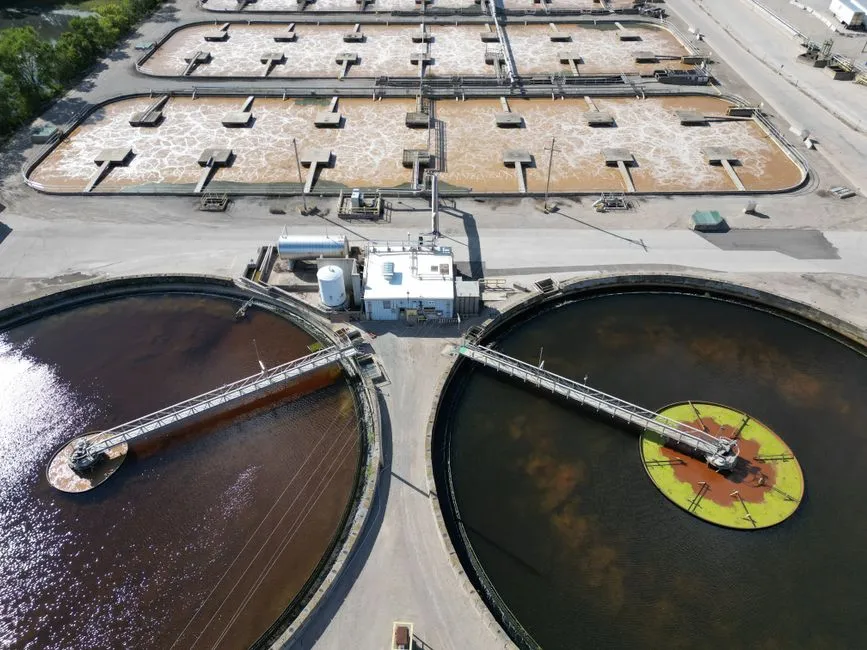
The single highest-impact decision in the train is the biological core, because it sets the effluent quality that everything downstream has to polish. Three options are realistic for 2026 Omani sites. Conventional activated sludge (CAS) is the lowest-CAPEX option with the largest footprint and the most operator-friendly process. Membrane bioreactor (MBR) — for example, an MBR membrane bioreactor system — has the smallest footprint and produces a near-reuse-quality effluent that pairs directly with downstream polishing. Sequencing batch reactor (SBR) handles batch and intermittent flows well, which is why it is common in Omani food processing where production is campaign-driven rather than continuous.
The MBR case is reinforced by the University of Twente PhD thesis "Direct nanofiltration of wastewater treatment plant effluent" (Schrader, University of Twente), which positions nanofiltration as a polishing step for MBR effluent when agricultural or indirect potable reuse is the target. For a 2026 Oman project, that means MBR is the right choice when MAR or crop irrigation is on the roadmap, even if the immediate permit is discharge-only. CAS remains defensible when the site has land, the operator team is strong on biological process control, and reuse is not on a five-year horizon.
The research supplied does not quantify energy per cubic meter, membrane replacement cadence, or operator-skill requirements for these three options. A buyer should request vendor-specific numbers against their actual influent characterization, not rely on generic brochures. For oil and gas and refinery sites, the influent profile — with high and variable oil and grease — typically forces a dissolved air flotation (DAF) system or a CPI separator upstream of the biological stage to protect biomass from shock loads. Building the biological step without that upstream protection is a frequent cause of poor compliance performance.
| Biological Option | Footprint | Effluent Quality | Best-Fit Omani Sectors | Key Trade-off to Quantify with Vendor |
|---|---|---|---|---|
| Conventional Activated Sludge (CAS) | Large | Secondary effluent; needs tertiary polish for reuse | Large chemical, refining, textile sites with land and skilled operators | Sludge handling cost; clarifier performance under hydraulic shock |
| Membrane Bioreactor (MBR) | Small | Near-reuse quality; pairs with NF/RO for MAR or irrigation | Space-constrained sites; projects with reuse roadmap | Energy per m³; membrane replacement cadence; cleaning chemistry |
| Sequencing Batch Reactor (SBR) | Moderate | Secondary effluent, batch-discharged | Food processing, batch chemical manufacturing | Cycle-time vs. flow; equalization tank sizing |
Tertiary Treatment and Disinfection: Getting to Reuse Quality
The final 10–20% of contaminant removal is the section most often under-scoped in EPC tenders, and it is the section that determines whether an ETP can deliver MAR or irrigation-grade water. The polish order, from least to most aggressive, is multi-media filtration, then ultrafiltration, then nanofiltration or reverse osmosis for indirect potable reuse. An ultrafiltration system is the typical workhorse between MBR and RO, and an industrial reverse osmosis system is the final barrier before reuse water is sent to an aquifer or to a crop.
Disinfection is a parallel decision. A chlorine dioxide generator provides broad-spectrum disinfection with fewer regulated by-products than chlorine, which matters when reuse water contacts crops. A UV sterilizer is effective against chlorine-resistant organisms such as Cryptosporidium and Giardia and leaves no chemical residual, which matters when reuse water feeds an aquifer. Many 2026 tenders in Oman specify both, with UV as the primary barrier and chlorine dioxide as the residual for the reuse distribution network.
Constructed wetlands have been studied as a polishing step for micropollutant removal from WWTP effluent — see Lei, "Removal of micropollutants from wastewater treatment plant effluent by constructed wetlands" (Wageningen University, 2022). The work is relevant to the antibiotic-residue concern flagged in the Applied Water Science 2018 review, but constructed wetlands remain a research-stage option rather than a default 2026 industrial selection in Oman. Buyers evaluating reuse should confirm that the proposed tertiary and disinfection train actually addresses the antibiotic-residue issue raised for MAR and crop irrigation, not only the standard BOD/COD/TSS envelope.
Compliance, Hazardous Waste, and the Be'ah-Aligned Paper Trail
Be'ah (Oman Environmental Services Holding Company) and Muscat Municipality are the reference regulators an industrial ETP proposal should be benchmarked against. The Khimji environmental services overview (khimji.com) cites its joint venture with Al Ahlia as operating "the first company in the Sultanate to establish and manage a hazardous waste storage facility near Liwa, under the patronage of Muscat Municipality/Be'ah." That Liwa facility is the practical benchmark for what counts as authorized handling of hazardous sludge and spent chemicals in Oman in 2026.
Industrial ETP projects in oil and gas, chemicals, and electroplating routinely produce hazardous sludge and spent chemicals that cannot be routed to a municipal sewer. Any shortlisted vendor must therefore demonstrate that the proposed flowsheet produces residuals that an authorized facility like the Liwa hazardous waste storage site will accept. CLEAR-ION states its ETPs are "designed to meet CPCB and international standards," which is a useful baseline expectation but is not a substitute for Omani-specific compliance review against the limits Be'ah applies to the buyer's sector.
The procurement filter that follows is short. Before signing an EPC contract, the buyer should require the vendor to deliver: an influent and effluent characterization report, a mass balance, a sludge handling plan naming the authorized receiving facility, and a discharge and reuse compliance matrix mapped line-by-line to the Be'ah-aligned limits for the relevant sector. Vendors who cannot produce these four documents in a 2026 tender should be downweighted regardless of price.
2026 CAPEX and OPEX Bands for an Industrial ETP in Oman
The supplied research does not publish Omani-specific ETP cost figures, so any number a buyer sees at the RFQ stage must be treated as a planning range to be confirmed against a site-specific influent audit. What the research does support is a sanity check on vendor scale: CLEAR-ION cites "circa 20 million liters per day of heavy duty" industrial ETP supply across its installed base, which gives a buyer a useful order-of-magnitude reference when comparing a vendor's claimed capacity against their actual Gulf footprint.
The cost drivers that swing 2026 pricing the most are influent COD and TDS, oil and grease load, the required reuse quality, hazardous sludge handling, and remote-site logistics for Duqm, Salalah, and inland Sohar locations. Buyers should request a single integrated EPC quote that covers civil, mechanical, electrical, instrumentation, commissioning, and a 12-month operations and maintenance envelope. Splitting those scopes across multiple contractors typically causes coordination cost overruns on Omani industrial projects because interface management falls back on the buyer's own engineering team.
On OPEX, the research does not give consumable or energy unit costs for Omani industrial sites, so the buyer should request vendor-specific numbers for membrane replacement cadence, chemical consumption per cubic meter, and power draw per cubic meter at the design load. For sludge dewatering, a plate and frame filter press is the typical mechanical dewatering step that reduces sludge volume before the authorized off-site route.
| Cost Driver | Why It Moves the 2026 Number | Information the Buyer Must Request from Vendor |
|---|---|---|
| Influent COD/TDS | Sets biological reactor volume and RO membrane area | Vendor-specific design basis against site audit |
| Oil and grease load | Forces DAF or CPI upstream; protects downstream biology | DAF sizing and underflow solids handling |
| Reuse quality target | Adds UF/NF/RO polishing and stricter disinfection | Polishing train justification against reuse end use |
| Hazardous sludge handling | Routes residuals through authorized facilities | Named receiving facility and acceptance criteria |
| Remote-site logistics | Duqm, Salalah, inland Sohar inflate transport and commissioning cost | Site-specific logistics premium in EPC quote |
Vendor Selection Checklist for a 2026 Omani ETP Project
Use this checklist in vendor meetings and score each item 0–2. A vendor scoring 12 or more out of 16 deserves serious consideration; a vendor scoring below 8 should not be shortlisted regardless of headline price.
- Track record: Oman or GCC references of similar influent type, sized within 0.5× to 2× the project flow, commissioned in the last five years.
- Compliance guarantee: Willingness to sign a performance guarantee against Be'ah-aligned discharge limits — and reuse limits where applicable — with defined liquidated-damages clauses.
- Sludge and consumables plan: Proposed flowsheet produces sludge that can be routed through authorized hazardous-waste channels, benchmarked against the Liwa facility model.
- Aftermarket and parts: Local or regional service coverage, membrane and chemical spare-parts lead times, and remote-monitoring capability — all standard 2026 procurement requirements. Membrane and chemical spares are typically sourced through a water treatment parts, valves, and media supply chain, and RO/UF membrane replacements through an RO and UF membrane and filter element channel.
For a deeper process-design cross-check, the effluent treatment plant design framework and the industrial ETP and DAF system guide give parameter-driven reference points from similar industrial sites. For a forward look on reuse-grade polishing, the micropollutant and reuse-quality treatment outlook covers the same regulatory direction that is driving Oman's 2026 reuse agenda.
| Checklist Item | Score 0 | Score 1 | Score 2 |
|---|---|---|---|
| Track record in Oman/GCC at similar flow and influent | No regional references | One reference, different sector | Multiple references, same sector, last 5 years |
| Signed performance guarantee with LD clauses | Refuses to guarantee | Will guarantee, vague LDs | Will guarantee, defined LDs mapped to Be'ah limits |
| Authorized sludge handling plan | No plan | Generic plan, no named facility | Named authorized receiving facility, acceptance criteria included |
| Aftermarket coverage and parts lead time | No local presence | Regional presence, long parts lead time | Local service, documented parts lead time, remote monitoring |
Frequently Asked Questions
What CAPEX should a 2026 industrial ETP buyer in Oman budget for?
The supplied research does not publish Omani ETP cost figures, so a buyer cannot fix a price band from secondary sources. Request a single integrated EPC quote (civil, mechanical, electrical, instrumentation, commissioning, and 12-month O&M) against your site-specific influent audit and reuse target. Vendor scale can be sanity-checked against CLEAR-ION's stated "circa 20 million liters per day" of installed industrial ETP capacity (clear-ion.org).
How do I shortlist ETP suppliers for an Oman 2026 project?
Score each vendor on the four-item checklist: regional track record at similar flow, willingness to sign a Be'ah-aligned performance guarantee with defined liquidated damages, a sludge handling plan naming an authorized receiving facility, and aftermarket coverage with documented parts lead times. The Khimji overview of the Liwa hazardous waste storage facility (khimji.com) is the benchmark for what counts as authorized handling.
When should an Omani industrial ETP include MBR instead of conventional activated sludge?
Choose MBR when the site is space-constrained, when reuse for MAR or crop irrigation is on a five-year roadmap, or when downstream nanofiltration or RO is planned. The University of Twente PhD thesis on direct nanofiltration of WWTP effluent positions MBR effluent as the appropriate feed for agricultural or indirect potable reuse polishing.
What tertiary and disinfection steps are needed for reuse-grade water in Oman?
For MAR or crop irrigation, a 2026 train typically runs MBR or CAS plus an ultrafiltration system, followed by an industrial reverse osmosis system for indirect potable reuse, with a UV sterilizer as the primary disinfection barrier and a chlorine dioxide generator for residual in the reuse distribution network. Confirm that the train addresses the antibiotic-residue concern flagged in the Applied Water Science 2018 review, not only the standard BOD/COD/TSS envelope.
Related Equipment
- industrial reverse osmosis system — specifications, capacity range, and technical data