Why Winery Wastewater Demands a Filter Press
Winery wastewater is not a generic industrial stream. According to a 2015 Stellenbosch University dissertation (Conradie, 2015) on the chemical characteristics of winery wastewater, the stream is high in COD, low in pH, and tied directly to winemaking practices such as harvest pressings, lees handling, bottling washwater, and CIP effluent. The same dissertation links the pollutant load to seasonal operations rather than a steady year-round discharge. A 6–10 week harvest peak concentrates flow and solids at exactly the moment a lagoon or drying bed has the least buffer volume.
Recessed-plate filter presses are suited to this profile. The US EPA fact sheet on recessed-plate filter presses (EPA 832-F-00-058, September 2000) describes them as equipment that "can produce the highest cake solids concentration of any mechanical dewatering equipment" and notes they "are more commonly used in industrial applications than in municipal wastewater facilities." For a winery generating low-volume, high-strength sludge that must be moved offsite quickly at vintage, high dryness and industrial-scale throughput provide a solution a lagoon cannot match. The mechanical cake can be stacked, composted, or sent for land application, sidestepping the long retention times that turn seasonal peaks into a permitting problem.
Filter Press Working Principle for Wineries
A plate and frame filter press for winery sludge dewatering is built around a stack of recessed polypropylene plates held together by an electro-hydraulic closure. According to Sigmadaf's hardware description, plate sizes range from 80×80 cm to 250×250 cm, with chamber counts typically between 12 and 50. Standard operating pressure is about 6 bar, while high-pressure machines reach up to 16 bar to push cake dryness higher. Filter cloths (polypropylene, polyester, or polyamide) line each plate; the recessed faces form chambers that act as a mold for the cake.
The cycle is straightforward. A pneumatic feed pump—pneumatic to handle the high solids load—pushes conditioned sludge into the chambers through a central manifold. Sigmadaf gives a typical fill time of about 5–6 minutes, after which the pump ramps pressure and the cloths plus accumulating cake drive the filtrate out the opposite side. The endpoint is detected by a pressure switch when the pump asymptotically stalls. The pack is then decompressed, plates are separated, and cakes fall by gravity into a container below; small presses are discharged manually, larger units use automatic plate-shifters with vibration or air-knife assist.
Reagent consumption is bounded. Sigmadaf states that flocculant consumption does not usually exceed 4 kg per tonne of dry matter, and lime slurry can reach 15% of sludge DM when higher dryness or stabilization is needed—at the cost of producing more solids to dispose of. Filter media is an engineering variable. A plate-frame study published by Indonesia's National Research and Innovation Agency (BRIN) compared cotton cloth and drill cloth on a simulated CaCO3 sludge at 1–4% w/w feed and reported a 56.00% solids-removal efficiency on cotton cloth at 4% w/w feed, beating drill cloth. Cloth selection is a documented lever on cake solids and filtrate quality.
Feed-Sludge Targets and Polymer Conditioning

A recessed-plate press has a specific feed-solids requirement. Sigmadaf specifies that sludge entering the press should be at 3%–5% DM; below that range, cycle time is wasted and the cake comes out wetter than design. Anything above 5% DM shortens fill time and improves cake dryness but places more demand on the upstream thickener or DAF. The chemistry side is split: a polymer flocculant dosed at up to 4 kg/t DM (Sigmadaf) is sufficient for most winery lees and press solids, while lime at up to 15% of DM is reserved for cases where the buyer wants higher cake dryness or pathogen stabilization, accepting the disposal-cost penalty of more total solids.
The dose is not a generic number. Wineries vary stream chemistry by varietal, harvest week, lees handling, and the CIP schedule, so a jar test or a small benchpress on a representative sample is the only reliable way to set flocculant type, dose, and mixing energy. Buyers should request the lab data and the conditioning recipe from the press supplier. The table below summarizes the conditioning envelope from Sigmadaf.
| Parameter | Value or Range | Source |
|---|---|---|
| Minimum feed DM to press | 3%–5% | Sigmadaf |
| Flocculant consumption | ≤ 4 kg per tonne of DM | Sigmadaf |
| Lime conditioning | Up to 15% of sludge DM (raises dryness, increases solids to dispose) | Sigmadaf |
| Co-conditioning options | Fe(OH)3 or PAC coagulants may be added upstream of flocculant in some cases | Sigmadaf |
| Polymer dose to confirm by test | Jar test or benchpress on representative winery sample | Process engineering practice; requested input |
An automatic polymer dosing system for filter press conditioning sized to the jar-test dose maintains repeatability across a harvest that runs 18 hours a day for six weeks.
Thickener vs DAF Upstream of the Press
The single biggest capex decision around a winery press is what sits in front of it. Sigmadaf is explicit: a conventional sedimentation clarifier underflow runs 0.6–1.5% DM, which is too thin to feed a press directly. The classical fix is an intermediate thickener—a large tank with mechanical scrapers and transfer pumps—that raises the feed to 3%–4% DM. The capital cost is significant because the thickener is essentially another civil structure.
DAF is the alternative. Sigmadaf states that a DAF unit delivers 4%–5% DM sludge directly, which means the intermediate thickening step is "dispensable" and the DAF underflow can be pumped straight to the press. The trade-off is that DAF needs saturation, pressurization, and depressurization equipment, so the economic delta between a thickener train and a DAF train is often smaller than the capex line items suggest. For a winery, the deciding factor is usually seasonality: a thickener's long hydraulic retention is poorly matched to a 6–10 week vintage peak, while a DAF's short retention tracks the harvest load curve more cleanly. The comparison is summarized below.
| Criterion | Sedimentation + Thickener Train | DAF Train |
|---|---|---|
| Underflow DM to press | 3%–4% (after thickener) | 4%–5% (direct from DAF) |
| Intermediate thickener required | Yes | No — "dispensable" per Sigmadaf |
| Footprint and civil works | Large tank, scrapers, transfer pumps | Compact skid; saturation vessel, press/depressurization loop |
| Hydraulic retention | Long — poor match to harvest peaks | Short — better match to seasonal load |
| Capex vs opex balance | Higher civil capex; lower reagent/energy | Lower civil capex; pressurization equipment adds opex |
Two product references frame the procurement decision: a DAF system for winery wastewater pretreatment sized to peak harvest flow, and a high-efficiency sedimentation tank option for sites that already operate a clarifier and only need polishing upstream of a thickener. The full DAF sizing logic for a winery is covered in the DAF system for winery wastewater sizing guide.
Sizing the Press: A Worked Example for a Mid-Sized Winery
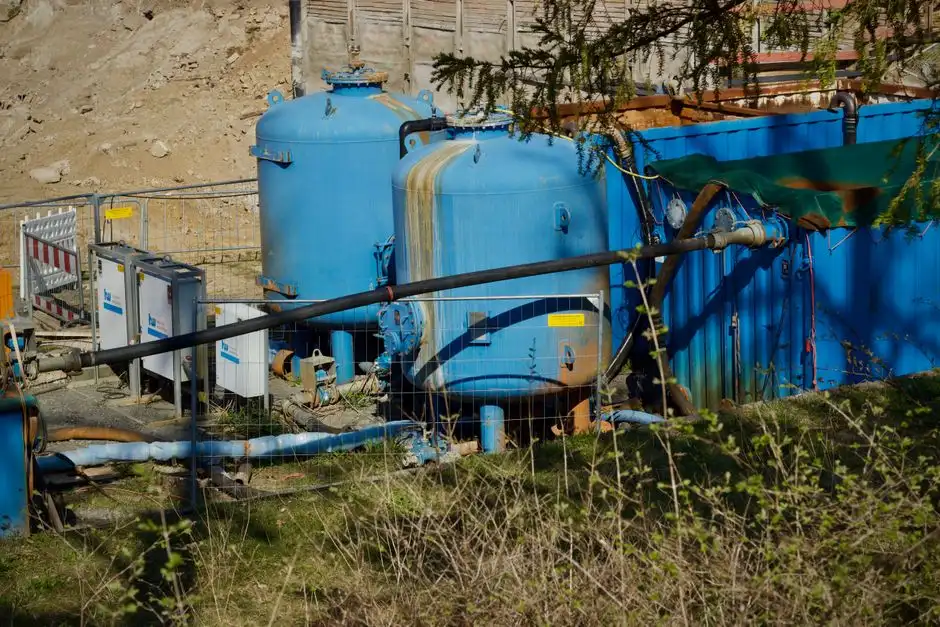
Sigmadaf's published example provides a calculation that scales to a winery. Take 785.7 L/day of sludge at a target 30% cake dryness, an 8 h/day operating window, and a 4 h cycle time (fill, press, open, discharge). Two cycles per day are required; each cycle must produce 392.85 L of cake. Dividing by a per-chamber volume of 19.7 L gives 19.9, i.e., 20 chambers. Because the number of plates equals chambers + 1, that is 21 plates. With a 1.53 m² plate area, the total filter area is 30.3 m².
The reader should treat this as a template, not a finished spec. A winery engineer must substitute their own peak harvest flow in m³/day, target cake dryness, available operating hours, and cycle time, then re-run the same chamber-count formula (daily cake volume ÷ cycles per day ÷ per-chamber volume). Plate area scales with chamber count and plate size—from 80×80 cm at the low end to 250×250 cm at the high end (Sigmadaf)—so a small estate can drop to fewer, smaller plates while a large cooperative sits at the upper end of the 12–50 chamber range. For reference, the equipment envelope is the plate and frame filter press for winery sludge line, with filtration areas from 1 m² to 500 m² and manual, hydraulic, or PLC-controlled operation. Operators familiar with screw presses will recognize the contrast in dryness; the comparison is laid out in the screw press common problems and solutions field guide.
2026 Procurement Checklist for a Winery Filter Press
A short, defensible checklist keeps a quote evaluation honest. First, confirm that the supplier's published cake-solids data is on a winery or comparable food-and-beverage sludge, not a generic municipal number—the EPA fact sheet (EPA 832-F-00-058, September 2000) is the right benchmark for "highest cake solids" but it does not by itself prove winery performance. Second, lock the mechanical spec: polypropylene plates, 6 bar standard or up to 16 bar high-pressure rating, plate size and chamber count inside the 12–50 / 80×80–250×250 cm envelope, manual, hydraulic, or PLC operation, and cloth material (cotton or polypropylene per the BRIN comparison logic).
Third, request references from comparable food-and-beverage or winery installations, plus documentation on polymer conditioning, lime dosing where used, and the cake disposal pathway (compost, land application, or authorized landfill). Finally, carry the DAF-vs-thickener decision into procurement so the press vendor and the upstream unit vendor are aligned on the 3%–5% DM feed-solids target. A quote that is silent on feed-solids assumptions is a quote that will be revisited at commissioning.
Frequently Asked Questions
What cake dryness should a winery expect from a recessed-plate press?
Per the EPA fact sheet (EPA 832-F-00-058, September 2000), recessed-plate filter presses produce the highest cake solids of any mechanical dewatering equipment, and Sigmadaf's worked example targets 30% dryness in its calculation. The exact value on a winery sludge is sludge-specific and must be confirmed by bench test; buyers should request a laboratory cake-solids curve at the proposed feed DM and polymer dose before signing.
How do I choose between a thickener and a DAF in front of the press?
Sigmadaf recommends DAF when the upstream clarifier cannot deliver 3%–5% DM, because DAF underflow already sits at 4%–5% DM and the intermediate thickener becomes "dispensable." For a winery, the deciding factor is usually the harvest-peak load curve: DAF's short hydraulic retention matches a 6–10 week vintage, while a thickener's long retention is a liability. Request a feed-solids guarantee in writing from whichever pretreatment vendor is shortlisted.
What does a winery filter press cost in 2026?
The research does not include a price figure, and quoting a typical range here would be speculation. A buyer should request a budgetary quote tied to the four sizing inputs: peak harvest sludge flow (m³/day), target cake dryness (%), available operating hours per day, and chosen pretreatment train (DAF or thickener). Plate area, chamber count, pressure rating, and PLC scope are the main cost drivers and should each appear as separate line items.