The 2026 Compliance Picture for Chemical Plants Tied to a POTW
Every chemical plant that discharges process wastewater to a municipal sewer in the United States is regulated by the EPA's National Pretreatment Program at 40 CFR Part 403, whether or not the receiving POTW has an approved pretreatment program and whether or not the plant holds a control mechanism or permit (EPA, "Pretreatment Standards and Requirements — General and Specific Prohibitions").
The rule stack runs in four layers, applied from the most general to the most specific: (1) general prohibitions at 40 CFR 403.5(a) against pass-through and interference; (2) the eight specific prohibitions at 40 CFR 403.5(b); (3) categorical standards in 40 CFR chapter I, subchapter N, including 40 CFR Part 414 for organic and inorganic chemicals; and (4) local POTW limits and the local sewer-use ordinance, which may be stricter than any federal floor. The control authority must apply the most stringent applicable requirement where multiple provisions cover the same pollutant (EPA, "Pretreatment Standards and Requirements — Applicability"). Van Wyck, SC's residential drinking water is served by Catawba River Wsp (PWSID 2920002, population served 25, report year 2026) per the EPA SDWIS/ UCMR5 dataset, but that public water system is not the industrial receiving POTW; the actual receiving POTW and its sewer-use ordinance must be identified and requested directly by the discharger. For a baseline reading of the broader rule stack, see the industrial effluent discharge guidelines for 2026.
What Pass-Through and Interference Actually Mean for a Chemical Plant
Pass-through is defined at 40 CFR 403.3(p) as a discharge that exits the POTW into waters of the United States in quantities or concentrations that, alone or in conjunction with discharges from other sources, is a cause of a violation of any requirement of the POTW's NPDES permit — including an increase in the magnitude or duration of a violation (EPA, "Pretreatment Standards and Requirements — General and Specific Prohibitions"). Interference, at 40 CFR 403.3(k), is a discharge that both (1) inhibits or disrupts the POTW, its treatment processes or operations, or its sludge processes, use, or disposal, and (2) therefore is a cause of a violation of the POTW's NPDES permit or of the prevention of sewage sludge use or disposal in compliance with CWA §405, RCRA, the Clean Air Act, TSCA, or the Marine Protection, Research and Sanctuaries Act (EPA, same source). For a chemical plant, the operational translation is direct: an acidic batch dump below pH 5.0 can both pass through the secondary treatment system and kill nitrification biomass in the aeration basin, so a single slug can draw citations under both definitions. The legal standard is "a cause," not "the sole cause"; a facility can be in violation even when its discharge is one of several contributors to a POTW excursion. A clear-looking effluent that contains a solvent fraction above the flashpoint floor, or a high-temperature stream that pushes the mixed temperature at the headworks above 40 °C (104 °F), will fail the same test because the harm occurs at the receiving plant, not at the industrial user's sewer tap.
The Eight Specific Prohibitions — and the Equipment That Defeats Each One
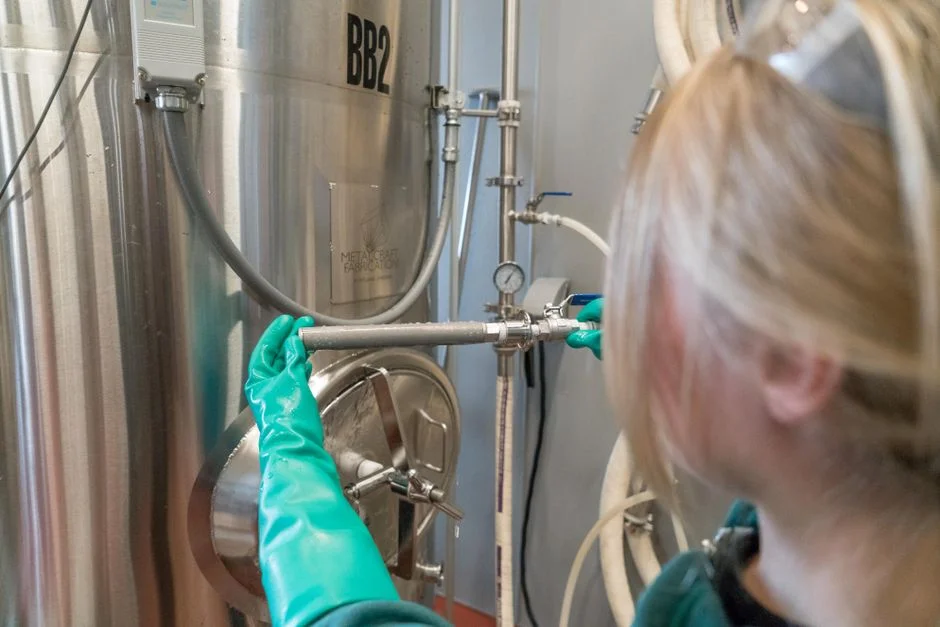
The specific prohibitions at 40 CFR 403.5(b) enumerate eight categories of discharge that may not be sent to a POTW, and each maps to a unit operation a chemical plant must deploy upstream of its sewer connection (EPA, "Pretreatment Standards and Requirements — General and Specific Prohibitions").
- Fire/explosion hazard — closed-cup flashpoint below 140 °F (60 °C) using the test methods in 40 CFR 261.21. Flammable streams cannot be sewered regardless of downstream treatment; the response is solvent segregation, fire/explosion-rated equalization, or off-site recovery.
- Corrosive pH — no discharge with pH lower than 5.0 unless the works is specifically designed to accommodate it. The response is on-site automatic chemical dosing for pH and coagulant control with inline monitoring before the sewer tap.
- Solid or viscous pollutants in amounts that will obstruct flow. The response is fine screening and grit removal at headworks, typically a rotary mechanical bar screen for headworks protection.
- Oxygen-demanding pollutants (BOD and COD are the standard indices for organic impurities, per the industrial pretreatment overview) released at a flow rate or concentration that causes interference. The response is biological treatment, equalization, or BOD/COD reduction ahead of discharge.
- Heat in amounts that inhibit biological activity, but in no case quantities that push the temperature at the POTW treatment plant above 40 °C (104 °F) unless the approval authority grants an alternate limit. The response is cooling towers, quench, or chilled equalization.
- Petroleum oil, nonbiodegradable cutting oil, or mineral-oil-origin products. The response is oil/water separation, with a DAF system for chemical plant pretreatment as the typical workhorse for FOG and emulsified oil.
- Toxic gases, vapors, or fumes that may cause acute worker health and safety problems. The response is covered equalization with vapor-phase treatment (activated carbon, scrubber) and OSHA-compliant ventilation.
- Trucked or hauled pollutants, except at discharge points designated by the POTW. Any off-site transfer must go to a permitted receiving point, not the nearest sewer manhole.
| Prohibition (40 CFR 403.5(b)) | Trigger | Defeating Unit Operation |
|---|---|---|
| (1) Fire/explosion | Closed-cup flashpoint < 140 °F (60 °C) | Solvent segregation; explosion-rated EQ; off-site recovery |
| (2) Corrosive pH | pH < 5.0 unless works designed for it | pH adjustment with automatic dosing; inline monitoring |
| (3) Solids/viscous | Flow obstruction | Bar screen; grit removal; rotary mechanical bar screen for headworks protection |
| (4) Oxygen demand | BOD/COD causing interference | Equalization; biological or chemical reduction |
| (5) Heat | > 40 °C (104 °F) at POTW headworks | Cooling tower; quench; chilled EQ |
| (6) Petroleum/mineral oil | Interference or pass-through | O/W separation; DAF system for chemical plant pretreatment |
| (7) Toxic gases/vapors | Acute worker safety risk | Covered EQ; carbon/scrubber; OSHA ventilation |
| (8) Hauled pollutants | Discharge outside POTW-designated points | Use only POTW-designated receiving points |
Categorical Standards Under 40 CFR Part 414 and How They Stack With Local Limits
Chemical manufacturers fall under the categorical standards in 40 CFR chapter I, subchapter N, with the organic and inorganic chemicals category codified at 40 CFR Part 414 (EPA, "Pretreatment Standards and Requirements — Applicability"). Categorical pretreatment standards, general and specific prohibitions, and local limits are the three pretreatment standards the control authority may apply, and they can be expressed as numeric limits, narrative prohibitions, or best management practices (BMPs) (EPA, same source). Where a chemical plant's discharge is subject to both a federal categorical limit and a local POTW limit, the control authority must apply the most stringent of the requirements that apply (EPA, same source). All three types of standards can be enforced by EPA, the state, and local government, even though they are developed at different levels (EPA, same source). The local Van Wyck-area receiving POTW's specific local-limit evaluation, allocation report, and sewer-use ordinance are not published in the supplied research; the discharger must request these documents directly from the control authority and treat the numeric local limits as the binding ceiling in any design.
Are You an SIU? The 25,000 gpd and 5% Capacity Triggers Explained
An industrial user becomes a Significant Industrial User (SIU) when any of three conditions are met, per 40 CFR 403.3(v) as cited in EPA's applicability guidance: (1) the IU is subject to categorical pretreatment standards under 40 CFR 403.6 and 40 CFR chapter I, subchapter N, except those designated as NSCIUs; (2) the IU discharges an average of 25,000 gallons per day or more of process wastewater to the POTW, excluding sanitary, noncontact cooling, and boiler blowdown wastewater; or (3) the IU's process wastestream makes up 5 percent or more of the average dry-weather hydraulic or organic capacity of the POTW treatment plant (EPA, "Pretreatment Standards and Requirements — Applicability"). The POTW may also designate a facility as an SIU on the basis of reasonable potential to adversely affect the POTW's operation or to violate any pretreatment standard or requirement, per 40 CFR 403.8(f)(6) as cited in the same EPA guidance. SIU status drives baseline monitoring, self-monitoring reports (SMRs), slug-control plans, and the requirement for an individual control mechanism (permit). Most chemical plants will trip at least one of these triggers and should plan for an SIU permit from day one.
| SIU Trigger (40 CFR 403.3(v)) | Threshold | What It Triggers |
|---|---|---|
| Categorical standard | Subject to 40 CFR Part 414 (or other subchapter N category) | Baseline monitoring; SMRs; slug-control plan; individual control mechanism |
| Process flow | ≥ 25,000 gpd average of process wastewater (excl. sanitary, noncontact cooling, boiler blowdown) | Same as above |
| Capacity share | Process wastestream ≥ 5% of POTW's average dry-weather hydraulic or organic capacity | Same as above |
| Discretionary designation | POTW finds reasonable potential for adverse effect or violation | Same as above |
Building a Pretreatment Train: Unit Operations in Sequence
The eight prohibitions and the typical contaminants of a batch chemical plant — solvents, acids and bases, FOG, suspended and emulsified solids, heavy metals, and reactive intermediates — collapse into a defensible unit-operation sequence when laid out in order. A typical train is equalization, then pH adjustment, then chemical oxidation or reduction (Fenton, NaOCl, NaHSO₃), then coagulation and flocculation, then DAF or lamella clarification, then multimedia filtration, then carbon or specialty polishing, and finally pH verification with continuous monitoring ahead of the sewer tap. Equalization dampens slug discharges that would otherwise cause pass-through or thermal interference, addressing prohibitions 3, 4, 5, and 6 by smoothing concentration and load (EPA, "Pretreatment Standards and Requirements — General and Specific Prohibitions"). Coagulation and flocculation, fed by an automatic chemical dosing for pH and coagulant control, target colloidal and emulsified contaminants that would slip past simple gravity settling. DAF handles FOG, oil, and suspended solids as the workhorse for prohibition 6 and the heavy-solids side of prohibition 3, followed by a lamella clarifier for chemical wastewater pretreatment where footprint matters or where the solids load is more mineral than oily. Final pH verification with continuous monitoring ahead of the sewer tap is non-negotiable, given the 5.0 floor in 40 CFR 403.5(b)(2) and the local POTW's typical upper bound. A useful companion to this section is the DAF vs clarifier decision for chemicals wastewater walkthrough, and the parallel case study at chemical plant pretreatment compliance near Mulberry.
Frequently Asked Questions
What capital cost range should a chemical plant budget for an in-house pretreatment train versus hauled discharge?
The supplied research does not include capital cost figures for either an in-house train or a hauled-discharge program, so any number given here would be invented. The defensible buyer action is to request itemized quotes from at least three pretreatment system integrators covering equalization, pH adjustment, DAF, and polishing for the specific flow and contaminant envelope, and to request a parallel cost-per-gallon proposal from the local POTW and at least two licensed liquid-waste haulers for the hauled-discharge option; the decision then rests on the net present value of the in-house system over its service life versus the operating-cost stream of hauling.
How do I size the train and pick suppliers so I can meet the SIU permit on the first sampling event?
Size the train against the most stringent applicable limit, not the federal floor, because the control authority applies the most stringent of federal, state, and local where multiple provisions exist (EPA, "Pretreatment Standards and Requirements — Applicability"). The first sampling event is governed by the local POTW's permit, so a buyer must request the local sewer-use ordinance, the local-limit evaluation, and the categorical standard under 40 CFR Part 414 from the control authority, and then specify those numeric limits to prospective suppliers as the design basis; suppliers should also be asked for documented startup data on similar chemical-plant matrices rather than generic cut sheets.
Which prohibition drives the most common SIU permit violations for chemical plants?
The eight specific prohibitions are not ranked by frequency in the supplied research, so a specific ranking cannot be cited. The defensible framing is that pH excursions below 5.0 (prohibition 2), petroleum oil and cutting oil (prohibition 6), and oxygen-demanding slugs (prohibition 4) are the prohibitions that map directly to the most common batch-chemical-plant unit operations — acid neutralization, oil-bearing cleaning steps, and solvent-bearing batch dumps — and should be treated as the highest-priority design risks when auditing an existing train.
What is the lead time for a chemical-plant pretreatment system in 2026?
The supplied research does not include lead-time data for pretreatment equipment, and a number cannot be supplied without inventing it. The defensible buyer action is to request written lead times for the long-lead items — typically equalization tanks, fabricated DAF units, and instrumentation skids — from each shortlisted vendor in the same RFQ, and to add the local POTW's pretreatment-permit review and approval time, which the buyer must request from the control authority, to arrive at a defensible total project schedule.