Why Most UPW Specifications Are Not Defensible
A specification that names "SEMI F63" or "ASTM D5127 Type E-1" is a label, not a contract. It tells the vendor which target to hit, but it does not bind the source water analysis, the per-stage performance envelope, the on-line instrument list, or the verification matrix. When that document lands at Factory Acceptance Test, the buyer's engineer has nothing to point at when the on-line resistivity drifts, when the TOC excursions at Site Acceptance Test, or when an auditor asks how the loop material was qualified.
Wikipedia (en.wikipedia.org/wiki/Ultrapure_water) confirms that absolutely pure water has a conductivity of 0.05501 μS/cm and a resistivity of 18.18 MΩ·cm at 25 °C, and that just 0.1 ppb of sodium chloride decreases resistivity to 18.11 MΩ·cm (0.05523 μS/cm) — a number sensitive enough that it must be measured on-line at the point of use, not pulled from a daily grab sheet. Carbon dioxide ingress through fittings or thin-wall polymer tubing forms carbonic acid that depresses resistivity, so the data pack has to lock down the distribution loop material, velocity, and dead-leg limits, otherwise the point-of-use number cannot be defended at the boundary. For pharmaceutical duty, the document also has to bind the governing pharmacopoeia monograph — USP, Ph. Eur., or JP — and the WFI test schedule, because compendial compliance is a regulatory artefact that sits on top of the engineering spec, not a replacement for it.
The Five Layers of a Defensible Minimum Data Pack
A defensible UPW procurement document is a five-layer minimum data pack, and every parameter in it has to be traceable from feed water to a named verification method. Layer 1 is the feed water analysis — TDS, SDI, hardness, alkalinity, silica, free chlorine, and microbial load — that the vendor must see before quoting. Layer 2 is the unit-operation performance target at each stage of the train: pretreatment, primary treatment (RO, EDI, or mixed bed), polishing, and the distribution loop. Layer 3 is the point-of-use product water parameter set, tied to the chosen standard rather than to a generic number pulled from a catalogue. Layer 4 is the standard reconciliation: SEMI F63 for semiconductor work with its 22 elements and 7 major anions per F63-0213 and on-line TOC; ASTM D5127 Type E-1 through E-4 for North American electronics procurement; and USP, Ph. Eur., and JP for pharmaceutical Water for Injection. Layer 5 is the verification matrix — which parameters are proven on-line continuously, which are proven by grab-sample laboratory analysis, and which are proven by a third-party witness at FAT and SAT. The buyer who hands a vendor all five layers owns the technical argument; the buyer who hands over only Layer 3 owns only a target number.
Layer 1 — Feed Water Analysis: What the Vendor Must See First
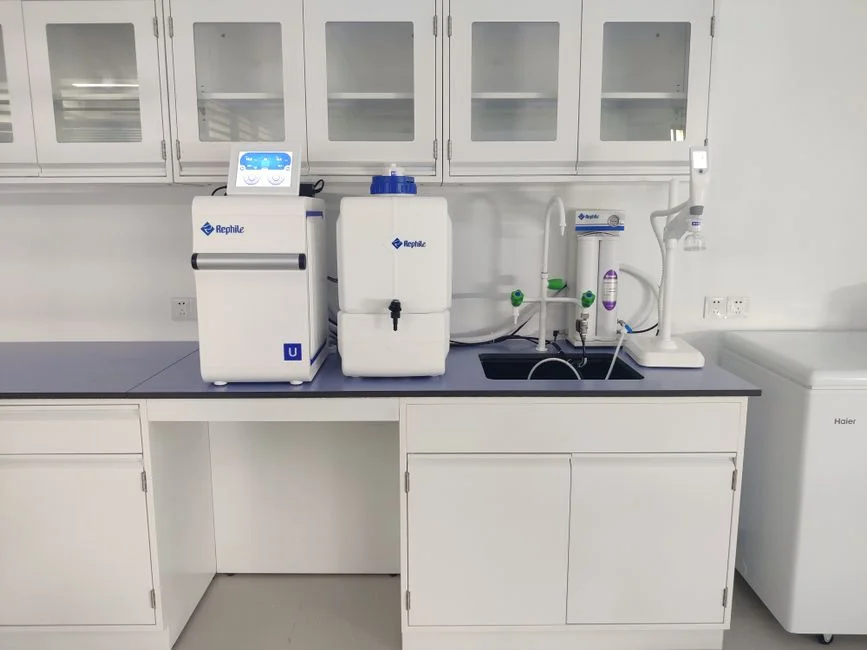
The feed water analysis is the foundation of the spec, and the same minimum analyte set that szhjwater's process-path design tool requests (TDS, SDI, hardness, alkalinity, silica, free chlorine, microbial load) is what every vendor should receive. Decision rules flow directly from that data: SDI above 5 mandates ultrafiltration ahead of the RO; hardness above 60 mg/L as CaCO₃ triggers softening; free chlorine above 0.1 mg/L requires activated carbon to protect the RO membrane. If reclaimed municipal or industrial wastewater is in scope, the data pack has to add urea and low-molecular-weight TOC, because conventional RO and ion exchange do not reject these reliably and sub-7 nm TOC targets then force UV-AOP or sulfate-radical advanced oxidation (en.wikipedia.org/wiki/Ultrapure_water). The sampling protocol — sample point, time, and method — has to be documented in the data pack as well, because source water seasonality is a known variability that the spec has to address at SAT rather than after.
| Feed water analyte | Trigger value | Required pretreatment response |
|---|---|---|
| SDI (15 min) | > 5 | Add ultrafiltration ahead of RO |
| Hardness (as CaCO₃) | > 60 mg/L | Softening (lime or ion exchange) before primary |
| Free chlorine | > 0.1 mg/L | Activated carbon to protect RO membrane |
| Silica | Site-specific, drives EDI feed limit | Lime softening in pretreatment (semiconductor) |
| Urea / low-MW TOC (reclaimed feed) | Detectable | Add UV-AOP or sulfate-radical AOP |
| Microbial load | Site-specific | UV steriliser and/or sub-micron pre-filter |
The pretreatment line on the train starts with a multi-media pretreatment filter sized to the feed SDI, and source-water intake protection typically pairs with a mechanical bar screen so debris does not enter the pretreatment chain.
Layer 2 — Unit-Operation Performance Targets Across the Train
Each unit operation in the train has to carry its own target envelope so the vendor cannot substitute an undersized component and still meet the point-of-use number. Pretreatment — multi-media plus activated carbon — must meet the RO feed limits and reliably drop turbidity downstream. The primary RO stage, normally a two-pass configuration for semiconductor-grade UPW, runs at a single-pass recovery of 70–75% as the practical maximum and 65–70% overall in two-pass service (szhjwater.com/technical-center); recovery is a design choice set against feed water chemistry, not chased after commissioning. Ion removal is split between an EDI polishing stack for continuous, chemical-free deionisation and a mixed-bed polisher for the final ppb-level trim, with the EDI feed spec written explicitly because EDI performance is bounded by feed CO₂ and silica (en.wikipedia.org/wiki/Ultrapure_water). The polishing UV stage — a 185 nm UV polishing unit — oxidises residual organics to CO₂, but lamp ageing is the silent killer of TOC performance, so the spec must require a lamp-ageing alarm and a 12–18 month replacement cycle. The distribution loop recirculates continuously to prevent stagnation, with POU filtration at ≤200 nm for semiconductor, 0.1 μm for wafer cleaning, 0.2 μm typical for display, and 0.2–0.45 μm for lithium battery and PCB use points (en.wikipedia.org/wiki/Ultrapure_water). Consumable envelopes belong in the data pack as well: RO membrane and filter consumables at 3–5 year service, EDI modules at 5–7 years, mixed-bed resin replaced on exhaustion. The primary industrial RO system is sized to the production target and feed water analysis together, not to a stand-alone POU spec.
| Stage | Performance target | Consumable life cycle |
|---|---|---|
| Pretreatment (MMF + AC) | RO feed SDI < 5, free Cl₂ < 0.1 mg/L | Sand / carbon media exhaustion-driven |
| Primary RO (single-pass) | 70–75% recovery (practical max) | RO membrane 3–5 yr |
| Primary RO (two-pass) | 65–70% overall recovery | RO membrane 3–5 yr per pass |
| EDI polishing | Resistivity to 15–18 MΩ·cm range, feed CO₂ and silica bounded | EDI module 5–7 yr |
| Mixed-bed polisher | Final ppb-level trim to 18.2 MΩ·cm | Resin exhaustion-driven |
| 185 nm UV polishing | TOC reduction to on-line < 10 ppb | UV lamp 12–18 mo |
| POU filter (semiconductor) | ≤200 nm pore size | Replacement per pressure drop |
Layer 3 — Point-of-Use Product Water Parameters
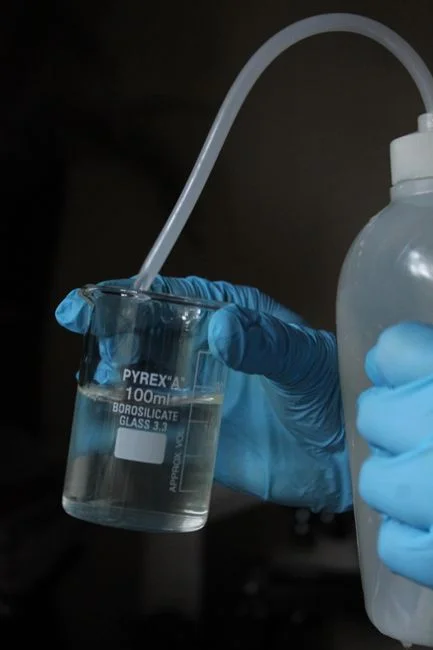
The POU parameter set is the layer an auditor will pull first, so every number in it has to be tied to a standard. Resistivity targets the theoretical 18.18 MΩ·cm at 25 °C (en.wikipedia.org/wiki/Ultrapure_water), and 0.1 ppb NaCl already drops it to 18.11 MΩ·cm, which is why on-line resistivity is the primary continuous ion sentinel. TOC is on-line < 10 ppb for advanced semiconductor UPW (en.wikipedia.org/wiki/Ultrapure_water); grab-sample laboratory methods are used to confirm and to cover analytes that lack a reliable on-line sensor. Dissolved oxygen is held at < 10 μg/L at POU for advanced microelectronics to prevent oxidation of wafer films (en.wikipedia.org/wiki/Ultrapure_water); sub-ppb DO control is also standard in power plant water/steam chemistry. Particles are filtered to one-half of the smallest chip feature (a 40 nm feature implies removal of all particles > 20 nm / 0.02 μm), with POU filters in semiconductor service typically ≤200 nm pore size (en.wikipedia.org/wiki/Ultrapure_water). Silica is held at sub-ppb to prevent deposition and volatilisation in power cycles; total silica is measured by atomic emission or mass spectrometry, dissolved silica by colorimetric molybdate methods (en.wikipedia.org/wiki/Ultrapure_water). Laboratory Type I is a useful reference set rather than a substitute for the application standard: 18.2 MΩ·cm, TOC < 10 ppb, < 10 CFU/ml, < 0.03 EU/ml endotoxin, nucleases and proteases non-detectable (us.elgalabwater.com/ultrapure-water).
| POU parameter | Semiconductor (SEMI F63 / ASTM D5127 E-1) | Lab Type I reference | Method |
|---|---|---|---|
| Resistivity (on-line, 25 °C) | Approach 18.18 MΩ·cm | 18.2 MΩ·cm | On-line conductivity / resistivity cell |
| TOC (on-line) | < 10 ppb | < 10 ppb | On-line UV-persulfate TOC analyser |
| Dissolved oxygen (POU) | < 10 μg/L (advanced microelectronics) | n/a | Electrochemical or optical fluorescence sensor |
| Particles | ≤ one-half smallest feature (≤200 nm POU filter) | n/a | On-line particle counter + POU filtration |
| Silica (total / dissolved) | Sub-ppb | n/a | ICP-MS / ICP-OES; molybdate colorimetric (dissolved) |
| Microbial | Per SEMI F63 / ASTM D5127 | < 10 CFU/ml | Grab-sample plate count |
| Endotoxin | n/a (semiconductor); pharma WFI per monograph | < 0.03 EU/ml | LAL grab-sample |
Layer 4 — Reconciling SEMI F63, ASTM D5127, and Pharmacopoeial Standards
The defensibility gap most often found at audit is single-standard specs. A SEMI F63 document that does not reconcile to ASTM D5127 Type E-1 to E-4 fails when the buyer's North American customer cites ASTM; a WFI spec that does not cite the relevant pharmacopoeia monograph fails at regulatory review. SEMI F63 governs semiconductor UPW and its analyte scope is the 22 most common elements and the 7 major anions plus ammonium per F63-0213, plus on-line TOC (en.wikipedia.org/wiki/Ultrapure_water). ASTM D5127 is the ASTM equivalent and classifies UPW into Type E-1 to E-4 by application criticality, widely used in North American procurement (szhjwater.com/technical-center). USP, Ph. Eur., and JP define compendial water grades; for Water for Injection the spec must cite the relevant monograph and its parallel limits, since USP and Ph. Eur. publish parallel WFI specifications (en.wikipedia.org/wiki/Ultrapure_water). The cross-standard rule is to name the primary standard, list the other standards with which it must reconcile, and explicitly flag any parameter that is tighter in one standard than another — dissolved oxygen is named explicitly in semiconductor but is not in all compendial monographs, so the data pack has to call that out. GB and JIS are additional national standards often referenced in Asia-Pacific projects and should appear in the reconciliation table even when not the primary standard (szhjwater.com/technical-center). For projects that must reconcile to China's GB 39731 framework, the electronics industry water pollutant standards 2026 reference lays out the limit structure used in mainland fabs.
| Standard | Scope | Analyte / parameter count | Primary application |
|---|---|---|---|
| SEMI F63 (with F63-0213) | Semiconductor UPW guide | 22 elements + 7 anions + NH₄; on-line TOC | Wafer fab UPW |
| ASTM D5127 | Electronics / semiconductor UPW | Type E-1, E-2, E-3, E-4 by criticality | North American electronics procurement |
| USP / Ph. Eur. / JP | Pharmacopoeial water grades including WFI | Compendial monograph parameters (conductivity, TOC, microbial, endotoxin for WFI) | Pharmaceutical and biotechnology |
| ASTM D1193 | Reagent water grades | Type I–IV | Laboratory analytical baseline |
| GB (China) | National UPW standard aligned to SEMI F63 structure | Equivalent to SEMI grade structure | Mainland China fabs |
| JIS (Japan) | Industrial water quality grades | Four grades | Asia-Pacific manufacturing |
Layer 5 — Verification Matrix and Acceptance Protocol

The verification matrix is what makes the spec enforceable at handover. On-line POU monitoring is mandatory for resistivity, TOC, conductivity, flow, pressure, and temperature — these are the parameters with reliable continuous sensors and they form the spine of the matrix (szhjwater.com/technical-center). Grab-sample laboratory analysis covers what on-line sensors cannot reliably see: ppb-level metallic ions, specific anions, microbial counts, endotoxin (pharma), and the full 22-element / 7-anion SEMI F63-0213 list. FAT runs 3–7 days depending on system size, with a 72-hour minimum continuous-run stability check, full alarm and interlock logic, control system functionality, and complete instrument calibration; customer witness is recommended (szhjwater.com/technical-center). SAT re-verifies the system on-site under actual source water, and for critical applications (semiconductor, lithium battery) independent third-party verification is recommended at SAT and annually thereafter. Long-term verification tracks on-line data trending, with the operator or vendor flagging gradual drift before it breaches spec — the same lifecycle that protects the consumable envelopes of the industrial RO system and downstream stages. For procurement engineers writing III-V semiconductor wet-process specs, the III-V semiconductor wet processing spec guide extends the verification matrix into the process tool interface, and the semiconductor process wastewater compliance guide closes the loop on the back end of the water balance.
Frequently Asked Questions
What does SEMI F63 actually require for advanced semiconductor UPW?
SEMI F63 specifies the analyte scope for advanced semiconductor UPW as the 22 most common elements and the 7 major anions plus ammonium, listed in F63-0213, with on-line TOC held below 10 ppb (en.wikipedia.org/wiki/Ultrapure_water). The buyer should request the F63-0213 analyte list explicitly in the RFQ and have the vendor map each analyte to its analytical method and detection limit, rather than accepting a generic "SEMI F63 compliant" statement.
How defensible is a Water for Injection spec that only cites USP?
A spec that cites only USP is defensible inside the US regulatory perimeter but is fragile in front of an EU or Japan audit, because Ph. Eur. and JP publish parallel WFI monographs that must be reconciled in the document (en.wikipedia.org/wiki/Ultrapure_water). The buyer should request from the vendor a side-by-side comparison of USP, Ph. Eur., and JP WFI limits and a statement of which monograph applies to each shipment destination, then attach that comparison to the data pack as the reconciliation layer.
How much source water sampling is enough before sending the RFQ?
The minimum data pack expects TDS, SDI, hardness, alkalinity, silica, free chlorine, and microbial load as a single composite sample, with documented sample point, time, and method, plus at least one seasonal follow-up to bound source variability (szhjwater.com/technical-center; en.wikipedia.org/wiki/Ultrapure_water). The buyer should request a second sample set in a different season if the project is on reclaimed municipal or industrial wastewater, because urea and low-molecular-weight TOC can shift between dry and wet seasons and drive the choice of advanced oxidation unit operation.
How should FAT and SAT be split so the spec holds up at warranty?
FAT proves the system at the factory with a 72-hour minimum continuous-run stability check, full alarm and interlock logic, control system functionality, and instrument calibration; SAT re-verifies the system on-site under actual source water, and for critical applications an independent third-party witness is recommended at SAT and annually thereafter (szhjwater.com/technical-center). The buyer should request the FAT and SAT protocols as contract deliverables, fix the on-line instrument list in the data pack, and require the trending reports from the first 12 months of operation as a warranty condition, because consumable envelopes (RO 3–5 yr, EDI 5–7 yr, UV 12–18 mo) only protect the warranty if the trending data is reviewed against those limits. Where the RFQ does not contain a price benchmark, the buyer should ask the vendor for a separate capex, consumable, and energy line item rather than a single lump sum, so warranty and operating-cost disputes can be traced back to a named envelope.