How Domestic Sewage Is Treated in Fujairah in 2026
Domestic wastewater in the Emirate of Fujairah is collected and treated by TANQIA, the first privately-held wastewater collection and treatment utility in the UAE and the wider Middle East, which operates the approved Fujairah treatment plant on a site of approximately 160,000 m² located 11 km north of Fujairah city and 4 km south of Qidfaa, with road access from the Fujairah–Khor Fakkan Highway (Source S3, tanqia.com). The plant entered service with an initial capacity of 16,000 m³/day, delivered as two modules of 8,000 m³/day each in a flexible layout that allows additional modules to be added; capacity is being expanded by a further 16,000 m³/day to reach 32,000 m³/day overall, driven by population growth in the emirate (Source S3, tanqia.com).
For the purposes of equipment selection, "domestic sewage" in this article means the combined blackwater (toilet flushes) and greywater (kitchen, laundry and bathroom discharges) generated at ambient temperature by a household, hotel, labour camp or community. The feed is high in biochemical oxygen demand (BOD), suspended solids, fats/oils/grease (FOG) and pathogens, with a per-capita hydraulic load that must be confirmed with the chosen supplier rather than assumed. This guide refers back to that definition when sizing a package plant or comparing technology options.
Network Connection vs On-Site Package Plant: The 2026 Decision Rule
Connected network coverage in 2026 is concentrated in Fujairah city, Mirbah and Qidfa, which feed the central TANQIA plant (Sources S3 and S5). Properties outside those covered towns — mountain villages, coastal communities, the Dibba area to the north, farms and new developments — are not on the sewer network and depend on septic tanks or holding tanks emptied by licensed vacuum-tankers, with every collected load discharged at the approved Fujairah treatment plant operated by TANQIA; illegal dumping is the compliance risk to flag to any contractor (Source S5, greasetrapcleaning.ae).
The decision rule for 2026 is: choose network connection where the property lies inside the covered towns and a sewer stub is available, and choose an on-site package STP where the site is rural, on a difficult access road, in a labour camp, or sized below the threshold the operator will accept for tanker service. A hybrid case exists where a beach hotel or resort outside the network combines an on-site package plant for daily flow with periodic tanker support for sludge and peak events — this is a deliberate design choice, not a default.
| Site profile in Fujairah (2026) | Primary delivery model | Key trigger |
|---|---|---|
| Fujairah city, Mirbah or Qidfa with a sewer stub | Connect to TANQIA network | Inside connected coverage; consent governed by TANQIA (Source S3) |
| Mountain village, coastal community or farm | On-site package STP + licensed vacuum-tanker for sludge | Outside connected network; tanker discharges to TANQIA (Source S5) |
| Labour camp on industrial or port-area land | On-site package STP sized to peak shift change | Remote from network; high single morning/evening peak (Source S5) |
| Beach hotel/resort outside the network | On-site package STP for daily flow + tanker for peak events | Tourist-season surges; combined service contract (Source S5) |
| Dibba area to the north | On-site package STP + tanker collection | Northern catchment outside TANQIA mains (Source S5) |
Technology Options for On-Site Domestic Sewage Treatment
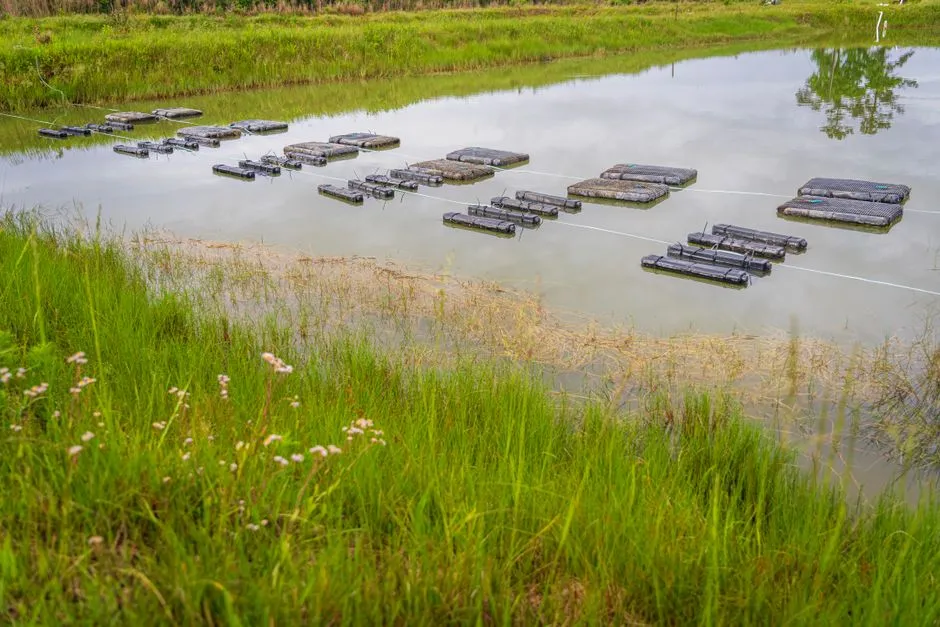
Four process trains are realistic for a Fujairah villa, labour camp, hotel or rural community in 2026. The first is A/O biological contact oxidation in a buried package unit, exemplified by the WSZ underground package sewage treatment plant, which combines anoxic and aerobic zones, sedimentation and disinfection in one automated buried skid and is rated for 1–80 m³/h with no on-site operator required (Source S6, HydropureWater catalog). The second is the integrated MBR membrane bioreactor, which pairs activated sludge with submerged PVDF membranes at sub-micron filtration to deliver near-reuse effluent from a smaller footprint than a conventional plant of equal capacity. The third, constructed wetlands combined with microbial fuel cells (CW-MFC), is a research-stage option that simultaneously treats domestic sewage and generates electricity, suited to low-rate rural or community applications (Source S1, InTech). The fourth, vermifiltration, uses earthworms in a filter bed, has been demonstrated on domestic septic-tank effluent in semi-arid regions, can be decentralised, needs less operator expertise and operates at lower cost than conventional systems (Source S4, IntechOpen).
Project requirements dictate the optimal technology. Selection should be driven by four site inputs: design flow in m³/day, peak loading (tourist season or shift-change surge), target effluent class (irrigation reuse versus sewer or tanker discharge), and the available footprint and operator skill. A buried A/O unit is the default where the goal is sewer-quality effluent and the site footprint is generous; an MBR is the default where the goal is on-site irrigation or non-potable reuse; CW-MFC and vermifiltration remain credible for community-scale or research-driven projects where land is available and reuse targets are modest.
| Process train | Typical flow range | Effluent class | Footprint and operator demand | Source |
|---|---|---|---|---|
| A/O biological contact oxidation (WSZ buried package) | 1–80 m³/h | Sewer-discharge quality; no on-site reuse unless polished | Buried, no operator; landscaping above | Source S6 |
| MBR (membrane bioreactor) | 10–2,000 m³/day | Near-reuse; suitable for irrigation with disinfection | Smaller footprint than conventional; routine membrane maintenance | Source S6 / catalog |
| CW-MFC (constructed wetland + microbial fuel cell) | Low-rate, community scale | Polishing/irrigation; electricity as co-product | Large land take; research-stage | Source S1 |
| Vermifiltration | Decentralised, low-rate | Decentralised reuse, semi-arid contexts | Low operator expertise; lower cost than conventional | Source S4 |
Sizing a Package STP for Fujairah Sites: Inputs to Give Your Supplier
A defensible specification starts with the design flow in m³/day, derived from occupancy — villa rooms, hotel keys or labour-camp beds — and a per-capita wastewater contribution that the supplier should be asked to confirm rather than assumed. Fujairah beach hotels and weekend tourism create 2–3× diurnal peaks, while labour camps create single morning and evening peaks, and the peak factor together with its duration in hours must be stated so the equalisation and aeration stages are not undersized. The influent profile for typical domestic sewage is high in BOD, COD, suspended solids, FOG and pathogens; a measured value should be supplied where available, otherwise the supplier should be asked to design against a domestic range.
Detailed design requires balancing effluent targets with physical site constraints. The effluent target must be fixed before the technology is locked in: disposal to a tanker or sewer, landscape irrigation on-site, or full non-potable reuse each point to a different downstream train — a basic A/O skid is sufficient for the first, while an MBR followed by disinfection is the typical 2026 path for the second and third. Site constraints then govern layout: confirm road access for a 40 ft tanker delivery, burial depth (WSZ units are designed to be buried with landscaping above), power availability, and the noise and odour buffer distance to the nearest receptor. Buyers should also consider upstream and downstream equipment, including a GX rotary mechanical bar screen for screenings removal, a UV sterilizer for water treatment or a chlorine dioxide generator for disinfection, and a plate and frame filter press for sludge dewatering.
| Input to supply to the vendor | What the vendor needs it for | Fujairah-specific note |
|---|---|---|
| Daily design flow (m³/day) and occupancy basis | Hydraulic sizing of reactor and clarifier | Request per-capita figure from supplier; do not assume |
| Peak factor and peak duration | Equalisation volume, aeration sizing | Hotels 2–3× diurnal; labour camps morning/evening single peak |
| Influent BOD/COD/SS/FOG (measured or domestic range) | Aeration and sludge-yield sizing | Provide measured value if available |
| Effluent target (sewer / tanker / irrigation / reuse) | Process-train selection | Reuse pushes the choice toward MBR + disinfection |
| Site constraints (tanker access, burial depth, power, buffer) | Layout and ancillaries | Mountain roads limit tanker size; confirm delivery route |
Compliance, Sludge and Reuse in the UAE Context

For network-connected properties, the TANQIA network discharge consent governs effluent quality and should be confirmed with the operator before a treatment train is specified (Source S3). For tanker-only sites, all collected wastewater is hauled to the approved Fujairah treatment plant operated by TANQIA, so the on-site plant's job is to keep sludge and FOG manageable for tanker pickup rather than to reach reuse quality (Source S5). For sites targeting on-site irrigation or non-potable reuse, an MBR followed by disinfection — UV or chlorine dioxide — is the typical 2026 train, with the on-site chain documented through waste-transfer notes aligned to UAE regulatory requirements (Source S5). Sludge handling is the closing step: a plate and frame filter press sized to the plant's sludge yield reduces tanker volume and the number of haulage trips, and buyers should ask the supplier for a sample chain-of-custody form before placing the order. Readers comparing emirate-level sizing practice can cross-reference the sizing a containerized MBR STP in Sharjah and the sizing a containerized MBR STP in Dubai guides, or the broader effluent treatment plant buyer's guide for Kochi for a different coastal context.
Frequently Asked Questions
How much does a domestic sewage treatment package plant cost in Fujairah?
The research supplied does not include a published price for a domestic sewage treatment package plant in Fujairah. Buyers should request a quotation that itemises the reactor unit, the GX rotary mechanical bar screen, the disinfection stage, the plate and frame filter press, and installation, so that capacities and warranties can be compared on a like-for-like basis rather than on a single headline figure.
How do I choose between two suppliers for a Fujairah package STP?
Ask each bidder to confirm in writing that the offered train is sized to your stated peak factor, that the disinfection stage (UV or a chlorine dioxide generator) is matched to your effluent target, and that the quoted sludge-yield figures match the on-site dewatering equipment. Also request a sample chain-of-custody form for tanker discharge at TANQIA and check that delivery is compatible with your access road.
What influent and site data do I need before a supplier can size a unit?
Provide daily design flow derived from occupancy, the peak factor and its duration, an influent BOD/COD/SS/FOG value (measured or a stated domestic range), the chosen effluent target, and the site constraints: tanker access, burial depth,