Why a Containerized MBR STP Fits Beirut Residential and Camp Projects
A containerized MBR package plant combines activated-sludge biology with submerged ultrafiltration inside a factory-built ISO container, skipping the deep civil works a buried package plant or conventional activated-sludge basin demands on a tight Beirut compound yard. Pure Aqua's MBR-C units drum-screen influent at 1.5 mm perforation, aerate it through fine-bubble diffusers, and polish it through submerged hollow-fiber (HF) ultrafiltration modules with a nominal 0.04 µm pore size (Pure Aqua, 2026).
MENA-Water frames the architecture around a small footprint that fits into natural surroundings without large excavation, suiting Beirut's constrained residential plots and temporary worker-camp footprints (MENA-Water, 2026). The container is easily transported and supports Plug & Play solutions at site, a key benefit when a camp moves between project phases or when an EPC contractor needs fast installation under a Beirut permit window. HUBER's product page for the MENA-Water MBR complete plant confirms that pre-assembled ISO containers include all main process components and external installation accessories, with optional remote monitoring from the supplier's back office (HUBER / MENA-Water, 2026). This combination of small footprint, factory QA, and relocatable architecture is why a containerized MBR is chosen over a buried concrete plant in Beirut.
Step 1 — Define the Population, Per-Capita Flow, and Peak Factor
The hydraulic design flow is the single number that drives container size, membrane area, and blower duty, requiring validation before any equipment is quoted. Pure Aqua's MBR-C sizing table uses a reference of 50 gpd per capita (≈190 Lpcd) for residential containerized MBR packages (Pure Aqua, 2026); if the client's engineer specifies a different value, that local number should override the 50 gpd reference. Average daily flow (m³/day) is population × Lpcd ÷ 1,000. The peak hourly factor must be added on top, as a camp at full breakfast, shower, and laundry overlap will run well above the daily average; a 2.0–2.5 multiplier is the engineering norm that the buyer should validate with the supplier. Black-water and grey-water streams should only be split if the camp layout makes a separate grey-water recycle economic; MENA-Water's grey-water note documents "up to 40%" fresh-water saving when showers and washbasins are recycled (MENA-Water, 2026), which is useful for a worker camp with a tight water budget. The final design flow should be the maximum concurrent occupancy, as Beirut camp populations often peak in summer when expatriate and construction rotations align.
Step 2 — Build the Sizing Parameter Table
Engineers require one auditable sheet that the client or permitting authority can approve before quoting a container. The table below captures the inputs that any reputable containerized MBR supplier will request for a Beirut enquiry. Pure Aqua publishes the operating temperature window as 68–86°F (20–30°C) with a design temperature of 68°F (20°C) (Pure Aqua, 2026), and Beirut summer sewage generally sits inside that range; however, the buyer should record the project's actual ambient and influent temperatures, as a sun-exposed holding tank can push the upper bound. Pure Aqua's standard electrical supply is 460V/3Ph/60Hz (Pure Aqua, 2026), which does not match Lebanon's typical 220V/380V 50Hz grid; the supplier must quote a 50Hz panel, with any step-up transformer or UPS sized separately. Because the research does not provide a Lebanese per-capita BOD figure, the client's influent characterization must be requested to calculate the organic load and finalize the membrane cassette count.
| Parameter | Value / Input | Source / Action |
|---|---|---|
| Design population (persons) | Project-specific | Client brief; use max concurrent occupancy for camp duty |
| Per-capita flow (Lpcd) | ≈190 (50 gpd) | Pure Aqua MBR-C reference (Pure Aqua, 2026); override if Lebanese norm specified |
| Average daily flow (m³/day) | Population × Lpcd ÷ 1,000 | Calculated |
| Peak hourly factor | To confirm with supplier | Request from vendor |
| Peak hourly flow (m³/h) | Average × peak factor ÷ 24 | Calculated |
| BOD load per capita (g/person/day) | To confirm | Request from client's influent characterization |
| Total BOD (kg/day) | Population × BOD per capita ÷ 1,000 | Calculated once per-capita BOD is supplied |
| Operating temperature window | 20–30 °C (design 20 °C) | Pure Aqua MBR-C specification (Pure Aqua, 2026) |
| Electrical supply | 220V/380V 50Hz typical for Lebanon | Pure Aqua standard 460V/3Ph/60Hz (Pure Aqua, 2026) — confirm 50Hz panel |
| Footprint / site access | Project-specific | Confirm against 20' or 40' HC dimensions in Step 4 |
Step 3 — Verify the Membrane Flux Can Carry the Hydraulic Load
Membrane flux, rather than tank volume, serves as the primary constraint on a containerized MBR system. Pure Aqua's MBR-C specification states that the submerged HF UF modules achieve complete retention of bacterial flocs, suspended solids, small colloids, and viruses at a nominal 0.04 µm pore size (Pure Aqua, 2026). MENA-Water's reference page places the ultrafiltration pore-size range at 2–100 nm and confirms that bubble-diffuser aeration continuously scours the membrane surface, so the modules only need one or two maintenance clearings per year (MENA-Water, 2026). HUBER's product page for the MENA-Water MBR complete plant adds that the membrane surface is cleaned by air bubbles flowing across it, with backwash and chemical cleaning applied as required (HUBER / MENA-Water, 2026). The buyer must obtain the rated flux (L/m²·h) of the specific module at the project's design temperature and mixed-liquor suspended solids (MLSS) from the supplier. If the calculated daily volume exceeds the supplier's stated flux envelope for a single cassette, the system requires a second membrane cassette rather than a larger tank. The submerged MBR membrane module is the capacity ceiling of the system, and any sizing memo should reference it directly.
Step 4 — Match the Daily Flow to a 20' or 40' HC ISO Container
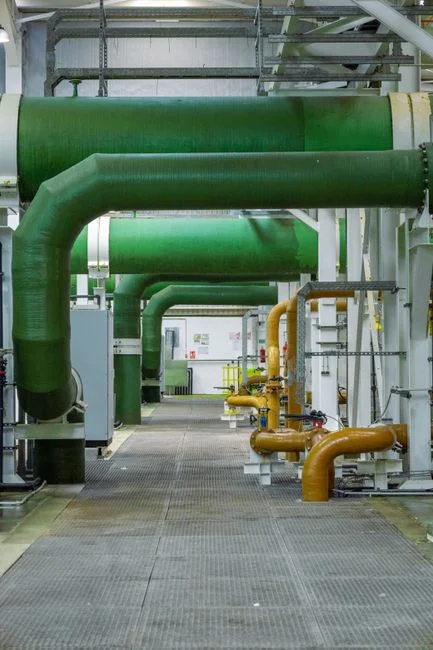
Container selection is a procurement decision that must be finalized before a purchase order is released. Pure Aqua's MBR-C product page confirms that both 20' and 40' high-cube (HC) containers are offered, with the choice driven by capacity (Pure Aqua, 2026). MENA-Water documents that more than 1,200 m³/day can be filtered in one 40-foot ISO container (MENA-Water, 2026), which serves as a benchmark for larger projects. The same MENA-Water product line handles a wide range of capacities, starting from a daily throughput of a few cubic meters, meaning smaller Beirut camp duties sit comfortably inside a single 20' or 40' HC unit (HUBER / MENA-Water, 2026). Site logistics also drive the choice: a 40' HC needs crane access and a Beirut road-haulage permit for an over-dimensional load, while a 20' HC can move on a standard flatbed.
| Container | Typical Capacity Envelope | Indicative Use | Site / Logistics |
|---|---|---|---|
| 20' HC ISO | Low m³/day range (per supplier) | Small camp / single residential block | Standard flatbed delivery; fits compact Beirut yards |
| 40' HC ISO | Up to >1,200 m³/day (MENA-Water, 2026) | Large camp / multi-block residential | Crane lift and Beirut over-dimensional haulage permit needed |
A UF polishing train downstream of the MBR is typically packaged inside the same container, keeping the civil scope to a single ISO footprint.
Step 5 — Apply Beirut-Specific Qualifiers Before Finalizing the Size
Successful MBR operation in Lebanon depends on reconciling local grid and environmental conditions with factory specifications. First, voltage and frequency: the Lebanese grid is typically 220V/380V 50Hz, while Pure Aqua's published standard is 460V/3Ph/60Hz (Pure Aqua, 2026); the supplier must confirm a 50Hz panel and quote any step-up transformer or UPS needed for outage ride-through. Second, temperature: Beirut summer sewage is broadly inside Pure Aqua's published 20–30 °C operating window (Pure Aqua, 2026), but a sun-exposed camp holding tank can trend warmer, and that figure should be measured at the design meeting. Third, operation: a remote-monitoring option—which MENA-Water offers from its back office—is useful if the client has no on-site wastewater staff (HUBER / MENA-Water, 2026). Fourth, discharge and reuse: confirm the receiving environment and the corresponding effluent quality with the Lebanese Ministry of Environment before locking the design. For projects needing a comparable Middle East workflow, the Amman containerized MBR sizing guide and the Almaty sizing guide use a similar five-step structure. Where organics removal is the deciding metric, the COD/BOD removal technology comparison is a useful cross-check before final cassette count.
Frequently Asked Questions
What is the realistic budget range for a containerized MBR STP on a Beirut camp project?
The surveyed supplier pages do not publish a price list, so a Beirut buyer must request a formal quotation tied to the Step 2 parameter table. The cost driver is container size (20' HC vs 40' HC), membrane cassette count, and whether a 50Hz panel, transformer, and remote-monitoring option are included. Request an itemized quote for spares and freight-to-Beirut to ensure accurate comparisons between vendors.
How do I choose between a 20' HC and a 40' HC container for my project?
Match the Step 1 average and peak flows against the supplier's stated envelope. Pure Aqua confirms both 20' and 40' HC are available (Pure Aqua, 2026), and MENA-Water documents that a single 40' HC can filter more than 1,200 m³/day (MENA-Water, 2026). For small-camp and single-block residential flows, a 20' HC is usually sufficient; for multi-block compounds, request a 40' HC quote and verify crane and Beirut road-haulage access.
What influent temperature and voltage data must I hand the supplier before they can size the plant?
Provide the measured peak summer influent temperature and the site's available voltage, frequency, and outage profile. Pure Aqua's operating window is 20–30 °C with a 20 °C design point (Pure Aqua, 2026), and the standard electrical supply is 460V/3Ph/60Hz (Pure Aqua, 2026) — the Beirut grid is typically 220V/380V 50Hz, so a 50Hz panel and any transformer/UPS must be quoted separately. Without these two inputs, the supplier cannot confirm the membrane flux envelope from Step 3.
Which discharge permits and effluent limits apply to a Beirut camp STP?
The buyer must obtain current effluent quality requirements (BOD, TSS, TN,