Why a Containerized MBR Fits Residential and Camp Projects in Astana
Containerized MBR systems combine a biological treatment stage (AO or A2O) with submerged or out-of-basin ultrafiltration membranes inside a single transportable ISO housing, which is the architectural fit most engineers look for when a residential complex or workforce camp in the Astana region cannot accommodate a poured-concrete activated-sludge plant. The containerized format eliminates most civil works, ships in compliance with export requirements, and is built up from a database of treatment modules so the same skid can be re-tuned for municipal, residential, catering, or sanitary camp wastewater, including streams with elevated FOG from camp kitchens, per the Skyview containerized MBR product literature (mbrwatertreatment.com).
The out-of-basin membrane configuration from Dynatec's containerized MBR design (dynatecsystems.com) allows the bioreactor to stay in place while new membrane skids are added beside it, which is a useful pattern for a phased housing block or a camp that grows from 200 beds to 1,500. For an engineer sizing a project near Astana, that combination of pre-engineered biological stage, UF polishing, and ISO-container logistics is the reason this architecture is now specified ahead of conventional STPs for residential and remote camp duty. A useful regional reference is the Almaty containerized MBR sizing guide, which uses the same four-step methodology adapted to a different climate envelope.
Step 1 — Build the Flow Basis for an Astana Residential or Camp Load
Design flow is the primary sizing decision because every downstream calculation—reactor volume, membrane area, blower duty, and container count—depends on it. Start with the design population: fixed residential occupants, rotating camp shift beds at full berth count, and a daytime uplift for offices, schools, dining halls, and visitor traffic. Convert that population into an average dry weather flow using a per-capita flow basis defined by the local utility, design code, or the project's environmental consultant—the scraped sources do not give a Kazakhstan-specific value, so this is a buyer-specific input to confirm. Once the average daily flow is set, apply a peaking factor (typically 2.0–2.5 in residential gravity systems) to convert the average dry weather flow into a peak instantaneous flow that the membrane train must handle, consistent with the adjustable-parameter philosophy described in the Skyview containerized MBR literature (mbrwatertreatment.com). Finally, check the resulting design flow against the integrated MBR envelope of 10–2,000 m³/day, because flows outside that band require a different architecture rather than a single containerized train. A useful cross-check against a different climate and density is the Tokyo residential and camp MBR sizing guide, which applies the same flow-basis logic to a high-density urban case.
| Input | What to confirm | Source / status |
|---|---|---|
| Design population (residents + camp beds + day uplift) | Project-specific; confirm with client occupancy schedule | Buyer input — not in scraped sources |
| Per-capita flow basis (L/cap·day) | Local utility or design code value for Astana | Buyer input — no Kazakhstan-specific value in scraped sources |
| Average dry weather flow (m³/day) | Population × per-capita basis | Calculated |
| Peaking factor (–) | 2.0–2.5 typical for residential gravity systems | Aligned with Skyview adjustable-parameter philosophy (mbrwatertreatment.com) |
| Design flow envelope check (m³/day) | 10–2,000 m³/day for integrated MBR | Product catalog envelope |
Step 2 — Convert the Design Flow into a Biological Reactor Volume
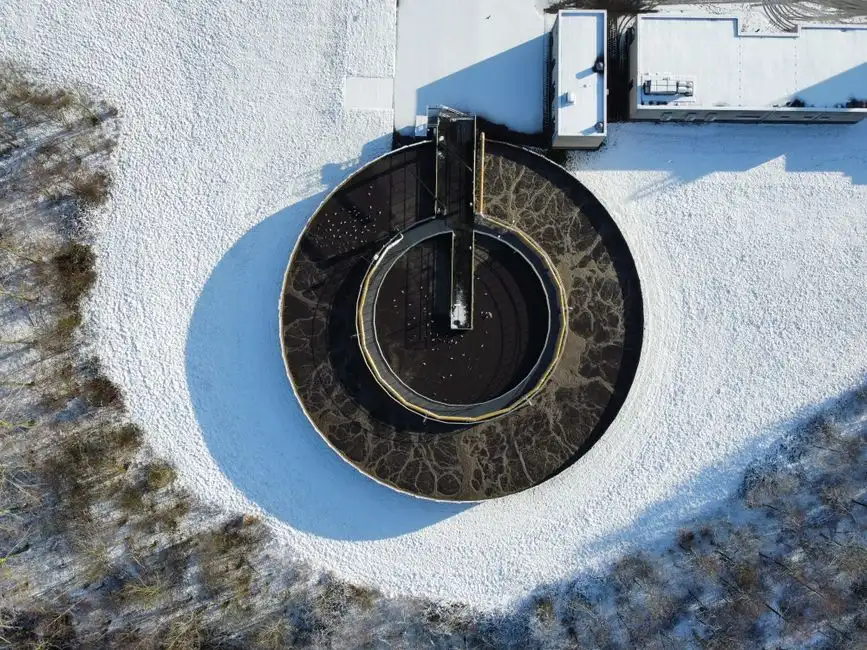
Bioreactor volume determines the capacity of the container section that the membranes will share or sit next to. The biological stage of a containerized MBR typically uses A2O or AO contact oxidation; the Skyview containerized MBR product page (mbrwatertreatment.com) explicitly references adjustable sludge retention time, sludge recycle rate, and sludge-concentration limit values so the same skid can be flexed across different organic and hydraulic loadings rather than being re-engineered for each project. Reactor volume is set by an organic loading rate (kg BOD/m³·day) and a hydraulic retention time that the design engineer must select—the engineer should request a recommended loading and HRT range from the membrane supplier for the specific waste type. For cold-climate operation in Astana, the engineer should specifically request a winter SRT and MLSS envelope from the supplier, because colder mixed-liquor temperatures reduce nitrification kinetics and force a higher SRT to keep ammonia removal on target. Dynatec's containerized MBR literature (dynatecsystems.com) notes that long SRT operation allows the bioreactor to degrade recalcitrant constituents, which is relevant for camps with pharmaceutical, hygiene, or kitchen loads, and it is the reason the same skid is often run at higher MLSS in winter than in summer. The biological and effluent-quality logic behind these parameters is laid out in more detail in the MBR effluent quality and working-principle guide.
Step 3 — Size the Membrane Area from Flux, Not Just Flow
Membrane area is set by flux rather than flow alone, which is a detail procurement teams often miss when pricing equipment on a m³/day basis. The basic relation is: membrane area equals design flow divided by net flux, and flux is set by the membrane supplier based on the waste type and operating temperature, per the adjustable-parameter philosophy in the Skyview containerized MBR literature (mbrwatertreatment.com). The HydropureWater integrated MBR system uses submerged PVDF membranes with sub-micron nominal filtration and is documented as delivering roughly 60% smaller footprint than a conventional plant, which is what allows the whole biological-and-membrane train to fit inside a 20-ft or 40-ft ISO frame. For the flat-sheet module family, the HydropureWater DF flat-sheet MBR module delivers 32–135 m³/day per stack in 80–225 m² configurations at 0.1 μm pore size with integrated aeration scouring, which is the per-stack capacity range the engineer should use to translate a design flow into a stack count. The Skyview literature also notes that the UF membranes eliminate routine membrane changing, which is an OPEX item the engineer should confirm for the Astana winter cycle, where mixed-liquor viscosity is higher and aeration scouring duty changes. Colder feed water reduces allowable flux, so the winter flux assumption should be requested from the module supplier rather than taken from a summer-rated datasheet.
| Parameter | Value / range | Source |
|---|---|---|
| Membrane type | Submerged PVDF, <1 μm nominal pore size | Product catalog (HydropureWater integrated MBR) |
| Pore size (DF flat-sheet) | 0.1 μm | Product catalog (HydropureWater DF module) |
| DF module area options | 80–225 m² per stack | Product catalog (HydropureWater DF module) |
| DF module flow per stack | 32–135 m³/day | Product catalog (HydropureWater DF module) |
| Footprint vs. conventional plant | Roughly 60% smaller | Product catalog (HydropureWater integrated MBR) |
| Membrane area sizing rule | Design flow ÷ net flux (winter flux to be confirmed with supplier) | Aligned with Skyview adjustable-parameter philosophy (mbrwatertreatment.com) |
Step 4 — Pick the Container Layout and Module Count
Engineering the container layout involves converting the total membrane area into a specific bill of materials. For small residential flows, a single 20-ft or 40-ft ISO container housing the bioreactor, membrane skid, blowers, and PLC is the standard layout, per the Skyview containerized MBR design (mbrwatertreatment.com). For larger camp or phased residential projects, the Dynatec out-of-basin architecture (dynatecsystems.com) lets the membrane skids sit in their own containers while the bioreactor occupies a separate tank, which simplifies future expansion and reduces the height of any single container. Using the DF flat-sheet module's 32–135 m³/day per-stack range, a 500 m³/day camp flow maps to roughly 4–16 modules depending on the chosen module size (80 m² or 225 m²) and the design flux assumed for Astana winter conditions—a range the engineer should narrow by requesting a confirmed winter flux from the module supplier. Mobile or backup deployments can also use the HydropureWater WSZ trailer-mounted package plant as a temporary unit while the main containerized MBR is being commissioned or during camp mobilization phases. The procurement team should price the layout as a container count plus a module count plus an option list (chemical P removal, ozone, remote PLC).
| Daily design flow (m³/day) | Suggested container layout | DF module count (using 32–135 m³/day per stack) |
|---|---|---|
| 10–50 | Single 20-ft ISO container (bio + membrane skid integrated) | 1 stack (within 32–135 m³/day range) |
| 50–200 | Single 40-ft ISO container, or 20-ft bio + 20-ft membrane skid | 1–6 stacks |
| 200–500 | 40-ft bio + separate 20-ft or 40-ft membrane skid container(s) | 2–16 stacks |
| 500–2,000 | Multi-container out-of-basin layout, membrane skids in parallel | 4–60+ stacks, sized against the 32–135 m³/day per-stack range |
Effluent Targets and Compliance Checklist for Astana Discharge
The engineer should verify that the selected MBR will meet the local discharge or reuse requirement before finalizing the design. The Dynatec containerized MBR literature (dynatecsystems.com) states that the system produces permeate with BOD, TSS, TKN, and ammonia well below typical discharge limits and that the containerized architecture meets discharge requirements as easily as a non-containerized system. The same source notes that the membrane filters can act as a biomass separation process and can be paired with chemical precipitation (metal salts) to meet low-phosphorus limits, which is the standard add-on if the project requires low-phosphorus effluent. Where enhanced phosphorus removal is required, the Skyview containerized MBR product page (mbrwatertreatment.com) offers optional chemical treatment, air flotation, and ozone units that should be priced into the scope. The engineer should confirm the local Kazakhstan discharge and reuse limits with the project civil or environmental consultant, as those values determine whether the optional P-removal and ozone skids are required. The cost line items associated with these add-ons are mapped in the MBR cost per cubic meter buyer guide.
Frequently Asked Questions
What flow basis should I use to size a containerized MBR for a residential block or camp in Astana?
Start with the design population (fixed residents plus full camp berth count plus a daytime uplift for offices, schools, and dining halls), apply a per-capita flow basis that the local utility or design code defines for the site, then apply a peaking factor of 2.0–2.5 to convert the average dry weather flow into a peak flow the membrane train must handle. Since the scraped sources do not provide a Kazakhstan-specific per-capita value, confirm that input with the project's environmental consultant.
How do I choose between a 20-ft container, a 40-ft container, or an out-of-basin multi-container layout?
Use the daily design flow as the first cut: up to about 50 m³/day typically fits a single 20-ft ISO container with an integrated bioreactor and membrane skid, 50–200 m³/day usually needs a single 40-ft container or a 20-ft bio plus 20-ft membrane skid split, and 200–2,000 m³/day moves to a
Frequently Asked Questions
How many people can one containerized MBR serve in a residential or camp project in Astana?
A single 40-foot containerized Membrane Bioreactor (MBR) unit is typically designed to serve between 200 and 500 equivalent residents, depending on the specific hydraulic and organic loading rates. For a standard residential camp project, this translates to a daily treatment capacity ranging from 40 to 100 cubic meters per day (m³/day).
What per-capita flow and peaking factor should I use to size a containerized MBR in Kazakhstan?
In accordance with local SNiP (Construction Norms and Regulations) standards adapted for Kazakhstan, a per-capita daily flow of 150 to 200 liters per person is recommended for residential camps with full plumbing. A peaking factor of 2.5 to 3.0 should be applied to the average daily flow to account for diurnal variations and peak morning/evening usage periods typical of camp facilities.
What effluent quality (BOD, TSS, ammonia) can a containerized MBR reliably produce for an Astana discharge?
An MBR system consistently achieves high-grade effluent suitable for discharge into municipal networks or restricted irrigation. Typical performance metrics include Biological Oxygen Demand (BOD₅) of less than 5 mg/L, Total Suspended Solids (TSS) of less than 1 mg/L, and Ammonia-Nitrogen (NH₄-N) levels below 1 mg/L, provided the system is operated within the design flux rates.
How do I decide between one 40-ft MBR container and multiple smaller membrane skids for a camp project?
The decision depends on your site's redundancy requirements and phasing. A single 40-ft container is more cost-effective for static, long-term sites, while multiple smaller skids offer modular scalability and critical redundancy. If the camp population is expected to fluctuate significantly or if downtime for membrane maintenance is unacceptable, multiple skids allow for partial operation during service cycles.
What is the typical delivery and commissioning lead time for a containerized MBR STP in Kazakhstan?
For projects in Astana, the typical lead time from order confirmation to site delivery is 16 to 24 weeks, accounting for international membrane sourcing and container fabrication. On-site commissioning, including hydro-testing, biological seeding, and PLC integration, generally requires an additional 2 to 4 weeks, depending on the availability of site utilities and local discharge permit finalization.